


Last Updated: October 2026
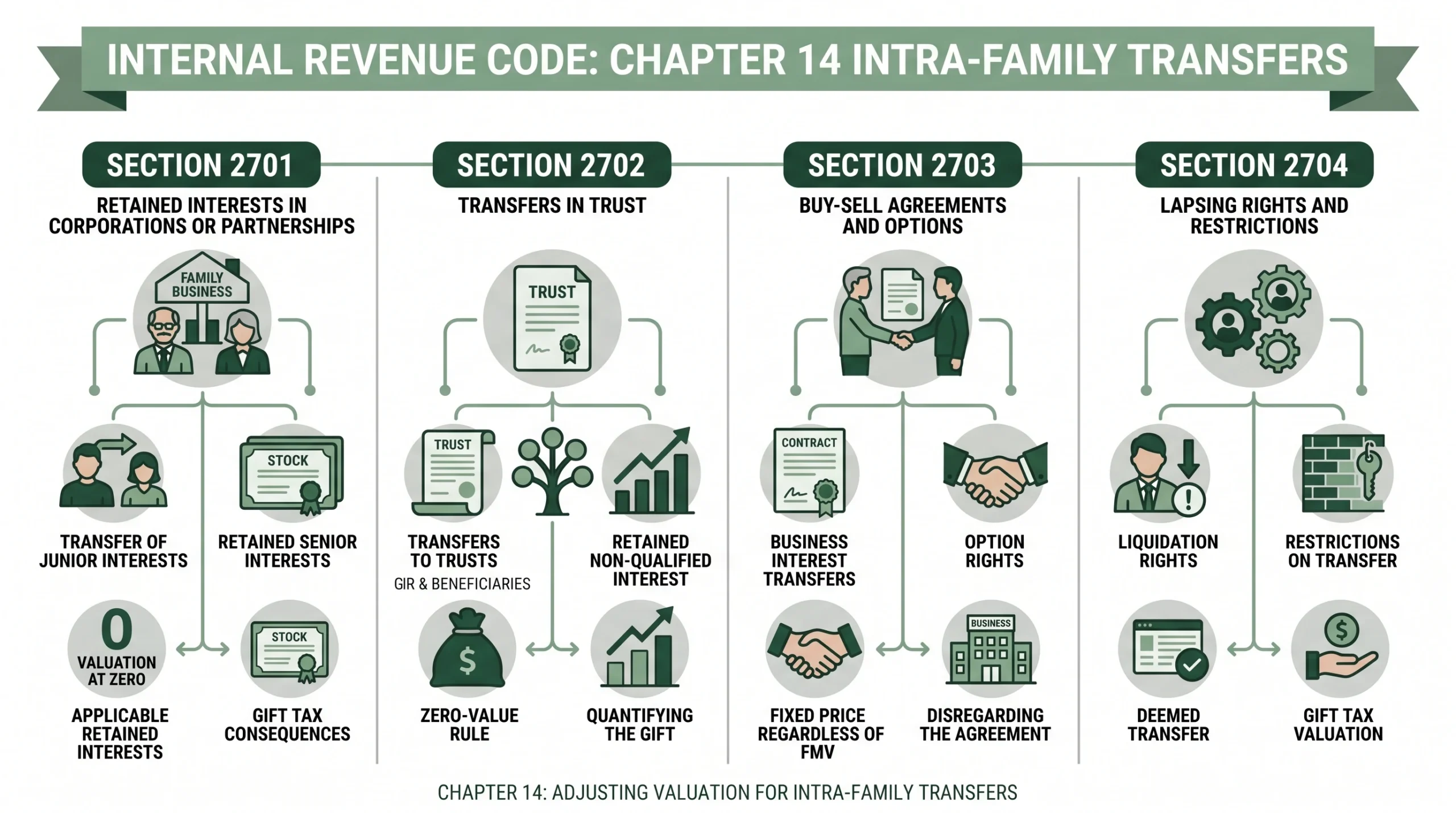
The Chapter 14 valuation rules are four sections of the tax code that override ordinary fair market value for transfers inside a family. They sit in Chapter 14 of the Internal Revenue Code, at Sections 2701 through 2704. Congress added them in 1990 to stop estate freeze tricks. When they apply, the willing buyer and willing seller test does not control the gift. A special rule sets the value instead.
The team at Sofer Advisors values family business interests for gift and estate tax, backed by Inc. 5000 recognition in both 2024 and 2025. These rules decide whether a transfer is taxed as planned or recast as a larger gift. Price an interest the ordinary way when a special rule applies, and the IRS resets the number. The gap becomes a taxable gift.
This guide explains what each section overrides and why. It also shows where valuation discounts still apply, because Chapter 14 does not reach every transfer.
Key Takeaways
- What Chapter 14 is: Sections 2701 through 2704 of the tax code, which override normal fair market value for certain family transfers.
- Section 2701: values a retained preferred interest at zero unless it carries a qualified payment, which inflates the gift of the common stock.
- Section 2702: values a retained trust interest at zero unless it is a qualified interest, which is the rule that makes a GRAT work.
- Sections 2703 and 2704: ignore a buy-sell that fails three tests, and undo discounts a family builds through lapsing rights or liquidation limits.
- Discounts survive: control and marketability discounts still apply outside Chapter 14 when they rest on real market facts.
Each rule overrides a different part of the valuation. The sections below take them one at a time.
Why Do Chapter 14 Valuation Rules Matter?
Chapter 14 matters because it can turn a planned transfer into a taxable gift. The rules target a classic move. An owner keeps a high-value interest and hands growth to the children at a low stated value. Left alone, that would shrink the taxable estate. Chapter 14 blocks the move by valuing the retained interest at zero in many cases. The reported gift then jumps.
The stakes are real money. Gift tax and estate tax share one graduated rate that reaches 40 percent at the top. A retained interest priced at zero can add millions to a reported gift. That is why the valuation has to be built on the right rule from the start. An appraiser who ignores Chapter 14 can produce a number the IRS will not accept. You can read how an estate freeze locks in today’s value and where these rules bite.
What Does Section 2701 Override in Family Transfers?
Section 2701 overrides the value of an interest a senior family member keeps when passing common equity to the next generation. It applies to transfers of equity in a family corporation or partnership. If the parent keeps a preferred interest and gives the children common stock, the retained preferred is often valued at zero. That makes the gift of the common stock much larger on paper.
There is a way out of the zero value. The retained interest can count if it carries a qualified payment, which is a fixed cumulative dividend paid on a set schedule. Paid like clockwork, that interest holds real value and lowers the gift. Miss the payments and a later tax can apply. The rule stops owners from claiming a rich retained interest while taking nothing out of it.
How Does Section 2702 Treat Trusts and GRATs?
Section 2702 controls transfers of an interest in trust to a family member. The default is strict. Any interest the grantor keeps is valued at zero unless it is a qualified interest. So a parent who funds a trust and keeps the right to income is treated as making a gift of the whole asset. The retained income right counts for nothing.
The qualified interest exception is what makes a GRAT work. A grantor retained annuity trust pays the grantor a fixed annuity for a set term. That annuity is a qualified interest, so it has value and cuts the taxable gift. The growth above the annuity passes to the children at little or no gift cost. Section 2702 is the reason the annuity must be fixed and paid on time. See how a GRAT passes business value to heirs.
When Does Section 2703 Disregard a Buy-Sell Agreement?
Section 2703 lets the IRS ignore a buy-sell agreement, option, or restriction that sets a price below fair market value. The agreement is disregarded unless it clears three tests. It must be a real business arrangement. It must not be a device to pass value to heirs for less than full consideration. And its terms must match what unrelated parties would agree to at arm’s length.
All three tests must be met, not just one. A family buy-sell that fixes a low price will not control estate value on its own. The owner’s estate can be taxed on the higher fair market value instead. One safe harbor helps. If people outside the family own more than half the interest by value, the agreement is respected. Otherwise the terms need to look like a deal struck between strangers.
What Does Section 2704 Do to Lapsing Rights?
Section 2704 attacks two things. First, a voting or liquidation right that lapses while the family keeps control is treated as a transfer. The lapse itself can create a taxable gift or an estate inclusion. Second, certain restrictions on the right to liquidate the entity are ignored when the value of the interest is measured. Both rules curb discounts the family creates for itself.
The target here is the applied liquidation restriction. Families used to write tight restrictions into an entity to push down the value of a minority interest. Section 2704 says some of those restrictions do not count for valuation. The interest is then valued as if the restriction were softer. The rule does not erase every discount. It removes only the ones the family made to beat the tax.
How Do Valuation Discounts Survive Chapter 14?
Discounts survive wherever Chapter 14 does not reach. The rules override value only in the narrow cases they describe. Outside those cases, normal valuation applies, and that includes the discount for lack of control and the discount for lack of marketability. A minority interest in a family company is still worth less than its pro rata share. Real, market-based restrictions still count.
The key is the source of the discount. A discount that rests on genuine market facts holds up. A minority owner cannot force a sale or set policy, so a buyer pays less. The interest is hard to sell, so a buyer pays less again. Those are economic facts, not family tricks. Chapter 14 removes only the discounts a family builds by its own restrictions. Sofer Advisors ties every discount to market data on estate and gift tax returns.
Who Performs a Chapter 14 Valuation, and How Do the Options Compare?
Owners choose a valuation partner by the size of the interest, the audit risk, and the budget. A Chapter 14 valuation needs an appraiser who knows which section applies and can document the number for the IRS. Large national firms such as Alvarez & Marsal, Stout, and Kroll serve big public companies with broad advisory teams. Sofer Advisors focuses on family and closely held transfers, with expert witness testimony in 11+ cases and 180+ five-star Google reviews.
| Provider | Typical role | Best for |
|---|---|---|
| Specialized valuation firm (e.g. Sofer Advisors) | Applies the right Chapter 14 section and documents the gift value | Family and closely held transfers needing audit-ready support |
| Large national firm | Broad advisory plus valuation at enterprise scale | Large public companies with complex, multi-entity plans |
| Estate attorney | Drafts the trust, buy-sell, and entity terms; does not value | Families needing the legal structure built and reviewed |
Sofer Advisors runs each engagement through a four-phase process it calls The Sofer Difference, moving from Discovery to Diligence to Analysis to Delivery. That order keeps each value tied to the right code section and the facts behind it. It reflects the Heart of a Teacher approach, which means explaining the reasoning behind a number instead of just handing over a figure. See how Sofer Advisors approaches estate and gift tax valuations.
Frequently Asked Questions
What are the Chapter 14 valuation rules?
The Chapter 14 valuation rules are Sections 2701 through 2704 of the Internal Revenue Code. They override ordinary fair market value for certain transfers inside a family. Congress passed them in 1990 to curb estate freeze abuses. When a rule applies, it sets the value of a retained or restricted interest, often at zero. Sofer Advisors identifies which section controls a transfer before building the valuation.
Which Internal Revenue Code sections make up Chapter 14?
Chapter 14 holds four sections. Section 2701 covers retained interests in family corporations and partnerships. Section 2702 covers transfers in trust, including GRATs. Section 2703 covers buy-sell agreements, options, and restrictions. Section 2704 covers lapsing rights and liquidation restrictions. Each one overrides a different part of the normal valuation. Sofer Advisors maps a transfer to the correct section so the reported gift matches what the tax code requires.
What does Section 2701 do?
Section 2701 applies when a senior family member keeps a preferred interest and transfers common equity to the next generation. The retained interest is often valued at zero, which makes the gift of the common stock larger. An exception applies when the retained interest carries a qualified payment, a fixed cumulative dividend paid on schedule. Sofer Advisors values the retained interest and documents any qualified payment so the gift figure holds.
What does Section 2702 do?
Section 2702 governs transfers of an interest in trust to a family member. Any interest the grantor keeps is valued at zero unless it is a qualified interest. A fixed annuity in a GRAT is the common qualified interest, which gives the retained right real value and lowers the gift. Without it, the grantor is treated as gifting the whole asset. Sofer Advisors values the annuity and the transferred remainder for the return.
What three tests must a buy-sell agreement meet under Section 2703?
Under Section 2703, a buy-sell agreement or option that sets a price below fair market value is ignored unless it meets three tests. It must be a real business arrangement. It must not be a device to pass value to heirs for less than full consideration. And its terms must match an arm’s-length deal. Sofer Advisors reviews the agreement and values the interest so the price can hold up for estate tax.
What does Section 2704 do?
Section 2704 does two things. A voting or liquidation right that lapses while the family keeps control is treated as a transfer, which can create a gift or estate inclusion. And certain restrictions on liquidating the entity are ignored when the interest is valued. The rule removes discounts a family builds for itself. Sofer Advisors tests each restriction to see whether Section 2704 applies before setting the value.
How does Chapter 14 affect valuation discounts?
Chapter 14 narrows some discounts but does not erase them. It removes discounts a family creates through its own restrictions or lapsing rights. Discounts that rest on real market facts still apply. A minority interest earns a discount for lack of control, and a hard-to-sell interest earns a discount for lack of marketability. Sofer Advisors ties each discount to market data so it survives IRS review.
Who needs a Chapter 14 valuation?
Anyone transferring an interest in a family business or entity to relatives may need one. That includes parents funding a GRAT, owners gifting common stock while keeping preferred, families with a buy-sell agreement, and entities with liquidation restrictions. A CPA or estate attorney often orders the valuation to support a gift tax return. Sofer Advisors prepares the report for owners, CPAs, and estate attorneys handling these transfers.
How much does a Chapter 14 valuation cost?
Most Chapter 14 valuations run from $7,500 to $25,000 and take about four to eight weeks, depending on the entity and the deadline. The range covers the analysis needed to apply the right section and document the gift value. A flat fee is quoted up front, so the cost is clear before work starts. Sofer Advisors scopes the engagement first, then quotes a fixed price. Request a free estimate for your situation.
Related Case Studies
- Section 2701: Valuing Preferred Interests in Family Transfers
- Section 2703: Does Your Buy-Sell Set Estate Value?
- Section 2704 and Family Entity Valuation Discounts
Executive Summary
Chapter 14 is Sections 2701 through 2704 of the tax code, added in 1990 to stop estate freeze abuses. It overrides ordinary fair market value for certain transfers inside a family. Section 2701 values a retained preferred interest at zero unless it carries a qualified payment. Section 2702 values a retained trust interest at zero unless it is a qualified interest, which is how a GRAT works. Section 2703 ignores a buy-sell that fails its three tests. Section 2704 undoes family-made discounts from lapsing rights and liquidation restrictions. Outside these rules, control and marketability discounts still apply when they rest on real market facts.
What Should You Do Next?
Start by listing every interest you plan to transfer and the entity documents behind each one, since the right Chapter 14 section depends on those facts. Confirm whether any retained interest carries a qualified payment or qualified annuity before the transfer is signed. This guide was prepared by David Hern CPA ABV ASA, founder of Sofer Advisors, an Inc. 5000 firm specializing in neutral third-party valuations for estate and gift tax. Schedule a free consultation through our contact page, or learn more about our business valuation services.
People Also Read
- How Family Limited Partnerships Are Valued for Gift and Estate Tax
- Minority Interest and Marketability Discounts in Business Valuation
About the Author
This guide was prepared by David Hern CPA ABV ASA, founder of Sofer Advisors, a business valuation firm headquartered in Atlanta, GA serving clients across the United States. David holds dual accreditations as an Accredited Senior Appraiser (ASA) and is Accredited in Business Valuation (ABV), credentials recognized by the IRS, SEC, and FINRA. He also holds the Certified Exit Planning Advisor (CEPA) designation. With 15+ years of valuation experience, David has served as an expert witness in 11+ cases across multiple jurisdictions and built Sofer Advisors into an Inc. 5,000-recognized firm with 180+ five-star Google reviews. Its full W2 employee team maintains subscriptions to all major valuation databases and operates under a next business day response policy.
For professional business valuation services, visit soferadvisors.com/about-us/ or contact Sofer Advisors at soferadvisors.com/contact-us/.
This content is for informational purposes only and does not constitute professional valuation advice. Business valuation conclusions depend on specific facts and circumstances. Contact Sofer Advisors for guidance regarding your specific situation.









