


Last Updated: August 2026
A Section 2701 valuation is a special set of gift tax rules. It applies when a family transfers business interests to younger relatives. The rules stop owners from hiding value in retained preferred shares. Under IRC Section 2701, some retained rights can be valued at zero. That can push the taxable gift far above what owners expect. Sofer Advisors has handled 11+ expert witness cases and holds 180+ five-star Google reviews.
Families run into these rules during an estate freeze, when parents pass common shares to children but keep preferred stock. The plan aims to move future growth cheaply. Section 2701 tests whether the kept interest is real or just on paper. If it fails, the taxable gift can jump to the full value of the business. That surprise is what careful structure works to avoid.
Key Takeaways
- Definition: A Section 2701 valuation applies special gift tax rules to family transfers of business interests.
- Zero-value rule: A weak retained interest counts as zero, which raises the taxable value of the gifted shares.
- Qualified payment right: A fixed, cumulative dividend lets the kept interest hold real value.
- Subtraction method: The gift is figured by valuing the whole entity, then subtracting the senior interests.
- Get it right: A weak report can trigger a large, surprise gift tax bill.
These rules shape how families plan and report each transfer. The sections below show when the rules apply. They also show how to protect the value of a retained interest.
What is a Section 2701 valuation?
A Section 2701 valuation is a gift tax analysis for family business transfers. It applies when a parent gives common shares to a child. At the same time, the parent keeps a preferred interest. The rules sit in Chapter 14 of the tax code. They force the appraiser to value the kept interest by strict terms. If that interest fails the test, its value drops to zero. The gifted shares then carry the full worth of the business.
Congress passed the rules in 1990 to stop a common trick. Owners once used an estate freeze to move growth to heirs cheaply. They kept preferred shares with vague rights, then claimed a low gift value. The rules ended that path. Now the kept interest must meet clear standards to hold value. The appraiser also follows fair market value rules from the IRS Revenue Ruling 59-60. That keeps the number solid if the IRS reviews the return.
When does Section 2701 apply?
The rules apply when three things line up. First, a family controls the business. Second, the owner keeps a senior, applicable retained interest. Third, the transfer goes to a family member. Control means the family holds at least 50 percent of the vote or value. A senior interest is one with a distribution right or a liquidation preference. When all three are present, the special rules take over.
Family here has a wide meaning. It covers a spouse, children and other descendants, and their spouses. The interest passed down is usually common stock or a junior unit. The interest kept behind is preferred, with a claim on income or on sale proceeds. Not every gift triggers the rules. A simple transfer with one class of stock often falls outside them. Sofer Advisors reviews the entity’s documents early to check which transfers are caught.
What is the zero-value rule?
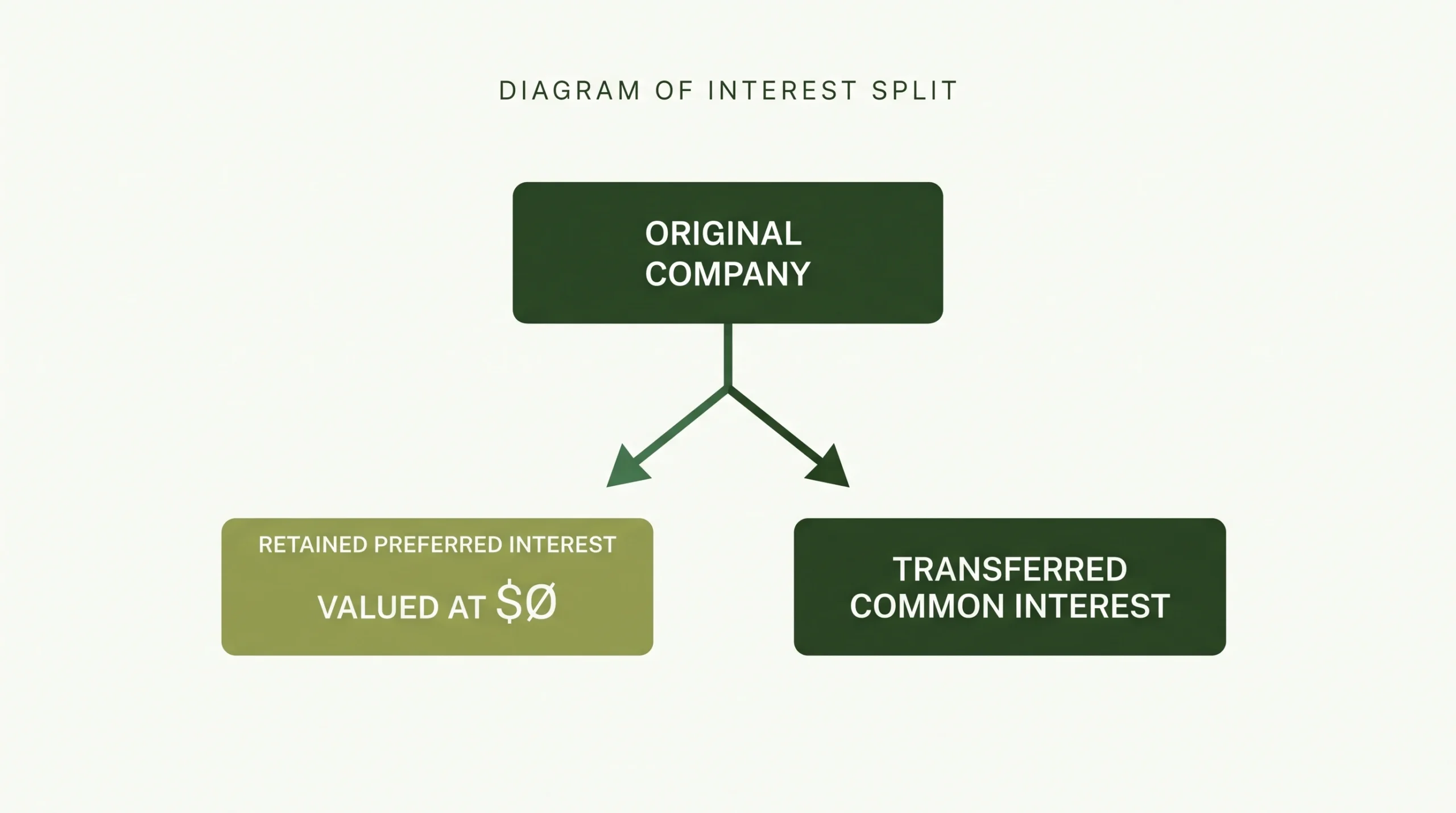
The zero-value rule is the default under Section 2701. It assigns a value of zero to a retained interest that fails the test. When that happens, the whole value of the business shifts to the gifted shares. The taxable gift then swells past its real size. The rule targets kept rights that an owner could ignore or waive at will. Those rights look valuable on paper but may never pay out.
Picture a company worth 10 million dollars. A parent keeps preferred shares and gives common shares to a child. If the preferred interest fails the test, it counts as zero. The taxable gift becomes the full 10 million dollars, not a smaller leftover. That gap can cost a family a steep gift tax bill. Sound structure and clear proof are the only ways to close it.
What is a qualified payment right?
A qualified payment right is the main way to escape the zero-value rule. It is a retained interest that pays a fixed dividend on a set schedule. The payment must be cumulative, so any missed amount still adds up. Because the cash flow is real and measurable, the IRS gives the interest value. That value then lowers the size of the taxable gift. The right must be written into the entity’s own terms.
| Feature | Qualified payment right | Non-qualified retained interest |
|---|---|---|
| Payment terms | Fixed, cumulative dividend | Waivable or skipped |
| Gift-tax value | Counted at fair value | Set to zero |
| Effect on the gift | Lowers the taxable amount | Inflates the taxable amount |
| Documentation | Written into entity terms | Often vague or missing |
A few other exceptions can remove the rules as well. The interest kept and the interest given may be the same class of stock. The transfer may cross every class in equal proportion, called a vertical slice. Or the shares may trade on a public market. Each path needs careful proof in the records. Sofer Advisors checks these options during the Discovery phase of The Sofer Difference, its four-phase process of Discovery, Diligence, Analysis, and Delivery.
How is the gift tax value figured?
The gift tax value comes from the subtraction method. It runs in four steps. First, value the whole family entity at fair market value. Second, subtract the value of the senior retained interests. Third, split the remainder among the transferred shares. Fourth, apply any discounts that the facts support. The result is the value of the gift. Each step needs its own support in the report.
The method is stricter than a normal appraisal. A senior interest set to zero pulls more value into the gift. So the appraiser must model each right with care. A discount for a minority interest or for lack of marketability may still apply to the common shares. But every discount needs evidence. The report follows AICPA SSVS and fair market value standards, so it holds up under audit. David Hern CPA ABV ASA leads this modeling for family entities.
Why hire a specialist for this work?
This work rewards deep, technical skill. A small error in the kept interest can trigger the zero-value rule by accident. The IRS and the courts read these reports closely. A defensible valuation needs current market data, clear modeling, and full support for each election. Those standards trace back to USPAP from The Appraisal Foundation. Sofer Advisors builds every report to that bar.
Large firms such as Alvarez and Marsal, Kroll, and Stout serve big corporate clients. Sofer Advisors brings that same senior-level rigor to middle-market families. Unlike a solo practitioner, it backs each conclusion with a full W2 team of 14 and a next business day response policy. The firm made the Inc. 5000 list in 2024 and 2025. It also brings a Heart of a Teacher approach, showing owners the math behind the gift value, not just the result.
Frequently Asked Questions
How does Section 2701 affect family business transfers?
Section 2701 changes how a family gift is valued for tax. It forces the appraiser to test each retained interest against strict terms. A kept interest that fails counts as zero, which raises the taxable gift. So the rules can undo a discount that owners hoped to claim. Sofer Advisors reviews the equity mix before any transfer, so the gift value matches the real economics of the deal.
What is an applicable retained interest?
An applicable retained interest is a senior interest that the transferor keeps. It usually holds a distribution right, such as a preferred dividend, or a liquidation preference. These rights can shift value between generations, so the rules watch them closely. If the interest does not pay on fixed terms, the zero-value rule may apply. Sofer Advisors weighs each kept right against the cash flow of the business to gauge its true worth.
Who counts as a family member under Section 2701?
Family covers a broad group under this rule. It includes the transferor’s spouse, any children or other descendants, and the spouses of those descendants. It also reaches ancestors of the transferor and their spouse. The entity is family-controlled when this group holds at least 50 percent of the vote or value. Sofer Advisors maps these ties early to confirm whether a transfer falls under the special rules.
What happens if qualified payments are missed?
Missed payments carry a real cost. If the entity fails to pay a qualified amount within four years, the shortfall grows. The unpaid amount, plus interest, can be added back to the donor’s taxable estate later. That can raise estate tax at death. Sofer Advisors flags this cash risk up front, so a family can set a payment schedule the business can actually meet over time.
Is a Section 2701 valuation required for every family gift?
No, the rules do not touch every transfer. They apply only when a family keeps a senior interest while giving a junior one. A simple gift of a single class of stock usually falls outside them. So does a transfer that crosses every class in equal shares. Sofer Advisors reviews the equity setup of each entity to decide whether these rules govern the planned transfer.
What is the subtraction method?
The subtraction method is the four-step process behind the gift value. First, an appraiser values the whole family entity. Next, the value of the senior retained interests is subtracted. The remainder is then split among the transferred shares. Any supported discount is applied last. This order stops owners from understating the gifted portion. Sofer Advisors uses the method to build reports that stand up during a gift tax review.
How does Section 2701 stop the estate freeze?
An estate freeze once let owners move future growth to heirs cheaply. They kept preferred shares with soft rights, then claimed a low gift value. Section 2701 blocks that move. A kept interest with vague or waivable rights now counts as zero, which raises the current gift. So the value cannot be quietly frozen. Sofer Advisors spots these traps in the planning stage, before a family files its return.
Can discounts still apply under Section 2701?
Yes, real discounts can still apply to the transferred shares. A minority interest discount or a discount for lack of marketability may fit the common shares given to heirs. But each one needs solid market evidence. The rules limit only the artificial value hidden in a weak retained interest. Sofer Advisors supports every discount with data, so the final gift value holds up under IRS and court review.
How much does a business valuation from Sofer Advisors cost?
Business valuations from Sofer Advisors usually run from 7,500 to 25,000 dollars. The price depends on how complex the equity is and the purpose of the work. A single-class entity for basic planning sits toward the lower end. A layered family entity with preferred and common shares needs more work, so it runs higher. Contact Sofer Advisors for a fee quote matched to your specific transfer.
Related Case Studies
- Estate Freeze Strategies: How Valuations Lock In Today’s Value
- Revenue Ruling 93-12: Why Family Attribution Doesn’t Apply
- Holding Company Discounts: How DLOC and DLOM Apply to Holdcos
Executive Summary
A Section 2701 valuation applies special gift tax rules to family business transfers. It matters when a parent gives common shares but keeps a preferred interest. Under the zero-value rule, a weak retained interest counts as zero, which can push a taxable gift to the full value of the business. A qualified payment right, paid as a fixed and cumulative dividend, keeps that interest at fair value. The gift is then figured with a four-step subtraction method under IRS Revenue Ruling 59-60 and AICPA SSVS. Sofer Advisors builds these reports for middle-market families, backed by a W2 team of 14 and 180+ five-star Google reviews.
What Should You Do Next?
Start by mapping every class of equity in your family entity before any gift. Confirm whether a retained interest can qualify as a payment right, then put the terms in writing. Model the subtraction method early, so no surprise gift tax appears at filing.
For a report you can defend, work with David Hern CPA ABV ASA. His team has given expert witness testimony in 11+ cases across Georgia, Florida, California, and New Mexico. Schedule a consultation to plan your family transfer.
People Also Read
- Section 6166: Deferring Estate Tax on a Business
- The Alternate Valuation Date (Section 2032) for Estates
About the Author
This guide was prepared by David Hern CPA ABV ASA, founder of Sofer Advisors, a business valuation firm headquartered in Atlanta, GA serving clients across the United States. David holds dual accreditations as an Accredited Senior Appraiser (ASA) and is Accredited in Business Valuation (ABV), credentials recognized by the IRS, SEC, and FINRA. He also holds the Certified Exit Planning Advisor (CEPA) designation. With 15+ years of valuation experience, David has served as an expert witness in 11+ cases across multiple jurisdictions and built Sofer Advisors into an Inc. 5000-recognized firm with 180+ five-star Google reviews. Its full W2 employee team maintains subscriptions to all major valuation databases and operates under a next business day response policy. For professional business valuation services, visit soferadvisors.com/about-us/ or contact Sofer Advisors at soferadvisors.com/contact-us/.
Disclaimer: This content is for informational purposes only and does not constitute professional valuation advice. Business valuation conclusions depend on specific facts and circumstances. Contact Sofer Advisors for guidance regarding your specific situation.









