Last Updated: November 2026
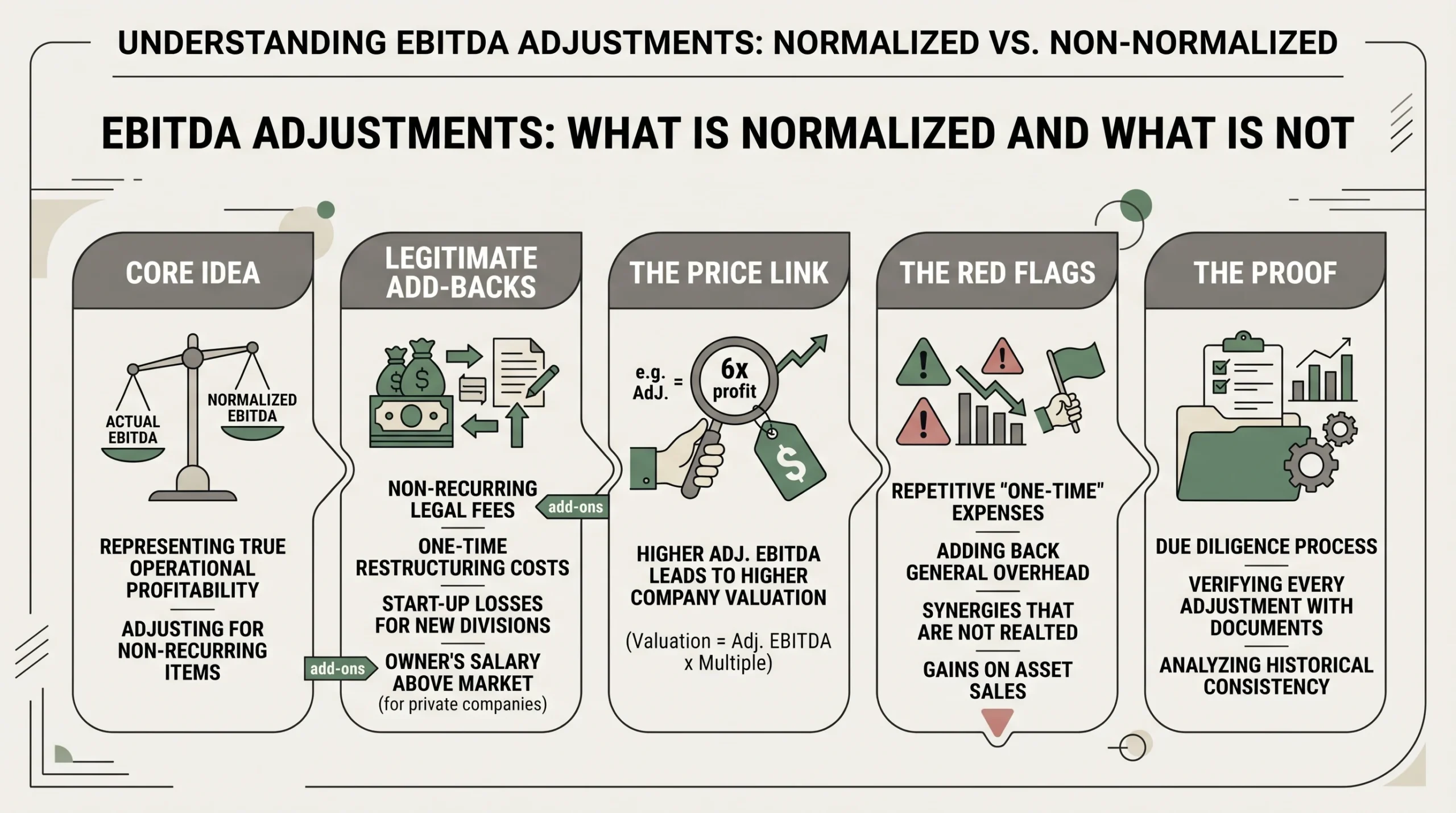
EBITDA adjustments add back items that fall outside a company’s normal operations, which produces adjusted, or normalized, EBITDA. The goal is a clean number that shows the earnings a new owner could expect to repeat. Legitimate add-backs cover non-recurring, non-operating, and discretionary costs, such as an owner’s pay above a market salary or a one-time lawsuit. This figure drives price, because a buyer multiplies adjusted EBITDA by a market multiple to set enterprise value. Recurring costs dressed up as one-time items will not survive review.
Sofer Advisors builds these adjustments for owners, CPAs, and attorneys who need a valuation they can defend.
This guide explains what is normalized and what is not, how add-backs drive the multiple, and the proof buyers demand.
Key Takeaways
- Core idea: Adjusted EBITDA strips out items that will not repeat for a new owner.
- Legitimate add-backs: These cover non-recurring, non-operating, and discretionary costs.
- The price link: Adjusted EBITDA times a market multiple drives enterprise value.
- The red flags: Recurring costs dressed up as one-time items will not survive review.
- The proof: Every add-back needs documents, and buyers test them in a quality of earnings analysis.
What are EBITDA adjustments, and why do they matter?
EBITDA adjustments are changes to reported earnings. They remove items that do not reflect normal, ongoing operations. The goal is a clean number. That number should show what the business earns year after year.
Why does this matter so much? Price. A buyer or lender starts with adjusted EBITDA. They apply a multiple to it. The product is the enterprise value. If an add-back raises adjusted EBITDA, it raises the price too.
The reverse is also true. A weak or unsupported add-back can backfire. Buyers lose trust fast. They may cut the price or walk away. So the aim is not the highest number. The aim is the highest number you can prove.
What is the difference between EBITDA and adjusted EBITDA?
EBITDA starts from net income. You add back interest, taxes, depreciation, and amortization. This removes the effects of financing and tax choices. It gives a rough view of operating profit.
Adjusted EBITDA goes one step further. You take EBITDA and normalize it. You add back non-recurring, non-operating, and discretionary items. What remains is sustainable earning power.
Here is a short example. Say a company reports $2,000,000 of EBITDA. The owner paid themselves $300,000 above a market salary. A one-time lawsuit cost $150,000. Both amounts get added back. Adjusted EBITDA becomes about $2,450,000. The figures are illustrative, but the logic is standard.
How does adjusted EBITDA drive the valuation multiple?
Most private deals use a simple pricing model. A buyer takes adjusted EBITDA. Then they apply a multiple. The result is the enterprise value. The multiple reflects risk, growth, and the industry.
So the two inputs work together. A higher adjusted EBITDA lifts the price at any given multiple. A stronger business can also earn a higher multiple. Both levers point the same way.
This is why add-backs carry so much weight. One extra dollar of adjusted EBITDA can add several dollars of value. The exact effect depends on the multiple, which varies by sector and deal. Treat any single multiple you hear as a rough guide, not a rule.
Which add-backs are legitimate?
A legitimate add-back shares one trait. The cost will not repeat for a normal owner running the business. Appraisers group these into a few clear buckets.
Owner compensation. Many owners pay themselves above or below market. You normalize the salary to a fair market rate for the role.
Non-recurring costs. These are true one-time items. Think of a legal settlement, a restructuring charge, or repairs after a storm.
Non-operating items. These sit outside the core business. Examples include investment income, rent from an unused building, or a gain on the sale of an asset.
Discretionary expenses. Owners often run personal costs through the company. Personal travel, a family car, or a relative on payroll who does no real work all qualify.
Related-party items. Rent paid to an owner may sit above or below market. You adjust it to an arm’s-length rate.
Which add-backs are not legitimate?
Not every cost can leave the books. Some add-backs fail the moment a buyer looks closely.
The most common error is simple. An owner labels a recurring cost as one-time. Marketing, repairs, and software fees happen every year. Calling them unusual does not make them so.
Aggressive add-backs are another trap. These stretch a real item far past its true size. A claim with no support falls into the same group.
Double-counting also sinks a schedule. An owner may normalize a salary, then also add back a bonus already inside that salary. The same dollar cannot come out twice. A careful reviewer will catch the overlap and remove it.
Each of these mistakes does more than inflate one line. It makes a buyer doubt the whole schedule.
How do owner compensation adjustments work?
Owner pay is the most common adjustment in a private company. Owners often set their salary for tax reasons, not market reasons. Some take very little. Others take far more than the job is worth.
The fix is to use a market salary. You ask a simple question. What would it cost to hire someone to do this job? You can support the answer with salary surveys and comparable roles.
The difference becomes the adjustment. Say an owner takes $500,000 and the market rate is $250,000. You add back $250,000. If the owner underpays, you subtract the shortfall instead. The point is the same. The books should reflect a normal cost of management.
How many years of financials should you review?
Most analysts look at three to five years of results. A single year can mislead. One strong year may hide a weak trend. One weak year may hide real strength.
A longer view shows the pattern. It reveals which costs repeat and which do not. A “one-time” expense that appears in three straight years is not one-time at all. The multi-year lens is how a reviewer catches that.
The purpose of the valuation also matters. A sale may focus on recent trailing months. A tax or estate matter may fix a single valuation date. Either way, the supporting history should go back several years.
What is the difference between historical and pro forma add-backs?
Historical add-backs look backward. They remove one-time costs from past results. A lawsuit, a storm repair, or a failed product launch all fit here. These items are facts, so buyers tend to accept them.
Pro forma add-backs look forward. They project a change that has not fully landed yet. A recently signed contract is one example. Cost savings from a new system is another.
Pro forma claims face far more doubt. The event has not played out in the numbers. Buyers want hard proof, such as a signed agreement or a firm purchase order. Without that proof, the add-back will not hold.
How do buyers test add-backs?
Buyers do not accept add-backs on trust. They run a quality of earnings analysis, often called a QoE. An outside accounting group digs into each claim.
They look for proof. An invoice. A signed contract. Board minutes. A tax filing. If you cannot document an add-back, the buyer will likely strike it.
They also test the story. Is the cost truly one-time? Does it show up again in another year? A pattern across years is the fastest way to lose an add-back.
The table below shows how common items tend to land.
| Item | Usually a valid add-back | Usually not valid |
|---|---|---|
| Owner salary above market | Yes, normalized to market | Full salary with no market basis |
| One-time legal settlement | Yes, with documents | A recurring legal retainer |
| Personal travel on the books | Yes, if clearly personal | Travel tied to real sales work |
| Gain on sale of equipment | Yes, non-operating | Routine trade-in activity |
| “One-time” marketing push | Rarely | Annual marketing relabeled |
Who relies on adjusted EBITDA?
Several parties lean on this number. Each one reads it for a different reason.
Buyers use it to set a price. They want the earnings a new owner can repeat, not a single good year. Lenders use it to size a loan. They check whether the cash flow can cover debt payments.
Sellers use it to prepare. A clean, documented schedule helps them defend the asking price. Appraisers use it in tax, estate, and litigation work, where a valuation must stand up to review. Each reader wants the same thing. They want a number that holds up under pressure.
Frequently Asked Questions
What is adjusted EBITDA in simple terms?
It is a cleaned-up version of a company’s core profit. You start with EBITDA. Then you add back costs that will not repeat for a new owner. The result shows the earnings the business can sustain.
How do you calculate adjusted EBITDA?
Start with net income. Add back interest, taxes, depreciation, and amortization to get EBITDA. Then add back non-recurring, non-operating, and discretionary items. Each add-back needs support, such as an invoice or a contract.
What are the most common EBITDA add-backs?
The usual ones are owner pay above market, one-time legal or settlement costs, and personal expenses run through the company. Non-operating income and above-market related-party rent also come up often. Each should trace to a clear document.
Which add-backs do buyers reject?
Buyers reject recurring costs that an owner labels as one-time. They also reject aggressive or unsupported claims. Double-counting is a third problem, where the same cost comes out twice. Any of these can hurt trust in the full schedule.
How does a quality of earnings report work?
A buyer hires an outside accounting group to review the numbers. They test each add-back against invoices, contracts, and tax filings. They check whether a cost repeats across years. The report tells the buyer which add-backs hold up.
How do owner compensation adjustments affect value?
You replace the owner’s actual pay with a fair market salary for the role. If the owner overpays, you add the excess back, which raises adjusted EBITDA. If the owner underpays, you reduce earnings. Both moves give a buyer a true cost of management.
How is EBITDA different from net income and cash flow?
Net income is profit after all costs, including interest and taxes. EBITDA adds those items back to show operating profit. Cash flow tracks the actual money moving in and out, including capital spending. EBITDA ignores capital spending, so it is not the same as cash flow.
Does adjusted EBITDA change the sale price?
Yes. Buyers apply a market multiple to adjusted EBITDA to set enterprise value. A higher supported figure means a higher price. A weak add-back can lower the price or end the deal.
What documents support an EBITDA adjustment?
Common proof includes invoices, employment agreements, board minutes, and tax filings. A salary survey can support an owner pay adjustment. A note in a spreadsheet is not enough for a lender or a buyer.
Related Case Studies
- Normalized EBITDA: Definition, Formula, and Why It Matters
- Healthcare Services EV/EBITDA Multiples: PE Benchmarks
- Normalization Adjustments: Recasting Earnings for Valuation
Executive Summary
Adjusted EBITDA strips out items that will not repeat for a new owner. These cover non-recurring, non-operating, and discretionary costs. Adjusted EBITDA times a market multiple drives enterprise value. Recurring costs dressed up as one-time items will not survive review. Every add-back needs documents, and buyers test them in a quality of earnings analysis.
What Should You Do Next?
Start with your records. Pull your profit and loss statements for the past three to five years. Flag any cost that is personal, one-time, or outside normal operations. Then gather the documents that prove each one. Keep invoices, contracts, and salary data in one place. Clean records make the whole review faster and far easier to defend.
Sofer Advisors prepares defensible EBITDA normalization for tax, M&A, and litigation matters, led by founder David Hern CPA ABV ASA CVA. Schedule a free consultation today to review your numbers.
People Also Read
- Adjusted EBITDA vs EBITDA: Key Differences Explained
- EBITDA Multiple for Business Valuation by Industry
About the Author
This guide was prepared by David Hern CPA ABV ASA CVA, founder of Sofer Advisors, a business valuation firm headquartered in Atlanta, GA serving clients across the United States. David holds accreditations as an Accredited Senior Appraiser (ASA) and is Accredited in Business Valuation (ABV), credentials recognized by the IRS, SEC, and FINRA, and is also a Certified Valuation Analyst (CVA). David has served as an expert witness in dozens of cases across multiple jurisdictions, and Sofer Advisors is an Inc. 5000 honoree in 2024 and 2025 with 240+ five-star Google reviews.
For professional business valuation services, visit soferadvisors.com/about-us/ or contact Sofer Advisors at soferadvisors.com/contact-us/.
Disclaimer: This content is for informational purposes only and does not constitute professional valuation advice. Business valuation conclusions depend on specific facts and circumstances. Contact Sofer Advisors for guidance regarding your specific situation.