


Last Updated: June 2026
This article is written for estate planning attorneys, CPAs, and family business owners exploring FLP structures. After reading it, you will understand how FLP interests are valued, which discounts apply, what the IRS looks for, and what a qualified appraisal must include.
A family limited partnership valuation is the process of finding the fair market value of FLP interests for gift and estate tax reporting. It uses accepted appraisal methods that account for ownership structure, control rights, and transfer restrictions. Getting this number right matters because the IRS scrutinizes FLP valuations closely, and errors can trigger audits, penalties, and disallowed discounts. Families use FLPs to shift wealth across generations while reducing the taxable value of transferred assets through legally defensible discounts.
The stakes in an FLP valuation are significant. A well-supported appraisal can reduce the gift or estate tax base by 25% to 45% through combined discounts for lack of control and lack of marketability. A poorly supported one can be challenged, reversed, and penalized. For families with business interests, real estate holdings, or investment portfolios inside an FLP, the difference between a defensible valuation and a rejected one can translate to hundreds of thousands in unnecessary tax. Sofer Advisors, headquartered in Atlanta, GA, provides IRS-compliant FLP valuations for middle-market families and their advisors across the United States.
Key Takeaways
- Two Core Discounts Drive FLP Value Reductions – Combined discounts for lack of control (DLOC) and lack of marketability (DLOM) typically range from 25% to 45% of the pro-rata underlying asset value, depending on the partnership agreement and asset type.
- IRS Scrutiny Is High – The IRS challenges FLP valuations in a meaningful share of estate and gift tax audits, particularly when the partnership was created close to the transferor’s death or lacks genuine business purpose.
- A Qualified Appraisal Is Non-Negotiable – Under IRC Section 2512 and Treasury Regulations, gift tax returns reporting FLP transfers must be supported by a qualified appraisal prepared by a qualified appraiser.
- The Three Approaches All Apply – Appraisers evaluate FLP interests using the income approach, market approach, and asset approach, then weight each based on what the partnership holds and how it operates.
- Business Purpose Protects the Structure – Courts have upheld FLP valuations where the entity serves a genuine business purpose beyond tax savings, such as centralized asset management or family governance.
- Timing of the Appraisal Is Critical – The valuation date for gift tax is the date of the transfer; for estate tax it is the date of death or the alternate valuation date six months later, and each date can produce materially different results.
Each of these elements interacts with how the IRS evaluates an FLP appraisal. The sections below examine each factor in detail.
What Is an FLP Interest and Why Does It Matter?
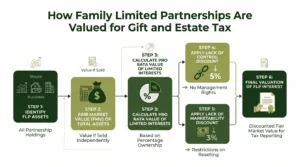
An FLP interest is a fractional ownership unit in a family limited partnership. Its fair market value for tax purposes is not the partner’s pro-rata share of underlying assets. A limited partner holding a 20% interest in a partnership owning $5 million in real estate does not hold a $1 million asset for tax purposes.
The actual value is lower. A limited partner cannot force a liquidation, compel distributions, or sell their interest without general partner consent. These restrictions reduce what a hypothetical buyer would pay, forming the basis for valuation discounts.
Courts have held that the willing buyer/willing seller standard under IRS Revenue Ruling 59-60 applies to FLP valuations. A qualified appraisal protects the family from a later challenge that could unwind years of planning.
How Are FLP Interests Valued Using the Three Approaches?
FLP interests are valued using three accepted approaches: the income approach, the market approach, and the asset approach. The appraiser weights each based on partnership assets, operating history, and the economic rights of the interest being valued.
The income approach looks at distributions available to a limited partner. If the partnership generates recurring cash flow, the appraiser capitalizes or discounts that stream.
The market approach compares the FLP interest to sales of similar interests in publicly traded limited partnerships. Private FLP transaction data is limited, so appraisers supplement it with asset-based analysis.
The asset approach starts with the NAV of the underlying assets, then applies DLOC and DLOM discounts. This is the most common starting point for FLPs holding passive investments.
What Discounts Apply to FLP Interests?
The two primary discounts in FLP valuation are DLOC and DLOM. Both are applied to the pro-rata share of net asset value. The result is the fair market value of the transferred interest.
DLOC reflects a limited partner’s inability to control partnership decisions, force distributions, or liquidate assets. A buyer demands a price reduction for this loss of control. DLOC typically ranges from 15% to 40%.
DLOM reflects the lack of a ready market for FLP interests. A partnership interest cannot be sold on an exchange, and transfer restrictions further limit exit options. DLOM typically ranges from 10% to 35%.
Discounts are applied sequentially. A 30% DLOC on a $1 million pro-rata value produces $700,000. A 25% DLOM on that produces a fair market value of $525,000 – a combined discount of about 47.5%. The appraiser must justify why selected levels fit the specific FLP.
What Does the IRS Look for in an FLP Appraisal?
The IRS reviews FLP valuations for three things: whether discounts are supported by data, whether the partnership was formed for legitimate business reasons, and whether the transfer complied with applicable regulations. Failing on any front can trigger an audit.
Section 2036 allows the IRS to pull partnership assets back into the decedent’s estate if the transferor retained income rights or continued to control assets after transfer. Section 2703 lets the IRS disregard transfer restrictions not comparable to arm’s-length arrangements.
A qualified appraisal under Treasury Regulations Section 1.170A-17 must identify the appraiser, describe the interest, state the valuation date, and explain the methods used.
What Are the Common Mistakes in FLP Valuations?
Several recurring mistakes cause FLP valuations to be challenged or disallowed. The most common include:
- Applying discount percentages without supporting empirical data from recognized studies
- Failing to analyze the partnership agreement terms before selecting discount levels
- Using a single valuation approach when USPAP standards require multiple approaches
- Valuing underlying assets at retail replacement cost rather than fair market value before applying discounts
- Allowing an appraiser with no specific FLP experience to sign the report
Each error is avoidable with proper engagement scoping and appraiser selection. The report must walk the IRS through the reasoning, data sources, and facts that justify every discount and approach weight.
David Hern CPA ABV ASA, founder of Sofer Advisors, brings a Heart of a Teacher approach to every FLP engagement. He translates complex discount methodology into clear, defensible reasoning.
How Does the Estate Planning Context Affect Valuation?
The context of an FLP valuation changes the documentation requirements and the valuation date. Estate tax valuations use the date of death. Gift tax valuations use the date of transfer. Each date may produce different results.
For estate planning purposes, FLPs work best when the partnership is established well before the senior generation’s death. It should also operate with documented business purposes. Transfers made within three years of death face heightened scrutiny under Section 2035.
The Sofer Difference is a four-phase process – Discovery, Diligence, Analysis, and Delivery. Discovery covers goals and the governing agreement. Diligence reviews financial statements and distribution history. Analysis applies all three valuation approaches. Delivery produces a compliant report built to withstand challenges.
How Do FLPs Compare to Direct Asset Transfers?
FLP structures generally produce better tax outcomes than direct transfers for families with large, concentrated holdings.
| Transfer Method | Typical Taxable Value | Discount Available | Best Use Case |
|---|---|---|---|
| Direct gift of asset | 100% of fair market value | None | Simple assets, small transfers |
| FLP limited partner interest (minority) | 55%-75% of pro-rata NAV | 25%-45% combined DLOC/DLOM | Large portfolios, family business interests |
| FLP general partner interest | 85%-95% of pro-rata NAV | 5%-15% control premium reduction | Small control block, active management |
| Grantor retained annuity trust (GRAT) | Gift value minus retained interest | Based on IRC 7520 rate | Appreciating assets with low interest rate environment |
Direct gifts carry no valuation discounts because there is no ownership restriction. An FLP interest carries real economic restrictions reflected in the fair market value standard. FLPs need updated appraisals every two to three years, and using an outdated valuation creates compliance risk.
Frequently Asked Questions
How much does an FLP valuation from Sofer Advisors cost?
An FLP valuation from Sofer Advisors typically ranges from $7,500 to $25,000. The fee depends on the assets held, the complexity of the discount analysis, and whether multi-entity work is needed. Most standard engagements are completed within four to eight weeks. Rush engagements are available at a 25-50% premium. Schedule a free consultation to receive a scoped estimate.
How are limited partnerships valued for tax purposes?
Limited partnership interests are valued at fair market value – the price a willing buyer would pay a willing seller, with neither under compulsion. The valuation starts with the net asset value of underlying assets, then applies DLOC and DLOM discounts. The final value reflects that a limited partner cannot force distributions or sell their interest freely.
What is the discount for lack of marketability and how is it calculated?
DLOM accounts for the absence of a ready market for a limited partnership interest. Appraisers calculate DLOM using data from restricted stock studies and pre-IPO databases. They compare restricted share prices to freely traded equivalents. DLOM for FLP interests typically ranges from 10% to 35%. The exact level depends on transfer restrictions in the partnership agreement and the expected sale horizon.
What are the disadvantages of an FLP?
FLPs carry real disadvantages. Setup costs include legal drafting, asset transfer fees, and an initial appraisal. Annual maintenance requires separate accounting and partnership tax returns. The IRS actively audits FLPs and may challenge the structure under Section 2036 if the transferor retains too much control. Courts have disallowed FLP discounts when the entity lacked genuine business purpose.
Are FLPs still a good investment vehicle in 2026?
FLPs remain a sound wealth transfer tool for families with large taxable estates, concentrated real estate, or closely held business interests. The federal estate tax exemption is scheduled to sunset after 2025, increasing the benefit of FLP discounts. FLPs require ongoing maintenance, periodic reappraisals, and adherence to formalities. The cost is most justified for estates that exceed or approach the exemption threshold.
How does the IRS challenge FLP valuations?
The IRS challenges FLP valuations under three main provisions. Section 2036 allows inclusion of FLP assets in the gross estate if the decedent retained control after transfer. Section 2703 lets the IRS disregard restrictions not comparable to arm’s-length arrangements. Section 2704 addresses lapsed voting or liquidation rights. The IRS may also attack discount methodology when the appraiser did not cite adequate market data.
What is a qualified appraisal for FLP gift tax returns?
A qualified appraisal is a written report prepared no earlier than 60 days before the transfer and no later than the due date of the return. It must include a description of the interest, the transfer date, valuation methods used, factors considered, and the appraiser’s credentials and signed declaration. Treasury Regulations Section 1.170A-17 and IRS Notice 2006-96 set the requirements.
How often should an FLP be revalued?
An FLP should be revalued whenever a significant transfer occurs, when asset composition changes materially, or at least every two to three years. Using an appraisal more than three years old on a current gift tax return is a common compliance error. Outdated studies can undermine an otherwise solid report.
What credentials should an FLP appraiser hold?
An FLP appraiser should hold the ABV (Accredited in Business Valuation) designation from the AICPA or the ASA (Accredited Senior Appraiser) designation from the American Society of Appraisers. Both require shown experience, examination, and continuing education. The IRS recognizes these as indicators of competence. An appraiser without these credentials risks a challenge that can invalidate the appraisal entirely.
How do courts decide whether to uphold FLP discounts?
Courts weigh several factors: whether the partnership serves a legitimate business purpose, whether the transferor followed formalities, whether assets were commingled with personal funds, and whether discount methodology is supported by credible data. The Tax Court has upheld discounts where the FLP operated under a coherent governance structure. Discounts have been disallowed when the partnership existed only on paper.
Related Case Studies
- Estate Planning Business Valuation Georgia Gift Tax Compliance Guide
- Exit Planning Valuation Case Study
- Business Appraisal Methodology Case Study
Executive Summary
Family limited partnership valuation finds the fair market value of transferred FLP interests for gift and estate tax compliance. The process applies three approaches – income, market, and asset – then reduces pro-rata asset value by DLOC and DLOM discounts, which typically combine to 25% to 45%. The IRS scrutinizes these valuations, challenging structures that lack business purpose or use discount data without empirical support. A qualified appraisal from a credentialed appraiser is required by Treasury Regulations for reportable transfers.
What Should You Do Next?
If your family is considering an FLP transfer, engage an estate planning attorney and a qualified appraiser before making any transfers. The valuation must be complete and compliant before filing the gift tax return.
David Hern CPA ABV ASA provides FLP valuations for gift and estate tax compliance backed by dual ABV and ASA credentials recognized by the IRS, SEC, and FINRA. Schedule a consultation to get an audit-ready appraisal report.
People Also Read
- Why You Must Start Planning Your Business Exit Now With The Right Valuation Expert
- What To Expect During A Business Valuation Step By Step Process
About the Author
This guide was prepared by David Hern CPA ABV ASA, founder of Sofer Advisors – a business valuation firm headquartered in Atlanta, GA serving clients across the United States. David holds dual accreditations as an Accredited Senior Appraiser (ASA) and is Accredited in Business Valuation (ABV), credentials recognized by the IRS, SEC, and FINRA. He also holds the Certified Exit Planning Advisor (CEPA) designation. With 15+ years of valuation experience, David has served as an expert witness in 11+ cases across multiple jurisdictions and built Sofer Advisors into an Inc. 5000-recognized firm with 180+ five-star Google reviews. The firm’s full W2 employee team maintains subscriptions to all major valuation databases and operates under a next business day response policy.
For professional business valuation services, visit soferadvisors.com or schedule a consultation.
This content is for informational purposes only and does not constitute professional valuation advice. Business valuation conclusions depend on specific facts and circumstances. Contact Sofer Advisors for guidance regarding your specific situation.