


Last Updated: August 2026
Section 2704 is a part of the tax code that limits discounts on transfers of family businesses. It tells the IRS to ignore some limits when it values a gift or an estate. The rule applies only when a family holds at least 50 percent of the votes or value of the entity. Sofer Advisors treats a section 2704 valuation as one of the most contested tasks in estate work.
The rule matters because family owners often pass shares at a discount. A small stake is worth less than its share of the whole. Shares that are hard to sell are worth less too. Section 2704 asks whether those discounts rest on real limits or on paper terms built to cut taxes. When a term is fake, the law drops it. The taxable value then goes up.
Key Takeaways
- Two parts: Section 2704(a) covers lapsing rights. Section 2704(b) covers limits on cashing out.
- Applicable limits: Any exit limit stricter than state law is ignored for tax value.
- Discounts still apply: A DLOM and a minority discount survive when they rest on real facts.
- 50 percent test: The rule bites only when the family controls the entity.
- Withdrawn rules: Draft rules to widen Section 2704 were pulled in 2017, so prior law stands.
These points tie estate planning to hard evidence. The sections below walk through each one. They show how the rule works, what it removes, and how a sound discount still holds up.
What are the two parts of Section 2704?
Section 2704 has two parts. Part (a) deals with lapsing rights. Part (b) deals with limits on exit. Both apply to family-owned firms and partnerships. Part (a) treats the lapse of a vote or a right to cash out as a transfer of value. Part (b) tells the appraiser to ignore exit limits that go past state law.
A right lapses when a holder loses the power to force a payout or a vote. If the family keeps control before and after, the law counts the drop in value as a gift. The statute on the Cornell Law School Legal Information Institute page spells out this control test. Part (b) then guards against private terms. It stops a family from writing rules that lower value on paper alone. Together the two parts keep the reported value close to real worth.
How does Section 2704 affect valuation discounts?
Section 2704 does not erase discounts. It removes only the fake ones. Say an operating agreement blocks a sale more tightly than state law allows. The IRS then ignores that block. The appraiser values the interest as if the holder could force a payout under state rules. This step raises the fair market value. The discount shrinks, and the tax goes up with it.
The key word is applicable. A limit counts only when it is stricter than the state default. If the agreement just matches state law, it stands, and the normal discount holds. So the analyst must read the agreement against the state rule line by line. David Hern CPA ABV ASA leads this review for family firms. The aim is a value a willing buyer would truly pay, not one shaped by terms built for tax alone.
What is an applicable restriction under 2704(b)?
An applicable restriction is any exit limit that is stricter than the state’s default law. When the IRS values a family interest for gift or estate tax, it ignores that limit. The rule targets terms placed in an agreement to lower value on paper. If the state lets a partner exit more freely than the agreement does, the extra barrier falls away for tax.
Here is a plain example. Say state law lets a limited partner exit with a simple majority vote. The agreement instead demands a full, unanimous vote. That higher bar is an applicable restriction. The IRS treats it as if it were not there. The interest is valued using the easier state test. This is why the choice of home state shapes the result. A family that matches its terms to state law keeps its discounts on firmer ground.
Do DLOM and minority discounts still apply?
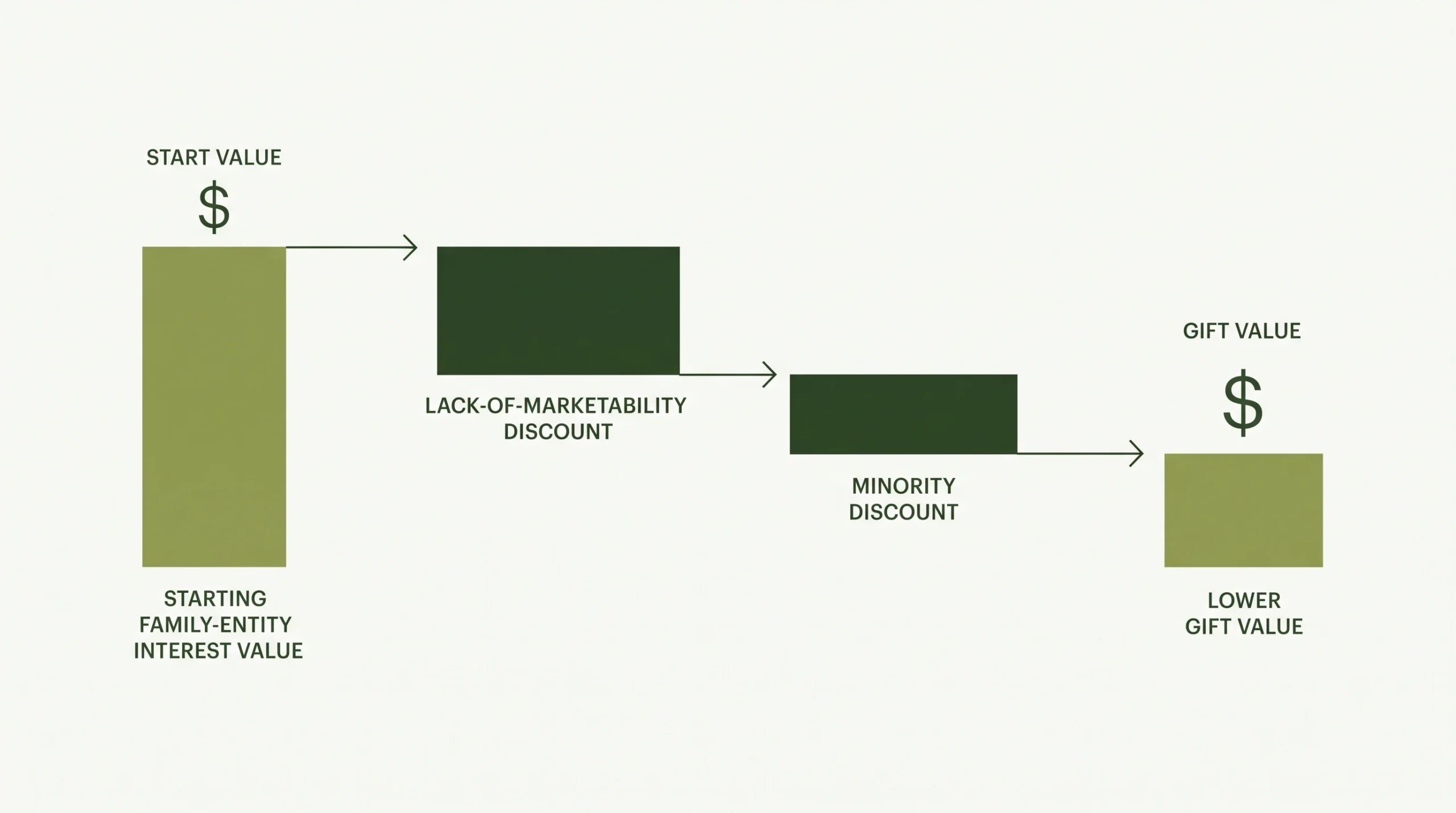
Yes. A discount for lack of marketability and a minority discount still apply under Section 2704. The rule removes only limits that beat state law. It does not remove the real facts that make a small interest worth less. A small stake still carries no control. A private interest still has no ready market. Those facts support a discount built on market data, not on private terms.
The table below shows how a standard fair market value view differs from a section 2704 valuation. The gap lies in how each treats the terms in an agreement.
| Valuation factor | Standard fair market value | Under Section 2704 |
|---|---|---|
| Exit limits | All agreement terms are weighed | Terms stricter than state law are ignored |
| Marketability discount | Reflects real and private hurdles | Reflects only real market hurdles |
| Minority discount | Based on actual lack of control | Still applies on the facts |
| Lapsing rights | Value drop is usually counted | A lapse is treated as a taxable transfer |
The lesson is that Section 2704 narrows the discount but does not delete it. An appraiser must split the facts that survive from the terms that fall away. IRS guidance in Internal Revenue Manual 4.25.5 confirms that a lack of control discount and a lack of marketability discount stay valid for small, closely held stakes. The work is to prove each one rests on market data, not on a private hurdle the law drops.
What happened to the 2016 proposed regulations?
In August 2016 the Treasury proposed new rules under Section 2704. They aimed to widen the reach of the statute and curb common discounts on family firms. Many advisors read the draft as a near end to minority and marketability discounts on family gifts. The draft drew heavy pushback and thousands of written comments during the review.
The Treasury pulled the draft in October 2017. So the older rules still govern today. This history matters for planning. It shows that discounts on family firms stay available under current law. It also shows why records must be careful. Rules here can shift fast. A value that rests on solid market data holds up better than one that leans on a draft that never took hold.
How do you support a defensible discount?
A sound discount rests on evidence, not on claims. The appraiser starts by reading the agreement against state law to find any applicable restriction. Next the analyst adjusts earnings and studies the exact interest being passed. Then each discount is tied to market data, such as restricted stock studies for a DLOM. The report must follow IRS Revenue Ruling 59-60, USPAP from The Appraisal Foundation, and the AICPA SSVS.
This is where The Sofer Difference guides the work. It is a four-phase process of Discovery, Diligence, Analysis, and Delivery that yields an audit-ready report. Sofer Advisors brings the same senior-level rigor that large firms such as Alvarez and Marsal or Kroll save for their biggest clients. Yet it backs every result with a full W2 team of 14, unlike a solo practitioner. The Heart of a Teacher approach means the report shows the owner and counsel the reasoning, not just a number. That clarity is what survives a review.
Frequently Asked Questions
What is the difference between Section 2704(a) and 2704(b)?
Section 2704(a) treats the lapse of a vote or exit right as a taxable transfer when the family keeps control. It closes a gap that once let rights vanish free of tax. Section 2704(b) instead governs value. It tells the appraiser to ignore exit limits that are stricter than state law. Sofer Advisors checks both parts, so lapsing rights and paper limits are handled right in one job.
Does Section 2704 apply to all business transfers?
No. Section 2704 applies only when the family controls the entity right before the transfer. Control means holding at least 50 percent of the votes or value. If the family lacks that control, the rule does not limit the minority or marketability discount. The firm reviews the ownership records and family holdings first. That step confirms whether the test is met before any discount is set.
What is the control test for Section 2704?
The control test asks whether the giver and family members hold at least 50 percent of the votes or equity value. The count adds related holdings together under family attribution rules. When the family clears that line, the entity is family-controlled, and the rules apply. Our team maps each owner and each interest to confirm whether this line is crossed at the transfer date.
Can you still take discounts on a family limited partnership?
Yes. A family limited partnership can still support a minority discount and a marketability discount. The rule only drops limits that are stricter than state law. If the partnership terms match the state default, the standard discounts stay valid and rest on market facts. Sofer Advisors reads the partnership agreement against the state rule to confirm each discount is based on real evidence, not a dropped term.
What is an applicable restriction under 2704(b)?
An applicable restriction is an exit limit that is stricter than the state’s default law. The IRS ignores it when valuing a family interest for gift or estate tax. A common example is a term that demands a full vote to sell when the state allows a simple majority. The extra barrier is removed for tax. Our team flags these terms early so owners see their effect on value.
Did the 2016 proposed regulations ever take effect?
No. The Treasury proposed new Section 2704 rules in 2016 to limit family firm discounts. The draft drew heavy pushback and thousands of comments. The Treasury then pulled it in October 2017, so the draft never became law. Current work follows the prior rules, and discounts on family firms stay available. Sofer Advisors builds each report to hold up under the rules that actually govern today.
Who counts as a family member under Section 2704?
Family members include the giver, the spouse, ancestors, lineal descendants of either, and siblings. Interests held by these people are added together to test for control. This count decides whether the family clears the 50 percent line. If it does, the entity is family-controlled and the rules apply. The firm names each family holder so the test uses the full set of related interests, not just direct shares.
How much does a business valuation from Sofer Advisors cost?
Business valuations from Sofer Advisors typically run from 7,500 to 25,000 dollars. The fee depends on the number of interests, the depth of the agreement review, and the purpose of the work. Simpler estate filings sit toward the lower end. A family firm with several gifts and a contested past calls for deeper work and a higher fee. Contact the firm for a quote matched to your situation.
Related Case Studies
- Holding Company Discounts: How DLOC and DLOM Apply to Holdcos
- Revenue Ruling 93-12: Why Family Attribution Doesn’t Apply
- Estate Freeze Strategies: How Valuations Lock In Today’s Value
Executive Summary
Section 2704 limits discounts on transfers of family businesses. It has two parts. Part (a) treats a lapse of a vote or exit right as a taxable transfer. Part (b) tells the appraiser to ignore exit limits that are stricter than state law. The rule applies only when a family holds at least 50 percent control. Real minority and marketability discounts still apply when market facts support them. Draft rules to widen the statute were pulled in 2017. A sound report follows IRS Revenue Ruling 59-60, USPAP, and the AICPA SSVS, and reads each agreement against state law.
What Should You Do Next?
Gather your governing papers, including the operating agreement or bylaws and any changes. Note the entity’s home state, since state law sets the baseline for any applicable restriction. Then have an appraiser read those terms against the statute before you file a gift or estate return.
For a discount you can defend, work with David Hern CPA ABV ASA. His team has given expert witness testimony in 11+ cases across Georgia, Florida, California, and New Mexico. Schedule a consultation to discuss your family entity transfer.
People Also Read
- Section 6166: Deferring Estate Tax on a Business
- The Alternate Valuation Date (Section 2032) for Estates
About the Author
This guide was prepared by David Hern CPA ABV ASA, founder of Sofer Advisors, a business valuation firm headquartered in Atlanta, GA serving clients across the United States. David holds dual accreditations as an Accredited Senior Appraiser (ASA) and is Accredited in Business Valuation (ABV), credentials recognized by the IRS, SEC, and FINRA. He also holds the Certified Exit Planning Advisor (CEPA) designation. With 15+ years of valuation experience, David has served as an expert witness in 11+ cases across multiple jurisdictions and built Sofer Advisors into an Inc. 5000-recognized firm with 180+ five-star Google reviews. Its full W2 employee team maintains subscriptions to all major valuation databases and operates under a next business day response policy. For professional business valuation services, visit soferadvisors.com/about-us/ or contact Sofer Advisors at soferadvisors.com/contact-us/.
Disclaimer: This content is for informational purposes only and does not constitute professional valuation advice. Business valuation conclusions depend on specific facts and circumstances. Contact Sofer Advisors for guidance regarding your specific situation.









