


Last Updated: June 2026
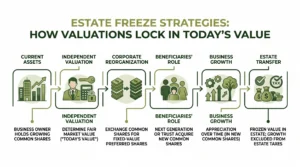
An estate freeze locks the current value of a business or asset in the owner’s estate. It shifts all future appreciation to heirs or a trust. This caps the estate tax exposure at today’s value. The freeze works only if that “today’s value” is defensible to the IRS. The valuation is not a formality, it is the legal and economic foundation of the entire transaction.
The IRS audits estate freeze transactions with sustained intensity because the stakes are high. An overvalued freeze locks in too much in the estate. An undervalued freeze triggers gift tax exposure or Section 2701 challenges. Getting the number right, and documenting it properly, is the difference between a successful transfer and a years-long audit. Sofer Advisors helps owners and their advisors work through exactly these questions and turn the analysis into a defensible business valuation they can act on.
The following takeaways summarize the key valuation and transaction factors covered in this guide.
Key Takeaways
- Estate Freeze Transfers Future – An estate freeze transfers future appreciation out of the owner’s estate while retaining today’s value. The valuation determines exactly what is frozen.
- Common Freeze Techniques Include – Common freeze techniques include GRATs, preferred stock recapitalizations, installment sales to IDGTs, and family LLC freezes.
- IRS Applies Revenue Ruling – The IRS applies Revenue Ruling 59-60 factors and comparable transaction data to challenge freeze valuations. Documentation must be contemporaneous.
- Valuation Discounts DLOM DLOC – Valuation discounts – DLOM and DLOC – can reduce the frozen value. But courts have increasingly scrutinized aggressive discount stacking.
- 55 Rule Estate Planning – The 5×5 rule in estate planning refers to the Crummey power exception – up to $5,000 or 5% of trust assets per beneficiary per year – not to business valuation multiples.
- Timing Matters Freeze Executed – Timing matters: a freeze executed before a liquidity event captures the maximum transfer benefit.
Each of these factors is examined in depth in the sections that follow.
What Is an Estate Freeze and How Does It Work?
An estate freeze separates a business or asset into two components: a frozen interest (retained by the owner) and a growth interest (transferred to heirs). The owner retains current value. Heirs receive everything above that baseline.
The mechanics vary by structure. In a preferred stock recapitalization, the owner exchanges common stock for preferred stock with a fixed liquidation preference and yield. The preferred stock is frozen at today’s value. New common stock, worth little today but capturing all future growth, is transferred to heirs at minimal gift tax cost.
In a Grantor Retained Annuity Trust (GRAT), the owner transfers assets into a trust and retains an annuity for a fixed term. At the end of the term, remaining appreciation passes to heirs free of gift tax. If the assets outperform the IRS Section 7520 hurdle rate (currently in the 3%–5% range), the excess transfers to heirs at no more transfer tax cost. The annuity is valued using IRS actuarial tables. But the underlying asset value going into the GRAT is determined by the appraiser.
An installment sale to an Intentionally Defective Grantor Trust (IDGT) lets an owner sell appreciated assets to a trust for a promissory note at the IRS Applicable Federal Rate (AFR). All appreciation above the AFR passes to trust beneficiaries free of estate and gift tax. The sale price, and the note amount, depends entirely on the valuation at the time of the transaction.
A family limited partnership (FLP) or family LLC freeze involves contributing appreciated assets to an entity. The owner then transfers limited partnership or non-managing membership interests to heirs at a discounted value. The discounts reflect DLOM and DLOC. The senior generation retains a general partner or managing member interest.
Because the strategy shifts future appreciation to the next generation, it is governed by the federal gift tax rules published by the IRS.
How Does the IRS Determine Fair Market Value in a Freeze?
The IRS standard for fair market value is the classic “willing buyer, willing seller” test. This is the price at which property would change hands between a hypothetical willing buyer and willing seller, neither under compulsion, both with reasonable knowledge of relevant facts. This standard appears in Treasury Regulation § 20.2031-1(b).
For operating businesses, the IRS applies the factors in Revenue Ruling 59-60. This remains the foundational guidance for valuing closely held business interests for estate and gift tax purposes. These factors include:
- The nature of the business and the history of the enterprise
- The economic outlook for the industry and the company
- Book value and financial condition
- Earning capacity
- Dividend-paying capacity
- Whether the company has goodwill or other intangible value
- Sales of stock and the size of the block being valued
- Market price of publicly traded stocks of comparable companies
The IRS will compare the taxpayer’s appraisal against internal valuation specialists in the Estate and Gift Tax Program. Cases that survive initial review often proceed to Tax Court. Judges have struck down both aggressive discounts and inflated frozen values.
| IRS Audit Focus Area | Common Challenge | Taxpayer Defense |
|---|---|---|
| Valuation discounts (DLOM/DLOC) | Discounts too large or stacked without support | Qualified appraisal with restricted stock and option pricing studies |
| Preferred yield adequacy | Preferred stock yield below market = implied gift | Set preferred yield at market rate; document at transaction date |
| GRAT annuity design | Zeroed-out GRAT structure challenged | Defensible asset valuation at transfer date |
| Comparable transactions | IRS uses different comps | Appraiser selection of comps must be well-documented |
| Section 2701 compliance | Preferred stock terms don’t meet minimum value rules | Mandatory payment preferred stock with cumulative dividends |
What Valuation Discounts Apply in Estate Freeze Transactions?
Two primary discounts apply to minority or non-controlling interests in closely held businesses: the Discount for Lack of Control (DLOC) and the Discount for Lack of Marketability (DLOM).
- DLOC reflects the economic reality that a non-controlling interest in a private company cannot compel distributions, force a sale, or direct management. Typical DLOC ranges in the lower middle market run from 15% to 35%. This depends on the degree of control deficiency, the operating agreement, and comparable transaction data.
- DLOM reflects the absence of a ready market for private company interests. A minority shareholder in a closely held company cannot simply call a broker and liquidate. Typical DLOM ranges run from 20% to 40%. These are supported by restricted stock studies, pre-IPO studies, and option pricing models.
Combined discounts of 30%–50% are achievable on legitimate minority interests. But the IRS has challenged stacked discounts when the underlying assets are liquid, for example, an FLP holding marketable securities. Courts in the Strangi, Estate of Bongard, and similar cases have disallowed discounts where the entity lacked a genuine non-tax business purpose.
The discounts must be supported by a contemporaneous qualified appraisal meeting Treasury Regulation § 1.170A-17 standards. An appraisal prepared after the fact will not survive IRS scrutiny.
What Is the 5×5 Rule in Estate Planning?
The 5×5 rule is a provision related to Crummey powers in irrevocable trusts, not a business valuation metric. It refers to the holder of a Crummey withdrawal right being able to withdraw annually the greater of $5,000 or 5% of the trust corpus. This does not trigger adverse gift tax consequences or cause the withdrawal right to be included in the holder’s estate.
In estate freeze planning, the 5×5 rule matters in the context of life insurance trusts (ILITs) and dynasty trusts. Premium payments or ongoing contributions need to qualify for the annual exclusion. When a trust beneficiary holds a Crummey power exceeding the 5×5 limit, the excess lapse can be treated as a taxable gift from the beneficiary.
For business owners using freeze techniques, the 5×5 context is relevant when the freeze transaction is coupled with an irrevocable life insurance trust. This is a common combination for business owners with illiquid estate assets.
David Hern CPA ABV ASA, founder of Sofer Advisors, brings a Heart of a Teacher to every engagement – translating complex valuation methodology into clear, actionable guidance that clients can act on before and after the report is delivered. With 15+ years of valuation experience, 11+ expert witness cases across multiple jurisdictions, and 180+ five-star Google reviews, David built Sofer Advisors into an Inc. 5000-recognized firm. The Sofer Difference is a four-phase process of Discovery, Diligence, Analysis, and Delivery that ensures every conclusion is defensible, documented, and tied to the specific facts of the business.
While national firms like Stout and Kroll serve large enterprise clients, Sofer Advisors specializes in middle-market businesses that require personalized attention, direct access to credentialed professionals, and a next business day response policy.
How Does a Freeze Valuation Get Challenged and What Happens?
An IRS challenge to a freeze valuation typically begins with an estate tax examination. This is often triggered by a large valuation discount, a transfer that appears below market, or an appraisal with inconsistent method.
The examination involves the IRS Estate and Gift Tax appraiser reviewing the taxpayer’s qualified appraisal. They request supporting workpapers and often prepare a competing valuation. If the parties cannot agree, the case proceeds to IRS Appeals. If still unresolved, it goes to U.S. Tax Court.
Tax Court judges have extensive experience with closely held business valuation disputes. They routinely split the difference between extreme positions. They give significant weight to the quality of the appraisal report and scrutinize whether the appraiser was qualified and independent. A valuation signed by a credentialed appraiser using recognized method and contemporaneous comparable data will significantly outperform a generic calculation.
The penalty for large undervaluation is significant. If the value claimed is 65% or less of the correct value, a 20% accuracy penalty applies under IRC § 6662. A “gross valuation misstatement” (40% or less of correct value) carries a 40% penalty. These penalties apply on the more tax owed, which can be material on a $10M+ estate.
How Should You Time an Estate Freeze?
Timing is the most impactful variable in estate freeze planning. The goal is to freeze value before two events: significant appreciation in the business and a liquidity event that converts a hard-to-value private interest into an obvious cash equivalent.
For a business owner with a company generating $2M in EBITDA at a 6x multiple ($12M enterprise value), executing a freeze today locks $12M in the estate. If the company grows to $4M EBITDA and sells at 7x ($28M) in five years, the more $16M passes to heirs without more estate tax, a potentially large transfer.
The risk of waiting is clear: every year of growth before the freeze increases the frozen value that stays in the estate. The risk of moving too early is executing a freeze when value is uncertain. This could trigger gift tax on an overvalued interest or fail to use available discounts because entity documentation wasn’t in order.
For Georgia business owners, the state follows federal gift and estate tax principles. Georgia has no separate state estate tax, it was repealed in 2014. This simplifies the state-level analysis compared to states like Massachusetts or Illinois that still impose separate estate taxes.
Sofer Advisors provides certified business valuations specifically structured to support estate freeze transactions. This includes preferred stock recapitalizations, GRAT transfers, and FLP/LLC formations. Our appraisals are prepared under USPAP standards and meet the qualified appraisal requirements of Treasury Regulation § 1.170A-17.
The questions below address the most common issues business owners raise before engaging a qualified appraiser for a estate freeze valuation engagement.
Frequently Asked Questions
What is the estate freeze rule?
There is no single “estate freeze rule” in the tax code, it is a planning concept. Section 2701 governs freeze transactions involving transfers of interests in corporations and partnerships where the transferor retains a senior interest. It establishes minimum value rules for retained interests to prevent abusive freezes.
What is the 5×5 rule in estate planning?
The 5×5 rule refers to the IRS safe harbor for Crummey withdrawal powers in irrevocable trusts. A trust beneficiary can hold a lapsing withdrawal right of up to $5,000 or 5% of trust corpus without the lapse being treated as a taxable gift. This matters when coupling life insurance trusts with estate freeze strategies.
How does the IRS determine the fair market value of an inherited business?
The IRS applies the willing buyer/willing seller standard using Revenue Ruling 59-60 factors. These include earnings history, asset value, dividend-paying capacity, goodwill, and comparable publicly traded company prices. For estates, the value is determined as of the date of death or the alternate valuation date six months later.
Are GRAT transfers risk-free for estate planning purposes?
A GRAT transfers assets to heirs free of gift tax only if the underlying assets appreciate faster than the IRS Section 7520 hurdle rate. If the grantor dies during the GRAT term, the assets are pulled back into the estate. Zeroed-out GRATs have been challenged but remain legal.
Can I use valuation discounts in an estate freeze?
Yes. Minority interest and lack of marketability discounts apply to non-controlling interests in private entities used in freeze transactions. But the discounts must be supported by a qualified appraisal. The entity must have legitimate non-tax business purpose. The discounts must also be appropriate given the specific facts of the interest.
What happens if my freeze valuation is too low?
If the IRS finds the value used in the freeze was understated, they can recharacterize the transaction as a taxable gift. Penalties under IRC § 6662 can be 20%–40% of the additional tax owed.
Should the freeze appraisal and the estate appraisal be done by the same firm?
They can be. The standards are the same: a qualified appraiser producing a qualified appraisal under USPAP. Consistency between the two appraisals is valuable. Using the same method at two different dates creates a coherent narrative.
How often are estate freeze valuations audited?
The IRS audit rate for estate and gift tax returns with closely held business interests is higher than for simple estates. Complex freeze transactions, particularly those with large valuation discounts or family LLC structures, draw elevated scrutiny. A professionally prepared, well-documented appraisal is the primary defense.
What is an IDGT and how does it use a freeze valuation?
An Intentionally Defective Grantor Trust (IDGT) is an irrevocable trust structured so that the grantor pays income tax on trust income. But the assets are outside the estate. A “sale” of business interests to an IDGT for a promissory note at the AFR requires a formal valuation to establish the sale price.
Does Georgia have its own estate tax that affects freeze planning?
No. Georgia eliminated its state estate tax in 2014 and does not impose a state-level gift tax. Business owners in Georgia only need to address federal estate and gift tax requirements, a simpler framework than states with independent estate taxes.
Related Case Studies
- Estate Planning Business Valuation Georgia Gift Tax Compliance Guide
- Closely Held Business Valuation For Estate Tax Atlanta Guide
- Minority Interest And Marketability Discounts In Business Valuation
Executive Summary
- Estate freeze transactions lock in current business value in the owner’s estate while transferring all future appreciation to heirs. The valuation determines the frozen amount.
- Common structures include GRATs, preferred stock recaps, IDGT installment sales, and family LLC freezes.
- The IRS applies Revenue Ruling 59-60 factors and comparable transactions to evaluate freeze valuations. Penalties for undervaluation are large.
- DLOM and DLOC discounts of 30%–50% combined are achievable on qualifying minority interests. They must be supported by contemporaneous qualified appraisals.
What Should You Do Next?
If you are considering an estate freeze transaction, or if your estate planning attorney has mentioned a GRAT, preferred stock recap, or family LLC, you need a certified business valuation before the transaction closes. David Hern CPA ABV ASA, founder of Sofer Advisors, holds dual ASA and ABV credentials recognized by the IRS, SEC, and FINRA, with 15+ years of valuation experience and 180+ five-star Google reviews. Schedule a consultation to discuss your business valuation needs.
People Also Read
- Valuation Of Closely Held Business For Estate Tax Purposes
- Estate Planning Business Valuation Georgia Gift Tax Compliance Guide
About the Author
This guide was prepared by David Hern CPA ABV ASA, founder of Sofer Advisors – a business valuation firm headquartered in Atlanta, GA serving clients across the United States. David holds dual accreditations as an Accredited Senior Appraiser (ASA) and is Accredited in Business Valuation (ABV), credentials recognized by the IRS, SEC, and FINRA. He also holds the Certified Exit Planning Advisor (CEPA) designation. With 15+ years of valuation experience, David has served as an expert witness in 11+ cases across multiple jurisdictions and built Sofer Advisors into an Inc. 5000-recognized firm with 180+ five-star Google reviews. The firm’s full W2 employee team maintains subscriptions to all major valuation databases and operates under a next business day response policy.
For professional business valuation services, visit soferadvisors.com/about-us/ or schedule a consultation at soferadvisors.com/contact-us/.
This content is for informational purposes only and does not constitute professional valuation advice. Business valuation conclusions depend on specific facts and circumstances. Contact Sofer Advisors for guidance regarding your specific situation.









