Last Updated: November 2026
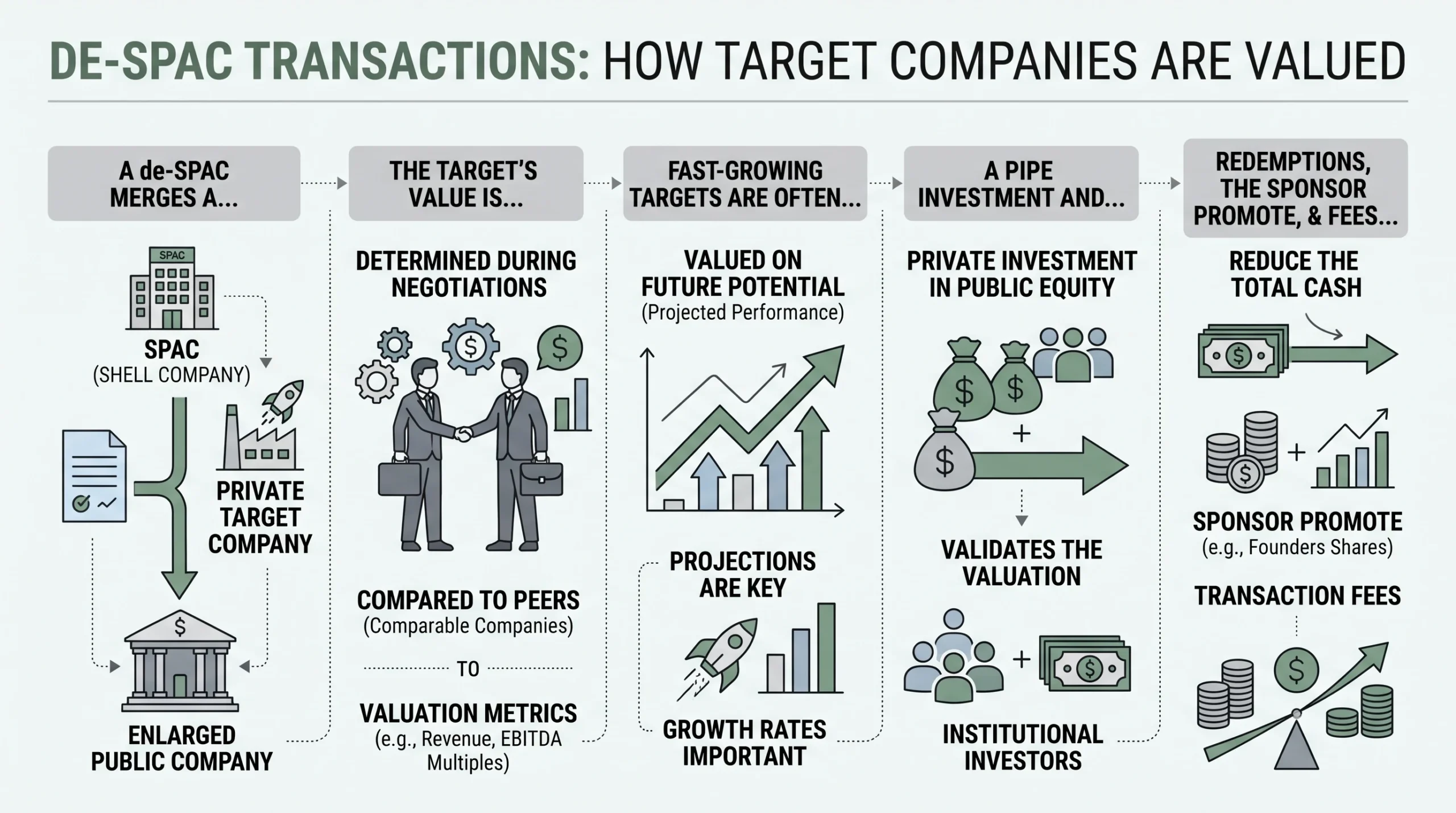
In a de-SPAC deal, the target company’s value is negotiated first, then supported by analysis. The sponsor and the target’s owners agree on an enterprise value that goes into the merger agreement. They back that number with a discounted cash flow model and comparable-company analysis, and for young, fast-growing targets they often use forward revenue multiples. A PIPE investment and a fairness opinion help confirm the price is fair. A de-SPAC takes a private company public through a merger with a listed cash shell rather than a standard IPO.
Sofer Advisors prepares independent valuation work for deals like these.
This guide explains how the value gets set, tested, and defended, and what happens to the numbers after the deal closes.
Key Takeaways
- A de-SPAC merges a private company with a listed cash shell to take it public.
- The target’s value is negotiated first, then supported by DCF and comparable-company analysis.
- Fast-growing targets are often priced on forward revenue multiples.
- A PIPE investment and a fairness opinion help confirm the price is fair.
- Redemptions, the sponsor promote, and warrants all shape the real value per share.
What is a de-SPAC transaction?
A SPAC is a shell company. It holds cash and little else. It raises money in its own IPO. Then it hunts for a private company to buy. When it finds one, the two merge. That merger is the de-SPAC.
The private company is the target. After the deal, it takes the SPAC’s place on the exchange. Its owners receive public stock. The cash held in the SPAC trust helps fund the deal. The target can also raise fresh money at the same time.
This path moves faster than a standard IPO. It also lets the target share its growth plans with investors. That appeal drove a boom in these deals in 2020 and 2021. The market then cooled sharply. In 2024, the SEC adopted new rules that tightened disclosure for these deals.
How is the target’s value set?
The value is negotiated. The sponsor and the target’s owners agree on a number. That number is usually the enterprise value. It reflects the whole business, not just its equity. The agreed figure then goes into the merger agreement.
Negotiation does not mean guesswork. Both sides bring analysis to the table. They study the target’s cash flow, growth, and risk. They look at what similar public companies are worth. They also weigh prices paid in past deals. The final number has to hold up to that evidence.
A PIPE often supports the price. PIPE stands for private investment in public equity. Large investors buy stock in the deal at a set price. Their willingness to pay is a strong signal. It tells the wider market that the valuation is credible.
The agreed value also reflects the leverage in the room. A target with steady revenue and real profit can push for a firmer price. A target that is still burning cash has less room to argue. The quality of the forecast, the strength of the market, and the appetite of PIPE investors all feed into the final figure.
What valuation methods are used?
Analysts lean on a few core methods. The first is discounted cash flow, or DCF. It projects the target’s future cash and brings it back to today’s value. The second is comparable-company analysis. It prices the target against similar public firms. The third is comparable-transaction analysis. It looks at what buyers paid for similar companies.
Many targets are young, fast-growing firms. Some earn little profit yet. For these, analysts often use forward revenue multiples. They take expected future revenue and apply a market multiple. This fits companies whose value lies ahead of them.
No single method rules. Each one gives a different view. A DCF rewards a strong long-term plan. Comparables anchor the value to the current market. Analysts weigh the methods together. The goal is a value range that makes sense from every angle.
How do projections shape the value?
Projections carry a lot of weight in these deals. Many targets lack a long track record. So their value rests on what they expect to earn. The forecast drives the DCF. It also drives the revenue multiple.
This is where risk creeps in. A rosy forecast can inflate the price. Regulators know this. The SEC has pushed for more careful disclosure of these forecasts. A sound projection ties to real data. It rests on market size, past results, and clear assumptions.
Careful analysts test the forecast. They ask whether the growth is realistic. They compare it against peers. They run more than one scenario. A value that only works in the best case is a weak value. A value that holds across a range is far stronger.
Clear documentation matters as much as the math. The report should spell out each assumption and the reason behind it. It should show how the value moves when a key input changes. That paper trail is what helps the number survive later review by auditors, investors, or a court.
What is a fairness opinion?
A fairness opinion is an independent check. An outside expert reviews the deal terms. The expert then states whether the price is fair to shareholders from a financial point of view. The opinion does not say the deal is wise. It speaks only to the numbers.
Boards use these opinions to support their decisions. A board has a duty to act in the shareholders’ interest. A fairness opinion shows the board did its homework. It gives written proof that an expert reviewed the terms. That record helps if shareholders later question the deal.
How do redemptions and dilution affect the deal?
SPAC shareholders have a right to redeem. They can hand back their shares for cash before the merger closes. Many choose to do so. When redemptions run high, the cash in the trust shrinks. That leaves less money for the target. A PIPE can fill some of the gap.
Dilution is the other pressure. The sponsor earns a reward called the promote. It is commonly about 20% of the shares from the SPAC’s IPO. Warrants add more dilution. They let holders buy stock later at a set price. The promote and the warrants both spread value across more shares. That lowers the value each share holds.
A sound valuation accounts for all of this. It looks past the headline price. It asks how much cash will actually arrive. It asks how many shares will exist once the deal is done. Those answers shape the true value per share.
What happens to the valuation after the merger?
The work does not stop at closing. The new public company must report its finances. Accounting rules require a purchase price allocation. ASC 805 sets out those rules. The company assigns value to the assets it acquired. That includes intangible assets like brands and technology.
Some items need special care. SPAC warrants often must be carried as liabilities. Earnout shares, which pay out only if targets are met, also need a value. Both use option-pricing models. The new company has to get these figures right. Auditors and the SEC will review them.
The purchase price allocation can reshape future earnings. Intangible assets are amortized over time. That charge flows through the income statement for years. Goodwill does not get amortized, but it must be tested for impairment. A weak first year as a public company can trigger that test. So the valuation work done at closing echoes well beyond the deal date.
How does a de-SPAC compare to a traditional IPO?
Both routes end in a public listing. The path differs. A traditional IPO sells new shares to the public. Bankers build demand through a roadshow. The open market sets the price. A de-SPAC skips that step. The target merges with a shell that is already public. The price comes from negotiation instead.
The table below sums up the main differences.
| Factor | Traditional IPO | De-SPAC Transaction |
|---|---|---|
| Pricing | Set by investor demand in a roadshow | Negotiated between the sponsor and the target |
| Speed | Longer, step-by-step process | Faster, merger-based path |
| Projections | Rarely shared with the public | Often central to the deal |
| Fairness opinion | Usually not used | Often used to support the board |
Neither path removes the need for careful valuation. A de-SPAC is quicker. It is not any looser. The price still has to stand up to the SEC and to investors. That is why solid analysis matters on both routes.
Frequently Asked Questions
What does de-SPAC mean?
It means the moment a SPAC merges with a private company. The SPAC starts as a cash shell on the stock exchange. The de-SPAC is the merger that fills that shell with a real operating business. The target becomes public as a result.
Who decides the target’s valuation in a de-SPAC?
The SPAC sponsor and the target’s owners decide it together. They negotiate the enterprise value and write it into the merger agreement. Outside analysis supports that number. The agreed price still has to satisfy regulators and investors.
What is a PIPE and why does it matter?
PIPE stands for private investment in public equity. Large investors buy stock in the deal at a set price. Their money helps fund the merger. Their price also acts as a check on the valuation. If serious investors pay it, the number looks more credible.
What is the sponsor promote?
The promote is the sponsor’s reward for forming the SPAC. It is commonly about 20% of the shares created in the SPAC’s IPO. The promote dilutes other shareholders. A careful valuation counts that dilution when it measures value per share.
Why do redemptions matter for the valuation?
SPAC shareholders can redeem their shares for cash before the merger closes. High redemptions drain the trust. That leaves less cash for the target to use. A deal may lean on a PIPE to make up the shortfall.
Do de-SPAC deals use a fairness opinion?
They often do. The target’s board may obtain one to support its decision. The opinion confirms the price is fair to shareholders from a financial view. It also gives the board a record of expert review.
How are SPAC warrants valued after the merger?
Warrants let holders buy stock later at a set price. After the deal, they often must be carried as liabilities. Analysts value them with option-pricing models. Those models weigh factors like the share price, the strike price, and time.
Is a de-SPAC faster than a traditional IPO?
Usually, yes. A de-SPAC merges with a shell that is already public, so it can move more quickly. A traditional IPO runs a longer registration and roadshow process. Speed does not lower the bar for valuation work.
What valuation methods apply to a de-SPAC target?
The main tools are DCF, comparable-company analysis, and comparable-transaction analysis. Fast-growing targets may also be priced on forward revenue multiples. Analysts usually blend these methods. The result is a range rather than one fixed figure. A single method rarely tells the whole story on its own.
Related Case Studies
- How Vertical SaaS Companies Are Valued: ARR Multiples by Niche
- Technology Company Valuation Atlanta: Guide for Startups and Growth Companies
- Valuation Timing
Executive Summary
A de-SPAC merges a private company with a listed cash shell to take it public. The target’s value is negotiated first, then supported by DCF and comparable-company analysis. Fast-growing targets are often priced on forward revenue multiples. A PIPE investment and a fairness opinion help confirm the price is fair. Redemptions, the sponsor promote, and warrants all shape the real value per share.
What Should You Do Next?
If you are weighing a de-SPAC, start with a clear, defensible view of your own value. Sofer Advisors prepares independent valuations and fairness opinions for these deals, led by David Hern CPA ABV ASA CVA. Schedule a free consultation to discuss your situation.
People Also Read
About the Author
This guide was prepared by David Hern CPA ABV ASA CVA, founder of Sofer Advisors, a business valuation firm headquartered in Atlanta, GA serving clients across the United States. David holds accreditations as an Accredited Senior Appraiser (ASA) and is Accredited in Business Valuation (ABV), credentials recognized by the IRS, SEC, and FINRA, and is also a Certified Valuation Analyst (CVA). David has served as an expert witness in dozens of cases across multiple jurisdictions, and Sofer Advisors is an Inc. 5000 honoree in 2024 and 2025 with 240+ five-star Google reviews.
For professional business valuation services, visit soferadvisors.com/about-us/ or contact Sofer Advisors at soferadvisors.com/contact-us/.
Disclaimer: This content is for informational purposes only and does not constitute professional valuation advice. Business valuation conclusions depend on specific facts and circumstances. Contact Sofer Advisors for guidance regarding your specific situation.