


Last Updated: November 2026
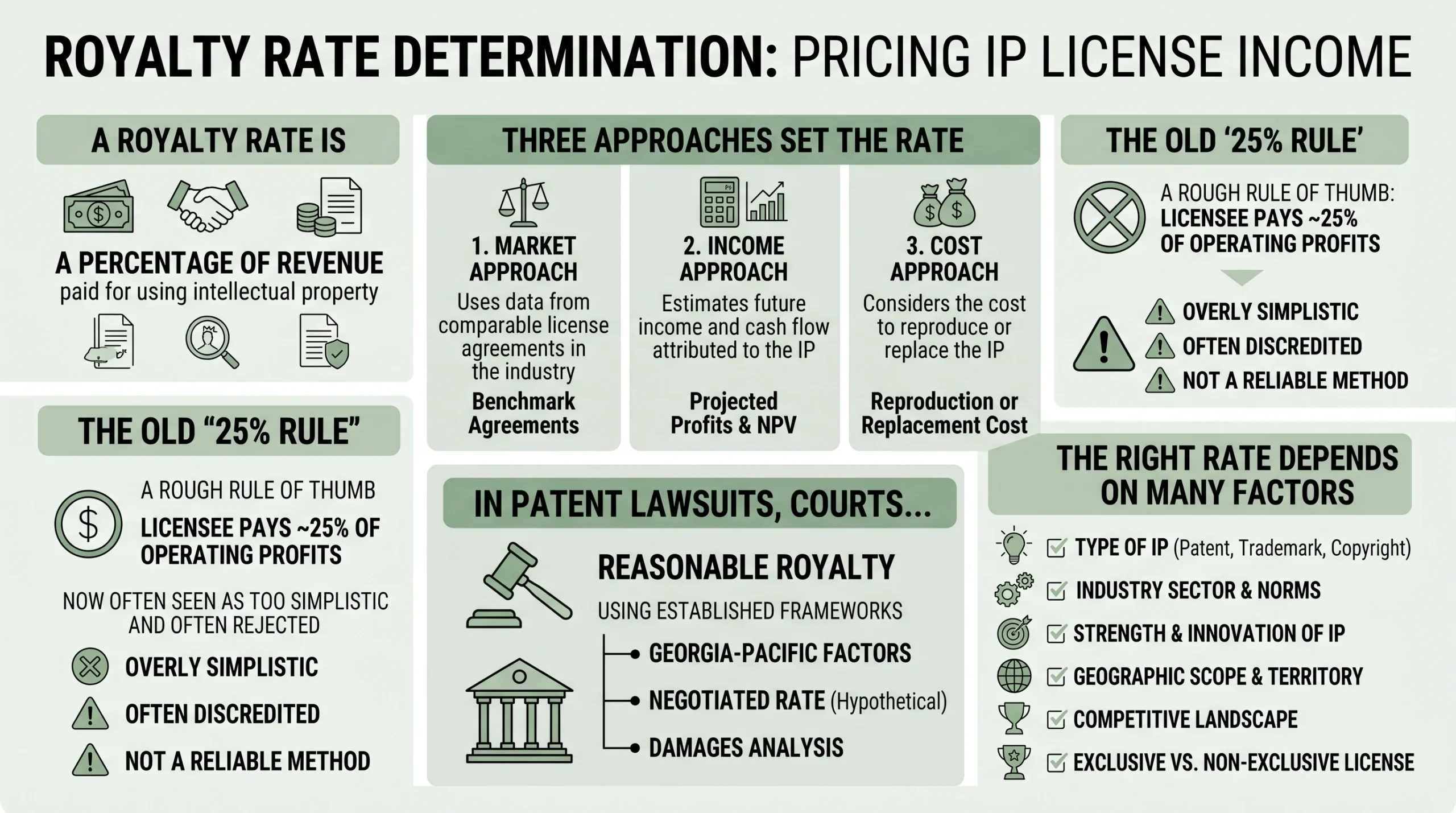
A royalty rate is the price of using someone else’s intellectual property, usually set as a share of revenue. Analysts set it with three approaches: the market, income, and cost approaches. The market approach, which studies comparable license deals, is the most direct. The right rate depends on the deal terms, including the royalty base, exclusivity, territory, and length. The old 25 percent rule of thumb is discredited and was rejected by a federal appeals court in 2011, and patent courts instead weigh the 15 Georgia-Pacific factors to judge a reasonable royalty.
Sofer Advisors builds these analyses for business owners, CPAs, and attorneys.
This guide explains the main methods, the key terms, and one old rule that courts no longer accept.
Key Takeaways
- A royalty rate is the price paid to use intellectual property, usually a share of revenue.
- Three approaches set the rate: the market, income, and cost approaches.
- The old “25% rule of thumb” is discredited and was rejected by a federal appeals court in 2011.
- In patent lawsuits, courts weigh the 15 Georgia-Pacific factors to judge a reasonable royalty.
- The right rate depends on the deal terms, such as the base, exclusivity, territory, and length.
What is the royalty base versus the royalty rate?
A royalty has two parts: the rate and the base. The rate is a percentage, such as a share of sales. The base is the dollar figure that the rate applies to. The payment is the rate times the base. Both must be defined clearly, or the deal invites disputes.
The base is often net sales of the licensed product. Sometimes it is gross sales, units sold, or profit. A clear base keeps each side honest. Many fights over royalties are really fights over the base, not the rate.
Deals also differ in how they pay. A running royalty pays a share of sales over time. A lump-sum royalty pays one fixed amount up front. A running royalty tracks real use. A lump sum gives certainty but shifts more risk onto the payer.
Exclusivity shapes the price too. An exclusive license gives one party the sole right to use the IP. A non-exclusive license lets the owner sign many users. Exclusive rights usually cost more, because they lock out rivals. Territory and term work in the same way.
What makes a royalty rate higher or lower?
No two IP assets are worth the same. A few traits tend to push the rate up or down. The strength of the IP comes first. A broad, well-protected patent earns more than a weak one. A trusted brand earns more than an unknown one.
The economics of the product matter too. If the IP drives a large share of the profit, the rate climbs. If it plays a minor role, the rate falls. A high-margin product can support a richer royalty than a thin one.
The deal terms also move the number. Exclusive rights, a wide territory, and a long term all raise the price. Narrow or shared rights lower it. Market conditions and competition round out the picture. A careful analyst weighs all of these together rather than trusting a single rule.
How does the market approach set a rate?
The market approach looks at what others pay. It studies comparable license agreements for similar IP. If real deals exist, they are strong evidence of a fair rate. This is the most direct way to set a royalty.
Analysts find these deals in royalty-rate databases. Services such as ktMINE and RoyaltyStat collect licensing terms from public filings and contracts. They let an analyst screen for deals in the same industry and asset type. Good comparables share the subject’s key traits.
No two licenses match exactly. So the analyst adjusts for the gaps. Differences in exclusivity, territory, term, and IP strength all change the rate. The aim is an apples-to-apples view. The result is a defensible range, not a single magic number.
How does the income approach set a rate?
The income approach ties the rate to the money the IP earns. It asks how much profit the asset helps create. Then it splits that profit in a fair way between owner and user. Two methods are common.
The first is a profit-split analysis. The analyst estimates the profit the licensed IP drives. The owner and the user each contribute something to that profit. The rate should reflect how much the IP itself adds. The split follows the value each side brings.
The second is the relief-from-royalty method. It is widely used in valuation. The idea is simple. If you own the IP, you avoid paying to license it. That avoided payment is a benefit. The method values the IP from the royalties you no longer owe. It leans on a market rate as its starting point.
Here is an illustrative example. Say a product earns $2,000,000 in sales each year. A market rate for similar IP points to a 5% royalty. The relief-from-royalty figure would be about $100,000 a year, before tax and discounting. The numbers are illustrative only. The steps stay the same in a real engagement.
When is the cost approach used?
The cost approach asks what it would cost to recreate the IP. It adds up the money to build a similar asset from scratch. That includes design, testing, and legal work. The total hints at a floor for value.
This approach is rarely the primary method for a royalty. Cost does not always track the money the IP can earn. A cheap patent can be worth a fortune. An expensive one can be worth little. Analysts mostly use cost as a cross-check, not the lead.
What was the 25% rule, and why is it rejected?
The “25% rule of thumb” was once a popular shortcut. It said the licensor should get about one quarter of the licensee’s profit from the IP. The user kept the other three quarters. It was quick, and it felt fair.
The rule is now discredited. Its flaw is that it ignores the facts of each case. It uses the same fraction for every asset, every industry, and every deal. Real royalty rates do not work that way. A rule of thumb is not evidence.
In 2011, the U.S. Court of Appeals for the Federal Circuit rejected it outright. The case was Uniloc USA v. Microsoft. The court held the 25% rule was not a reasonable method for figuring patent damages. Treat the rule as history, not practice. Modern work rests on comparable deals and real economics.
What are the Georgia-Pacific factors?
Patent lawsuits often turn on a “reasonable royalty.” This is the rate the parties would have agreed on in a fair negotiation. Courts need a structured way to estimate it. In the United States, they use the Georgia-Pacific factors.
The factors come from a 1970 federal court case, Georgia-Pacific Corp. v. United States Plywood Corp. The decision listed 15 factors a court can weigh. They include past royalties for the patent, rates for similar patents, and whether the license is exclusive. They also cover the territory, the term, and the profit the invention drives.
No single factor decides the rate. The court weighs them together for the specific patent. Valuation experts use the same framework to support an opinion. It keeps the analysis grounded in facts, not guesswork.
How do the approaches compare?
Each approach answers the question from a different angle. The table below shows the common choices. In many engagements, an analyst uses more than one and checks whether the results agree.
| Approach | What it looks at | Best used when |
|---|---|---|
| Market | Comparable license agreements and royalty databases | Similar, real licenses exist |
| Income | Profit split or relief from royalty on expected earnings | Future cash flow can be forecast |
| Cost | The expense to recreate the IP | Little market or income data exists |
The market approach is strong when good comparables exist. The income approach fits when you can forecast what the IP will earn. The cost approach serves as a backstop. The best choice depends on the asset, the data, and the purpose of the report.
Frequently Asked Questions
How are royalty rates determined?
A royalty rate is set by studying the IP and the deal. Analysts look at comparable license agreements for similar assets. They also model the profit the IP helps earn. Then they adjust for terms like exclusivity, territory, and length. The result is a rate that evidence can support.
What is the royalty base?
The base is the dollar figure the rate is applied to. It is often net sales of the licensed product. It can also be gross sales, units, or profit. The royalty payment is the rate times the base. A clear base prevents most disputes.
What is the difference between a running royalty and a lump sum?
A running royalty pays a share of sales over the life of the deal. A lump-sum royalty pays one fixed amount up front. A running royalty tracks real use over time. A lump sum gives both sides more certainty but shifts risk.
Does an exclusive license cost more than a non-exclusive one?
Usually, yes. An exclusive license gives one party the sole right to use the IP. That shuts out competitors, so it tends to command a higher rate. A non-exclusive license lets the owner sign many users, which lowers the price each one pays.
Is the 25% rule still used?
No. The 25% rule was a shortcut that gave the licensor about a quarter of the profit. It ignores the facts of each deal. The U.S. Court of Appeals for the Federal Circuit rejected it in 2011 in Uniloc USA v. Microsoft. Analysts now rely on real data.
What is the relief-from-royalty method?
It values IP from the royalties an owner avoids paying. If you own the asset, you do not license it from anyone. That saved payment is a benefit. The method estimates a market rate, applies it to expected sales, and values the savings. It is common in valuation work.
What are the Georgia-Pacific factors?
They are 15 factors courts weigh to set a reasonable royalty in patent cases. They come from a 1970 decision, Georgia-Pacific Corp. v. United States Plywood Corp. The factors include past license rates, exclusivity, territory, and the profit the invention drives. Courts weigh them together.
Is a 20% royalty rate normal?
There is no single normal rate. The right number depends on the industry, the IP’s strength, and the deal terms. A rate that fits one license can be far too high or low for another. Reliable work compares real agreements rather than assuming a fixed percentage.
What documents help set a royalty rate?
Useful records include financial statements and any existing license agreements. Details on the IP, its history, and its legal protection also help. Information on the licensee’s sales and margins rounds out the picture. Records of any past or related licenses help as well. Good records make the final rate much easier to defend.
Related Case Studies
- Discount Rate vs Capitalization Rate
- Cost Approach vs Income Approach: Complete Guide
- What Is a Capitalization Rate in Business Valuation?
Executive Summary
A royalty rate is the price paid to use intellectual property, usually a share of revenue. The market, income, and cost approaches. The old “25% rule of thumb” is discredited and was rejected by a federal appeals court in 2011. In patent lawsuits, courts weigh the 15 Georgia-Pacific factors to judge a reasonable royalty. The right rate depends on the deal terms, such as the base, exclusivity, territory, and length.
What Should You Do Next?
Start by listing the IP you plan to license and the terms you want, then gather comparable deals and a simple profit forecast. For a formal, independent opinion, Sofer Advisors provides IP and royalty valuations led by David Hern CPA ABV ASA CVA. Schedule a free consultation to discuss your situation.
People Also Read
About the Author
This guide was prepared by David Hern CPA ABV ASA CVA, founder of Sofer Advisors, a business valuation firm headquartered in Atlanta, GA serving clients across the United States. David holds accreditations as an Accredited Senior Appraiser (ASA) and is Accredited in Business Valuation (ABV), credentials recognized by the IRS, SEC, and FINRA, and is also a Certified Valuation Analyst (CVA). David has served as an expert witness in dozens of cases across multiple jurisdictions, and Sofer Advisors is an Inc. 5000 honoree in 2024 and 2025 with 240+ five-star Google reviews.
For professional business valuation services, visit soferadvisors.com/about-us/ or contact Sofer Advisors at soferadvisors.com/contact-us/.
Disclaimer: This content is for informational purposes only and does not constitute professional valuation advice. Business valuation conclusions depend on specific facts and circumstances. Contact Sofer Advisors for guidance regarding your specific situation.









