


Last Updated: September 2026
Under IRC Section 2703, the price in your buy-sell agreement sets the estate tax value of your business only if the agreement passes three specific tests. If it fails, the IRS ignores your contract price and taxes the estate on the full fair market value instead. That gap matters because the federal estate tax reaches up to 40% of value above the exemption.
Many owners assume a signed buy-sell agreement settles the value question forever. It does not. Section 2703 sits inside Chapter 14 of the tax code, a set of rules built to stop families from using private contracts to lower a taxable business value. Knowing how the rule works separates a defensible plan from a costly surprise at death.
Sofer Advisors provides neutral, independent business valuation services that help owners set a price the IRS will respect. With 180+ five-star Google reviews and a full W2 employee team, it pairs technical valuation work with the tax standards that govern these agreements.
Key Takeaways
- Section 2703 can void your price: the IRS may disregard a buy-sell price and tax the estate on full fair market value.
- Three tests decide it: the agreement must be a bona fide business arrangement, not a family transfer device, and comparable to arm’s-length terms.
- Fixed prices are risky: a number set years ago rarely reflects current value and often fails the comparability test.
- The tax gap is real: heirs can owe tax on a high IRS value while the sale pays out a much lower contract price.
- Independent appraisals help: a periodic valuation by a credentialed appraiser gives the price a defensible, market-based record.
These points shape whether your agreement protects your estate or exposes it. The sections below cover the rule, the three tests, why fixed prices fall short, and how to build an agreement that holds up.
What does IRC Section 2703 do to a buy-sell price?
IRC Section 2703 lets the IRS ignore the price in a buy-sell agreement and tax the estate on full fair market value instead. The rule stops owners from using a private contract to lock in a low value for family members. It applies to agreements, options, and restrictions that limit how an owner can sell a business interest. The price only holds for estate tax if the agreement clears the three tests in Section 2703(b).
The general rule in Section 2703(a) is blunt. For estate and gift tax, the government values property as if the restrictive agreement did not exist. That default flips only when the agreement meets every part of the safe harbor. You can read the full statute text of IRC Section 2703 to see how the two parts fit together. Because the rule targets transfers within a family, agreements among unrelated owners face lighter scrutiny.
What three tests must a buy-sell agreement pass?
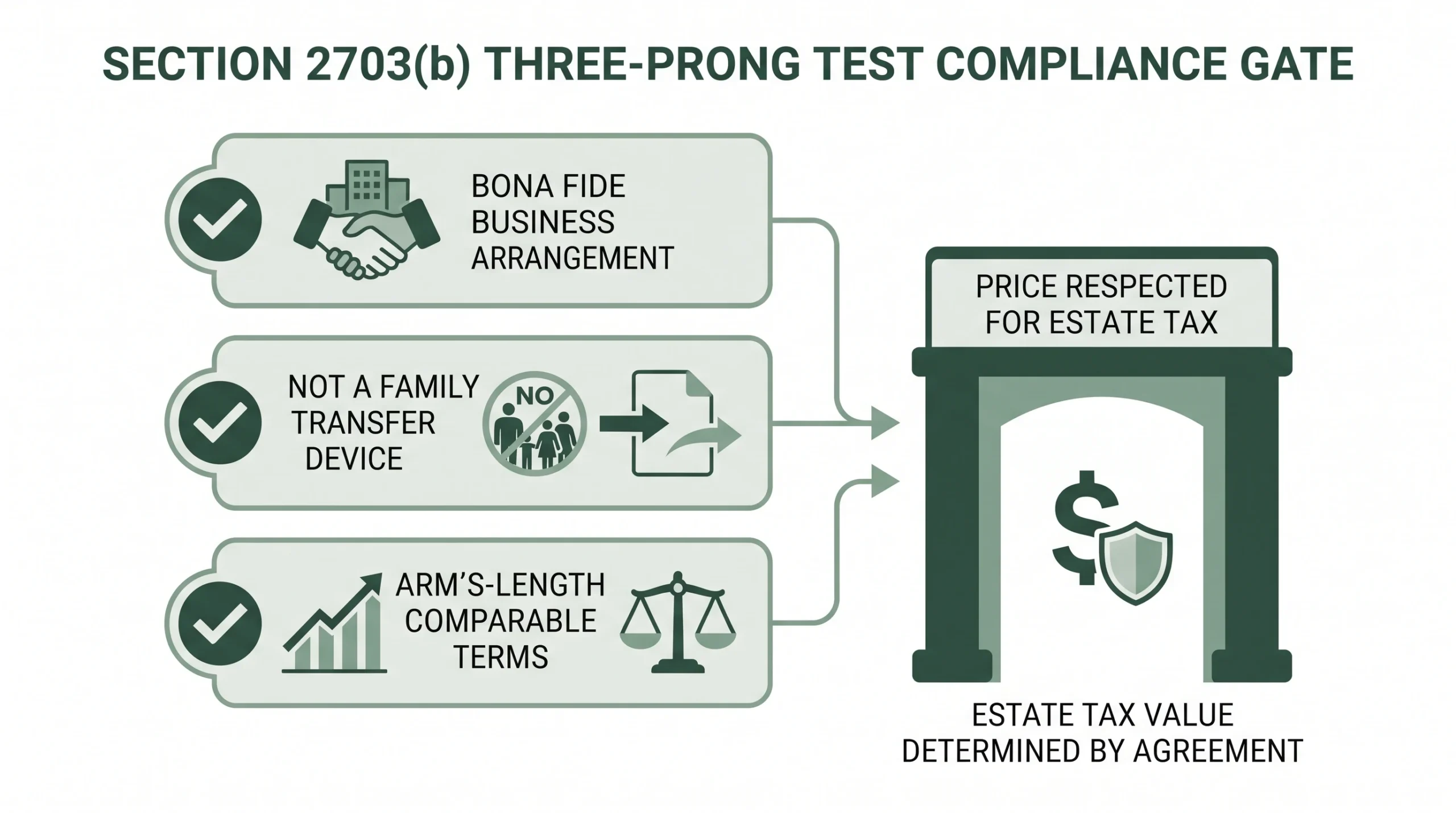
A buy-sell agreement passes Section 2703(b) only when it meets all three of these tests at the same time:
- Bona fide business arrangement: the agreement serves a real business purpose, such as keeping ownership stable or blocking outside parties.
- Not a family transfer device: it is not a way to pass value to heirs for less than full and adequate consideration.
- Comparable to arm’s-length terms: the price and terms match what unrelated parties would agree to in an open market.
All three must be true; meeting two is not enough. The first test is usually easy, since most agreements serve continuity goals. The third is where many break down, because proving arm’s-length terms takes real market evidence. This is why a formal opinion of fair market value carries weight, converting a bare contract price into a supported conclusion.
Why do fixed-price buy-sell agreements fail?
Fixed-price buy-sell agreements fail because a stale number rarely matches fair market value years later. Two unrelated parties in an arm’s-length deal would never agree today to a price set a decade ago. When a business grows, that old figure quietly turns into a way to move value to heirs below market.
Simple formulas carry the same flaw. A fixed book-value clause or a rigid multiple can drift far from real worth as the business changes. If the formula produces a number well below current value, the IRS can treat the agreement as a device rather than a genuine business deal. Without a process that tracks current value, these agreements often fall short.
Can a buy-sell agreement still set your estate tax value?
Yes, a buy-sell agreement can still set your estate tax value when it is built to pass all three Section 2703 tests. The key is to drop the stale price and instead require a process that produces a fair market value result. An agreement that calls for a periodic independent appraisal by a qualified appraiser creates a market-based record. That record satisfies the comparability test.
This approach mirrors how unrelated parties actually behave. Before a real sale, a careful buyer or seller seeks an objective, third-party opinion of value. Tying the purchase price to a formal report shows the terms are fair and current. It also moves the document away from looking like a testamentary device and toward a true business arrangement.
What happens if the IRS disregards your agreement?
If the IRS disregards your agreement, it substitutes its own fair market value and taxes the estate on that higher figure. The danger is sharpest when an owner is bound to sell shares at a low contract price. The estate receives the low cash amount but owes tax on the larger IRS value. That mismatch can drain liquidity fast.
Under the 2025 tax law, the federal estate tax exemption is a permanent $15 million per person and $30 million for a married couple, with no scheduled sunset. Even with that larger shield, a growing business can push an estate over the line, and heirs may face a bill they cannot pay without selling the company. A defensible valuation up front is the cleanest way to avoid that trap. Our guide to fair market value for estate tax explains how the reporting value is built and defended.
How do you make a buy-sell agreement defensible?
You make a buy-sell agreement defensible by tying its price to a periodic, independent appraisal from a credentialed valuation professional. A neutral expert holding ABV or ASA accreditation can set the price at fair market value and document the method. That directly answers the arm’s-length test. It also gives the estate a clear trail if the IRS asks how the number was reached.
Large firms such as Alvarez & Marsal, Stout, and Kroll handle valuation work for the biggest deals, while independent specialists serve middle-market owners who need senior-level attention on every file. The table below compares three common paths to a buy-sell price.
| Approach | How the price is set | IRS scrutiny risk | Estate tax outcome |
| Fixed price or book-value formula | A number or clause set years ago and rarely updated | High; often disregarded under Section 2703 | Tax may be based on a higher IRS value than the sale price |
| Independent appraisal | Periodic fair market value opinion by a credentialed appraiser | Low; supports the arm’s-length test with market evidence | The agreement price is far more likely to be respected |
| Legal drafting counsel | Attorney writes clauses that mandate a compliant valuation | Low; focuses on enforceability and tax compliance | Legal framework supports the intended tax result |
The strongest plans use both an appraiser and an attorney. The valuation sets a supportable number, and counsel embeds the clause into the operating agreement or bylaws. Sofer Advisors follows The Sofer Difference, a four-phase path of Discovery, Diligence, Analysis, and Delivery, and brings a Heart of a Teacher to each engagement, walking owners through the standards behind the number. That method draws on IRS Revenue Ruling 59-60 and USPAP so the conclusion holds up in an audit.
Frequently Asked Questions
What is Section 2703?
IRC Section 2703 is a federal tax rule inside Chapter 14 that governs whether a value set in an agreement will be respected for estate and gift tax. It lets the IRS disregard certain restrictive options, agreements, or restrictions that do not meet strict safe harbor tests. In practice, it means a buy-sell price only fixes the taxable value when the underlying agreement clears all three of the statute’s requirements.
What are the disadvantages of a buy-sell agreement?
A key disadvantage is the risk that an outdated pricing formula creates an estate tax liability. If the contract price falls well below actual fair market value, the estate may owe tax on the higher IRS figure while receiving less cash from the sale. Agreements can also grow stale, restrict an owner’s flexibility, and require funding through life insurance or reserves, which adds cost and planning complexity.
How is a buy-sell price respected for estate tax?
A buy-sell price is respected for estate tax only when the agreement satisfies the safe harbor in IRC Section 2703(b). The arrangement must be a bona fide business deal, not a device to pass value to family for less than full consideration, and comparable to terms unrelated parties would accept. A formal, independent valuation gives the estate a defensible basis for the reported value and supports each of these tests.
Does a buy-sell agreement set estate value?
A buy-sell agreement fixes estate value only if it meets the tests in federal tax law and reflects true fair market value. When it fails those tests, the IRS can ignore the contract price and substitute its own determination of value. That is why the pricing clause matters so much. An agreement built around a periodic appraisal is far more likely to control the taxable value than one that relies on a stale number.
How much does a tax and estate valuation cost?
A tax and estate valuation from Sofer Advisors generally ranges from $7,500 to $25,000, depending on the complexity of the business and the timeline for the work. The fee covers the analysis, documentation, and support of the value against a potential IRS challenge. For a quote tied to your agreement, contact us with your financials.
What is a bona fide business arrangement under Section 2703?
A bona fide business arrangement is an agreement entered into for a genuine business purpose rather than tax avoidance. Common purposes include keeping ownership within active partners, ensuring continuity, or preventing shares from reaching competitors or outside parties. This is the first of the three Section 2703 tests. It is usually the easiest to meet, since most buy-sell agreements do serve a legitimate continuity or control goal for the company.
How often should a buy-sell valuation be updated?
A buy-sell valuation should be refreshed at regular intervals, often every one to two years, or whenever a major triggering event occurs. Regular updates prevent stale pricing that can invite IRS scrutiny and fail the comparability test. Many owners pair an annual review with a fresh independent appraisal when the business changes size or direction. Keeping the value current is one of the simplest ways to protect the agreement.
Can a formula price satisfy Section 2703?
A formula price can satisfy Section 2703 if it consistently produces a result near fair market value at the time of a triggering event. A formula tied to current earnings and tested against market data has a chance to hold. An arbitrary or rigid formula that drifts below true value is likely to be disregarded. The safer route is to require a periodic independent appraisal rather than to rely on a fixed formula alone.
Are family-only buy-sell agreements treated differently?
Yes, agreements among family members face higher scrutiny under Section 2703. The IRS more closely examines whether the deal is a device to shift wealth for less than full and adequate consideration. To overcome that presumption, the terms must be shown to match arm’s-length arrangements between unrelated parties. Independent valuation evidence is often the strongest support for a family agreement, giving it a defensible, market-based foundation.
Related Case Studies
- Chapter 14 Rules: How IRC 2701 and 2703 Affect Family Transfers
- How Is a Buy-Sell Agreement Funded with Life Insurance?
- Valuation Discounts (DLOC and DLOM) on Estate and Gift Tax Returns
Executive Summary
IRC Section 2703 decides whether a buy-sell price controls estate tax value. The default rule lets the IRS ignore the contract price and tax the estate on full fair market value. The price holds only when the agreement clears three tests: a bona fide business arrangement, not a family transfer device, and terms comparable to arm’s-length deals. Fixed prices and rigid formulas often fail, leaving heirs taxed on more than the sale delivers. The most defensible fix is a periodic independent appraisal built into the agreement, supported by USPAP and IRS Revenue Ruling 59-60.
What Should You Do Next?
Pull your current buy-sell agreement and check how it sets the price. If it relies on a fixed number or an old formula, flag it for your tax and legal team. Then amend the agreement to require a periodic, independent appraisal at fair market value, and calendar a refresh every one to two years. That process builds the market-based record Section 2703 rewards and helps prevent a liquidity crunch at death.
David Hern CPA ABV ASA, founder of Sofer Advisors, works with owners and their advisors to align buy-sell pricing with current tax rules. Schedule a consultation to discuss your specific situation.
People Also Read
- Buy Sell Agreement vs Shareholder Agreement: Key Differences
- Fair Market Value for Estate Tax: What Executors Need
About the Author
This guide was prepared by David Hern, CPA, ABV ASA, founder of Sofer Advisors, a business valuation firm headquartered in Atlanta, GA, serving clients across the United States. David holds dual accreditations as an Accredited Senior Appraiser (ASA) and is Accredited in Business Valuation (ABV), credentials recognized by the IRS, SEC, and FINRA. He also holds the Certified Exit Planning Advisor (CEPA) designation. With 15+ years of valuation experience, David has served as an expert witness in 11+ cases across multiple jurisdictions and built Sofer Advisors into an Inc. 5000-recognized firm with 180+ five-star Google reviews. Its full W2 employee team maintains subscriptions to all major valuation databases and operates under a next business day response policy.
For professional business valuation services, visit soferadvisors.com/about-us/ or contact Sofer Advisors at soferadvisors.com/contact-us/.
Disclaimer: This content is for informational purposes only and does not constitute professional valuation advice. Business valuation conclusions depend on specific facts and circumstances. Contact Sofer Advisors for guidance regarding your specific situation.









