


Last Updated: November 2026
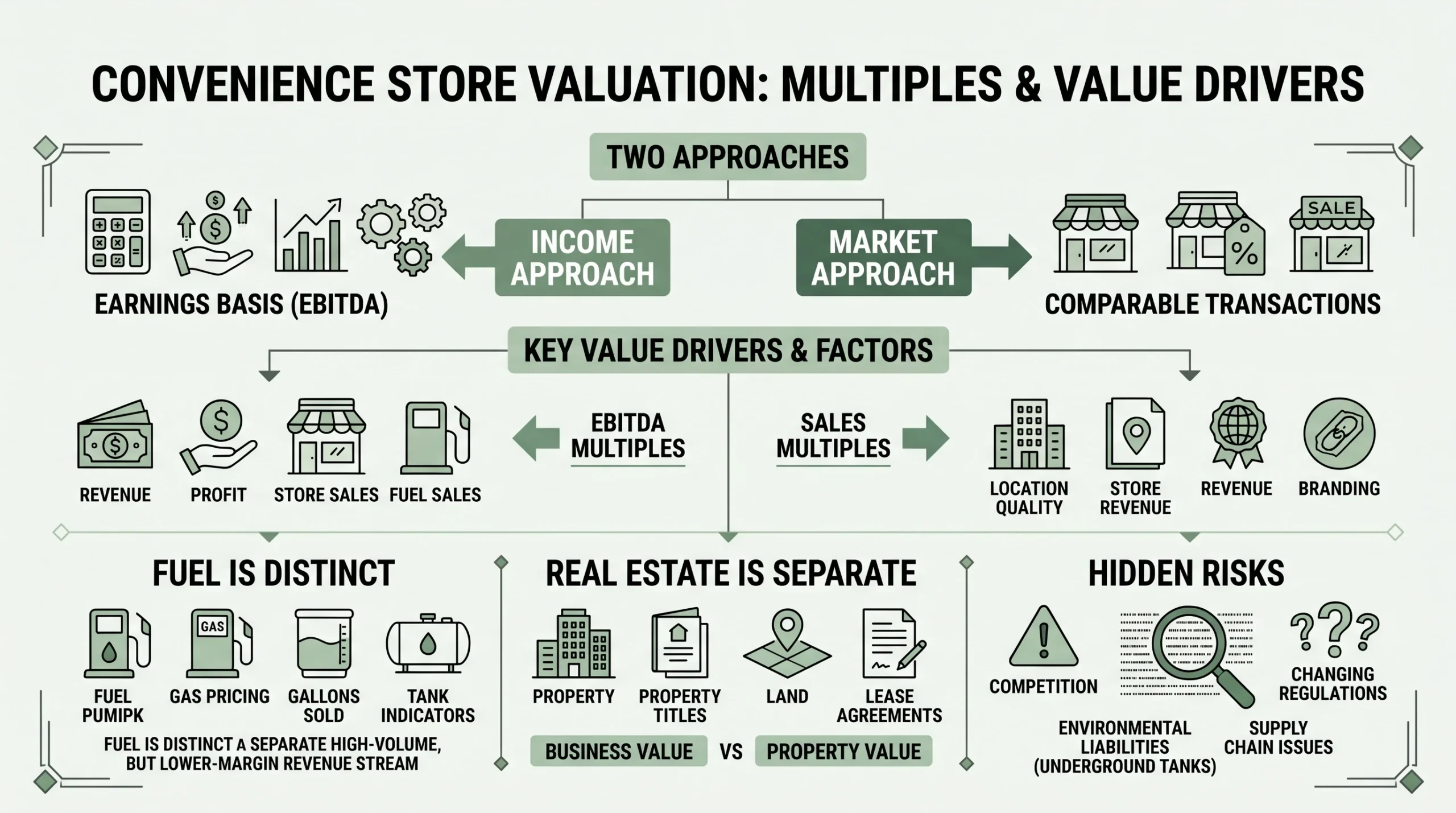
A convenience store is valued as a business, mostly on its earnings. Appraisers use the income approach, applying a market multiple to normalized earnings, and check the result against the market approach, which looks at what similar stores sold for. Smaller owner-run stores are valued on Seller’s Discretionary Earnings, while larger operators are valued on EBITDA. Fuel is weighed apart from in-store sales, because it moves high volume at thin margins.
The team at Sofer Advisors values convenience stores and gas stations for owners across the country.
This guide covers the methods, the main value drivers, and the hidden risks, including the land under the store and its underground fuel tanks.
Key Takeaways
- Two approaches: Appraisers value c-stores with the income approach and the market approach.
- Earnings basis: Smaller owner-run stores are valued on SDE, while larger operators use EBITDA.
- Fuel is distinct: Fuel is high-volume and low-margin, so it is weighed apart from in-store sales.
- Real estate is separate: Owned land is usually valued on its own, apart from the business.
- Hidden risk: Buried fuel tanks carry cleanup and compliance risk that can pull value down.
How are convenience stores valued?
Most appraisers value a convenience store with the income approach and the market approach. The income approach starts with normalized earnings. It then applies a market multiple to turn those earnings into a value. The market approach looks at what similar stores sold for. An appraiser often uses both and checks that the results agree.
Normalized earnings matter here. An appraiser adjusts the books to show true operating profit. They remove owner perks, one-time costs, and non-business expenses. This gives a clean earnings figure. That figure drives the whole valuation, so the cleanup step is key.
The right method also depends on why you need the value. A sale, a tax filing, and a partner dispute can each call for a different standard of value. An appraiser sets that standard first. The chosen approach then has to fit it. This keeps the final number useful for its real purpose.
What multiples apply to a convenience store?
The earnings base depends on the size of the store. Small, owner-run stores are usually valued on Seller’s Discretionary Earnings, or SDE. SDE shows the full benefit to one working owner. Larger or multi-store operators are valued on EBITDA. EBITDA reflects profit for an owner who does not work in the store.
Published multiples vary a lot by market, so treat any single number with care. Treat any figure here as illustrative only. A small store might trade at a low multiple of SDE. A larger operator might earn a higher EBITDA multiple. The real figure depends on earnings quality, location, lease terms, and risk. An appraiser sets the multiple from the facts of the store, not a rule of thumb.
Several things move the multiple up or down. Clean books and steady profit push it up. A strong, high-traffic site pushes it up too. Heavy reliance on thin fuel margins can pull it down. So can old equipment or a short lease. The multiple is a result of these facts, not a starting point.
| Measure | Typical use | What it reflects |
|---|---|---|
| SDE | Owner-operated single stores | The full benefit to one working owner |
| EBITDA | Larger or multi-store operators | Profit for an owner who does not work there |
How do fuel sales affect value?
Fuel and in-store sales are valued in different ways. Fuel moves high volume but earns thin margins. In-store goods and hot food sell less often but earn more per dollar. For this reason, appraisers weigh fuel apart from the rest of the store. They often track fuel by gallons sold and by the cents earned per gallon.
Fuel margins swing with the market. A good month can look very different from a weak one. An appraiser studies several periods to find a normal level. A single strong year should not set the whole value. Smoothing these swings keeps the result fair.
Supply terms matter too. A branded store buys fuel under a brand agreement. That brings support, signage, and a steady supply, but also rules and set prices. An unbranded store has more freedom and less backing. Each setup changes the risk, and risk changes the value.
What are the main value drivers?
Location sits at the top of the list. A busy corner with easy access brings steady traffic. Traffic brings fuel volume and store visits. Store size and layout matter as well. A larger store with a kitchen can sell high-margin food, which lifts value.
The sales mix is a core driver. A store that leans on hot food, coffee, and drinks tends to earn more than one that leans on fuel alone. Higher-margin goods lift the whole profit picture. That richer mix often supports a stronger multiple.
Brand and supply ties also play a part. So does labor. A store that runs on stable, trained staff carries less risk than one that cannot keep workers. Clean records and simple compliance help as well. Lower risk tends to mean a higher value.
How is the real estate handled?
Many convenience stores sit on land the owner also owns. In that case, an appraiser values the business and the real estate as separate pieces. The business value rests on earnings. The land value rests on the property market. Adding them gives the full picture.
Whether the owner owns or leases the site changes the math. An owned site removes rent from the books, so reported profit looks higher. An appraiser adds back a fair market rent before setting the business value. This keeps the earnings clean and avoids counting the land twice.
A leased site shifts focus to the lease. The rent, the length, and the renewal terms all matter. A short or costly lease raises risk for a buyer. A long, fair lease lowers it. The lease can lift or limit the value on its own.
Why do underground storage tanks matter?
Fuel is stored in tanks buried under the site. These underground storage tanks, or USTs, carry real risk. A leak can pollute soil and groundwater. Cleanup can cost a lot, and the law often puts that cost on the owner. A buyer will weigh this risk before setting a price.
Age and records tell the story. Newer tanks with good inspection records lower the worry. Old tanks with thin records raise it. Federal and state rules also require testing and leak detection. A store that keeps up with these rules looks safer to a buyer.
Buyers often order an environmental review before closing. The review checks the tanks, the soil, and the paperwork. An appraiser notes this risk because it can lower value or hold up a sale. In some deals, the issue is large enough to change the price.
How are inventory and equipment treated in a sale?
Equipment and inventory are handled in separate ways. Furniture, fixtures, and equipment, often called FF&E, stay inside the business value. The coolers, pumps, shelving, and kitchen gear all help earn the profit. So the earnings multiple already covers them. This avoids counting the same value twice.
The condition of that equipment still matters. New coolers and pumps need less repair soon. Old gear may need costly replacement. A buyer factors that into the offer. An appraiser notes the state of the key assets.
Sellable inventory is treated on its own. Stock on the shelves changes every day. For this reason, the parties count it just before closing. They value it at cost and add it to the price. The final number is the earnings-based business value plus the counted inventory.
Which valuation is reliable enough for taxes or a sale?
A formal, credentialed valuation is the most reliable choice for high-stakes needs. Online calculators give a fast guess from a few inputs. A broker gives a listing price aimed at a sale. Neither is built to survive close review. A formal report is.
The difference is depth and independence. A credentialed appraiser studies the real books and the real risks. The work follows set professional standards. The report then holds up with the IRS, courts, and lenders. For a tax filing, an estate plan, or a dispute, that rigor is what counts.
Match the level of work to the stakes. A quick estimate may be fine for a rough idea. A formal report makes sense when real money or taxes are on the line. The best choice depends on your goal and who will read the result.
Frequently Asked Questions
What approach is used to value a convenience store?
Appraisers mainly use the income approach and the market approach. The income approach applies a multiple to normalized earnings. The market approach compares the store to similar sales. The asset approach can set a floor value when earnings are weak.
What is SDE, and why does it matter for c-stores?
SDE stands for Seller’s Discretionary Earnings. It shows the full cash benefit to one working owner. Many convenience stores are small and owner-run. For these stores, SDE often reflects value better than net income does.
Why is fuel valued differently from in-store sales?
Fuel sells in high volume at thin margins. In-store goods sell in lower volume at higher margins. Mixing them under one multiple would distort the value. So appraisers weigh fuel apart, often by gallons and cents per gallon.
Does owning the real estate raise the value?
Owning the site can raise the total deal value. The buyer gets both the business and the land. An appraiser values the two parts on their own. Rent is added back as a fair market cost so the earnings stay clean.
How do underground storage tanks affect value?
Buried fuel tanks carry cleanup and compliance risk. A leak can be costly, and the owner often bears that cost. Old tanks with weak records raise the concern. This risk can lower value or slow a sale.
Are branded and unbranded stores valued the same way?
Not quite. A branded store buys fuel under a supply agreement. That brings support, but also rules and set terms. An unbranded store has more freedom and less backing. The setup changes risk, and risk changes value.
How is inventory handled at closing?
Sellable inventory is counted just before the sale closes. It is valued at cost, not at a multiple. That amount is added to the business price. Equipment, by contrast, stays inside the earnings-based value.
What makes one convenience store worth more than another?
Location and traffic lead the list. A strong sales mix with food and drinks helps too. Stable staff, good fuel terms, and clean records lower risk. Lower risk tends to support a higher value.
Is a broker estimate the same as a formal valuation?
No. A broker estimate aims at a listing price. A formal valuation follows set standards and detailed analysis. Courts, lenders, and tax authorities expect the formal report. It holds up far better under outside review.
Related Case Studies
- Boutique Hotel Valuation: How to Value Your Property with ADR, RevPAR, and Key Multiples
- Retail Company Valuation Multiples: Complete Guide 2026
- Medical Practice Valuation Multiples 2025-2026: Complete Guide
Executive Summary
Appraisers value c-stores with the income approach and the market approach. Smaller owner-run stores are valued on SDE, while larger operators use EBITDA. Fuel is high-volume and low-margin, so it is weighed apart from in-store sales. Owned land is usually valued on its own, apart from the business. Buried fuel tanks carry cleanup and compliance risk that can pull value down.
What Should You Do Next?
Start by gathering clean financial records, fuel volume data, and your lease or deed. Review how much of your profit comes from fuel versus in-store sales. If a sale, tax filing, or dispute is ahead, a formal valuation will protect you. Sofer Advisors prepares independent convenience store valuations led by David Hern CPA ABV ASA CVA. Schedule a consultation to discuss your situation.
People Also Read
- Construction Company Valuation Multiples by Trade
- Childcare Daycare Valuation: How to Value a Business in 2026
About the Author
This guide was prepared by David Hern CPA ABV ASA CVA, founder of Sofer Advisors, a business valuation firm headquartered in Atlanta, GA serving clients across the United States. David holds accreditations as an Accredited Senior Appraiser (ASA) and is Accredited in Business Valuation (ABV), credentials recognized by the IRS, SEC, and FINRA, and is also a Certified Valuation Analyst (CVA). David has served as an expert witness in dozens of cases across multiple jurisdictions, and Sofer Advisors is an Inc. 5000 honoree in 2024 and 2025 with 240+ five-star Google reviews.
For professional business valuation services, visit soferadvisors.com/about-us/ or contact Sofer Advisors at soferadvisors.com/contact-us/.
Disclaimer: This content is for informational purposes only and does not constitute professional valuation advice. Business valuation conclusions depend on specific facts and circumstances. Contact Sofer Advisors for guidance regarding your specific situation.