Last Updated: November 2026
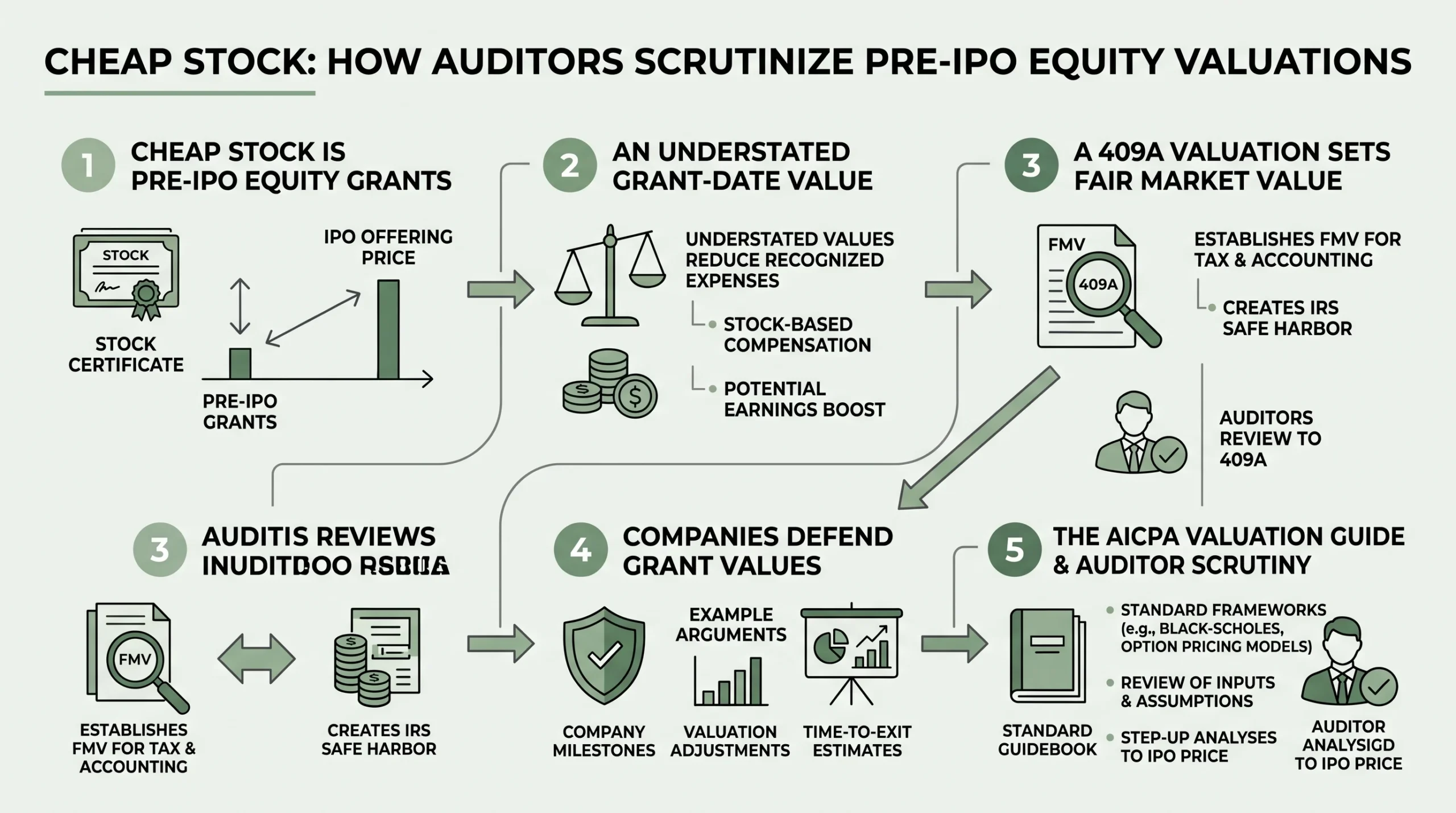
Cheap stock is pre-IPO equity or stock options that look underpriced once the IPO price is set. The worry is expense. An understated grant-date value understates stock-based compensation expense under ASC 718, which can overstate earnings in the run-up to an offering. If a grant was priced too low, a company may have to record added expense or even revise or restate its financial statements. That is why auditors and the SEC study these grants with care.
The team at Sofer Advisors prepares pre-IPO equity valuations for companies and the auditors and advisors who review them.
This guide explains the rules behind the issue, the methods used to set values, such as the OPM and PWERM, and the facts that raise an auditor’s risk.
Key Takeaways
- Cheap stock is pre-IPO equity that looks underpriced once the IPO price is set.
- An understated grant-date value understates stock-based compensation expense under ASC 718.
- A 409A valuation sets a tax value; ASC 718 sets a financial-reporting value. The two can differ.
- Companies defend grant values with contemporaneous valuations and methods like OPM and PWERM.
- The AICPA valuation guide is the main reference, and the SEC often sends comment letters.
What is “cheap stock” in a pre-IPO context?
Cheap stock is not a legal term. It is shorthand that auditors and regulators use. It points to common stock or options granted shortly before an IPO. The grant price sat at or near fair value on the grant date. Then the company filed to go public at a higher price.
The grant itself is normal. Private companies grant options to hire and keep staff. The strike price is set to the fair value of common stock on the grant date. The issue is timing and hindsight. When the IPO price lands well above a recent grant value, a question follows. Was that grant-date value really fair, or was it too low?
That question drives the whole review. A grant priced below true fair value carries extra compensation cost. The company may need to record that added cost. So each grant-date value has to hold up to scrutiny.
Why do auditors and the SEC scrutinize these grants?
The core issue is expense. Stock-based compensation is a real cost under ASC 718. The expense rests on the fair value of each award on its grant date. If that fair value was too low, the recorded expense was too low as well.
A low expense flatters the income statement. It can overstate earnings in the run-up to an IPO. Auditors test whether the grant-date fair values were reasonable. They want each value to match the facts known on the grant date. The SEC runs its own review when it reads the registration statement.
When reviewers doubt a value, they act. The SEC often issues a comment letter. The letter asks the company to explain how it set each grant value. The company must show its method and its support. The response can run long and take weeks to prepare.
If a value was too low, the result is costly. The company may book added compensation expense. In some cases it must revise or restate earlier figures. That extra expense lowers reported earnings. It can also delay the offering while the numbers are fixed.
The stakes rise as the IPO nears. Underwriters set the offering price close to the listing date. That price becomes a public marker. Reviewers then compare it with the recent grant values. A smooth, well-supported trend of values draws fewer questions. A sharp, late jump draws more.
How is a 409A valuation different from ASC 718 fair value?
These two values look alike. They serve different goals. People mix them up often, so the difference matters.
A 409A valuation sets the fair market value of common stock for tax purposes. It supports the strike price of stock options under IRC Section 409A. A proper, independent 409A valuation gives the company a safe harbor. That shifts the burden to the IRS if a dispute arises. In short, it protects option holders from harsh tax treatment.
ASC 718 is an accounting rule. It calls for a fair-value measurement of each award for financial reporting. That value drives the compensation expense in the financial statements. The purpose is accurate reporting, not tax compliance.
So one company can reach two different numbers. The tax value and the reporting value are measured for separate reasons. Near an IPO, auditors may want a fresh look at the reporting value. They want it to reflect current facts and the rising odds of a public exit. A value that made sense a year ago may look stale once a filing is near.
What valuation methods support pre-IPO common stock?
Private companies have layered capital structures. Preferred stock sits above common stock. It carries rights that common shares lack, such as liquidation preferences. So you cannot simply split total equity value by share count. You need an allocation method.
Three methods appear most often. Each handles the gap between preferred and common in its own way. The table below sums them up.
| Method | How it works | Best fit |
|---|---|---|
| Option Pricing Method (OPM) | Treats common stock as an option on total equity value | Early stage, uncertain exit timing |
| Probability-Weighted Expected Return Method (PWERM) | Weights specific exit outcomes, such as an IPO or a sale | Late stage, clear exit paths |
| Hybrid | Blends the OPM and PWERM in one model | A likely near-term IPO plus other outcomes |
The OPM treats common stock as a call option on the whole business. It uses inputs like volatility and the time to a liquidity event. It fits early companies where the exit path is still unclear. PWERM takes a different route. It lays out specific exit scenarios and weights each by its odds. It fits later companies with a clearer path to an IPO or sale.
Analysts often add a backsolve. The company just raised money at a known price per share. The backsolve calibrates the model to that recent financing. It anchors the allocation to a real, arm’s length deal. That anchor makes the resulting common stock value easier to defend.
The right method depends on stage and facts. Early companies with murky exits lean on the OPM. Companies close to an IPO often use PWERM or a hybrid. The goal stays the same each time. The model must support the common stock value in a way an auditor can follow.
Many values also carry a discount for lack of marketability, or DLOM. Private shares cannot be sold quickly on an open market. That limit lowers their value next to public shares. The discount tends to shrink as an IPO nears, since a liquid market is closer at hand.
How do companies document the grant-date value?
Support comes in two forms. The timing of the work sets them apart.
A contemporaneous valuation is prepared at or near the grant date. It uses only the facts known at that time. This is the preferred form. It carries the most weight with auditors and the SEC. The reason is simple. It is not shaped by hindsight.
A retrospective valuation is prepared later. It looks back at an earlier grant date. A company turns to it when no contemporaneous valuation exists. It is harder to defend. The analyst must set aside what happened after the grant date. The value must rest only on what was known then.
The AICPA Accounting and Valuation Guide is the key reference here. Its full title is “Valuation of Privately-Held-Company Equity Securities Issued as Compensation.” It sets out these methods and the case for contemporaneous work. Auditors expect analysis that lines up with that guidance. Sofer Advisors builds its pre-IPO valuations to meet that standard.
What raises cheap stock risk?
Some facts draw more scrutiny than others. Auditors look for signals that a grant value was too low. A few patterns stand out.
A wide gap between a recent grant value and the IPO price is the first signal. A large jump over a short span invites questions. Grants made close to the filing draw a harder look. So do grants made right after a new financing round at a higher price per share.
Big events between the last valuation and a grant also matter. A major customer win can lift value fast. So can a new round or a strong quarter. If a grant ignores such a change, the recorded value may be stale. Reviewers test whether each grant reflected the facts on its grant date.
Infrequent valuations add risk as well. A value that sits unchanged for many months can drift from reality. Regular updates keep each grant anchored to current facts. They also give auditors a clean record to follow.
Good records help at every step. Keep the board minutes that approve each grant. Keep the valuation report behind each grant-date value. Keep the terms of each financing round. When reviewers ask, clear files make the answer faster and stronger.
Frequently Asked Questions
Is “cheap stock” an official legal term?
No. It is informal shorthand used by auditors, underwriters, and the SEC. It describes pre-IPO equity grants that look underpriced once the IPO price is known. The accounting rules behind the issue are ASC 718 and IRC Section 409A.
Does cheap stock always mean a company did something wrong?
No. A grant can be priced in good faith and still look low later. Value can rise fast before an IPO. The review simply tests whether the grant-date value was reasonable given the facts at that time.
What happens if a grant value was too low?
The company may need to record extra stock-based compensation expense. It may also revise or restate earlier financial statements. Either step can lower reported earnings and slow the IPO timeline.
How does a 409A valuation relate to cheap stock?
A sound 409A valuation sets a defensible fair market value for option strike prices. It gives the company a tax safe harbor. It also serves as support when auditors review grant-date values. Still, the reporting value under ASC 718 can differ from the tax value.
Why is a contemporaneous valuation better than a retrospective one?
A contemporaneous valuation is prepared near the grant date. It is not colored by later events. Auditors and the SEC give it more weight. A retrospective valuation is allowed, but it is harder to defend.
When should a private company get a new 409A valuation?
The common practice is at least once a year. A company should also refresh the value after a material event. New financing rounds and major business changes are typical triggers. This helps keep the safe harbor in place.
What is a backsolve in an equity valuation?
A backsolve calibrates the allocation model to a recent financing. It uses the price a new investor just paid. That anchors the model to a real transaction. The result supports the common stock value with market evidence.
Who reviews pre-IPO equity values besides auditors?
The SEC reviews them during the registration process. It can send comment letters that ask how each grant value was set. Underwriters and their counsel also review these values before the offering.
Related Case Studies
- Blockage Discount Valuation: Large Blocks of Stock
- Pre-Money vs Post-Money Valuation: A Founder’s Guide
- ASC 718 Stock Compensation: Valuing Employee Equity
Executive Summary
Cheap stock is pre-IPO equity that looks underpriced once the IPO price is set. An understated grant-date value understates stock-based compensation expense under ASC 718. A 409A valuation sets a tax value; ASC 718 sets a financial-reporting value. The two can differ. Companies defend grant values with contemporaneous valuations and methods like OPM and PWERM. The AICPA valuation guide is the main reference, and the SEC often sends comment letters.
What Should You Do Next?
Review every equity grant made in the period before a planned IPO. Check each grant-date value against a contemporaneous valuation and a sound allocation method. Sofer Advisors prepares independent, defensible pre-IPO valuations, and every engagement is led by David Hern CPA ABV ASA CVA. Schedule a consultation to review your grant history before you file.
People Also Read
About the Author
This guide was prepared by David Hern CPA ABV ASA CVA, founder of Sofer Advisors, a business valuation firm headquartered in Atlanta, GA serving clients across the United States. David holds accreditations as an Accredited Senior Appraiser (ASA) and is Accredited in Business Valuation (ABV), credentials recognized by the IRS, SEC, and FINRA, and is also a Certified Valuation Analyst (CVA). David has served as an expert witness in dozens of cases across multiple jurisdictions, and Sofer Advisors is an Inc. 5000 honoree in 2024 and 2025 with 240+ five-star Google reviews.
For professional business valuation services, visit soferadvisors.com/about-us/ or contact Sofer Advisors at soferadvisors.com/contact-us/.
Disclaimer: This content is for informational purposes only and does not constitute professional valuation advice. Business valuation conclusions depend on specific facts and circumstances. Contact Sofer Advisors for guidance regarding your specific situation.