


Last Updated: September 2026
A qualified business appraisal is a formal, independent valuation of a private company interest, prepared to support the value you report to the IRS. In estate and gift planning, it substantiates fair market value on filings like Form 706 and Form 709. It is required in some transfers and merely wise in others. A gross valuation misstatement can add a 40 percent penalty under IRC Section 6662, so knowing which case you face protects your filing and your wallet.
This guide maps the common estate and gift scenarios to one clear answer: appraisal required, strongly recommended, or not needed. It covers gifts of stock, estate filings, charitable transfers, and trusts such as GRATs and IDGTs. The rules differ by transfer type, and one wrong assumption can cost more than the report.
Sofer Advisors prepares defensible estate and gift valuations for business owners, CPAs, and estate planning attorneys across the United States. It holds dual accreditations recognized by the IRS and maintains 180+ five-star Google reviews. Its work has supported 11+ expert witness cases across Georgia, Florida, California, and New Mexico, under standards such as USPAP and Revenue Ruling 59-60.
Key Takeaways
- Required for charitable business gifts: a charitable gift of a private interest above $5,000 needs a qualified appraisal and Form 8283.
- Recommended for taxable gifts: a gift of closely held stock on Form 709 needs an appraisal to meet adequate disclosure and start the three-year audit clock.
- Expected for estate filings: Form 706 must report fair market value, so an estate holding a private business almost always needs a professional appraisal.
- Formulas rarely suffice: a buy-sell price or a rule of thumb seldom binds the IRS for transfer tax, especially among family members.
- Credentials and independence matter: a qualified appraiser holds a designation such as ABV or ASA and cannot be the donor or the recipient.
The sections below cover when the IRS demands an appraisal, when one is simply smart, and when you can skip it.
When is a qualified appraisal required in estate and gift planning?
A qualified appraisal is required whenever the tax value of a private business interest is not readily known and the transfer must be reported to the IRS. Cash and public stock carry a value anyone can look up. A stake in a closely held company does not. So the IRS asks for independent proof of value when that interest moves by gift, bequest, or charitable donation.
The trigger is the type of asset and the type of filing, not the size of the family. A $50,000 gift of private stock can draw the same scrutiny as a $5 million one. A report built to standard is cheap insurance against a later challenge.
Which transfers require a qualified appraisal?
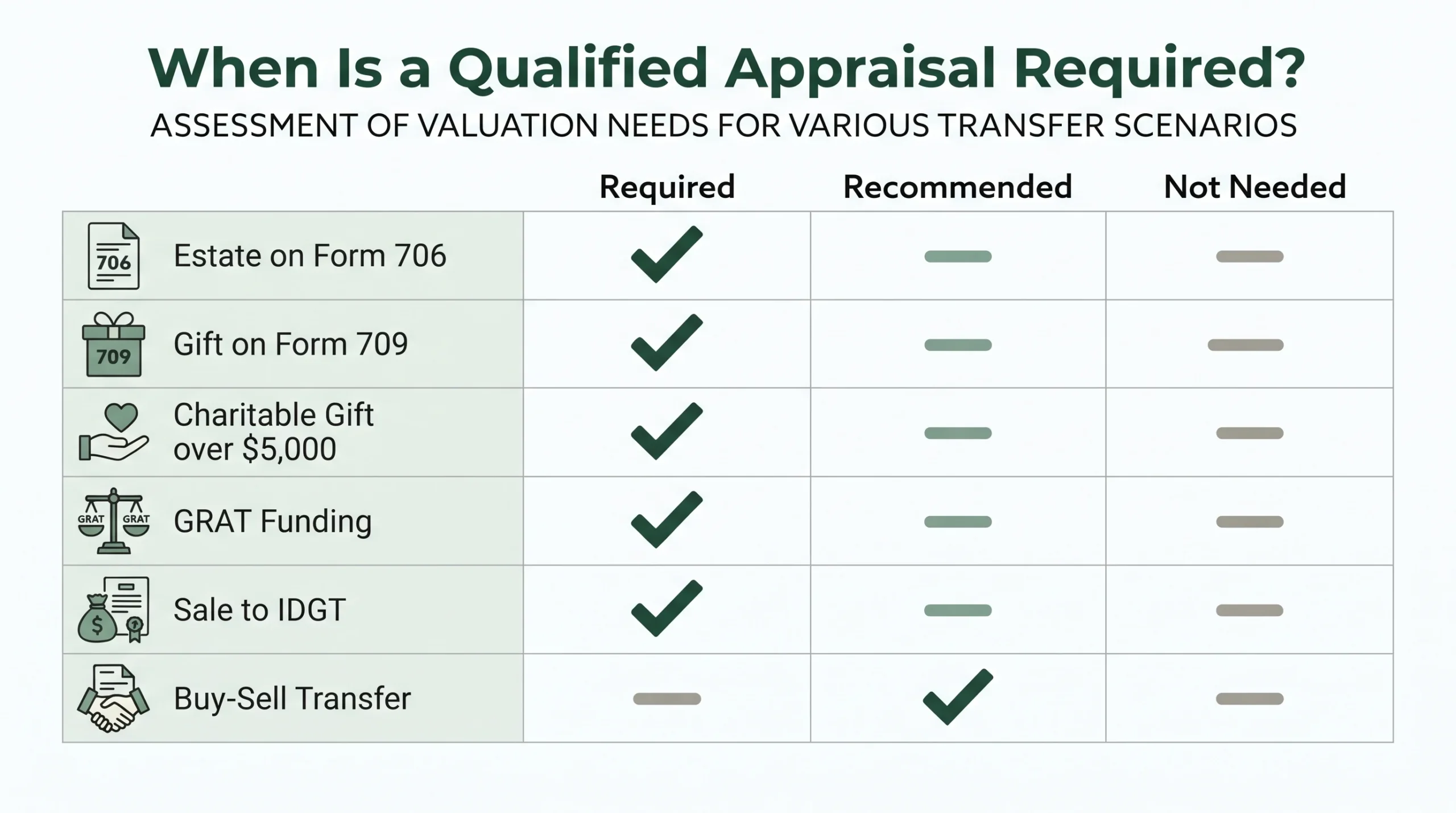
Transfers of non-publicly-traded business interests are the ones that require a qualified appraisal for gift and estate tax reporting. The table below maps the common scenarios to a plain answer, and the notes that follow explain each one.
| Transfer scenario | Form or vehicle | Appraisal status |
| Estate holding a private business interest | Form 706 | Required in practice |
| Taxable gift of closely held stock | Form 709 | Strongly recommended |
| Charitable gift of a business interest over $5,000 | Form 8283 | Required |
| Sale to an IDGT or funding a GRAT or SLAT | Trust documents | Required to set value |
| Gift within the annual exclusion | Often no Form 709 | Usually not needed |
| Transfer of cash or public stock | Any | Not needed |
For estates, Form 706 must report the fair market value of every asset, so a closely held business almost always needs a professional appraisal. For lifetime gifts, Form 709 reports the transfer, and an appraisal proves the number. Charitable gifts follow a separate rule set: a donated business interest worth more than $5,000 requires a qualified appraisal, and one worth more than $500,000 means you attach the full report. Trust strategies add their own need, since a GRAT or a sale to an IDGT only works if the interest is valued correctly.
What makes a business appraisal “qualified” for the IRS?
An appraisal is “qualified” when it meets the content, timing, and appraiser standards the IRS sets for that transfer. The two frameworks differ, and mixing them up is a costly mistake. The charitable rules under IRC Section 170 define a formal “qualified appraisal” summarized on a signed Form 8283. Gift and estate transfers instead rely on the fair market value standard under IRC Sections 2031 and 2512.
Both frameworks share the same backbone. A credible report describes the interest, states the valuation date, and explains the income, market, and asset approaches used. It applies discounts for lack of control and lack of marketability with real data, a point covered in our guide to valuation discounts on estate and gift tax returns. Timing matters too. An estate values the interest as of the date of death, a gift as of the gift date, and a charitable appraisal no earlier than 60 days before the donation.
When can you skip a qualified appraisal?
You can skip a qualified appraisal when the asset has a value the IRS can verify on its own. Cash needs no appraisal. Public stock has a quoted market price, so a broker statement settles the question. A gift inside the annual gift tax exclusion, $19,000 per recipient in 2025, often needs no gift tax return at all, and no formal report.
Even so, skipping documentation carries a risk. Without a written value on file, a later audit puts the burden of proof on the taxpayer, not the IRS. A short valuation memo is cheap and creates a record while facts are fresh. For a business interest of any real size, a full tax and estate valuation is the safer path.
How do trusts and buy-sell agreements change the requirement?
Trusts and buy-sell agreements raise the need for an appraisal rather than remove it. A gift to a SLAT, a sale to an intentionally defective grantor trust, or a beneficiary defective trust each moves a business interest that must be valued at transfer. A GRAT sets its annuity from the funded value, so an error there flows through the whole plan. The same holds for family limited partnership interests used to shift value to heirs.
Buy-sell agreements deserve special care. Owners often assume a formula price will set the transfer tax value. Among family members, it usually will not. Under IRC Section 2703, the IRS can ignore a buy-sell restriction unless it reflects a bona fide business arrangement and mirrors arm’s length terms. An independent appraisal that follows Revenue Ruling 59-60 gives a figure the IRS is far more likely to respect.
What is The Sofer Difference in estate and gift valuation?
The Sofer Difference is a four-phase process built to make every conclusion defensible under IRS review. It starts with Discovery, where the purpose and the interest are defined. Diligence follows, reviewing financial statements, tax returns, and governing documents. Analysis applies the income, market, and asset approaches to reach fair market value. In Delivery, Sofer Advisors explains the drivers behind the number using a Heart of a Teacher approach, so you and your advisors can stand behind the report.
Choosing a provider also matters. Owners weigh national firms, regional CPA shops, and specialized valuation practices against the standard their filing demands. The table below compares the common options.
| Provider | Primary focus | Best for |
| Sofer Advisors | Private company valuations for tax, estate, and litigation | Owners and advisors needing defensible, senior-led reports |
| Alvarez & Marsal, Stout, Kroll | Large enterprise and restructuring engagements | Multinationals and complex corporate matters |
| Regional CPA firm | General accounting with valuation as a side service | Existing clients needing a basic compliance report |
Large firms like Alvarez & Marsal, Stout, and Kroll serve enterprise clients well, but middle-market owners often want senior attention on their file. A general accounting firm may treat valuation as a small add-on. The lead appraiser’s credentials, independence, and estate tax experience best predict whether a report survives scrutiny.
The questions below answer what owners and advisors ask most about these appraisals.
Frequently Asked Questions
When is a qualified business appraisal required for estate and gift planning?
A qualified appraisal is required when a private business interest passes by gift, bequest, or charitable donation and must be reported to the IRS. It is mandatory for charitable business gifts above $5,000 and expected for estates reporting a closely held company on Form 706. For taxable gifts on Form 709, an appraisal is the standard way to prove fair market value.
What makes a business appraisal “qualified” for the IRS?
A qualified appraisal describes the interest in detail, states the valuation date, and explains the income, market, and asset approaches used. It applies control and marketability discounts with real data and is signed by an appraiser with recognized credentials. For charitable gifts, it must also meet the content rules under IRC Section 170 and be summarized on Form 8283. Independence is required in every case.
Which estate and gift transfers can skip a qualified appraisal?
Transfers of assets with a value the IRS can verify on its own can skip a qualified appraisal. Cash and publicly traded securities carry quoted or face values, so no report is needed. A gift within the annual gift tax exclusion often requires no gift tax return either. Documenting the value of any private interest remains wise, since it shifts the burden of proof to the taxpayer in a later audit.
Who is qualified to sign an estate or gift business appraisal?
A qualified appraiser is a professional who regularly performs valuations for pay and holds a recognized designation such as the Accredited in Business Valuation (ABV) or Accredited Senior Appraiser (ASA). The appraiser must have real experience with the type of interest and remain independent of the transaction. That person cannot be the donor, the recipient, or an employee of either party.
Does a gift of a business interest always require a qualified appraisal?
Not every gift of a business interest legally requires a qualified appraisal, but one is the standard way to substantiate the value. Without it, the taxpayer carries the burden of proving fair market value during any audit. A gift within the annual exclusion may need no report. A larger gift of closely held stock almost always warrants one to support the Form 709 filing.
What is adequate disclosure on a gift tax return?
Adequate disclosure is the standard that starts the three-year clock on the IRS’s ability to challenge a reported gift value. Under Treasury Regulation Section 301.6501(c)-1(f), a gift must be reported in enough detail for the IRS to understand it. A qualified appraisal, or a thorough description of the valuation method, satisfies the rule. Without it, the statute of limitations never starts, so the IRS can revisit the gift for years.
Can I use a buy-sell agreement value for gift or estate tax?
A buy-sell agreement value rarely controls the gift or estate tax figure, especially among family members. Under IRC Section 2703, the IRS can disregard a buy-sell restriction unless it reflects a bona fide business arrangement and matches arm’s length terms. An independent appraisal that follows Revenue Ruling 59-60 provides a figure far more likely to hold up under review.
What happens if I file without a qualified appraisal?
Filing without a supporting appraisal leaves the reported value exposed to challenge and to accuracy-related penalties. Under IRC Section 6662, a substantial valuation misstatement can add a 20 percent penalty, and a gross misstatement can add 40 percent of the underpayment. Without a report, the taxpayer also lacks the evidence to defend the number. A standards-based valuation is the most reliable protection against a costly dispute.
How much does a tax and estate valuation cost?
A tax and estate valuation from Sofer Advisors typically costs $7,500 to $25,000, based on the complexity of the entity, the number of interests, and the timeline. The fee reflects the analysis needed for a report that holds up under IRS review. For a quote tied to your specific transfer, contact us for a consultation with your financials and transfer details.
Related Case Studies
- Estate Freeze Strategies: How Valuations Lock In Today’s Value
- Chapter 14 Rules: How IRC 2701 and 2703 Affect Family Transfers
- Valuation of Closely Held Business for Estate Tax Purposes
Executive Summary
A qualified business appraisal is required for a charitable gift of a private interest above $5,000 and, in practice, for any estate reporting a closely held business on Form 706. For taxable gifts on Form 709, an appraisal meets the adequate disclosure rule and starts the three-year audit clock. Formulas and buy-sell prices rarely satisfy the IRS. Even with the permanent $15 million exemption, a documented fair market value protects your filing. Sofer Advisors prepares these reports under USPAP and Revenue Ruling 59-60; pricing runs $7,500 to $25,000.
What Should You Do Next?
Start by listing every planned transfer: outright gifts, trust funding, charitable donations, and any interest passing through your estate. Match each to the matrix above to see whether an appraisal is required, recommended, or optional. Then gather three years of financial statements, tax returns, and any buy-sell or trust documents before the transfer date, since value is measured as of that date.
David Hern CPA ABV ASA, founder of Sofer Advisors, prepares defensible estate and gift valuations for owners and their advisors. Schedule a consultation to review your specific situation.
People Also Read
- Stepped-Up Basis at Death: What Business Owners Must Know
- Using the Annual Gift Exclusion to Transfer Business Interests
About the Author
This guide was prepared by David Hern CPA ABV ASA, founder of Sofer Advisors, a business valuation firm headquartered in Atlanta, GA serving clients across the United States. David holds dual accreditations as an Accredited Senior Appraiser (ASA) and is Accredited in Business Valuation (ABV), credentials recognized by the IRS, SEC, and FINRA. He also holds the Certified Exit Planning Advisor (CEPA) designation. With 15+ years of valuation experience, David has served as an expert witness in 11+ cases across multiple jurisdictions and built Sofer Advisors into an Inc. 5000-recognized firm with 180+ five-star Google reviews. Its full W2 employee team maintains subscriptions to all major valuation databases and operates under a next business day response policy.
For professional business valuation services, visit soferadvisors.com/about-us/ or contact Sofer Advisors at soferadvisors.com/contact-us/.
Disclaimer: This content is for informational purposes only and does not constitute professional valuation advice. Business valuation conclusions depend on specific facts and circumstances. Contact Sofer Advisors for guidance regarding your specific situation.









