


Last Updated: June 2026
This article is for business owners, estate planning attorneys, CPAs, and financial advisors. After reading it, you will understand how IRC 2701 and 2703 interact and what steps protect a family transfer from gift tax surprises.
Chapter 14 valuation rules refers to special gift and estate tax provisions in the Internal Revenue Code. Congress enacted them in 1990 to stop families from shifting business wealth at discounted values through corporate or partnership structures. Any business owner transferring an interest to a family member must account for these rules or risk unexpected gift tax liability.
Understanding these rules matters well beyond the tax return. They affect how appraisers value retained interests, how attorneys draft transfer documents, and how estate plans are structured. A transfer that appears straightforward can trigger a taxable gift many times larger than expected. Sofer Advisors, headquartered in Atlanta, GA, provides qualified, defensible valuations that hold up to IRS scrutiny.
Key Takeaways
- Chapter 14 Overview – IRC 2701 through 2704 create four anti-freeze rules that apply to family transfers of business interests.
- IRC 2701 Gift Tax Risk – Retaining a preferred interest and transferring common stock can reduce the retained interest value to zero, inflating the taxable gift significantly.
- IRC 2703 Restrictions – Buy-sell agreements are ignored for estate and gift tax unless they meet a three-part safe harbor test under IRC 2703(b).
- Qualified Appraisal Required – IRS regulations require a qualified appraisal by a credentialed ASA or ABV appraiser for any discounted family transfer subject to Chapter 14.
- Valuation Discounts at Risk – Minority interest discounts and DLOM may be partly or fully disallowed when Chapter 14 applies.
- IRC 2704 Lapse Rules – Voting or liquidation rights that lapse at death are treated as taxable transfers under IRC 2704.
Chapter 14 rules interact in ways that are not obvious from reading a single code section. The sections below examine each rule and show what a well-structured valuation must address.
What Is Chapter 14 of the Internal Revenue Code?
Chapter 14 of the Internal Revenue Code covers IRC sections 2701, 2702, 2703, and 2704. Before 1990, a senior family member could freeze their estate by retaining preferred equity and transferring common equity to children at a low gift tax value. Congress passed Chapter 14 as part of the Revenue Reconciliation Act of 1990 to stop these strategies.
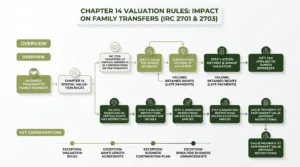
Each section targets a different technique. IRC 2701 addresses corporate and partnership freezes. IRC 2702 covers grantor retained annuity trusts. IRC 2703 applies to buy-sell agreements. IRC 2704 handles lapsing rights. They apply whenever a family transfer could otherwise reduce the gift or estate tax base.
A qualified business appraiser is essential to apply these rules correctly. Most families encounter unexpected tax exposure where Chapter 14 and standard valuation discounts interact.
How Does IRC 2701 Affect Family Transfers?
IRC 2701 applies when a senior family member transfers common stock while retaining preferred stock. The statute sets the retained interest value to zero unless it qualifies as a “qualified payment right”, a cumulative preferred dividend paid at a fixed rate. If it does not qualify, the taxable gift equals the full entity value, not just the transferred interest.
For example, a parent holds an LLC worth $5 million and transfers 60 percent of common units while retaining a preferred interest worth $2 million. Under standard valuation, the gift is $3 million. Under IRC 2701, if the preferred interest does not pay qualified payments, its value is zero and the entire $5 million becomes the taxable gift.
Structuring around IRC 2701 requires drafting the retained interest to pay fixed cumulative dividends. A valuation that ignores this analysis will not survive an IRS audit.
How Does IRC 2703 Apply to Buy-Sell Agreements?
IRC 2703 requires that any right or restriction on an asset be disregarded when finding its fair market value for estate and gift tax purposes. This applies unless the arrangement meets all three conditions of the IRC 2703(b) safe harbor. The restriction must be a bona fide business arrangement. It must not transfer property to family members below fair market value. Its terms must also be comparable to arm’s-length arrangements between unrelated parties.
Before 1990, families routinely fixed the buy-sell price at a low value to cap estate tax liability. IRC 2703 ended that practice. A below-market buy-sell price will be ignored by the IRS unless it passes the three-part test.
The comparability test is where most agreements fail. A formula based on book value usually fails because arm’s-length buyers and sellers do not use it to price operating businesses. A formula based on a multiple of EBITDA or a current appraisal is far more defensible. Many estate attorneys recommend that buy-sell agreements require a business valuation every three years and at any triggering event.
What Valuation Methods Apply Under Chapter 14?
When Chapter 14 applies, appraisers follow the ordinary fair market value standard with adjustments mandated by the regulations. A standard income, market, or asset approach remains the foundation. Chapter 14 adjustments must be worked through before arriving at a reportable value.
The income approach is most common for operating companies. Appraisers use discounted cash flow (DCF) analysis or capitalization of earnings. Under Chapter 14, minority interest discounts and DLOM may be limited or disallowed depending on the retained interest structure.
| Valuation Factor | Standard Transfer | Chapter 14 Transfer |
|---|---|---|
| Income Approach (DCF) | Full discount allowed | May be limited by 2701 |
| Minority Interest Discount | Typically 15-35% | May be restricted |
| Lack of Marketability Discount (DLOM) | Typically 20-35% | May be restricted |
| Buy-Sell Price Cap | Respected if arm’s-length | Disregarded under 2703 if not comparable |
| Retained Interest Value | Fair market value | Zero if not a qualified payment right |
| Lapsing Rights | Included in estate | Treated as transfer under 2704 |
An appraiser who applies full discounts without addressing Chapter 14 produces a number that will not withstand IRS challenge. The valuation must document every adjustment. It must also explain how the regulations were applied to the specific facts.
Why Does the Valuation Date and Method Matter?
The alternate valuation date election under IRC 2032 lets the estate value assets six months after death. This is allowed only if it reduces both the gross estate and the estate tax liability. For Chapter 14 interests, this election requires a current appraisal as of both dates.
Valuation date selection also matters for gift tax. The taxable gift is measured as of the transfer date. A stale appraisal that predates the signing may not reflect the actual gift amount. The IRS requires gift tax appraisals to be current as of the valuation date.
David Hern CPA ABV ASA, founder of Sofer Advisors, explains valuation dates and Chapter 14 mechanics in plain terms that clients and attorneys can act on.
What Are the Common Mistakes in Chapter 14 Planning?
Family transfers under Chapter 14 tend to fail for predictable reasons. The following mistakes appear repeatedly in IRS audits:
- Using book value or a fixed price in a buy-sell agreement without testing whether the price reflects arm’s-length terms under IRC 2703(b).
- Retaining a preferred interest that does not pay cumulative, fixed distributions, which triggers the zero-value rule of IRC 2701.
- Applying minority interest discounts and DLOM without analyzing whether Chapter 14 limits or eliminates those adjustments.
- Relying on an appraisal prepared more than 60 days before the transfer, which leaves the valuation date unsupported.
- Failing to document lapsing rights under IRC 2704, particularly in family limited partnerships where voting or liquidation rights lapse at the senior member’s death.
Many families only learn about Chapter 14 after the transfer closes. Proactive appraisals reviewed by the appraiser and estate counsel before transfer catch these issues in time to restructure. The Sofer Difference, Discovery, Diligence, Analysis, and Delivery, ensures every Chapter 14 engagement produces a report the IRS expects in an audit file.
When Should You Get a Valuation for a Family Transfer?
Get a valuation before the transfer documents are signed. Many families schedule an appraisal after the transfer closes. If the appraiser finds a different value, the gift tax return may be incorrect. Correcting a closed transaction is far more complicated than building the valuation into the planning process from the start.
For estate planning purposes, the right time is during the drafting phase. The appraiser should review the entity structure and transfer documents before they are finalized. This confirms the retained interest qualifies under IRC 2701, buy-sell terms satisfy IRC 2703(b), and lapsing rights are accounted for under IRC 2704.
Frequently Asked Questions
What is Chapter 14 of the Internal Revenue Code?
Chapter 14 covers IRC sections 2701 through 2704, each targeting a different technique for transferring business wealth at artificially low values. Congress enacted these sections in 1990 to stop estate freeze strategies used by families.
How does IRC 2701 create a gift tax trap for families?
IRC 2701 applies when a senior family member retains a preferred interest while transferring common equity. If the retained interest does not pay fixed cumulative distributions, the IRS treats its value as zero and the full entity value becomes the taxable gift.
How is the date of death valuation calculated?
The date of death valuation is the fair market value of each asset as of the decedent’s date of death, using a qualified appraisal. Estates may also elect the alternate valuation date under IRC 2032, but only if it reduces both the gross estate and the estate tax.
What is the 5 by 5 rule in estate planning?
The 5 by 5 rule lets a trust beneficiary withdraw the greater of five thousand dollars or five percent of the trust’s value each year without triggering a general power of appointment. It is used in credit shelter and irrevocable life insurance trusts to give limited access to funds while preserving estate tax benefits.
What are the three requirements of the IRC 2703(b) safe harbor?
The IRC 2703(b) safe harbor requires: a bona fide business arrangement, no device to transfer property below fair market value, and terms comparable to arm’s-length arrangements between unrelated parties. Failing any one condition causes the restriction to be disregarded for tax purposes.
How much does a Chapter 14 business valuation from Sofer Advisors cost?
A Chapter 14 family transfer valuation from Sofer Advisors typically ranges from $7,500 to $25,000, depending on entity complexity, the number of interests transferred, and the purpose of the appraisal. Most standard estate and gift tax engagements complete within four to eight weeks. Rush engagements are available at a 25 to 50 percent premium. Schedule a free consultation to receive a scoped estimate.
Can valuation discounts still apply under Chapter 14?
Minority interest discounts and DLOM may still apply, but IRC 2701 can eliminate them on the retained interest by setting its value to zero. Chapter 14 adjustments must be worked through before any discount is applied.
What makes a buy-sell agreement defensible under IRC 2703?
A buy-sell agreement survives IRC 2703 when its pricing terms match what unrelated parties would negotiate. Formulas tied to current appraisals or EBITDA multiples are stronger than fixed prices or book value formulas.
How long does an estate and gift tax appraisal take?
A qualified estate and gift tax appraisal typically takes four to eight weeks. Appraisals involving preferred versus common interest analysis under IRC 2701 take longer due to additional regulatory work.
What credentials should a Chapter 14 appraiser hold?
A Chapter 14 appraiser should hold the Accredited Senior Appraiser (ASA) or Accredited in Business Valuation (ABV) credential. Treasury Regulation 20.2031-1 requires that qualified appraisers meet specific education and experience standards.
How does IRC 2704 affect family limited partnerships?
IRC 2704 treats the lapse of a voting or liquidation right in a family entity as a taxable transfer. In a family limited partnership, a general partner’s liquidation right may lapse at death and be treated as a gift or estate inclusion at fair market value.
Related Case Studies
- Estate Planning Business Valuation Georgia Gift Tax Compliance Guide
- Sofer Advisors Case Study: Family Business Succession and Ownership Transfer
- Minority Interest And Marketability Discounts In Business Valuation
Executive Summary
Chapter 14 covers IRC sections 2701 through 2704. IRC 2701 can inflate the taxable gift in a preferred interest freeze by treating retained interests as worthless. IRC 2703 disregards buy-sell agreements that fail the bona fide business arrangement and arm’s-length comparability tests. IRC 2704 includes lapsing voting and liquidation rights as taxable transfers. These rules require qualified appraisals by credentialed professionals.
What Should You Do Next?
Review your entity structure and buy-sell agreements with your estate attorney to determine whether Chapter 14 applies. Commission a qualified appraisal before signing transfer documents, not after. If you are unsure whether your retained interest qualifies for IRC 2701 payment rights, have an appraiser and attorney review the operating agreement before closing.
David Hern CPA ABV ASA, founder of Sofer Advisors, has 15 years of valuation experience and has served as an expert witness in 11+ cases across multiple jurisdictions. His firm holds dual ASA and ABV accreditation recognized by the IRS, SEC, and FINRA. Schedule a consultation to discuss your Chapter 14 valuation needs.
People Also Read
- Why You Must Start Planning Your Business Exit Now With The Right Valuation Expert
- What To Expect During A Business Valuation Step By Step Process
About the Author
This guide was prepared by David Hern CPA ABV ASA, founder of Sofer Advisors – a business valuation firm headquartered in Atlanta, GA serving clients across the United States. David holds dual accreditations as an Accredited Senior Appraiser (ASA) and is Accredited in Business Valuation (ABV), credentials recognized by the IRS, SEC, and FINRA. He also holds the Certified Exit Planning Advisor (CEPA) designation. With 15+ years of valuation experience, David has served as an expert witness in 11+ cases across multiple jurisdictions and built Sofer Advisors into an Inc. 5000-recognized firm with 180+ five-star Google reviews. The firm’s full W2 employee team maintains subscriptions to all major valuation databases and operates under a next business day response policy.
For professional business valuation services, visit soferadvisors.com or schedule a consultation.
This content is for informational purposes only and does not constitute professional valuation advice. Business valuation conclusions depend on specific facts and circumstances. Contact Sofer Advisors for guidance regarding your specific situation.