Last Updated: November 2026
Portability lets a surviving spouse use the federal estate tax exemption their late spouse did not use. That leftover amount is called the Deceased Spousal Unused Exclusion, or DSUE, and the survivor adds it to their own exemption. The benefit is not automatic. The executor must elect it on a timely Form 706, the federal estate tax return, even when no estate tax is due. Without that filing, the unused amount is lost.
The team at Sofer Advisors prepares the estate valuations that support this process for families, CPAs, and attorneys across the country.
This guide explains how portability works, who can elect it, how to file, and the deadlines that matter.
Key Takeaways
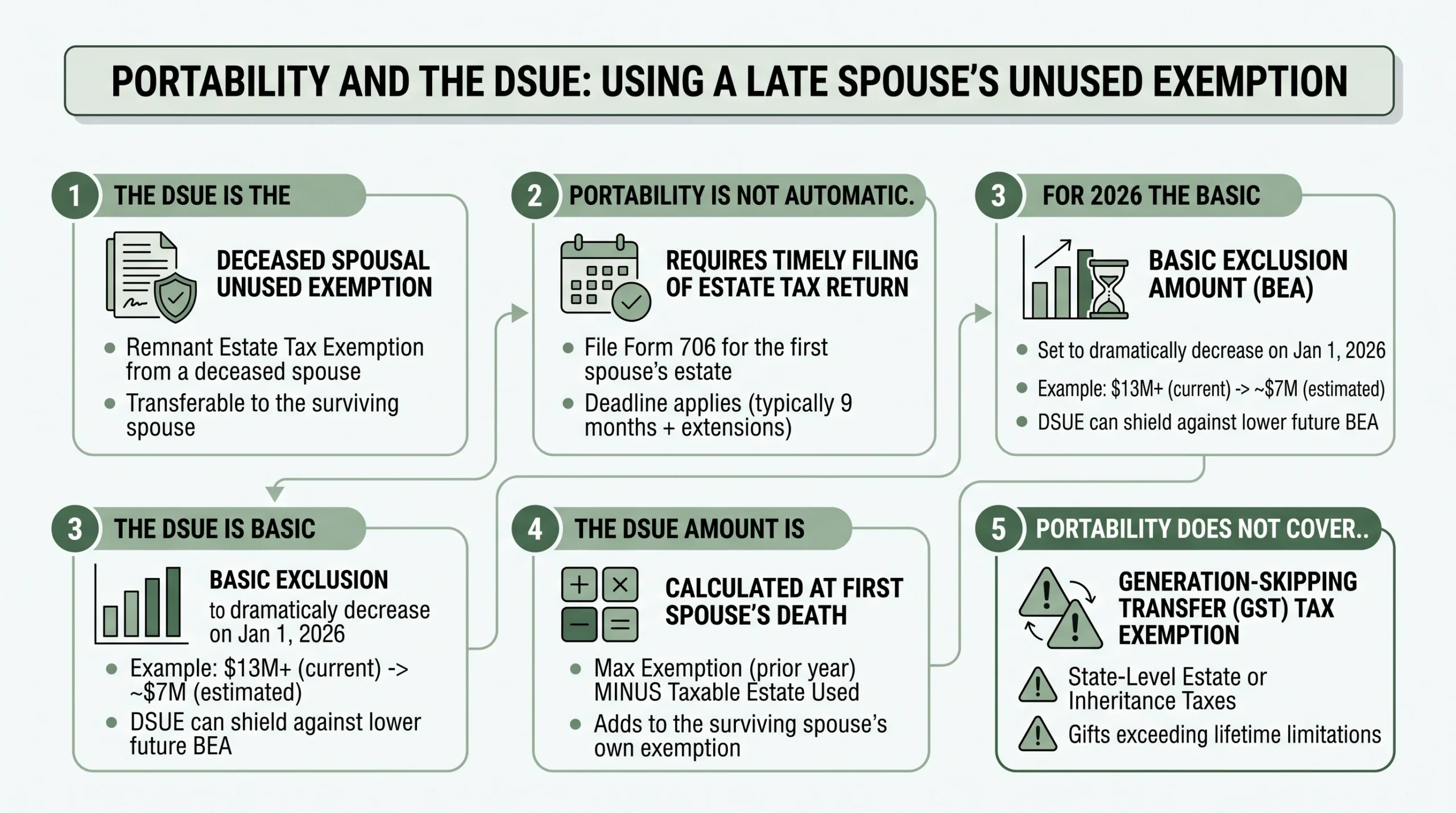
- The DSUE is the unused federal exemption a late spouse leaves behind. The survivor can use it.
- Portability is not automatic. The executor must elect it on a timely Form 706.
- For 2026 the basic exclusion is $15,000,000 per person, per the IRS (Revenue Procedure 2025-32).
- The DSUE amount is fixed once it is set. It does not grow with inflation.
- Portability does not cover the generation-skipping transfer (GST) tax exemption.
What is the DSUE and how does portability work?
The DSUE is the part of a late spouse’s federal exemption that went unused. Portability is the rule that lets the survivor claim it. Together they let a married couple use both exemptions, even when one spouse dies first.
Here is the basic flow. A spouse dies and does not use their full exemption. The executor elects portability on the estate tax return. The leftover amount, the DSUE, passes to the survivor. The survivor adds it to their own exemption.
The survivor can use the DSUE in two ways. They can apply it to lifetime gifts. Or they can hold it for their own estate at death. Either way, it raises the total they can transfer tax free.
The election is the key step. The IRS does not grant the DSUE on its own. The executor must make an active choice on a filed return. Without that filing, the unused amount is lost for good.
Portability changed estate planning for married couples. In the past, a couple often needed a trust just to use both exemptions. Portability offers a simpler route. The survivor can still plan with trusts, but the second exemption is no longer tied to one.
Who can elect portability?
Portability is open to the estate of a married U.S. citizen or resident. The person must have been married at the time of death. The executor makes the election for the benefit of the surviving spouse.
There is one important limit. A survivor can only use the DSUE from their last deceased spouse. Say a widow remarries and her second husband also dies. She can use his DSUE, but not the first husband’s. So timing matters for anyone widowed more than once.
This last-spouse rule can cost a family real money. A large unused exemption from a first marriage does not carry forward past a second death. Planning ahead helps a survivor avoid that trap.
One more detail is worth knowing. The estate of a noncitizen spouse cannot always make a standard election. Those cases follow different rules and often call for a trust. A tax advisor can confirm which path applies.
How much is the federal exemption in 2026?
For 2026 the basic exclusion amount is $15,000,000 per person. The IRS set this figure in Revenue Procedure 2025-32. The 2025 tax law, often called the OBBBA, made the higher exemption permanent.
A married couple can shield up to twice that amount. Portability is what makes the second exemption usable. If the first spouse to die does not use their $15,000,000, the survivor can carry it forward.
The annual gift exclusion is separate. For 2026 it is $19,000 per recipient. You can give that much to any number of people each year. Those gifts do not touch your lifetime exemption.
One more point on the DSUE. The amount is fixed once the first spouse’s estate determines it. It does not rise with inflation later. The survivor’s own exemption still adjusts over time. The inherited DSUE does not.
How does the DSUE add up in practice?
A short example helps. The figures below are illustrative. They show how the math works, not a promise for any one estate.
Say a husband dies in 2026. He had used none of his exemption during life. His estate elects portability on a timely Form 706. That passes his full $15,000,000 exclusion to his wife as her DSUE.
His wife now holds two amounts. She has her own $15,000,000 exclusion. She also has his $15,000,000 DSUE. Added together, she can transfer up to $30,000,000 free of federal estate and gift tax.
She can use that combined amount in life or at death. If she gifts shares of a family business today, the DSUE can cover part of the transfer. Whatever she does not use passes to her estate. Without the election, half of that shelter would have been lost.
The example also shows why the first filing matters so much. The DSUE only exists because the executor claimed it. A missed return would have erased it. That is why many families file Form 706 even when no tax is due.
What is the deadline to file for portability?
The portability election is made on IRS Form 706. This is the federal estate tax return. The executor must file it even when no estate tax is due.
The normal deadline is nine months after the date of death. An executor can request a six-month extension before that date passes. That is the standard timeline for most estates.
Many smaller estates miss the deadline because no tax was owed. The IRS offers relief for them. Under Revenue Procedure 2022-32, an estate that was not otherwise required to file can make a late portability election. The window runs up to five years after death. This simplified path only applies when the estate had no separate duty to file.
What assets need valuation for Form 706?
Form 706 reports the full value of the estate. Every asset gets a dollar figure. The list includes real estate, financial accounts, and private business interests.
Private business interests are the hard part. They do not trade on a public market. There is no daily price to point to. So the estate usually needs a qualified appraisal to set fair market value.
The appraisal looks at several things. It weighs the company’s earnings and its assets. It considers how the business compares to similar firms. It may also apply discounts for a minority stake or for limited marketability. Each of these choices needs support and clear reasoning.
A solid valuation does more than fill in a form. It supports the reported figures if the IRS asks questions. It also helps set the stepped-up basis for the heirs who inherit the interest. That basis can reduce their capital gains tax if they sell later.
Sofer Advisors prepares these valuations for estate filings. The goal is a report that holds up under review and reflects real economic worth at the date of death.
How do state and federal estate taxes differ?
Portability is a federal rule only. It applies to the federal estate tax and the gift tax exemption. It has no effect on state taxes.
Many states run their own estate or inheritance tax. These often have much lower exemptions than the federal level. A few states tax the heirs directly through an inheritance tax. The rules change from state to state.
So a family can clear the federal threshold and still owe state tax. State planning stays important even with a large federal exemption. An estate attorney who knows your state can map the local rules.
There is also a timing point. Some states set their own return deadlines, and they may differ from the federal one. A spouse who moves to a new state can face a different set of rules too. It pays to check the state tax picture early, not after a deadline has passed.
Portability or a bypass trust: which one fits?
Portability is simple. A bypass trust gives more control. Many families weigh the two.
Portability lets the survivor use the first spouse’s unused exemption. It takes a timely Form 706 and little else. A bypass trust is set up in advance. It holds assets outside the survivor’s estate. It can also protect those assets from creditors.
There is one gap worth naming. Portability does not carry the GST tax exemption. A trust can use that exemption to pass wealth across generations. Families with that goal often choose a trust. Some use both tools together.
The table below compares the two at a glance.
| Feature | Portability (DSUE) | Bypass Trust |
|---|---|---|
| Setup | Simple, after death | Planned in advance |
| Creditor protection | None | Strong |
| GST exemption | Not available | Available |
| Asset control | Full for survivor | Set by trust terms |
The right choice depends on the estate and the family’s goals. There is no single answer for everyone. An estate attorney and a tax advisor can help you compare the paths for your own situation.
Frequently Asked Questions
What is the DSUE?
The DSUE is the Deceased Spousal Unused Exclusion. It is the part of a late spouse’s federal estate tax exemption that was not used. Portability lets the surviving spouse add it to their own exemption.
Do you have to file Form 706 even if no estate tax is due?
Yes, to get portability you do. The election only works on a filed return. Many estates that owe no tax still file Form 706 just to preserve the DSUE.
What is the federal estate tax exemption for 2026?
For 2026 the basic exclusion amount is $15,000,000 per person. The IRS set this in Revenue Procedure 2025-32. The 2025 tax law made the higher figure permanent.
Is the annual gift exclusion the same as the exemption?
No. They are separate. For 2026 the annual gift exclusion is $19,000 per recipient. The lifetime exemption is a much larger, separate amount.
Does the DSUE grow with inflation?
No. The DSUE is fixed once the first spouse’s estate sets it. It does not adjust later. The survivor’s own exemption still rises with inflation, but the inherited DSUE does not.
Can you use the DSUE for lifetime gifts?
Yes. The survivor can apply the DSUE to lifetime gifts. They can also save it for their estate at death. It is added to their own exemption either way.
Does portability cover the GST tax exemption?
No. Portability applies only to the estate and gift tax exemption. It does not carry the generation-skipping transfer tax exemption. That exemption needs separate planning, often through a trust.
Can a survivor use the DSUE and a trust together?
Yes, and many families do. Portability captures the unused exemption, while a trust adds control and creditor protection. A trust can also use the GST exemption that portability cannot. An estate attorney can design a plan that uses both.
What if the executor missed the Form 706 deadline?
There may still be relief. Under Revenue Procedure 2022-32, an estate not otherwise required to file can make a late portability election. The window runs up to five years after death.
Related Case Studies
- Promissory Note Valuation for Gift and Estate Tax
- Qualified Appraisal for Estate Tax: The IRS Definition
- Section 6166: Deferring Estate Tax on a Business
Executive Summary
The DSUE is the unused federal exemption a late spouse leaves behind. The survivor can use it. Portability is not automatic. The executor must elect it on a timely Form 706. For 2026 the basic exclusion is $15,000,000 per person, per the IRS (Revenue Procedure 2025-32). The DSUE amount is fixed once it is set. It does not grow with inflation. Portability does not cover the generation-skipping transfer (GST) tax exemption.
What Should You Do Next?
Start by listing the estate’s assets and checking the Form 706 deadline. Gather recent financial statements for any private business the decedent owned. If business interests are involved, you will need a defensible valuation to support the return. Sofer Advisors prepares these valuations, and the work is led by David Hern CPA ABV ASA CVA. An estate attorney or tax advisor can confirm whether a portability election is right for your family. Acting early gives you the most options.
People Also Read
- Fair Market Value for Estate Tax: What Executors Need
- Life Insurance Policy Valuation Estate Tax Rules
About the Author
This guide was prepared by David Hern CPA ABV ASA CVA, founder of Sofer Advisors, a business valuation firm headquartered in Atlanta, GA serving clients across the United States. David holds accreditations as an Accredited Senior Appraiser (ASA) and is Accredited in Business Valuation (ABV), credentials recognized by the IRS, SEC, and FINRA, and is also a Certified Valuation Analyst (CVA). David has served as an expert witness in dozens of cases across multiple jurisdictions, and Sofer Advisors is an Inc. 5000 honoree in 2024 and 2025 with 240+ five-star Google reviews.
For professional business valuation services, visit soferadvisors.com/about-us/ or contact Sofer Advisors at soferadvisors.com/contact-us/.
Disclaimer: This content is for informational purposes only and does not constitute professional valuation advice. Business valuation conclusions depend on specific facts and circumstances. Contact Sofer Advisors for guidance regarding your specific situation.