Last Updated: November 2026
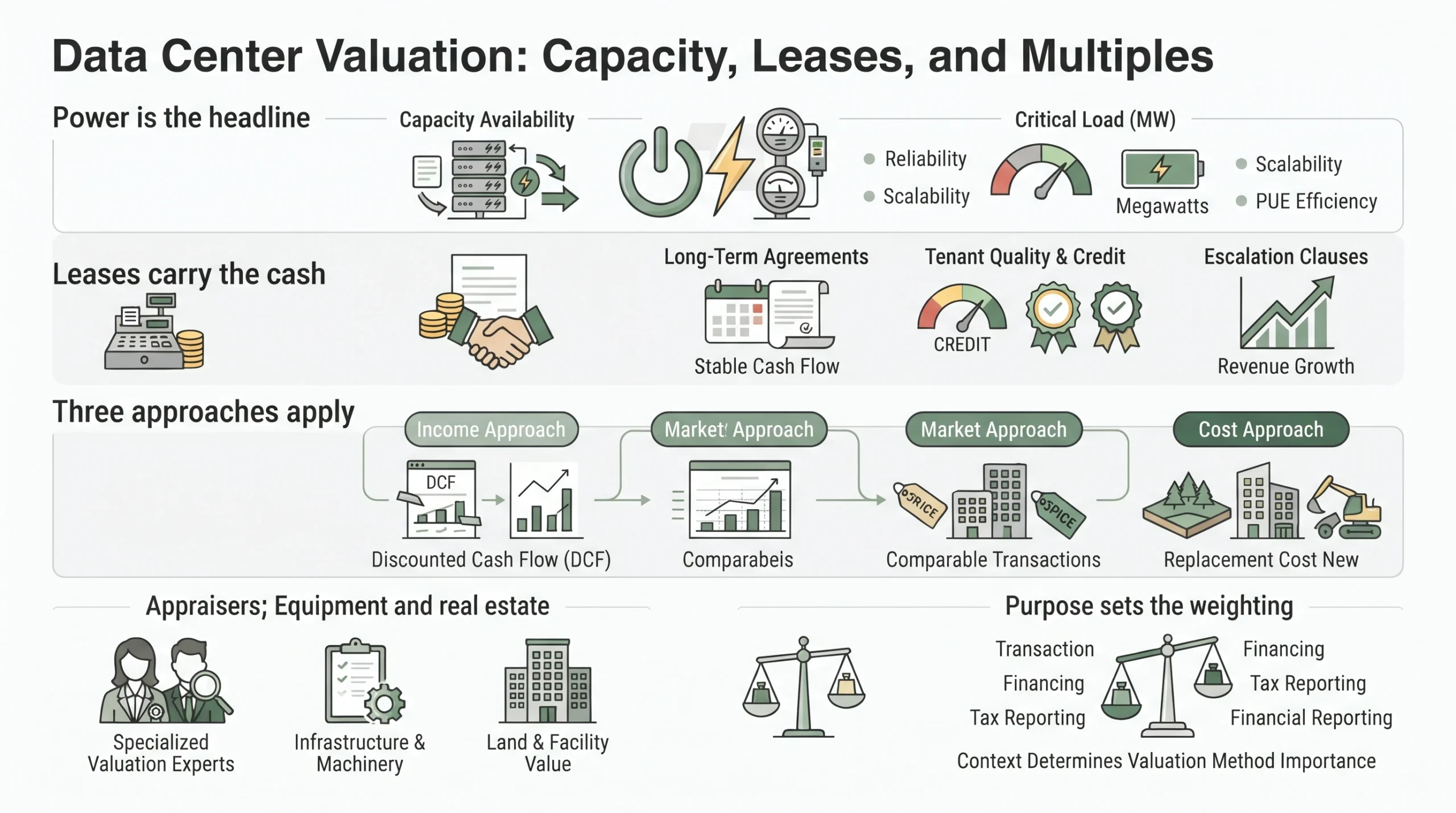
A data center’s value rests on three things: its power capacity, the leases in place, and the prices buyers pay for similar sites. Power, measured in megawatts, leads the list, and buyers often price deals on a per-megawatt basis. Leases carry the cash flow, so their term, tenant credit, and rent escalators shape how stable that cash flow is. Appraisers apply the income, market, and cost approaches, then weigh the results. A data center is not ordinary real estate, because its value comes from power, cooling, fiber, and signed contracts rather than the building shell.
Sofer Advisors builds these valuations for owners, lenders, and investors.
This guide explains the methods appraisers use, the drivers that move value, and the traps to avoid.
Key Takeaways
- Power is the headline metric. Capacity in megawatts, and how well it is used, drives most of the value.
- Leases carry the cash flow. Term, tenant credit, and rent escalators shape how stable that cash flow is.
- Three approaches apply. Appraisers use the income, market, and cost methods, then weigh the results.
- Equipment and real estate differ. Servers and cooling gear age fast, while the land and shell often hold value.
- Purpose sets the weighting. Tax work, lending, and deals can each lean on a different method.
Why does data center valuation matter?
A clear value supports real decisions. Owners use it to plan a sale, settle a tax position, or raise capital. Each of these needs a number that holds up to review. A guess will not survive an audit or a court.
Deals are the common trigger. When a buyer acquires a site, accounting rules require a purchase price allocation under ASC 805. The total price is split across land, building, equipment, and intangible assets. Each bucket is then tracked on its own. Later, the buyer tests goodwill for impairment under ASC 350. Both steps depend on a sound valuation.
Lenders want one too. Data centers cost a great deal to build, so the financing is large. A lender needs a defensible value before it extends that credit. A clear appraisal lowers the risk on both sides of the loan.
Owners also use valuations to manage property tax. A local authority can over-assess a site. A supported value gives the owner grounds to appeal. The result can be a real saving on the yearly tax bill. A careful appraisal pays for itself in these cases.
What drives the value of a data center?
Power leads the list. Capacity is measured in megawatts, or MW. More usable power means more computing a site can host. That, in turn, means more rent it can earn. Buyers often price deals on a per-MW basis for this reason.
Efficiency matters next. Power usage effectiveness, or PUE, is a key metric. It compares the total energy a site draws to the energy that reaches the servers. A figure near 1.0 is very efficient. A better PUE means lower running costs and stronger margins.
Leases shape the cash flow. Many data centers use triple-net leases. Under those, the tenant pays the tax, the insurance, and the upkeep. That leaves the owner with cleaner income. Long terms and built-in rent escalators make that income more predictable.
Tenant quality matters just as much. A lease backed by a large cloud provider is worth more than one with a weak tenant. The reason is simple. Strong credit means the rent is far more likely to be paid in full. Appraisers study each tenant before they trust the cash flow.
Reliability adds value too. The Uptime Institute rates facilities by tier, from Tier I to Tier IV. Higher tiers have more backup power and cooling. They suffer less downtime as a result. Tenants pay more for that assurance, so higher tiers can command higher rent.
Location and connectivity round out the picture. Access to cheap power, strong fiber, and fast network routes all lift demand. Sites near major fiber hubs tend to attract the best tenants. Demand from cloud and AI workloads has made these features more valuable than ever.
What valuation methods apply to data centers?
Appraisers rely on three standard approaches. Each looks at value from a different angle. A strong report uses more than one and compares the results.
The income approach values the cash the site produces. The analyst builds a discounted cash flow, or DCF, model from the contracted lease income. Future rent is projected year by year. Each year is then discounted back to today’s dollars. This method fits operating sites with stable, long-term tenants.
The market approach compares the site to others. The analyst studies recent sales of similar facilities. Pricing may be shown per MW, per kilowatt, or as an EV/EBITDA multiple. The method works best when good comparable sales exist. The analyst must still adjust for differences between the sites.
The cost approach measures what it would take to rebuild. It adds the cost of the land, the shell, and the power and cooling systems. It then subtracts depreciation for wear and age. This method fits new builds and highly specialized sites with little sale data.
How do the income, market, and cost approaches differ?
Each method answers a different question. The income approach asks what the cash flow is worth. The market approach asks what buyers have actually paid. The cost approach asks what it would cost to replace the asset. The table below sums up the fit.
| Approach | Primary basis | Best used for |
|---|---|---|
| Income | DCF of contracted lease income | Operating sites with stable tenants |
| Market | Comparable sales, per-MW or EV/EBITDA | Sites with good transaction data |
| Cost | Replacement cost less depreciation | New builds and specialized sites |
The purpose of the report guides the weighting. A stable, leased site leans on the income approach. A site still under construction leans on the cost approach. When sale data is strong, the market approach carries more weight. There is no single right answer for every case.
The analyst then reconciles the results. The three methods rarely agree to the dollar. Judgment decides how much weight each one earns. The final figure should reflect both the physical plant and the income it earns. A report that shows this reasoning is far easier to defend.
How are real estate and equipment valued separately?
A data center holds very different asset types. The appraisal should value them apart. This split matters for both tax and financial reporting. Mixing them leads to errors that an auditor will catch.
Real estate is the land and the building shell. It tends to hold its value over time. It can even rise as nearby demand grows. Its useful life is long, so it depreciates slowly.
Equipment is a different story. Servers, cooling units, and power gear age fast. They can lose value quickly as technology moves on. Their useful life is short. Depreciation on this gear is therefore steep.
There is also intangible value. Signed customer contracts and operating know-how let the site earn more than its hardware alone. Appraisers call this business enterprise value. It reflects the going concern, not just the bricks and the boxes.
Keeping these three buckets apart supports a clean purchase price allocation under ASC 805. It keeps depreciation schedules correct for tax. It also keeps property tax filings accurate. A clear split protects the owner if a sale or an audit follows.
What makes data center valuation difficult?
Fast obsolescence is the first challenge. Equipment can fall behind well before a building wears out. The model must reflect the ongoing spending needed to keep the site current. Skip that, and the value will look too high.
Comparable sales are scarce. Each site has its own power setup, tenant mix, and location. A direct price match is rare. The analyst must adjust for these gaps rather than copy a headline figure from one deal.
Power cost is volatile. Energy prices swing, and they drive a large share of operating cost. A single guess can throw off the whole model. A sound analysis tests a range of power-cost assumptions instead.
Multi-tenant sites add complexity. A colocation facility serves many clients under different contracts. The analyst must study tenant credit and churn. Only then can the model judge how stable the income really is. The going-concern value can also overlap with the plain real estate value. A skilled appraiser must keep those two figures apart.
Frequently Asked Questions
How is power capacity used to value a data center?
Capacity is measured in megawatts, or MW. It sets the ceiling on how much computing a site can host. It also sets how much rent the site can earn. Buyers often price deals on a per-MW or per-kilowatt basis. More usable, contracted power generally means a higher value.
What is PUE, and why does it affect value?
PUE stands for power usage effectiveness. It compares the total energy a site draws to the energy that reaches the servers. A figure near 1.0 is very efficient. A better PUE means lower running costs. Lower costs lift margins, and that supports a higher value.
Which valuation approach is best for a data center?
No single method is best on its own. An operating site with stable leases usually leans on the income approach. A new build often leans on the cost approach. The market approach helps most when good sale data exists. A strong report uses more than one and reconciles them.
How do leases affect a data center’s value?
Leases carry the cash flow, so their terms drive value. Long terms and rent escalators make income more predictable. Triple-net structures push operating costs onto the tenant. Strong tenant credit, such as a major cloud provider, raises the value of that income.
What is the Uptime Institute tier system?
The Uptime Institute rates reliability from Tier I to Tier IV. Higher tiers have more backup power and cooling. They face less downtime as a result. Tenants pay more for higher tiers. That premium can lift both the rent and the value.
How does AI demand change data center values?
AI and cloud workloads need large amounts of power. They also need dense, well-cooled computing. That has pushed demand for high-capacity sites higher. Sites that can deliver more power, and cool it well, are in strong demand. This can support both rents and sale prices.
Why is a data center valued differently from normal real estate?
Normal property value tracks the land and the building. A data center’s value tracks its power, cooling, fiber, and signed leases. The shell matters far less than the capacity it supports. That is why specialized methods and metrics apply to these sites.
What accounting rules apply to data center valuations?
Two rules come up often. ASC 805 governs how a buyer allocates a purchase price across assets. ASC 350 governs goodwill impairment testing after the deal. Appraisers also follow USPAP, the professional standard for valuation work. Together these keep the report credible. A valuation that follows them is far easier to defend before a tax authority or a court.
Related Case Studies
- Georgia Manufacturing Company Valuation: EBITDA Multiples and Market Data
- Georgia Construction Company Valuation: Market Data and EBITDA Multiples for 2025-2026
- Retail Company Valuation Multiples: Complete Guide 2026
Executive Summary
Power is the headline metric. Capacity in megawatts, and how well it is used, drives most of the value. Leases carry the cash flow. Term, tenant credit, and rent escalators shape how stable that cash flow is. Three approaches apply. Appraisers use the income, market, and cost methods, then weigh the results. Equipment and real estate differ. Servers and cooling gear age fast, while the land and shell often hold value. Purpose sets the weighting. Tax work, lending, and deals can each lean on a different method.
What Should You Do Next?
Start by gathering your lease schedule, your power capacity, and your recent operating costs. Those inputs drive every approach. If a sale, a loan, or a tax filing is near, a defensible valuation protects your position. Sofer Advisors provides independent data center valuations, led by David Hern CPA ABV ASA CVA. Schedule a consultation to discuss your site.
People Also Read
- Medical Practice Valuation Multiples 2025-2026: Complete Guide
- Construction Company Valuation Multiples by Trade
About the Author
This guide was prepared by David Hern CPA ABV ASA CVA, founder of Sofer Advisors, a business valuation firm headquartered in Atlanta, GA serving clients across the United States. David holds accreditations as an Accredited Senior Appraiser (ASA) and is Accredited in Business Valuation (ABV), credentials recognized by the IRS, SEC, and FINRA, and is also a Certified Valuation Analyst (CVA). David has served as an expert witness in dozens of cases across multiple jurisdictions, and Sofer Advisors is an Inc. 5000 honoree in 2024 and 2025 with 240+ five-star Google reviews.
For professional business valuation services, visit soferadvisors.com/about-us/ or contact Sofer Advisors at soferadvisors.com/contact-us/.
Disclaimer: This content is for informational purposes only and does not constitute professional valuation advice. Business valuation conclusions depend on specific facts and circumstances. Contact Sofer Advisors for guidance regarding your specific situation.