


Last Updated: July 2026
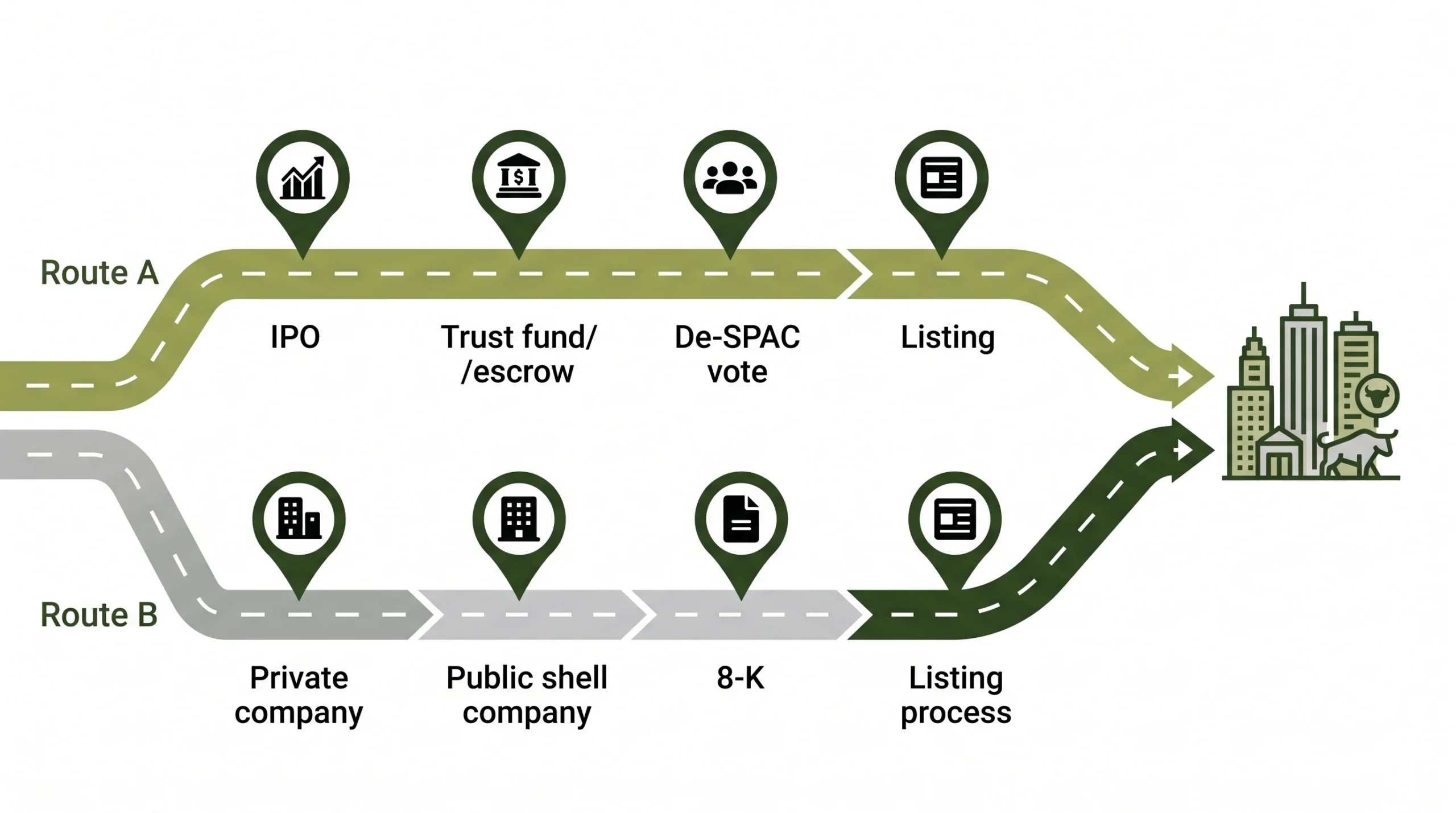
A special purpose acquisition company, or SPAC, is a shell entity formed to raise capital through an IPO in order to acquire an existing private business. A reverse merger works the other way: a private company acquires a public shell to gain immediate access to public trading. Both serve as alternatives to a traditional IPO for private firms moving into public markets.
Sofer Advisors provides neutral valuation insight for entities weighing these complex deals. With seven years in business and 180+ five-star Google reviews, it helps owners analyze the financial implications of a go-public strategy. Its analysts have guided clients through many advisory needs, including 11+ expert-witness cases with court testimony across multiple states. That background helps founders weigh the costs and benefits of each structure before committing.
Market data shows why these paths draw scrutiny. SPAC IPO proceeds fell sharply after their 2021 peak, a major shift in sentiment for this strategy, per PitchBook. Understanding these trends helps stakeholders judge whether a public listing fits their growth plan. Owners must balance regulatory compliance against sudden market shifts that affect liquidity.
Key Takeaways
- Different capital source: SPACs use IPO trust funds to pay for a deal, while reverse mergers often require the target to raise its own capital.
- Valuation reliability: SPAC pricing is negotiated privately before closing, while reverse merger value stays tied to the public trading history.
- Speed versus liabilities: reverse mergers list fast, but they carry the legal and financial history of the existing shell.
- Compliance: both are IPO alternatives that require rigorous reporting, including PCAOB-audited financial statements.
- Dilution: both dilute original owners, and SPACs add sponsor promotes and warrants that reshape the capital stack.
Each structure offers unique advantages and requirements based on your growth and liquidity goals. The sections below cover how these paths affect valuation and reporting.
What is a Special Purpose Acquisition Company (SPAC)?
A SPAC is a publicly traded blank-check company formed to raise capital via an IPO in order to acquire a private firm. It has no commercial operations at formation. Its job is to pool investor funds and find a target within a set window, usually 18 to 24 months. Our guide to how SPACs work covers the mechanics.
Merging the blank-check company with the target is known as a de-SPAC transaction. In this phase, the target goes through detailed vetting for public-market readiness. Once an agreement is reached, stakeholders approve the deal through a formal shareholder vote. If the merger gains enough support, the target completes the transition. At closing, the final entity becomes a public company, often under a new ticker. This gives private firms an alternative route to public markets.
What is a traditional reverse merger?
A reverse merger is a deal where a private company’s shareholders acquire a controlling interest in a dormant public shell. It is a practical alternative to a standard IPO for entering public markets. The private company merges into the public entity, and its former owners receive most of the shell’s outstanding stock. After closing, the private entity’s operations trade under the public shell’s listing. This lets a private company go public without a lengthy, costly registration statement.
Companies often choose a reverse takeover because it is faster than a conventional offering. The private firm takes control of the ticker and the board of the shell. After the legal merger, the entity files a Form 8-K with the SEC to disclose the change in ownership and the nature of the deal. Sofer Advisors helps owners analyze the financial implications through its business valuation services. Valuing both the shell and the target is vital to set the right share exchange ratio.
How do capital and fundraising differ?
The core difference is that a SPAC is pre-funded with cash held in a trust account, while a reverse merger provides no initial capital at closing. Because the SPAC raises money in an IPO before finding a target, the cash is ready to fund the deal and provide operating capital right away. A private company in a reverse merger must find other ways to finance its growth.
To bridge that gap, many SPAC deals add PIPE financing, or Private Investment in Public Equity. This lets institutional investors commit extra capital at the time of the merger agreement. Companies finishing a standard reverse merger often face a harder search for post-merger financing. Securing those funds means showing performance and clear plans to private investors, so the company has enough cash to operate as a public entity.
Which path offers more valuation certainty?
SPAC deals generally offer more valuation certainty, because the price is set through a direct, negotiated valuation with the SPAC founders before the deal reaches the public. That avoids the sudden price swings often seen in a reverse merger. In a reverse merger, a private firm trades its shares for a public shell, tying its value to the market’s reception of the ticker. If the market reacts poorly, the value can drop fast in the first days of trading.
To confirm the price, the board typically hires a third party to issue a fairness opinion. That report gives an independent view of the negotiated terms and confirms the price aligns with market data. Sofer Advisors supports this with neutral assessments of the target. A technology company valuation often anchors these figures for growth firms.
Discuss your transaction valuation needs with a Sofer Advisors specialist to find the method best suited to your goals.
What are the key regulatory differences?
The key regulatory differences center on the intensity and timing of oversight from the SEC. SPACs face rigorous SEC review during the IPO and again through the de-SPAC process, so the target meets public requirements. Reverse mergers face scrutiny mainly after the fact, often through extensive filings by the new public entity that disclose the history and financials of the merged companies.
Regulators focus intensely on forward-looking statements in de-SPAC deals, because those projections often drive investor interest. For transparency, the SEC requires both paths to use PCAOB-audited financials, consistent with AICPA auditing standards, to give an accurate picture of public-company readiness. This keeps all parties compliant through each phase. Meeting these standards gives firms the credibility to trade on public exchanges while meeting ongoing investor expectations.
How do timelines and costs compare?
A de-SPAC transaction usually takes 3 to 6 months, while a reverse merger is the quickest route at 1 to 3 months. The faster reverse merger timeline is often offset by the work to clean up hidden shell liabilities, which can cause delays. The main cost items to weigh are:
- SPAC underwriting fees, legal costs, and a sponsor promote near 20% of post-merger equity
- Reverse merger costs to fix legal or tax issues attached to the shell
- Legacy debt or unresolved regulatory obligations on a shell’s balance sheet
- Dilution from warrants, promotes, and any post-merger capital raise
The sponsor promote is a major part of the dilution founders must accept in a SPAC. A reverse merger avoids SPAC underwriting fees, but an owner instead pays to fix the shell’s existing issues. Sofer Advisors assesses these costs during transaction planning, so owners can weigh the speed of a merger against the financial burden before proceeding.
Which path is right for your company?
The right path depends on your capital needs and the level of board scrutiny required. The table below compares the two routes head to head.
| Feature | SPAC | Reverse merger |
| Capital at closing | Yes; funded by IPO trust and PIPE | No; requires separate capital raises |
| Fairness opinion | Typically provided to the SPAC board | Generally not required by shell entities |
| Timeline to public | ~3 to 6 months post-target ID | Potentially fastest, ~1 to 3 months |
| Valuation certainty | Higher; negotiated upfront | Lower; depends on post-merger market |
Choosing means weighing the company’s capital needs and the scrutiny the board requires. Each structure carries distinct risks on dilution, compliance, and post-merger liquidity. SPACs saw shifting market conditions in recent years that demand careful modeling before a deal. Reverse mergers can be faster but often lack the immediate cash a well-capitalized SPAC sponsor brings. National firms like Alvarez & Marsal, Stout, and Kroll operate in this advisory space; Sofer Advisors brings the same rigor through The Sofer Difference, a phased process that helps the board fully grasp the valuation drivers and meet its fiduciary duties.
Go-public deals reward objective valuation and clean records. The questions below cover what founders ask most.
Frequently Asked Questions
Do SPAC stocks drop after a merger?
SPAC stock prices often face downward pressure after a merger closes. The drop frequently comes as early investors or PIPE participants exit to lock in gains. The shift from a speculative shell to an operating company also exposes the business to market scrutiny and new quarterly disclosure. Sofer Advisors includes post-transaction volatility in its analysis when advising owners on long-term value expectations.
What is the downside of a SPAC?
The main downside is significant dilution for early shareholders and the high cost of sponsor payouts. If a company misses its growth projections, the fixed costs of the SPAC structure can strain the balance sheet. Investors also face low liquidity or sudden price drops if redemption rates are high. Sofer Advisors evaluates these capital structure risks during the pre-transaction phase.
What happens if a SPAC does not merge?
If a SPAC fails to complete a merger within its window, it must liquidate. The funds in trust return to shareholders pro rata, often with accrued interest. Investors get their capital back but lose the opportunity cost of the holding period. Sofer Advisors helps stakeholders review the technical requirements of these liquidation processes for full compliance.
Is a reverse merger a good idea?
A reverse merger can be an efficient path to public markets for firms not ready for a traditional IPO. It gives faster access to capital and public trading than a standard registration. It also brings immediate reporting burdens under SEC rules. Sofer Advisors examines the long-term viability by benchmarking against industry financial metrics and historical deal data.
What is the main advantage of a SPAC over a traditional IPO?
A SPAC can present a forward-looking financial forecast in its documents, which a traditional IPO is restricted from doing. That lets companies market on growth potential rather than only historical earnings. It also offers a fixed entry price for investors. Sofer Advisors helps management prepare these projected models so they meet the defensibility standards institutional investors expect.
Can a private company be valued before a reverse merger?
Yes, and it should be. An independent valuation sets a baseline enterprise value, which is vital for negotiating a fair equity split with the shell. Sofer Advisors provides these independent valuations to support fair negotiation in the pre-merger phase.
Are reverse mergers still viable in 2026?
Reverse mergers remain viable in 2026 for companies that meet specific liquidity and regulatory thresholds. Market interest cycles shift, but these deals offer a legitimate route to public status through a faster path. Success depends on choosing a high-quality shell and keeping clean financial records. Sofer Advisors tracks current private-to-public trends to give firms updated insight.
Why did the SPAC market cool after the 2021 boom?
The SPAC market cooled as regulators tightened oversight and investors grew more selective on target quality. The 2021 surge was followed by high redemption rates and weak post-merger performance, which soured sentiment. Participants now prioritize profitability over pure growth, leading to more rigorous due diligence. Sofer Advisors keeps a neutral view by focusing on the underlying financial health of the companies involved.
How much does a fairness opinion for a SPAC transaction cost?
A fairness opinion for a SPAC transaction from Sofer Advisors runs $15,000 to $40,000, based on its published engagement data, with complex targets and deep industry research at the higher end. Cost varies with the target’s complexity and the timeline. For a quote tied to your deal, request an engagement estimate with your deal terms and target financials.
Related Case Studies
- How Vertical SaaS Companies Are Valued: ARR Multiples by Niche
- DTC Ecommerce Valuation: Why Multiples Compressed in 2026
- Revenue Multiple Valuation: When to Use It Instead of EBITDA
Executive Summary
A SPAC and a reverse merger are two routes to public markets, and they differ most on capital and certainty. A SPAC is pre-funded from IPO trust plus PIPE, and its price is negotiated upfront, which brings more valuation certainty but heavier SEC review and sponsor dilution near 20% of post-merger equity. A reverse merger is faster, often 1 to 3 months, but provides no new cash and ties value to the market while carrying the shell’s legal and financial history. Both require PCAOB-audited financials. To prepare, engage legal and financial counsel, assess your balance sheet, and set an independent baseline value before negotiating with sponsors or shell owners.
What Should You Do Next?
Engage legal and financial counsel to define your capital needs and audit readiness, then assess your balance sheet alongside a professional valuation to confirm you meet SEC reporting standards. Set an independent baseline value now, since it protects your ownership when negotiating terms with sponsors or shell owners.
David Hern CPA ABV ASA, founder of Sofer Advisors, provides neutral valuation and fairness opinions for public-market transitions. Schedule a free consultation to discuss your situation.
People Also Read
- Adjusted EBITDA vs EBITDA: Key Differences Explained
- Normalized EBITDA: Definition, Formula, and Why It Matters
About the Author
This guide was prepared by David Hern CPA ABV ASA, founder of Sofer Advisors, a business valuation firm headquartered in Atlanta, GA serving clients across the United States. David holds dual accreditations as an Accredited Senior Appraiser (ASA) and is Accredited in Business Valuation (ABV), credentials recognized by the IRS, SEC, and FINRA. He also holds the Certified Exit Planning Advisor (CEPA) designation. With 15+ years of valuation experience, David has served as an expert witness in 11+ cases across multiple jurisdictions and built Sofer Advisors into an Inc. 5000-recognized firm with 180+ five-star Google reviews. Its full W2 employee team maintains subscriptions to all major valuation databases and operates under a next business day response policy.
For professional business valuation services, visit soferadvisors.com/about-us/ or contact Sofer Advisors at soferadvisors.com/contact-us/.
Disclaimer: This content is for informational purposes only and does not constitute professional valuation advice. Business valuation conclusions depend on specific facts and circumstances. Contact Sofer Advisors for guidance regarding your specific situation.









