


Last Updated: November 2026
The One Big Beautiful Bill Act changed estate planning by making the high federal estate and gift tax exemption permanent. Congress passed the law in 2025, and it ended the scheduled cut that was set to shrink the exemption after 2025. For years, families rushed to give away wealth before that deadline arrived. The deadline is now gone. The new goal is patience, not speed.
The team at Sofer Advisors values business interests for owners, CPAs, and attorneys who plan gifts and estates.
This guide explains what the law does, the numbers for 2026, and how business owners can plan the smart way.
Key Takeaways
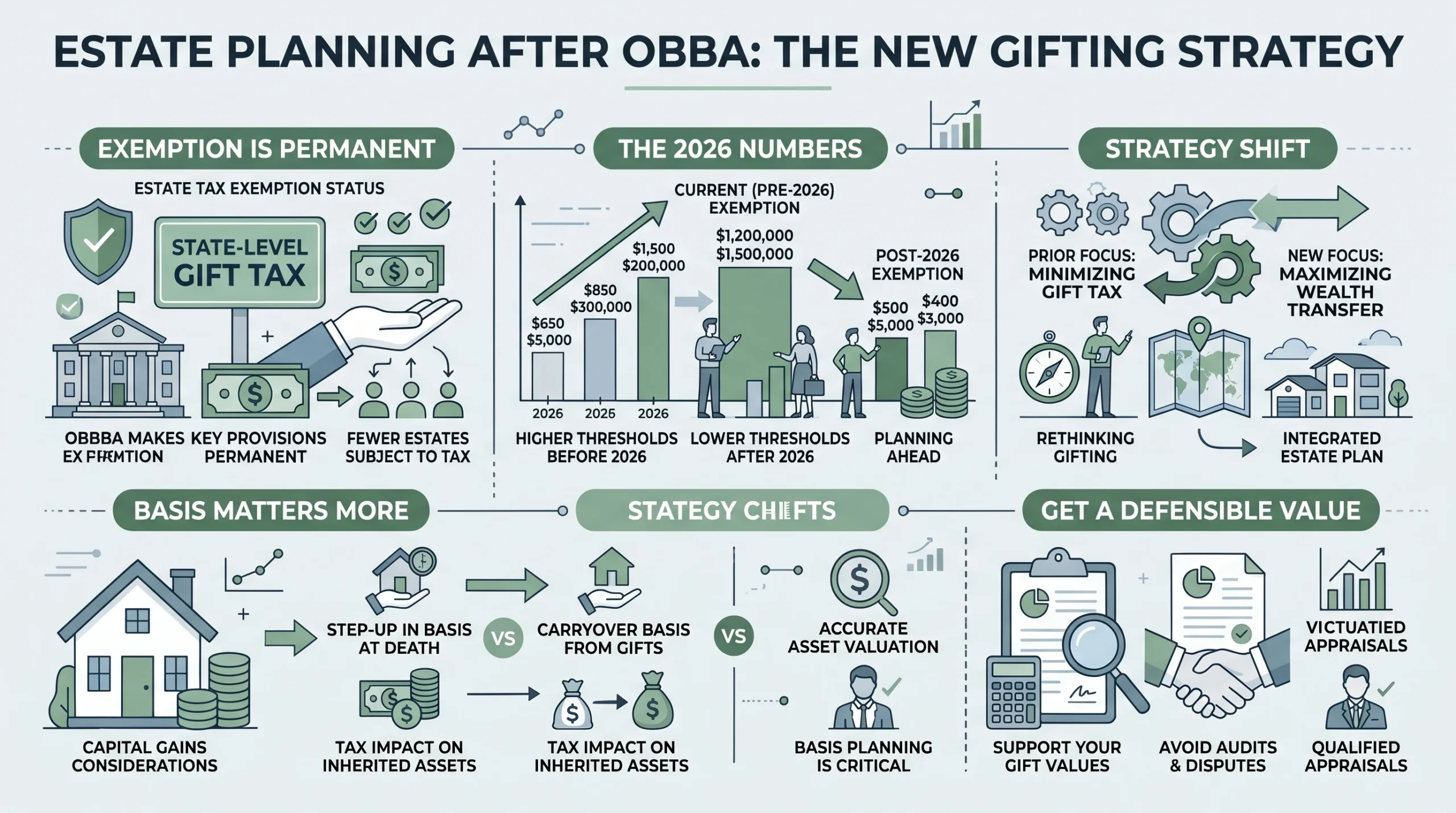
- Exemption is permanent: OBBBA kept the high federal estate and gift tax exemption in place and ended the scheduled cut.
- The 2026 numbers: The basic exclusion is $15,000,000 per person and the annual gift exclusion is $19,000 per recipient, per the IRS.
- Strategy shift: The old race to use the exemption is over. The focus moves to long-term gifting, basis planning, and valuation discounts.
- Basis matters more: Gifting passes your cost basis to heirs, while assets held until death get a step-up. The choice drives real tax.
- Get a defensible value: Gifts of business interests need a qualified, independent valuation to hold up with the IRS.
What did OBBBA change for estate and gift taxes?
OBBBA is the One Big Beautiful Bill Act. It became law in 2025. Before it passed, the large estate and gift tax exemption was temporary. It was due to fall by about half after 2025. OBBBA cancelled that cut. The high exemption is now permanent.
This matters for one reason. The old plan was built on the fear of losing the exemption. People gave early to lock it in. Now the exemption is not going away. So the pressure to act fast is gone.
The change does not remove the estate tax. Large estates can still owe it. But owners now have time. They can plan over years, not weeks.
How big is the exemption in 2026?
Two numbers drive most gift planning. Both come from the IRS.
The federal estate and gift tax basic exclusion amount is $15,000,000 per person for 2026. The IRS set this figure in Revenue Procedure 2025-32. A married couple can shield up to $30,000,000 between them. OBBBA made this exemption permanent and indexes it for inflation.
The annual gift tax exclusion is $19,000 per recipient for 2026, per the IRS. You can give that amount to any number of people each year. These gifts do not use your lifetime exemption. They also do not need a gift tax return.
The two limits work together. The table below shows how they differ.
| Feature | Annual gift exclusion | Lifetime exemption |
|---|---|---|
| Amount for 2026 | $19,000 per recipient | $15,000,000 per person |
| How it resets | Every year | One lifetime total |
| Reporting | None if under the limit | Form 709 tracks the use |
| Best use | Steady, smaller gifts | Large transfers of business interests |
Why does a permanent exemption change your strategy?
The old strategy had one word: hurry. Owners feared the 2026 cut. They gave large gifts early to use the exemption before it shrank. That race is over.
The new strategy is different. It rewards patience and design. You no longer gift just to beat a deadline. You gift to meet a goal.
Three ideas now lead the plan. The first is long-term gifting, spread over many years. The second is basis planning, which decides what your heirs owe later. The third is valuation discounts on gifted business interests. Each one gets its own look below.
How can small annual gifts add up?
Annual gifts look small. Over time they do real work. Each year you can give $19,000 to as many people as you like. A married couple can combine their limits. Together they can give $38,000 to each recipient. This move is called gift-splitting.
Picture a family with three children. Two parents can move $114,000 to the next generation in a single year. None of it touches the lifetime exemption. None of it needs a gift tax return. Repeat that pattern for a decade and the total grows large.
There is another exclusion that many owners miss. You can pay someone’s tuition or medical bills directly with no gift tax. The payment must go straight to the school or the provider. That amount does not count against any limit. This rule can move real money to children and grandchildren over the years.
These steady gifts fit the new, patient strategy. They shrink the taxable estate year by year. They also let you watch the results and adjust. For business owners, small yearly gifts of company stock can shift ownership to heirs on a planned schedule.
How do gifts affect your heirs’ tax basis?
Basis is the starting point for figuring a capital gain. It sets the tax when an asset is later sold. OBBBA did not change how basis works. But a permanent exemption puts basis at the center of the plan.
Here is the trade-off. When you give an asset during life, your heir takes your basis. This is called carryover basis. If the asset has grown a lot, your heir may owe a large gain on a future sale.
When an asset passes at death, the rule changes. Your heir’s basis resets to the fair market value on the date of death. This is the step-up in basis. The built-in gain can disappear.
So gifting is not always best. If an estate sits well under the exemption, holding an asset until death may save tax. If an estate is large, moving future growth out of it can still win. The right call depends on the numbers.
What role do valuation discounts play now?
Many business owners hold stock that is hard to sell. A minority stake cannot control the company. A private interest has no ready market. These facts lower what the interest is worth.
Appraisers reflect this with two adjustments. A discount for lack of control (DLOC) applies when the owner cannot direct the business. A discount for lack of marketability (DLOM) applies when the interest is hard to sell. Together they can lower the taxable value of a gifted interest.
A lower value means you use less of your exemption per share. You can transfer more of the company for the same tax cost. This is a core reason to gift business interests rather than cash.
The IRS reviews these discounts closely. A gift of a business interest needs a qualified, independent appraisal. The value must follow fair market value standards under Revenue Ruling 59-60. Sofer Advisors prepares appraisals built for this kind of review. A strong report holds up. A weak one invites a challenge.
Which trusts help move a business out of your estate?
Trusts let you give an asset and still guide how it is used. Two tools fit the new landscape well.
A Spousal Lifetime Access Trust, or SLAT, is an irrevocable grantor trust. One spouse funds it for the benefit of the other. The assets leave the taxable estate. Future growth leaves with them. Yet the couple can still reach the funds through the beneficiary spouse.
A Grantor Retained Annuity Trust, or GRAT, works on appreciation. You place an asset in the trust and take back fixed payments for a term. Growth above an IRS set rate passes to your heirs. The gift tax cost can be very low.
Both tools shift future value out of the estate today. They work best with a clear valuation and careful legal drafting. Your estate attorney and tax advisor should design the structure together.
How does portability protect a surviving spouse?
Portability lets a surviving spouse use a late spouse’s unused exemption. The unused amount is called the DSUE, short for deceased spousal unused exclusion. It is not automatic.
To claim it, the estate must file a federal estate tax return, Form 706. The return is due after the first spouse dies, even when no tax is owed. A timely election can preserve millions in exemption. Missing it can waste that amount for good.
With the exemption now permanent, portability is a steady planning tool. It gives couples a simple way to use both exemptions. A trust can still offer more control over how assets pass to the next generation. It can also protect future growth and guard assets from a beneficiary’s creditors. Many plans use both tools side by side.
Frequently Asked Questions
What is OBBBA?
OBBBA is the One Big Beautiful Bill Act, a federal tax law passed in 2025. It made the high federal estate and gift tax exemption permanent. It also removed the cut that was set to take effect after 2025.
What is the estate and gift tax exemption for 2026?
The basic exclusion amount is $15,000,000 per person for 2026, according to the IRS in Revenue Procedure 2025-32. A married couple can shield up to $30,000,000. The amount is indexed for inflation.
How much can I give someone in 2026 without filing a gift tax return?
You can give up to $19,000 per recipient in 2026. This is the annual gift tax exclusion set by the IRS. Gifts at or below that amount need no return. Larger gifts require Form 709 and use part of your lifetime exemption.
Did OBBBA lower the estate tax exemption?
No. OBBBA did the opposite. It kept the exemption high and made it permanent. The earlier law would have cut the exemption by about half after 2025.
What is the difference between the annual exclusion and the lifetime exemption?
The annual exclusion is a per recipient amount you can give each year with no reporting. The lifetime exemption is the total you can transfer tax free over your life and at death. Gifts above the annual exclusion reduce your lifetime exemption.
Is it better to gift a business interest now or leave it at death?
It depends on the size of the estate and how fast the asset grows. Gifting moves future growth out of the estate but passes your cost basis to your heir. Leaving the asset at death gives your heir a step-up in basis. A valuation and a tax advisor can model both paths.
What is portability and how do I keep it?
Portability lets a surviving spouse use the late spouse’s unused exemption. To keep it, the estate must file Form 706 and make the election on time. The filing is required even when no estate tax is due.
Why do valuation discounts matter for gifting a business?
A minority or hard to sell interest is worth less than a simple slice of the whole. Discounts for lack of control and lack of marketability lower the taxable value of a gift. That lets you transfer more of the company while using less of your exemption.
Do I still need an estate plan if my estate is below $15 million?
Yes. An estate plan does more than cut estate tax. It directs who receives your assets, names guardians, and can lower income tax for your heirs. Some states also set their own estate tax below the federal limit.
Related Case Studies
- Estate Planning Business Valuation Georgia: Gift & Tax Compliance Guide
- Business Succession Planning Guide
- Selling a Business in Georgia: Complete Exit Planning Guide 2026
Executive Summary
OBBBA kept the high federal estate and gift tax exemption in place and ended the scheduled cut. The basic exclusion is $15,000,000 per person and the annual gift exclusion is $19,000 per recipient, per the IRS. The old race to use the exemption is over. The focus moves to long-term gifting, basis planning, and valuation discounts. Gifting passes your cost basis to heirs, while assets held until death get a step-up. The choice drives real tax. Gifts of business interests need a qualified, independent valuation to hold up with the IRS.
What Should You Do Next?
Start with a current value for your business interests, then review your trusts and shareholder agreements with your estate attorney and tax advisor. Sofer Advisors provides independent, defensible business valuations for estate and gift planning, led by David Hern CPA ABV ASA CVA. Schedule a free consultation to discuss your situation.
People Also Read
- Estate Freeze Valuation: Preferred Interests and 2701
- Promissory Note Valuation for Gift and Estate Tax
About the Author
This guide was prepared by David Hern CPA ABV ASA CVA, founder of Sofer Advisors, a business valuation firm headquartered in Atlanta, GA serving clients across the United States. David holds accreditations as an Accredited Senior Appraiser (ASA) and is Accredited in Business Valuation (ABV), credentials recognized by the IRS, SEC, and FINRA, and is also a Certified Valuation Analyst (CVA). David has served as an expert witness in dozens of cases across multiple jurisdictions, and Sofer Advisors is an Inc. 5000 honoree in 2024 and 2025 with 240+ five-star Google reviews.
For professional business valuation services, visit soferadvisors.com/about-us/ or contact Sofer Advisors at soferadvisors.com/contact-us/.
Disclaimer: This content is for informational purposes only and does not constitute professional valuation advice. Business valuation conclusions depend on specific facts and circumstances. Contact Sofer Advisors for guidance regarding your specific situation.









