

Last Updated: April 2026
A SPAC, or special purpose acquisition company, is a publicly traded shell company formed for the sole purpose of acquiring or merging with a private business, allowing that business to become publicly listed without conducting a traditional initial public offering. The SPAC raises capital from investors through its own IPO, deposits the proceeds into an interest-bearing trust account, and then uses that capital to fund a business combination with a privately held target company within a defined timeframe, typically 18 to 24 months. When the merger closes, the target company assumes the SPAC’s public listing and begins trading as a public company.
For business owners considering a liquidity event, a SPAC merger represents a distinct path to the public markets that differs from a conventional IPO in its timeline, structure, governance, and the business valuation process used to establish deal terms. Sofer Advisors, a nationally recognized business valuation firm headquartered in Atlanta, GA, regularly provides fairness opinions, business appraisals, and purchase price allocations for companies involved in SPAC transactions, ensuring that deal valuations are defensible to shareholders, the Securities and Exchange Commission (SEC), and acquiring parties.
Understanding how a SPAC works, how targets are valued, and what the de-SPAC merger process entails is essential for any business owner or founder evaluating whether a SPAC exit aligns with their goals, timeline, and valuation expectations.
The sections below break down the SPAC structure from IPO to closing, examine the valuation requirements at each stage, and identify what business owners should evaluate before pursuing a SPAC as an exit strategy.
Key Takeaways
- Shell Company Structure: A SPAC is a publicly listed blank check company with no operations, formed to raise IPO capital and use it to acquire a private business within 18 to 24 months.
- De-SPAC Merger: The business combination between a SPAC and its target is called the de-SPAC transaction; the target assumes the SPAC’s public listing and begins trading immediately after closing.
- Fairness Opinion Required: SPAC boards must obtain an independent fairness opinion confirming the merger consideration is fair from a financial point of view to shareholders before the deal goes to a vote.
- Valuation Drives the Deal: The agreed enterprise value of the target determines the equity split between SPAC shareholders and the target’s existing owners, the PIPE terms, and the post-merger capital structure.
- Redemption Rights: SPAC shareholders can redeem their shares at approximately $10 per share if they vote against the deal, providing a downside floor that traditional IPO investors do not have.
Each of these elements, from the blank check structure to the redemption mechanics and the required fairness opinion, shapes the economics of a SPAC deal for business owners on both sides of the transaction. The sections below examine each in detail.
What Is a SPAC?
A special purpose acquisition company is a blank check company that raises money from public investors through an IPO, deposits the proceeds into a trust account, and then searches for a private company to acquire or merge with. The SPAC has no operations, no employees, and no revenue at the time of its IPO. It exists solely to deploy its trust capital into a business combination. If the SPAC fails to complete an acquisition within its defined window, typically 18 to 24 months, it liquidates and returns the trust funds to shareholders with interest.
SPACs are formed and managed by a sponsor group, typically an experienced operator, private equity team, or industry executive, who contributes a nominal amount of capital in exchange for 20% of the SPAC’s equity in the form of founder shares, commonly called the “promote.” The sponsor’s economic return depends entirely on completing a successful business combination at a valuation that preserves value for public shareholders. Most SPACs disclose a target industry or stage thesis in their IPO prospectus, giving investors a general sense of where the trust capital is likely to be deployed.
How Does a SPAC Work?
A SPAC operates in two distinct phases. In the first phase, the SPAC completes its own IPO, issuing units that typically consist of one share of common stock and a fraction of a warrant to purchase additional shares at a fixed price. The IPO proceeds, minus underwriting fees, are placed in a trust account invested in short-term government securities. Investors in the SPAC hold a protected position: they can vote on the proposed business combination and redeem their shares for approximately $10 per unit regardless of how they vote, providing a built-in downside floor.
In the second phase, the de-SPAC transaction, the SPAC sponsor identifies a target company, negotiates the deal terms including the implied enterprise value, and presents the business combination to SPAC shareholders for approval. The target company’s existing shareholders receive SPAC shares or a cash-and-stock combination in exchange for their ownership interest. Institutional capital in the form of PIPE, or Private Investment in Public Equity, is typically committed alongside the deal to supplement trust funds and cover redemptions. The target assumes the SPAC’s listing, and the combined entity begins trading as a public company. According to the SEC’s Final SPAC Rule (2024), SPACs must now provide shareholders with enhanced disclosures including reviewed financial projections, underwriter conflict disclosures, and a more rigorous fairness analysis before the shareholder vote, adding both compliance time and cost to the de-SPAC process.
What Are the Stages of a SPAC Transaction?
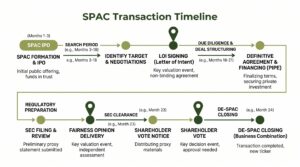
A SPAC transaction follows a defined sequence from the SPAC’s own IPO through the closing of the business combination. Each stage carries distinct legal, financial, and valuation requirements, and the full timeline from SPAC IPO to de-SPAC closing typically spans 12 to 24 months. Business owners evaluating a SPAC exit should understand what happens at each step before signing any letter of intent, since the obligations introduced at the SEC review and fairness opinion stages directly affect deal timing, cost, and the final proceeds available to the selling shareholders:
- SPAC IPO: The blank check company completes its IPO, raising trust capital from institutional and retail investors. Units are typically priced at $10 per share.
- Target search: The sponsor identifies and conducts due diligence on potential acquisition targets within the SPAC’s stated industry focus.
- Letter of intent: The SPAC and target execute a non-binding LOI establishing the proposed enterprise value, equity split, and deal structure.
- Definitive agreement: The parties sign the business combination agreement, which triggers the SEC review process and preparation of the proxy or registration statement.
- PIPE financing: Private Investment in Public Equity commitments from institutional investors are secured to supplement trust capital and offset expected share redemptions at closing.
- SEC review and proxy: The SEC reviews the registration statement, which includes audited target financials, projections, and the fairness opinion. Shareholders receive the proxy and vote on the transaction.
- De-SPAC closing: The business combination closes, the target becomes a public company, and the SPAC sponsor’s founder shares convert into publicly tradeable equity.
How Is a Target Company Valued in a SPAC Deal?
Valuing a target company in a SPAC transaction is a multistep process that must satisfy both the negotiating parties and the regulatory requirements imposed by the SEC. The agreed enterprise value is negotiated between the SPAC sponsor and the target company’s management using standard valuation approaches: the income approach through discounted cash flow analysis, the market approach using public company comparable multiples and precedent M&A transactions, and in asset-heavy businesses, the asset approach. The result becomes the foundation for every economic term in the deal.
According to the AICPA Forensic and Valuation Services section (2023), fairness opinions in de-SPAC transactions must be independently prepared and must confirm that the deal price is fair from a financial point of view to non-redeeming shareholders, a standard that requires the appraiser to assess whether the agreed enterprise value falls within a reasonable range of independently derived values. This independence requirement is particularly important because the SPAC sponsor and target management share a mutual interest in closing the deal rather than returning trust capital to shareholders. National transaction advisory firms such as Kroll and Stout provide fairness opinions in large-cap SPAC transactions; for middle-market deals, credentialed valuation firms like Sofer Advisors provide more direct access to ABV and ASA credentialed appraisers and a faster engagement turnaround than the structured processes of larger advisory practices.
Schedule your free consultation with Sofer Advisors to understand how your company would be valued in a SPAC transaction and what a fairness opinion engagement involves, and discover The Sofer Difference.
After closing, a purchase price allocation under ASC 805 is required to assign the deal consideration across the target’s tangible and intangible assets, creating post-merger valuation work that is the acquiring entity’s responsibility. Key factors that affect the enterprise value negotiated in a SPAC deal include:
- Revenue and EBITDA multiples: The sponsor benchmarks the target against comparable public companies to establish a defensible entry multiple that will hold up under SEC review.
- Projected financial performance: SPAC deals rely heavily on management forward projections for revenue and EBITDA, which must be disclosed in the proxy and reviewed by auditors.
- PIPE terms: The willingness of PIPE investors to commit capital at the agreed valuation serves as an independent market check on the negotiated deal price.
- Redemption risk: High expected redemptions reduce the cash available to the target, which can affect deal structure, PIPE size, and the final agreed valuation.
Each of these inputs interacts with the others, and small changes in projected EBITDA or expected redemption rates can shift the enterprise value negotiated in the LOI by millions of dollars. Establishing an independent baseline valuation before entering SPAC negotiations gives business owners a defensible position and strengthens the fairness opinion process that follows.
How Do SPACs Compare to a Traditional IPO?
SPACs and traditional IPOs both result in a company becoming publicly listed, but they differ significantly in timeline, cost, valuation certainty, and governance. A traditional IPO requires the company to file an S-1 registration statement with the SEC, complete a multi-week roadshow with institutional investors, and allow the market to set the IPO price through an underwriting process that typically takes six to twelve months. The IPO price is set by market demand on a single day, creating pricing uncertainty for selling shareholders who cannot lock in valuation terms in advance.
A SPAC merger allows the target company to negotiate a fixed enterprise value with the SPAC sponsor before any public disclosure, providing more valuation certainty upfront. According to SPAC Research (2024), the average time from SPAC IPO to completed business combination was approximately 16 months in 2023, with de-SPAC transactions closing as quickly as four to six months from the signing of the definitive agreement, compared to the six-to-twelve-month timeline of a traditional IPO.
| Feature | SPAC Merger | Traditional IPO |
|---|---|---|
| Valuation certainty | Negotiated in advance | Set by market at pricing |
| Timeline to public listing | 4-8 months from LOI | 6-12 months from S-1 filing |
| Ability to share projections | Yes, disclosed in proxy | Restricted during quiet period |
| Shareholder redemption rights | Yes, at approximately $10/share | No downside protection |
| Sponsor dilution | 20% founder share promote | No sponsor dilution |
| SEC review document | Proxy or registration statement | S-1 registration statement |
What Are the Risks of a SPAC for Business Owners?
SPACs carry specific risks for target company owners that differ from a traditional M&A sale or IPO. High redemption rates from SPAC shareholders reduce the cash available to the target at closing, requiring larger PIPE commitments and creating uncertainty about the actual liquidity the business will receive from the transaction. The sponsor’s founder share promote dilutes the economic interest of the target’s existing shareholders by up to 20% from day one of trading, which can suppress the post-merger stock price and complicate future equity raises.
Target companies in SPAC transactions also inherit the full regulatory burden of being a public company immediately upon closing, including SEC reporting obligations, Sarbanes-Oxley compliance requirements, and public market scrutiny of the financial projections used in the proxy. Business owners who negotiated an enterprise value based on aggressive forward projections face significant stock price pressure if those projections are not met in the quarters following the de-SPAC close. These structural risks make a thorough pre-deal business valuation and an independent fairness opinion essential, not optional, components of any SPAC transaction.
Frequently Asked Questions
What is a SPAC?
A SPAC, or special purpose acquisition company, is a publicly traded blank check company that raises capital from investors through its own IPO and uses those funds to acquire or merge with a private business. The SPAC has no operations at the time of its IPO. When the business combination closes, the target company becomes publicly listed by merging into the SPAC, bypassing the full traditional IPO process. This combined transaction is called the de-SPAC merger.
How does a SPAC work step by step?
A SPAC raises money through its own IPO, places the proceeds in a trust account, and searches for a private acquisition target within 18 to 24 months. The sponsor negotiates a deal with the target, files a registration statement with the SEC, and puts the business combination to a shareholder vote. Shareholders who approve receive equity in the combined public company; those who oppose can redeem their shares at approximately $10 per share. Once the vote passes and redemptions clear, the target becomes a publicly traded company.
What is the risk of investing in a SPAC?
The primary risks are sponsor conflicts of interest, dilution from the 20% founder share promote, and the risk that the target’s post-merger financial performance falls short of the projections used to negotiate the deal price. For business owners selling into a SPAC, the key risks are high shareholder redemptions reducing available cash at closing, the burden of immediate public company compliance, and stock price pressure if aggressive forward projections disclosed in the proxy are not achieved in the quarters following close.
How is a company valued in a SPAC transaction?
The enterprise value is negotiated between the SPAC sponsor and the target’s management using income, market, and asset-based valuation approaches. An independent fairness opinion confirms the deal price is fair from a financial point of view to SPAC shareholders. After closing, a purchase price allocation under ASC 805 assigns the deal consideration across the target’s tangible and intangible assets, recognizing goodwill and any identified intangibles. Both the fairness opinion and the post-merger PPA require credentialed appraisers experienced in public company transactions.
Do SPACs require a business valuation?
Yes. SPACs require an independent fairness opinion that includes a business valuation analysis confirming the agreed enterprise value is within a reasonable range of fair value. The SEC’s enhanced SPAC rules require more rigorous disclosure of valuation methodology and any appraiser conflicts before the shareholder vote. After the de-SPAC merger closes, the combined entity must also complete a purchase price allocation under ASC 805 to assign goodwill and intangible assets, which is a separate valuation engagement.
How long does a SPAC deal take to close?
From the SPAC’s IPO, the sponsor typically has 18 to 24 months to complete a business combination. Once a target is identified and a letter of intent is signed, the de-SPAC process, including SEC review, proxy preparation, and the shareholder vote, typically takes four to eight months. If no deal is completed within the allowed window, the SPAC liquidates and returns trust funds to shareholders with interest.
Can any private company merge with a SPAC?
Most private companies with sufficient scale and public market appeal are eligible SPAC targets, but the structure works best for companies with visible revenue growth, a credible forward earnings trajectory, and management teams prepared for public company reporting obligations. Companies with complex financials, regulatory exposure, or highly cyclical revenues face greater SEC scrutiny during the proxy review process. Smaller businesses that cannot absorb the ongoing cost of SOX compliance and SEC reporting are generally not practical SPAC targets.
What is a PIPE in a SPAC deal?
A PIPE, or Private Investment in Public Equity, is a commitment from institutional investors to purchase shares in the combined company at a negotiated price, typically at or near the SPAC’s $10 per share trust value. PIPE proceeds supplement the trust capital that remains after shareholder redemptions and provide additional closing liquidity to the target. PIPE investors receive shares at a fixed price before the deal closes and are subject to lock-up restrictions that delay when they can sell those shares in the open market.
How much does a fairness opinion for a SPAC transaction from Sofer Advisors cost?
A fairness opinion from Sofer Advisors for a SPAC or middle-market transaction typically ranges from $15,000 to $40,000 depending on the transaction’s complexity, the number of valuation approaches required, and the regulatory filing requirements. Engagements are generally completed in four to eight weeks from engagement. For a fee estimate based on your transaction specifics, contact Sofer Advisors.
Related Case Studies
- Deferred Compensation Dispute: Precise Valuation Changed the Outcome
- Divorce Business Valuation: Resolving Conflict Through Expert Analysis
- Valuation Timing: Why the Right Date Changes Everything
Executive Summary
A SPAC is a publicly listed shell company that raises IPO capital to acquire a private business, allowing the target to reach the public markets through a merger rather than a traditional IPO. The de-SPAC merger process requires a negotiated enterprise valuation, an independent fairness opinion, SEC proxy disclosure, and a purchase price allocation after closing. For business owners, SPACs offer valuation certainty and a faster path to liquidity than a conventional IPO, but carry risks from shareholder redemptions, sponsor dilution, and the immediate burden of public company compliance. Sofer Advisors provides fairness opinions, business appraisals, and purchase price allocations for SPAC transactions, ensuring every valuation conclusion is credentialed, documented, and defensible to shareholders and the SEC.
What Should You Do Next?
If your company is evaluating a SPAC merger as an exit or liquidity strategy, understanding the deal’s implied enterprise value and obtaining an independent fairness opinion are essential steps before any shareholder vote. David Hern CPA ABV ASA, founder of Sofer Advisors, and his team of 14 credentialed valuation professionals have provided business appraisals and fairness opinions across M&A, ESOP, and public company transactions throughout the United States. Schedule your free consultation to understand how a SPAC deal would be valued and what Sofer Advisors can provide at each stage of the transaction.
People Also Read
- Business Valuation for Mergers: Buy-Side vs Sell-Side
- Business Exit Planning Strategies Guide for Owners in 2025
About the Author
This guide was prepared by David Hern CPA ABV ASA, founder of Sofer Advisors – a business valuation firm headquartered in Atlanta, GA serving clients across the United States. David holds dual accreditations as an Accredited Senior Appraiser (ASA) and is Accredited in Business Valuation (ABV), credentials recognized by the IRS, SEC, and FINRA. He also holds the Certified Exit Planning Advisor (CEPA) designation. With 15+ years of valuation experience, David has served as an expert witness in 11+ cases across multiple jurisdictions and built Sofer Advisors into an Inc. 5000-recognized firm with 180+ five-star Google reviews. The firm’s full W2 employee team maintains subscriptions to all major valuation databases and operates under a next business day response policy.
For professional business valuation services, visit soferadvisors.com or schedule a consultation.
This content is for informational purposes only and does not constitute professional valuation advice. Business valuation conclusions depend on specific facts and circumstances. Contact Sofer Advisors for guidance regarding your specific situation.