


Last Updated: June 2026
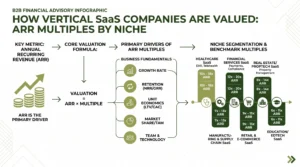
A vertical SaaS valuation measures what a niche, industry-specific software company is worth, and in 2026 those businesses trade at 3x to 10x ARR. The wide range is explained by net revenue retention, churn, growth rate, and the competitive dynamics of the niche. Post-rate-hike compression took horizontal SaaS multiples from 20x+ ARR down to 5x to 8x ARR, and it affected vertical SaaS too, but less severely. Vertical SaaS businesses tend to have stickier customers, higher switching costs, and more defensible market positions, so a well-run company serving a specialized professional market can still command a premium multiple today.
The key difference between vertical and horizontal SaaS matters for valuation. Vertical SaaS is built for a specific industry, construction management, restaurant operations, legal practice management, dental office workflow, or funeral home administration. The software handles workflows that are unique to that industry. It often integrates with industry-specific regulatory requirements, billing codes, or compliance frameworks. That specificity creates customer lock-in that horizontal software cannot replicate. But it also constrains TAM. That is the central tension in vertical SaaS valuation. Sofer Advisors helps owners and their advisors work through exactly these questions and turn the analysis into a defensible business valuation they can act on.
The following takeaways summarize the key valuation and transaction factors covered in this guide.
Key Takeaways
- Vertical SaaS ARR Multiples – Vertical SaaS ARR multiples range from 3x to 10x in 2026, with healthcare IT, legal tech, and high-growth fintech niches at the upper end
- Net Revenue Retention 110 – Net revenue retention above 110% is the single strongest premium signal for vertical SaaS buyers
- Constrained TAM Real Discount – Constrained TAM is a real discount factor – buyers underwrite peak revenue potential, not just current ARR
- Customer Concentration 20 Single – Customer concentration above 20% in a single account is a red flag that compresses multiples materially
- Rule 40 Remains Valid – The Rule of 40 remains a valid benchmark; companies scoring 40+ are positioned for premium processes
- Founder Dependency Poor Records – Founder dependency and poor records of product roadmap are the most common deal risks in sub-$10M ARR vertical SaaS businesses
Each of these factors is examined in depth in the sections that follow.
What Makes Vertical SaaS Valuation Different from Horizontal SaaS?
Horizontal SaaS businesses, project management tools, CRM platforms, HR information systems, compete across every industry and size of company. Their TAM is theoretically enormous. Their challenge is differentiation and customer acquisition cost in a crowded market. Vertical SaaS inverts this: the market is smaller and well-defined, but the product has deep workflow integration. That makes it very hard for customers to leave.
That stickiness is the core valuation driver. When a veterinary clinic runs its appointment scheduling, medical records, inventory management, and payment processing through one platform, the cost of switching is high. Training, data migration, workflow interruption, and regulatory re-credentialing all add up. Most customers stay for years. That translates into low gross churn, typically 5%–10% annually for well-run vertical SaaS versus 15%–25% for horizontal alternatives, and high NRR.
Buyers value that stickiness through a higher multiple on ARR. But they also underwrite the ceiling. If a vertical SaaS company serves 2,000 of a potential 15,000 dental offices nationally, the ceiling is knowable. Buyers will model penetration rates, average contract values, and the competitive response of incumbents. They do this to determine whether current growth rates are sustainable through the addressable market.
The TAM constraint also affects exit valuation planning. A vertical SaaS business with 40% market penetration in a niche market has a different growth story than one with 8% penetration. Founders planning a sale should think carefully about where they are in their market penetration curve. It affects the type of buyer and the multiple range they should expect.
A market multiple is a starting point, not a conclusion of value. A defensible fair market value still rests on the factors the IRS sets out for valuing closely held businesses under Revenue Ruling 59-60.
What Are Current ARR Multiples by Vertical SaaS Niche?
Multiples vary significantly by vertical. The primary differentiators are growth rate, NRR, competitive intensity, and regulatory complexity of the niche.
| Vertical | Typical ARR Multiple | Key Multiple Drivers |
|---|---|---|
| Healthcare IT (EHR, RCM, practice management) | 5x–10x ARR | HIPAA lock-in, billing complexity, high switching cost |
| Legal Tech (case management, e-billing, contract lifecycle) | 4x–8x ARR | Deep workflow integration, matter-level data lock-in |
| Construction Tech (project management, estimating, job cost) | 3x–7x ARR | Subcontractor network effects, lien/compliance workflows |
| Restaurant Tech (POS, labor management, inventory) | 3x–6x ARR | High churn in restaurant segment, competitive POS market |
| Dental/Veterinary Practice Management | 4x–8x ARR | High NRR, low competitive threat, regulatory integration |
| Ag Tech / Farm Management | 3x–5x ARR | Seasonal revenue, limited TAM, geographic concentration |
| Funeral / Death Care Software | 4x–7x ARR | Captive market, high retention, low growth potential |
| Real Estate / Property Management | 3x–6x ARR | Competitive market, moderate switching cost |
| Insurance Agency Management | 4x–8x ARR | Carrier integration lock-in, compliance workflows |
Healthcare IT and legal tech sit at the upper end. Regulatory complexity and compliance workflows create the highest switching costs in the vertical SaaS landscape. Restaurant tech sits lower because the restaurant industry has high business failure rates. Involuntary churn is high, and the POS market is intensely competitive.
These multiples apply to businesses with $2M–$20M ARR. Below $2M ARR, multiples compress because there is insufficient revenue history to validate the retention and growth story. Above $20M ARR, institutional buyers and growth equity firms enter the picture. The process then looks more like a formal investment banking process.
How Does Net Revenue Retention Drive Vertical SaaS Valuation?
NRR is the metric that separates a 4x ARR business from an 8x ARR business. NRR measures the revenue retained and expanded from the existing customer base over a 12-month period. It includes expansion from upsells, seat additions, and module adoption. It excludes new customer acquisition. An NRR of 100% means the existing customer base is flat. An NRR of 115% means existing customers are growing revenue by 15% annually before any new logos are added.
For vertical SaaS, NRR above 110% shows the platform has genuine expansion revenue pathways. These might come through more modules, seat-based pricing as customer businesses grow, or payment processing volume. NRR above 120% is rare in pure vertical SaaS. But it commands a meaningful multiple premium when it occurs.
NRR below 100%, sometimes called negative NRR or contraction, is the fastest way to kill a deal or compress a multiple to the 2x–4x range. Contraction means customers are downgrading or canceling faster than expansion is occurring. It signals product-market fit problems or competitive pressure. A buyer will have to fix those issues post-acquisition.
Gross revenue retention (GRR) measures only churn without expansion. Best-in-class vertical SaaS businesses maintain GRR above 90%. If GRR is high but NRR is only 105%, there is limited expansion opportunity. That is a moderate discount. If GRR is below 85%, buyers will investigate whether the customer base is stable enough to justify any premium.
The interaction between NRR and growth rate determines the Rule of 40 score. A business with 25% ARR growth and 18% free cash flow margin scores 43 on Rule of 40, an attractive profile. A business with 15% growth and 20% FCF margin scores 35, which is acceptable but not premium. Businesses below 30 on Rule of 40 should expect sub-5x ARR multiples unless there is a compelling strategic narrative.
David Hern CPA ABV ASA, founder of Sofer Advisors, brings a Heart of a Teacher to every engagement – translating complex valuation methodology into clear, actionable guidance that clients can act on before and after the report is delivered. With 15+ years of valuation experience, 11+ expert witness cases across multiple jurisdictions, and 180+ five-star Google reviews, David built Sofer Advisors into an Inc. 5000-recognized firm. The Sofer Difference is a four-phase process of Discovery, Diligence, Analysis, and Delivery that ensures every conclusion is defensible, documented, and tied to the specific facts of the business.
While national firms like Stout and Kroll serve large enterprise clients, Sofer Advisors specializes in middle-market businesses that require personalized attention, direct access to credentialed professionals, and a next business day response policy.
What Customer Concentration and TAM Constraints Do Buyers Penalize?
Customer concentration is a persistent deal risk in vertical SaaS because the customer bases are often small. A business serving 300 enterprise trucking companies, where one shipper represents 18% of ARR, faces meaningful concentration risk. If that customer does not renew, for any reason, the revenue impact is material. Buyers will underwrite accordingly.
The standard threshold is 10%. If any single customer represents more than 10% of ARR, buyers will ask detailed questions about contract terms, renewal probability, and relationship quality. Above 15%, many buyers require a discount to the applicable multiple. Above 20%, some buyers will not proceed without a strong mitigant. A long-term contract with a material early termination penalty is one example.
TAM constraints are less often discussed but equally important. Buyers build a model of how large the ARR base can grow before market saturation. If a vertical SaaS company is serving a fragmented industry with 50,000 potential customers at an average contract value of $10,000, the theoretical ceiling is $500M ARR, plenty of runway. But if the market has 2,000 potential customers and 600 are already using the product, the buyer is acquiring a business that is 30% of the way to theoretical saturation. That affects both growth rate sustainability and the strategic optionality argument.
Companies that have recognized this constraint and built product adjacencies can partially offset the TAM ceiling argument. Examples include entering new verticals, adding payments or financing products, or creating marketplace functionality. Buyers view these expansion moves positively if they are generating real revenue and not just roadmap promises.
How Should Vertical SaaS Founders Position for M&A?
The founders who get the best outcomes in a vertical SaaS sale are the ones who have been thinking about the deal two to four years before it happens. They make deliberate operational decisions with buyer due diligence in mind.
The three highest-return pre-deal investments are: (1) building NRR above 110% through deliberate product expansion, (2) reducing customer concentration by signing new logos and building out the long tail of the customer base, and (3) keeping clear records of the product roadmap and technical architecture. That makes the business legible to a buyer who does not know the vertical.
On financial presentation, vertical SaaS buyers want to see an ARR bridge analysis. This is a schedule showing beginning ARR, new ARR from new customers, expansion ARR from existing customers, contraction, and churn, for each of the last three years. It makes NRR and GRR calculable from first principles. Buyers who have to construct this analysis themselves will build in conservative assumptions.
The due diligence process will also investigate technical debt, security posture, and infrastructure scalability. SOC 2 Type II certification is expected for healthcare IT and legal tech. Founders who have deferred technical investment to maximize short-term EBITDA will face questions about whether the platform needs a re-architecture investment post-close.
Revenue quality is a second area of focus. This is the distinction between recognized revenue, deferred revenue, and contracted-but-not-yet-billed ARR. Vertical SaaS companies that recognize revenue aggressively will have their revenue metrics haircut in due diligence.
The questions below address the most common issues founders raise before engaging a qualified appraiser for a vertical saas valuation arr engagement.
Frequently Asked Questions
What is a good ARR multiple for a vertical SaaS company in 2026?
A business with NRR above 110%, ARR growth of 25%+, and Rule of 40 score above 40 should expect 6x–9x ARR in a competitive process. Sub-20% growth businesses with moderate NRR are more likely in the 3x–5x range.
Does vertical SaaS command a premium over horizontal SaaS?
At smaller ARR scales (under $20M ARR), yes. Vertical SaaS often commands a premium because the stickiness and competitive moat are more defensible than most horizontal products at the same scale. At larger scales, horizontal SaaS with massive TAM and proven land-and-expand motion can exceed vertical premiums.
How important is Rule of 40 for vertical SaaS valuation?
It is a strong secondary indicator. Buyers use it to assess whether a business is balancing growth and profitability. Rule of 40 scores above 40 position a business for premium multiples. Below 30 requires an explanation.
What NRR should a vertical SaaS company target before a sale?
110% or higher is a strong positioning threshold. If NRR is below 100%, the business will face significant multiple compression regardless of growth rate.
How does churn affect vertical SaaS valuation?
Gross revenue retention below 85% is a serious concern. Even if headline ARR is growing, buyers will model the long-run revenue run-rate as a declining business and value it accordingly. Best-in-class vertical SaaS maintains GRR above 90%.
Is a $5M ARR vertical SaaS company too small to sell to a PE firm?
Most PE firms have a floor of $5M–$10M ARR for platform investments. But software-focused acquirers and strategic buyers will transact below $5M ARR. At $2M–$5M ARR, founders should expect add-on pricing (3x–5x ARR) rather than platform pricing.
What kills vertical SaaS deals most often?
Customer concentration above 20%, NRR below 100%, undocumented technical architecture, and founder dependency. Any of these can delay or kill a deal.
Should I take all cash at close or roll equity in a vertical SaaS deal?
Rolling equity in a PE-backed deal can produce a strong second bite of the apple if the platform exits at a premium multiple. It also ties you to post-close performance. The decision turns on your confidence in the buyer’s execution plan and your personal risk tolerance.
How does the competitive landscape of my niche affect valuation?
If a well-funded competitor is attacking your market, buyers will discount your growth rate assumption and increase their churn sensitivity in the model. Showing competitive differentiation through customer retention data and win/loss analysis is more persuasive than product marketing claims.
What financial statements do vertical SaaS buyers want to see?
Typically three years of GAAP-basis income statements and balance sheets, an ARR bridge analysis, a cohort retention analysis by customer vintage, and a revenue recognition policy. Audited financials are preferred; reviewed financials are acceptable at smaller ARR thresholds.
Related Case Studies
- SaaS Valuation Complete Guide To Software Company Value
- Technology Company Valuation Atlanta Guide For Startups And Growth Companies
- 409A Valuation Atlanta Startup Equity Compensation Guide 2026
Executive Summary
- Vertical SaaS ARR multiples range from 3x to 10x in 2026, with healthcare IT and legal tech at the high end
- NRR above 110% is the single strongest premium signal; NRR below 100% triggers material multiple compression
- TAM constraints are a real discount factor – buyers model market penetration ceilings, not just current growth rates
- Customer concentration above 15%–20% in a single account requires mitigation or results in a pricing discount
What Should You Do Next?
If you own a vertical SaaS company and are evaluating a sale, recapitalization, or equity raise, a certified business valuation establishes a defensible view of value before you enter any buyer conversation. David Hern CPA ABV ASA, founder of Sofer Advisors, holds dual ASA and ABV credentials recognized by the IRS, SEC, and FINRA, with 15+ years of valuation experience and 180+ five-star Google reviews. Schedule a consultation to discuss your business valuation needs.
People Also Read
- Saas Valuation Complete Guide To Software Company Value
- Why You Must Start Planning Your Business Exit Now With The Right Valuation Expert
About the Author
This guide was prepared by David Hern CPA ABV ASA, founder of Sofer Advisors – a business valuation firm headquartered in Atlanta, GA serving clients across the United States. David holds dual accreditations as an Accredited Senior Appraiser (ASA) and is Accredited in Business Valuation (ABV), credentials recognized by the IRS, SEC, and FINRA. He also holds the Certified Exit Planning Advisor (CEPA) designation. With 15+ years of valuation experience, David has served as an expert witness in 11+ cases across multiple jurisdictions and built Sofer Advisors into an Inc. 5000-recognized firm with 180+ five-star Google reviews. The firm’s full W2 employee team maintains subscriptions to all major valuation databases and operates under a next business day response policy.
For professional business valuation services, visit soferadvisors.com/about-us/ or schedule a consultation at soferadvisors.com/contact-us/.
This content is for informational purposes only and does not constitute professional valuation advice. Business valuation conclusions depend on specific facts and circumstances. Contact Sofer Advisors for guidance regarding your specific situation.









