


Last Updated: November 2026
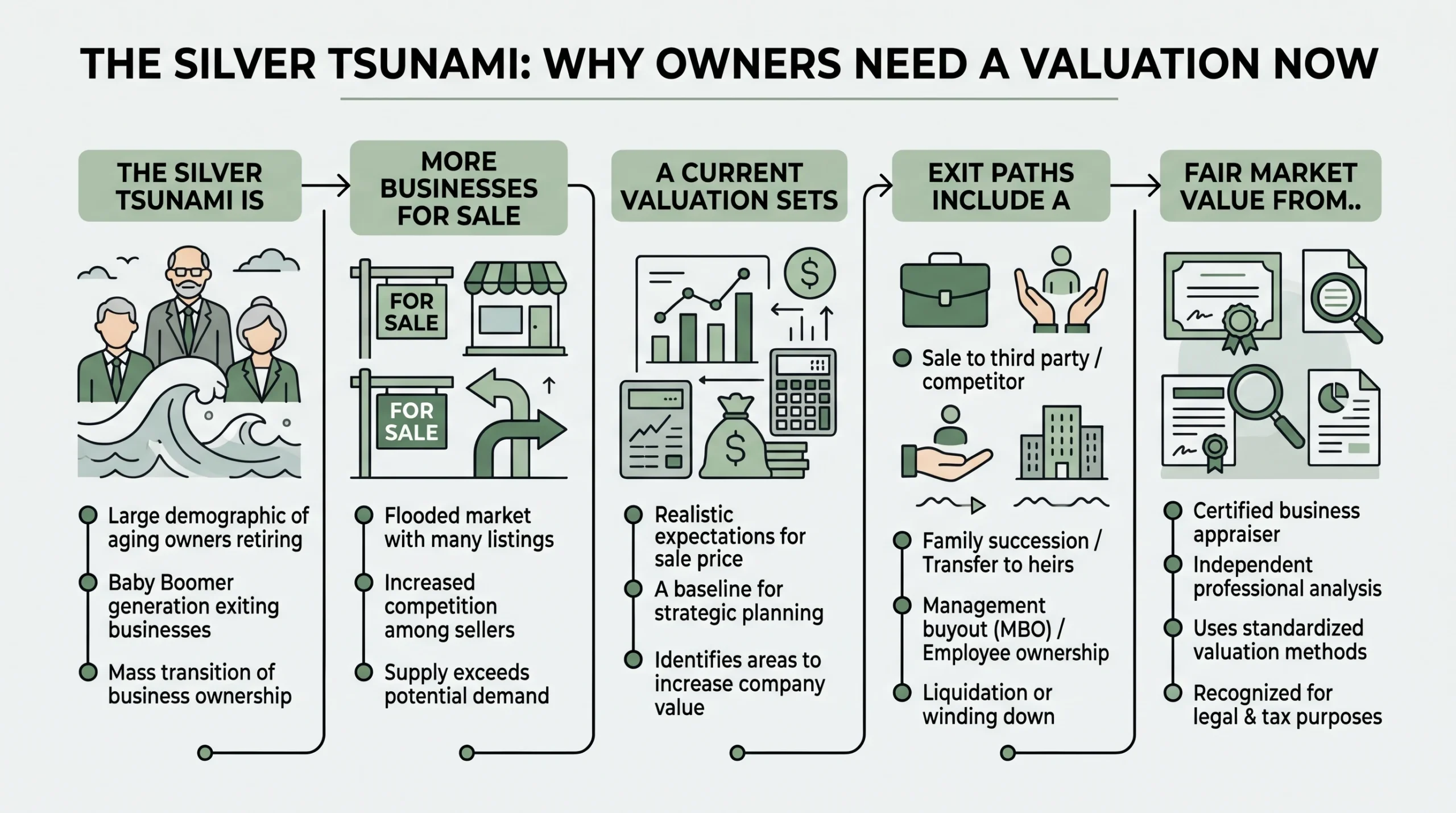
Business owners should get a valuation now because a large wave of baby boomer owners is reaching retirement and heading for an exit at the same time. As more businesses come up for sale, buyers gain pricing power, and sellers have to work harder to stand out. A current valuation sets a baseline for what your business is worth today. It also reveals the value gaps you still have time to fix before you go to market.
The team at Sofer Advisors prepares fair market value appraisals that support tax, estate, and deal planning for owners and their advisors.
This guide explains why now is the right time, what happens if you wait, and the exit paths open to you, from a third-party sale to an ESOP.
Key Takeaways
- The silver tsunami is a wave of boomer owners heading toward retirement and exit.
- More businesses for sale can shift pricing power toward buyers.
- A current valuation sets a baseline and reveals gaps you can still fix.
- Exit paths include a third-party sale, a family transfer, a management buyout, and an ESOP.
- Fair market value from a qualified appraiser supports tax, estate, and deal planning.
What is the silver tsunami?
The silver tsunami refers to a demographic shift. The baby boomer generation owns a large share of privately held businesses. Many of these owners are nearing or past retirement age. Over the coming years, a large number plan to step back.
Some will sell to outside buyers. Others will pass the business to family or to key staff. Some will simply wind the company down. The result is the same. More owners will look for an exit in a short span of time.
This is a broad demographic trend, not a forecast about any one company. Still, it shapes the market you will sell into. Knowing that helps you plan with clear eyes.
Why does this wave affect your business value?
Value depends in part on supply and demand. When many businesses hit the market at once, buyers have more choices. More choices give buyers more leverage on price and terms. Sellers then have to work harder to stand out.
This does not mean good companies lose value. Strong, well-run businesses still attract buyers. But a crowded market can stretch out timelines. It can also push buyers to be more selective during due diligence.
A current valuation helps you prepare for that reality. It shows how a buyer may view your earnings and your risk. With that view in hand, you can act early rather than react late.
Why should you get a valuation now?
A valuation is not just a number for a sale. It is a planning tool you can use for years. Getting one now gives you several clear advantages.
First, it sets a baseline. You learn what your business is worth today. That baseline anchors every later decision.
Second, it finds value gaps. A good report shows what drives your value and what drags it down. Common drags include customer concentration, thin margins, or heavy reliance on the owner. You still have time to fix these before you go to market.
Third, it sets realistic expectations. Many owners carry a number in their head. That number is often based on hope, not evidence. A valuation replaces the guess with support.
Fourth, it buys time to grow value. Closing a gap can take a year or more. Starting now gives you room to make changes that pay off at sale.
Taken together, these benefits compound over time. The earlier you start, the more each one pays off. A number on paper today becomes a plan you can act on tomorrow.
What happens if you wait too long?
Waiting carries real risk. Life does not always follow a plan. A sudden illness, a divorce, or a dispute can force a quick sale. A rushed sale rarely brings top dollar.
A crowded market adds to that risk. If you wait until everyone sells, you join a bigger crowd. More competition can mean lower offers and longer waits. Moving early helps you avoid the rush.
There is also a cost to standing still. Each year without a plan is a year you cannot get back. A valuation now puts you ahead of owners who wait.
What drives the value buyers care about?
Buyers look past the top-line revenue. They focus on profit, risk, and growth. A few factors tend to move value the most.
Earnings quality comes first. Steady, well-documented profit earns a higher price. Clean books make that profit easy to trust.
Customer mix matters too. If one client drives most of your sales, buyers see risk. A broad base of customers lowers that risk.
Owner reliance is another big factor. If the business depends on you for everything, its value can drop. Buyers want a company that runs without the founder.
Growth prospects round out the picture. A clear path to grow supports a stronger price. A valuation shows you which of these levers you can still pull.
How does a valuation support estate and gift planning?
A valuation also supports estate and gift planning. If you plan to gift shares to family, you need a defensible value. The IRS expects gifts and estate transfers to reflect fair market value. A qualified appraisal provides that support.
Tax laws and exemption levels can change over time. So the planning window will not stay the same forever. That is one more reason to get current advice and a current number.
A valuation done today reflects today’s facts. It gives your attorney and your CPA a solid base to build on. Together, they can plan transfers with far more confidence.
What are your exit options?
Most owners choose from four main paths. Each one fits a different goal.
A third-party sale means selling to an outside buyer. This often brings the most cash at close. It usually offers the least control over what happens next.
A family transfer keeps the business in the family. It protects legacy and continuity. It often needs careful tax and estate planning.
A management buyout sells the company to your current leaders. It rewards the people who helped build it. It often relies on seller financing or outside loans.
An ESOP, or employee stock ownership plan, sells shares to employees through a trust. It can offer tax benefits and a gradual exit. It also adds rules and ongoing costs.
A valuation supports every one of these paths. Each path needs a credible value to work.
How do the exit paths compare?
The table below compares the four paths at a high level. Your best fit depends on your goals, your timeline, and your successor.
| Exit Path | Speed | Legacy Focus | Typical Cash at Close |
|---|---|---|---|
| Third-party sale | Fast | Lower | Often highest, market-driven |
| Family transfer | Slow | High | Lower, often gift-focused |
| Management buyout | Moderate | Moderate | Moderate, often financed |
| ESOP | Moderate | High | Moderate, tax-advantaged |
No single path is best for everyone. A fast sale may bring the most cash. A family transfer may protect your legacy. The right choice balances money, control, and the people you leave in charge.
What is fair market value, and who should appraise your business?
Fair market value is the standard most valuations use. It is the price a willing buyer and willing seller would agree on. Both act with full information. Neither is under pressure to act.
For closely held businesses, the IRS points to Revenue Ruling 59-60. It lists the factors an appraiser should weigh. These include earnings, assets, the economy, and the company’s outlook.
A qualified appraiser applies these standards with care. Credentials like ABV, ASA, and CVA signal real training. A credentialed appraiser produces a report that can stand up to review by the IRS, a court, or a buyer.
How does a current valuation prepare you for due diligence?
Every serious buyer runs due diligence. They dig into your numbers, contracts, and records. Weak records slow the deal and raise doubts. Clean records build trust and speed things up.
A valuation engagement surfaces these issues early. It pushes you to organize financials and explain your results. You fix problems on your own schedule, not under deal pressure. That control often protects both your value and your peace of mind.
Preparation also shortens the path to close. A buyer who trusts your records moves faster. Fewer surprises mean fewer price cuts late in the deal.
What should you prepare for a valuation?
A valuation goes faster when you come prepared. Start with three to five years of financial statements. Add your tax returns for the same period. Gather key contracts, leases, and customer lists.
Write down any one-time costs or owner perks. These items help an appraiser adjust your earnings. Note any recent changes in the business too. The more context you share, the sharper the result.
Can a valuation help even if you are not selling soon?
Yes. A valuation helps owners who plan to stay for years. It gives you a scorecard for progress. You can track your value as you grow.
It also supports other needs along the way. Think of buy-sell agreements, loans, or bringing in a partner. Each of these works better with a current number. A valuation is useful long before any sale. In short, it is a tool for today, not just for the day you sell.
Frequently Asked Questions
What is the silver tsunami in business?
It is the wave of baby boomer business owners reaching retirement age. Many plan to sell or transfer their companies this decade. That creates more ownership changes and more businesses for sale.
Why should I get a business valuation now?
A current valuation sets a baseline for what your business is worth today. It also reveals gaps you can still fix before a sale. Starting early gives you time to act and plan.
How often should I update a business valuation?
Many owners refresh a valuation every year or two. You should also update it after a big change. Examples include a new large customer, a major loss, or a shift in the market.
Does the silver tsunami lower business values?
It can add pressure in a crowded market. More sellers give buyers more choices and more leverage. Strong, well-prepared businesses still attract serious buyers.
What are my main exit options?
The four common paths are a third-party sale, a family transfer, a management buyout, and an ESOP. Each fits a different goal for cash, control, and legacy. A valuation supports all four.
What standard of value is used for a business valuation?
Most valuations use fair market value. It reflects the price a willing buyer and seller would accept. For private companies, the IRS points to Revenue Ruling 59-60.
Who is qualified to value my business?
Look for an appraiser with recognized credentials. Common ones include ABV, ASA, and CVA. These signal training and a report that can stand up to review.
How does a valuation help with estate and gift planning?
Gifts and estate transfers must reflect fair market value. A qualified appraisal gives your attorney and CPA the support they need. It helps document transfers of shares to family.
How long does a business valuation take?
Timelines vary with the size and complexity of the business. A straightforward engagement can move quickly. A complex one takes longer, and your appraiser can estimate after a first review.
Related Case Studies
- Business Succession Plan: The Valuation Inside It
- CLAT Business Interest Valuation: A Guide for Owners
- Business Valuation in Suwanee GA: What Owners Need to Know
Executive Summary
The silver tsunami is a wave of boomer owners heading toward retirement and exit. More businesses for sale can shift pricing power toward buyers. A current valuation sets a baseline and reveals gaps you can still fix. Exit paths include a third-party sale, a family transfer, a management buyout, and an ESOP. Fair market value from a qualified appraiser supports tax, estate, and deal planning.
What Should You Do Next?
Start by gathering your recent financial statements and key contracts. Then decide what you want from your exit, whether that is cash, legacy, or continuity. A current valuation turns that goal into a clear plan. Sofer Advisors provides independent business valuations led by David Hern CPA ABV ASA CVA. Schedule a consultation to discuss your situation.
People Also Read
- Franchise Valuation Considerations for Business Owners
- Business Interruption Valuation: Insurance Claims Guide for Business Owners
About the Author
This guide was prepared by David Hern CPA ABV ASA CVA, founder of Sofer Advisors, a business valuation firm headquartered in Atlanta, GA serving clients across the United States. David holds accreditations as an Accredited Senior Appraiser (ASA) and is Accredited in Business Valuation (ABV), credentials recognized by the IRS, SEC, and FINRA, and is also a Certified Valuation Analyst (CVA). David has served as an expert witness in dozens of cases across multiple jurisdictions, and Sofer Advisors is an Inc. 5000 honoree in 2024 and 2025 with 240+ five-star Google reviews.
For professional business valuation services, visit soferadvisors.com/about-us/ or contact Sofer Advisors at soferadvisors.com/contact-us/.
Disclaimer: This content is for informational purposes only and does not constitute professional valuation advice. Business valuation conclusions depend on specific facts and circumstances. Contact Sofer Advisors for guidance regarding your specific situation.