


Last Updated: November 2026
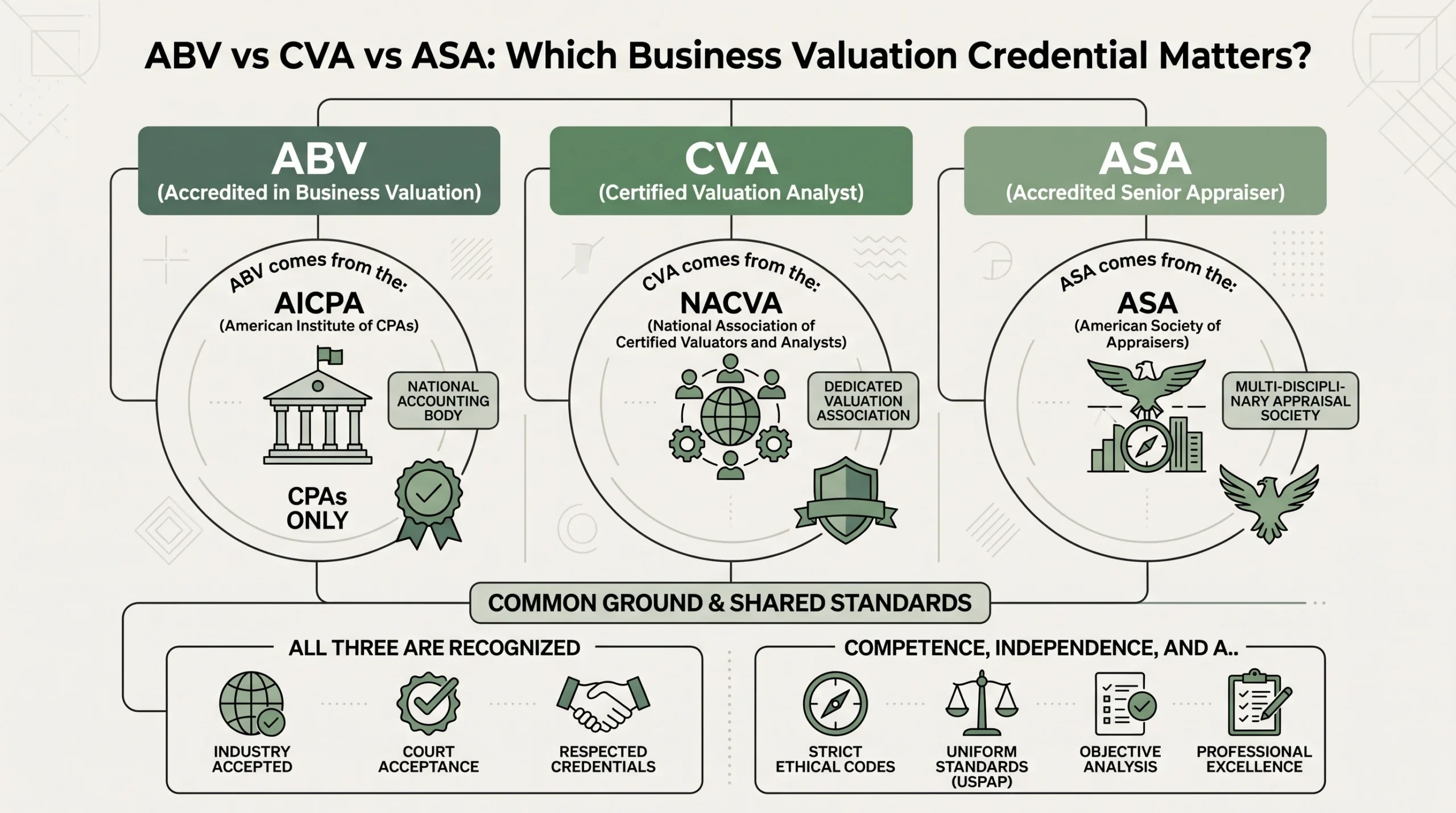
No single credential among the ABV, CVA, and ASA is automatically the best one. All three are recognized by the IRS and accepted in US courts. Each shows that an appraiser passed an exam, met experience rules, and agreed to a code of ethics. What actually decides the fit is the purpose of the valuation. A gift tax filing, a shareholder lawsuit, and a company sale all pull in different directions.
The valuation work at Sofer Advisors is led by David Hern, who holds the CPA, ABV, ASA, and CVA, and serves owners, CPAs, and attorneys.
This guide explains what each credential means, who issues it, and where each one tends to fit.
Key Takeaways
- ABV comes from the AICPA. It once required a CPA license, but qualified non-CPA finance professionals can now earn it too.
- CVA comes from the NACVA. It is open to a broad range of finance professionals who meet its experience and exam rules.
- ASA comes from the American Society of Appraisers. Its business valuation track asks for several years of full-time experience and a peer-reviewed report.
- All three are recognized by the IRS and accepted in US courts. None is automatically better than the others.
- Competence, independence, and a defensible report matter more than the letters after a name.
What is the ABV credential?
ABV stands for Accredited in Business Valuation. The American Institute of CPAs, known as the AICPA, issues it. The credential marks a professional who has focused training in valuing businesses.
For many years, only licensed CPAs could earn the ABV. That has changed. The AICPA now opens the credential to qualified finance professionals who are not CPAs. Both paths still demand real proof of skill, not just a title.
To earn the ABV, a candidate must pass an exam. They must also meet the education and experience requirements the AICPA sets. On top of that, holders agree to follow the AICPA Statement on Standards for Valuation Services, usually called the SSVS.
The SSVS is the rulebook for how a valuation should be performed and reported. It covers the work itself and the way conclusions are documented. The training spans the income, market, and asset approaches to value. Because of these accounting roots, the ABV is common in tax, estate, and financial reporting work. Holders tend to be at home where valuation meets accounting rules and IRS filings. Like the other credentials, the ABV also carries ongoing education rules to keep holders current.
What is the CVA credential?
CVA stands for Certified Valuation Analyst. The National Association of Certified Valuators and Analysts, or NACVA, issues it. It is one of the most widely held valuation credentials in the country.
The CVA is open to both CPAs and other finance professionals. A candidate usually needs a business degree or an existing credential as a starting point. From there, they must show relevant experience and pass an exam. That mix keeps the door open to accountants, analysts, and other advisors.
NACVA puts a strong focus on litigation support and private company work. Many CVA holders value small and mid-sized businesses. They also appear often in divorce, shareholder, and M&A matters. The organization runs training built around real engagements and courtroom work.
The credential confirms that an analyst can apply accepted valuation methods. It also signals a commitment to NACVA’s professional and ethical standards. For owners of closely held companies, a CVA is a familiar and respected choice.
What is the ASA credential?
ASA stands for Accredited Senior Appraiser. The American Society of Appraisers grants it. The society covers several appraisal disciplines, and business valuation is one of them.
The business valuation track is demanding by design. A candidate needs several years of full-time appraisal experience. This is commonly cited as five years at the senior level. They also need college education and must pass the required exams.
One step sets the ASA apart from the others. The candidate must submit an actual valuation report for peer review. Experienced appraisers check that work against professional standards before the credential is granted. It is a test of real output, not just exam answers.
ASA holders must also follow USPAP, the Uniform Standards of Professional Appraisal Practice. USPAP is the baseline code of ethics and performance for appraisers. It pushes every report toward being objective, transparent, and defensible. The multi-discipline background can help on engagements that touch machinery or real property as well.
How do the three credentials compare?
The three credentials share one goal. Each confirms that an appraiser has cleared an exam, an experience bar, and a code of ethics. Their real differences sit in who issues them and where they tend to fit.
The ABV grew out of the accounting profession. The CVA serves a broad base of valuation analysts. The ASA sits inside a wider appraisal society that also covers real property and machinery. The table below lays out the basics at a glance.
| Credential | Issuing Body | Typical Focus |
|---|---|---|
| ABV | AICPA | Tax, estate, and financial reporting |
| CVA | NACVA | Litigation, M&A, and private businesses |
| ASA | American Society of Appraisers | Multi-discipline appraisal, including business valuation |
Read the table as a starting point, not a hard rule. Many strong appraisers hold more than one of these credentials. Overlap is common, and the lines between them are not rigid. An ABV holder can testify in court, and an ASA holder can handle an estate filing.
Holding several credentials is a real signal of depth. David Hern, who leads the valuation work at Sofer Advisors, holds the CPA, ABV, ASA, and CVA. Each issuing body also asks members to complete continuing education. That keeps holders current as valuation theory and tax rules change. So the credential on a report is only part of the story. The appraiser’s recent, hands-on work carries just as much weight.
Where does the CFA fit in?
You may also run into the CFA, or Chartered Financial Analyst. The CFA Institute awards it. The CFA is a broad investment and finance credential, not a dedicated valuation accreditation.
Charterholders often work in investment analysis and portfolio management. Many also do valuation work, especially on larger or public companies. Think of the CFA as adjacent to ABV, CVA, and ASA rather than a direct swap. On a private company tax or litigation matter, a dedicated valuation credential usually fits better. Some professionals pair a CFA with one of the valuation credentials, which can be a strong mix.
Which credential is best for tax and estate work?
For tax, gift, and estate matters, many owners look first for the ABV. Its accounting roots line up well with IRS filings and financial reporting. ABV holders tend to know the SSVS framework in depth, and that helps on sensitive filings.
That said, the IRS does not require one specific credential. It cares that the appraiser is qualified and that the report is defensible. A sound report under Revenue Ruling 59-60 matters far more than the letters on the cover page.
CVA and ASA holders also handle tax and estate work every day. The right choice depends on the appraiser’s experience with matters like yours. Ask how often they file reports for the IRS, and how those reports have held up. Gift and estate filings often draw close review, so a seasoned appraiser is worth the search. A report that anticipates the hard questions saves time and stress later.
Which credential matters most in litigation?
Courts do not rank these credentials. What a judge weighs is the reliability of the method and the clarity of the testimony. This is the heart of the Daubert standard used in federal and many state courts.
All three credentials can support expert testimony. NACVA is well known for its focus on litigation and expert witness training. Many CVA and ASA holders testify in disputes, and ABV holders do as well. No single set of letters is a ticket into the witness box.
The deciding factor is rarely the credential itself. It is whether the expert used sound methods and can defend each assumption under questioning. A clear, well-documented report tends to win out over a long list of initials.
Opposing counsel will probe the report for weak spots. They look for untested assumptions and gaps in the data. An expert who shows their work and explains each step is harder to shake. Jurors and judges follow a plain explanation more easily than a dense one. So the ability to teach the numbers, not just run them, often decides the day.
So which credential actually matters?
The honest answer is that no single credential is the one that counts. ABV, CVA, and ASA each require a real exam, real experience, and a code of ethics. The IRS recognizes all three, and the courts accept all three.
What separates a strong appraiser is not the acronym. It is competence in the specific type of engagement. It is independence from the outcome. And it is the ability to produce a report that holds up under challenge.
So look past the letters. Ask about the appraiser’s experience with matters like yours. Ask how they support their assumptions. Ask to see how they document their conclusions. Those answers tell you more than any credential on its own.
Frequently Asked Questions
What does ABV stand for?
ABV stands for Accredited in Business Valuation. The AICPA issues it to professionals with focused training in valuing businesses. Holders agree to follow the AICPA Statement on Standards for Valuation Services.
Can you earn the ABV without being a CPA?
Yes. For years the ABV was open only to licensed CPAs. The AICPA now also admits qualified non-CPA finance professionals. Both paths still require an exam plus education and experience.
What does CVA stand for?
CVA stands for Certified Valuation Analyst. The NACVA issues it to both CPAs and other finance professionals. Candidates must meet experience requirements and pass an exam.
What does ASA stand for?
ASA stands for Accredited Senior Appraiser. The American Society of Appraisers grants it. The business valuation track calls for several years of full-time experience and a peer-reviewed report.
Does the IRS accept all three credentials?
Yes. The IRS does not require one specific credential. It asks for a qualified appraiser and a defensible report, often under Revenue Ruling 59-60. ABV, CVA, and ASA holders all meet that bar.
Are these credentials recognized in court?
Yes. Courts accept experts holding any of the three. Under the Daubert standard, a judge weighs the reliability of the method, not the letters after a name.
What is USPAP?
USPAP stands for the Uniform Standards of Professional Appraisal Practice. It is the baseline code of ethics and performance for appraisers. ASA holders must comply with it.
Is the CFA a business valuation credential?
Not exactly. The CFA is a broad investment and finance credential from the CFA Institute. It sits adjacent to valuation work rather than serving as a dedicated valuation accreditation.
Which credential should I look for when hiring?
It depends on your purpose. Match the appraiser’s experience to your matter, whether that is tax, litigation, or a sale. Competence, independence, and a defensible report matter most.
Related Case Studies
- What is ABV Certification? Complete Guide to Business Valuation
- Why Independence Matters in Valuation: AICPA, ASA, Court Standards
- Business Valuation Appraiser
Executive Summary
ABV comes from the AICPA. It once required a CPA license, but qualified non-CPA finance professionals can now earn it too. CVA comes from the NACVA. It is open to a broad range of finance professionals who meet its experience and exam rules. ASA comes from the American Society of Appraisers. Its business valuation track asks for several years of full-time experience and a peer-reviewed report. All three are recognized by the IRS and accepted in US courts. None is automatically better than the others. Competence, independence, and a defensible report matter more than the letters after a name.
What Should You Do Next?
Start with the purpose of your valuation, then match it to the right expert. For tax or estate filings, an ABV background often fits the work well. For a dispute or a sale, look for an appraiser with a real track record in that exact setting. Sofer Advisors provides independent business valuations led by David Hern CPA ABV ASA CVA. Schedule a consultation to talk through your situation.
People Also Read
About the Author
This guide was prepared by David Hern CPA ABV ASA CVA, founder of Sofer Advisors, a business valuation firm headquartered in Atlanta, GA serving clients across the United States. David holds accreditations as an Accredited Senior Appraiser (ASA) and is Accredited in Business Valuation (ABV), credentials recognized by the IRS, SEC, and FINRA, and is also a Certified Valuation Analyst (CVA). David has served as an expert witness in dozens of cases across multiple jurisdictions, and Sofer Advisors is an Inc. 5000 honoree in 2024 and 2025 with 240+ five-star Google reviews.
For professional business valuation services, visit soferadvisors.com/about-us/ or contact Sofer Advisors at soferadvisors.com/contact-us/.
Disclaimer: This content is for informational purposes only and does not constitute professional valuation advice. Business valuation conclusions depend on specific facts and circumstances. Contact Sofer Advisors for guidance regarding your specific situation.