


Last Updated: November 2026
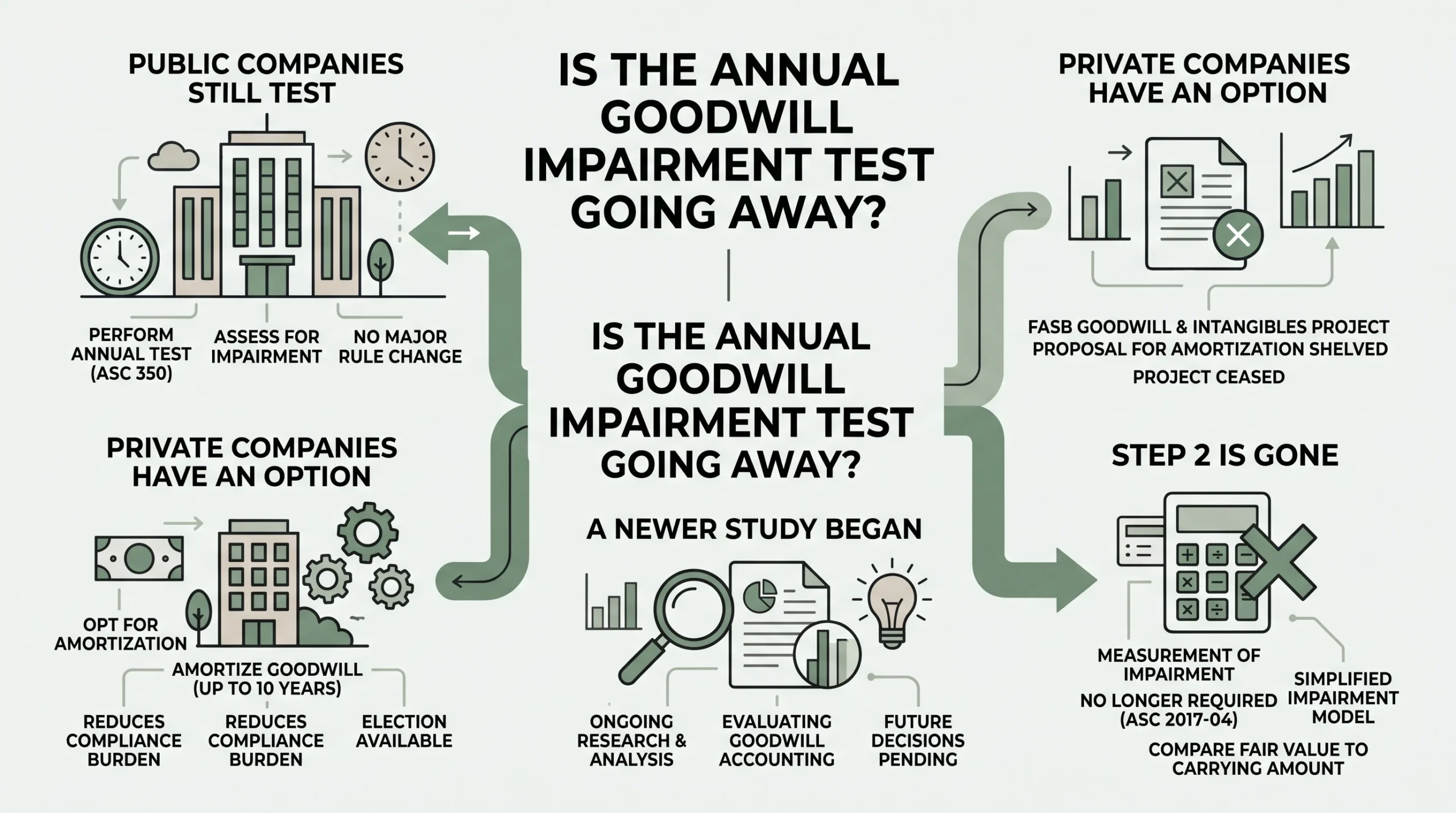
For public companies, the annual goodwill impairment test is not going away. Under ASC 350, public companies must still test goodwill at least once a year, plus whenever a triggering event signals a drop in value. Private companies and not-for-profits have another choice. They can elect to amortize goodwill over 10 years or less and then test only when a triggering event occurs. That private company option is the main reason the question keeps coming up.
The team at Sofer Advisors performs goodwill and impairment valuations for companies and their auditors.
This guide explains the current rules, the private company election, and what the FASB is studying now.
Key Takeaways
- Public companies still test: Under ASC 350, public companies must test goodwill for impairment at least once a year, plus whenever a triggering event occurs.
- Private companies have an option: Private companies and not-for-profits may elect to amortize goodwill over 10 years or less. They then test only on a triggering event.
- A past project was dropped: The FASB studied requiring amortization for all companies. It removed that project from its agenda in 2022 with no change made.
- A newer study began: In 2026, the FASB began exploring whether to test goodwill at the operating-segment level. That segment-level study is still at an early stage.
- Step 2 is gone: ASU 2017-04 removed the old “Step 2” of the test, which made the yearly test simpler for everyone.
What is the goodwill impairment test?
Goodwill shows up when one company buys another. It is the amount paid above the fair value of the net identifiable assets. Public companies do not amortize this goodwill. Instead, they test it for impairment.
The test lives in ASC 350. It checks whether the goodwill on the books is still worth its carrying amount. Companies run the test at the reporting-unit level. A reporting unit is an operating segment or one level below it.
The test has two parts. First comes an optional qualitative check, often called Step 0. Here a company asks a simple question. Is it more likely than not that fair value is below carrying amount? If the answer is no, the work can stop there.
If the qualitative check raises a concern, the company runs a quantitative test. It compares the fair value of the reporting unit to its carrying amount. If the carrying amount is higher, the company records an impairment loss. That loss cannot be larger than the goodwill assigned to the unit.
ASU 2017-04 made this simpler. It removed the old “Step 2.” In the past, Step 2 forced companies to calculate an implied fair value of goodwill. That step was slow and costly. It worked much like a fresh purchase price allocation. Now the test is a single comparison of fair value against carrying amount. The change reduced the effort behind each annual test, though the yearly cadence itself stayed in place for public companies.
Do public companies still test goodwill every year?
Yes. Public companies must test goodwill at least once a year. They also test whenever a triggering event suggests a drop in value. This rule has not changed. For public companies, the annual test is not going away.
A triggering event is a sign that value may have fallen. Examples include a sharp revenue decline, the loss of key staff, or a drop in the stock price. A lost major contract can count too. So can a downturn across the whole industry. When one appears, the company tests outside its normal annual date. The point is to catch a real decline early. The annual test then acts as a backstop that runs no matter what.
This two-part rule is the core of ASC 350 for public companies. It has held steady through recent years. Talk of change has not altered the basic duty to test each year.
Can private companies skip the annual test?
Yes, if they elect to. The FASB issued ASU 2014-02 through the Private Company Council. It created an accounting alternative for private companies.
A private company that makes this election does two things. It amortizes goodwill on a straight-line basis over 10 years, or less if a shorter life fits better. It then tests for impairment only when a triggering event occurs. The yearly test is no longer required.
The election also lets a company choose where to test. It can test at the entity level or at the reporting-unit level. That choice is a policy decision made when the company adopts the alternative. Testing at the entity level is often simpler for a small business. It can mean one test instead of several.
Not every private company should elect this path. A company that plans to go public may want to match public rules now. A company with no goodwill gains nothing from the choice. The election is best weighed with an advisor who knows the facts.
The FASB later extended this option to not-for-profit organizations. So both private companies and not-for-profits can amortize goodwill if they elect the alternative. This is the real source of the “going away” question. For these electors, the annual test effectively is gone.
Why do people think the test is going away?
Two things drive the confusion. The first is the private company election described above. Many readers hear that some entities amortize goodwill and skip the yearly test. They then assume the rule applies to everyone. It does not.
The second reason is an old FASB project. For several years, the board studied whether public companies should also amortize goodwill. That study drew wide attention. Many expected a change.
The board did not make that change. In 2022, the FASB removed the project from its agenda. Public company rules stayed the same. The annual test under ASC 350 remained in force. So the headlines about amortization never became a public company rule. That history still fuels the question today.
What is the FASB studying now?
The board still looks at goodwill from time to time. In 2026, the FASB added a project to explore the testing level. The question is whether to test goodwill at the operating-segment level rather than the reporting-unit level.
This is an early-stage agenda project. It is exploratory only. There is no exposure draft. There is no effective date. It does not remove the annual test. Companies should watch it, but nothing has changed yet.
Because this project is still at an early stage, its details may shift as the board deliberates. Readers should confirm the current status before relying on it for any decision.
How does amortization change the numbers?
For private companies that elect the alternative, the accounting looks different. Amortization creates a steady, non-cash expense on the income statement. That expense lowers reported net income each year. It also reduces earnings per share where that figure applies.
The goodwill balance falls over time. Each year, the amortization charge trims the asset. By the end of the useful life, the goodwill is gone from the books. This is a predictable path.
The trade-off is fewer surprises. Under the annual test, a company can face a large, sudden write-down. That write-down can shock lenders and owners in a single period. Under amortization, the cost is spread out and planned. Many owners prefer that smoother profile.
The choice also touches key ratios. A smaller asset base can shift return on assets. A lower net income can affect loan covenants that track earnings. Buyers and auditors read these numbers closely. So the election is not just an accounting detail. It shapes how the business looks on paper for years. The table below shows the two paths side by side.
| Feature | Public company (ASC 350) | Private company election |
|---|---|---|
| Goodwill treatment | Not amortized; carried until impaired | Amortized straight-line over 10 years or less |
| Impairment testing | At least annually, plus on triggering events | Only when a triggering event occurs |
| Income statement effect | No recurring charge; possible large write-downs | Steady annual amortization expense |
| Testing level | Reporting unit | Entity or reporting unit, by policy election |
Sofer Advisors helps companies model both paths during financial reporting valuation work. The right choice depends on your reporting goals, your lenders, and your plans for a future sale.
What should companies do about goodwill now?
Public companies should keep testing goodwill each year. They should also watch the 2026 segment-level project, but not act on it yet. No rule has changed.
Private companies and not-for-profits have a decision to make. They can keep testing each year, or they can elect to amortize. The election affects net income, loan covenants, and how buyers read the financials. Sofer Advisors can help weigh those effects before the choice is made.
Frequently Asked Questions
Is the annual goodwill impairment test going away for public companies?
No. Under ASC 350, public companies must still test goodwill for impairment at least once a year. They also test on triggering events. The annual requirement remains in force.
Can private companies stop testing goodwill every year?
Yes, if they elect the accounting alternative from ASU 2014-02. Those electors amortize goodwill over 10 years or less. They then test only when a triggering event occurs, not every year.
What did the FASB decide in 2022 about goodwill amortization?
The FASB had been studying whether public companies should amortize goodwill. In 2022, the board removed that project from its agenda. It made no change, so the annual test for public companies stayed in place.
What is the FASB studying about goodwill in 2026?
In 2026, the FASB added a project to explore testing goodwill at the operating-segment level instead of the reporting-unit level. It is an exploratory agenda project. There is no exposure draft and no effective date.
What is a triggering event for goodwill impairment?
A triggering event is a sign that goodwill may have lost value. Examples include a large revenue drop, the loss of major customers, or a falling share price. It prompts a test outside the normal annual schedule.
Did ASU 2017-04 change the impairment test?
Yes. ASU 2017-04 removed the old “Step 2” of the test. Companies no longer calculate an implied fair value of goodwill. The test is now a single comparison of fair value against carrying amount.
How is goodwill tested under ASC 350?
A company compares a reporting unit’s fair value to its carrying amount. An optional qualitative check can come first to screen for risk. If carrying amount is higher, the company records an impairment loss, capped at the goodwill assigned to that unit.
Do not-for-profit organizations have the amortization option?
Yes. The FASB extended the private company alternative to not-for-profit organizations. A not-for-profit that elects it can amortize goodwill and test only on triggering events, just like an electing private company.
How often must public companies test goodwill?
Public companies must test at least once a year. They must also test any time a triggering event suggests that value has fallen below the carrying amount. The yearly test is the minimum.
Related Case Studies
- What is Goodwill Impairment Testing? Complete Guide
- Goodwill Impairment Disclosure Requirements
- Impairment Triggering Events: When to Test Early
Executive Summary
Under ASC 350, public companies must test goodwill for impairment at least once a year, plus whenever a triggering event occurs. Private companies and not-for-profits may elect to amortize goodwill over 10 years or less. They then test only on a triggering event. The FASB studied requiring amortization for all companies. It removed that project from its agenda in 2022 with no change made. In 2026, the FASB began exploring whether to test goodwill at the operating-segment level. That segment-level study is still at an early stage. ASU 2017-04 removed the old “Step 2” of the test, which made the yearly test simpler for everyone.
What Should You Do Next?
Start by confirming which rules apply to you. Public companies should keep the annual test on the calendar and document each year’s result. Private companies and not-for-profits should decide whether the amortization election fits their reporting goals. Sofer Advisors provides independent financial reporting valuations, led by David Hern CPA ABV ASA CVA. A clear read of your goodwill today can prevent a costly surprise later. Schedule a free consultation to review your goodwill and your options.
People Also Read
- Qualitative Step 0 Goodwill Impairment Assessment
- Goodwill Amortization vs Impairment: Key Differences
About the Author
This guide was prepared by David Hern CPA ABV ASA CVA, founder of Sofer Advisors, a business valuation firm headquartered in Atlanta, GA serving clients across the United States. David holds accreditations as an Accredited Senior Appraiser (ASA) and is Accredited in Business Valuation (ABV), credentials recognized by the IRS, SEC, and FINRA, and is also a Certified Valuation Analyst (CVA). David has served as an expert witness in dozens of cases across multiple jurisdictions, and Sofer Advisors is an Inc. 5000 honoree in 2024 and 2025 with 240+ five-star Google reviews.
For professional business valuation services, visit soferadvisors.com/about-us/ or contact Sofer Advisors at soferadvisors.com/contact-us/.
Disclaimer: This content is for informational purposes only and does not constitute professional valuation advice. Business valuation conclusions depend on specific facts and circumstances. Contact Sofer Advisors for guidance regarding your specific situation.









