


Last Updated: June 2026
A DTC ecommerce valuation measures what a direct-to-consumer brand is worth, and the basis has reset: businesses valued at 4x to 8x revenue in 2020 and 2021 now trade at 3x to 6x EBITDA in 2026. This compression reflects structurally higher customer acquisition costs, the lasting effects of iOS privacy changes, a normalized debt-cost environment, and the market’s hard reset on what good unit economics actually look like. For founders and owners considering a sale, this is not a temporary dip, it reflects a permanent repricing of DTC risk.
The brands still commanding premium multiples share common traits: strong gross margins above 55%, repeat purchase rates above 40%, LTV:CAC ratios above 3:1, and a customer base that is not wholly dependent on paid Meta or Google traffic. Everything else, single-channel brands, commodity products, thin-margin operations, has been repriced accordingly. Understanding exactly where your business falls on that spectrum is the first step toward a defensible valuation. Sofer Advisors helps owners and their advisors work through exactly these questions and turn the analysis into a defensible business valuation they can act on.
The following takeaways summarize the key valuation and transaction factors covered in this guide.
Key Takeaways
- DTC EBITDA Multiples Compressed – DTC EBITDA multiples compressed from 6x–15x peaks (2020–2021) to 3x–6x in 2026 for most brands.
- Rising CAC IOS 145 – Rising CAC, iOS 14.5 privacy changes, and higher debt costs are structural headwinds, not temporary fluctuations.
- Gross Margin Important Financial – Gross margin is the most important financial metric: sub-40% gross margins signal commodity risk and suppress multiples.
- Subscription Subscriptionadjacent DTC Brands – Subscription or subscription-adjacent DTC brands command a premium of 1x–2x EBITDA over one-time purchase models.
- Buyers Underwrite LTV/CAC Ratio – Buyers underwrite LTV:CAC ratio, payback period, and cohort retention – not just top-line revenue.
- Platform Concentration Shopify Amazon – Platform concentration on Shopify or Amazon is scrutinized; revenue diversification across channels improves multiple.
Each of these factors is examined in depth in the sections that follow.
What Happened to DTC Ecommerce Multiples Between 2021 and 2026?
The 2020–2021 DTC boom was a product of convergent anomalies: stimulus-driven consumer spending, artificially cheap paid social advertising (pre-iOS 14.5), near-zero cost of capital, and a cohort of VC and growth equity investors who believed digital-native brands could displace traditional retail at scale. Multiples of 4x–8x revenue, not EBITDA, became standard in competitive processes for brands above $10M in revenue.
The unwinding began with Apple’s AppTrackingTransparency (ATT) framework released in April 2021. Within 12 months, Meta CPMs increased 30%–50% for many DTC advertisers as audience targeting accuracy degraded. Customer acquisition costs rose across the board. Brands that built their entire growth model on Meta and Google paid channels saw payback periods extend from 6 months to 18+ months.
At the same time, the Federal Reserve’s rate hike cycle that began in 2022 changed the cost of capital for buyers. Revenue multiples that assumed future growth discounted at near-zero rates no longer worked when discount rates normalized. Strategic buyers and PE sponsors shifted to EBITDA-based underwriting. Brands with no EBITDA, the majority of high-growth DTC startups, either shut down or sold at distressed prices.
By 2026, the market has largely completed its repricing. The froth is gone. What remains is a more rational market where buyers underwrite actual cash flow, actual unit economics, and actual retention data. That is a healthier market for serious sellers, but one that requires real preparation.
A market multiple is a starting point, not a conclusion of value. A defensible fair market value still rests on the factors the IRS sets out for valuing closely held businesses under Revenue Ruling 59-60.
What Are DTC Ecommerce EBITDA Multiples in 2026?
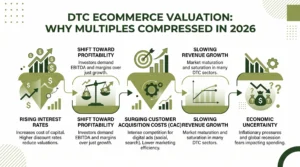
EBITDA multiples in 2026 vary significantly by category, gross margin, revenue scale, and business model. The table below summarizes current market ranges based on M&A transaction activity.
| DTC Segment | EBITDA Multiple Range | Revenue Multiple Range |
|---|---|---|
| Commodity / low-margin DTC (<40% GM) | 2x – 3.5x | 0.3x – 0.6x |
| Mid-tier branded DTC (40–55% GM) | 3x – 5x | 0.5x – 1.2x |
| Premium branded DTC (>55% GM) | 4.5x – 7x | 0.8x – 2x |
| Subscription DTC (>40% recurring) | 5x – 9x | 1x – 3x |
| Health/wellness or personal care DTC | 5x – 8x | 0.8x – 2.5x |
| Amazon-native / marketplace-dependent | 2x – 4x | 0.4x – 0.8x |
These ranges apply to profitable businesses. Unprofitable DTC brands with declining revenue are effectively unsaleable to institutional buyers in 2026, with occasional exceptions for brands with extraordinary IP, customer data, or strategic fit with a specific acquirer.
Revenue multiples are used when EBITDA is negative but the brand has strong top-line metrics and a credible path to profitability. Even so, buyers applying revenue multiples are discounting heavily for execution risk. A brand generating $5M in revenue with negative EBITDA might trade at 0.5x–0.8x revenue, $2.5M–$4M. A comparable brand generating $800K in EBITDA at the same revenue level would trade at 5x EBITDA, or $4M.
What Metrics Do Buyers Underwrite in a DTC Acquisition?
Buyers have become more sophisticated about DTC unit economics than at any prior point. The data room for a 2026 DTC process includes cohort analysis, customer lifetime value curves, monthly retention charts, COGS breakdown, and channel-specific CAC by acquisition channel. Sellers who cannot produce this data are at a negotiating disadvantage.
The six metrics that most directly influence buyer underwriting and multiple selection are:
Gross Margin. This is the starting point. Gross margin for DTC businesses is calculated as revenue minus COGS, where COGS includes product cost, inbound freight, duties, and fulfillment. Sub-40% gross margins indicate commodity exposure and leave insufficient spread to cover sales, marketing, and G&A while remaining profitable. Buyers target 50%+ for branded consumer products and 55%+ for personal care and supplement brands.
LTV:CAC Ratio. Lifetime value divided by customer acquisition cost. A ratio below 2:1 is a yellow flag. Below 1.5:1 is a red flag. A ratio above 3:1 signals strong economics. LTV must be calculated using actual cohort data, not theoretical models, buyers will build their own cohort analysis and will spot inflated LTV assumptions immediately.
Payback Period. How many months does it take to recover the CAC on a new customer? Pre-2022, buyers accepted 12–18 month payback periods if growth was sufficient. In 2026, buyers want 6–12 months for branded DTC and are skeptical of anything beyond 18 months.
Repeat Purchase Rate. The percentage of customers who make a second purchase within 12 months of their first. A repeat rate above 40% indicates brand loyalty. Below 25% suggests the brand has a significant one-time buyer problem. This directly compresses LTV and the LTV:CAC ratio.
Average Order Value (AOV). Higher AOV typically means lower shipping cost as a percentage of revenue, better gross margin improvement, and a more premium customer. DTC brands with AOV above $80–$100 tend to have better economics than high-volume, low-AOV brands.
Revenue Concentration by Channel. Brands that derive >70% of revenue from a single paid channel (Meta, Google, TikTok) carry execution risk. Channel diversification across paid, email/SMS, SEO, and direct/retail improves buyer confidence in revenue durability.
David Hern CPA ABV ASA, founder of Sofer Advisors, brings a Heart of a Teacher to every engagement – translating complex valuation methodology into clear, actionable guidance that clients can act on before and after the report is delivered. With 15+ years of valuation experience, 11+ expert witness cases across multiple jurisdictions, and 180+ five-star Google reviews, David built Sofer Advisors into an Inc. 5000-recognized firm. The Sofer Difference is a four-phase process of Discovery, Diligence, Analysis, and Delivery that ensures every conclusion is defensible, documented, and tied to the specific facts of the business.
While national firms like Stout and Kroll serve large enterprise clients, Sofer Advisors specializes in middle-market businesses that require personalized attention, direct access to credentialed professionals, and a next business day response policy.
How Do Strategic vs. PE Buyers Value DTC Brands Differently?
Strategic buyers, existing consumer brands, CPGs, or retailers acquiring DTC brands, typically pay the highest multiples. They have a use case for the brand beyond its standalone financials. A strategic may be paying for the customer list, the brand positioning in a demographic, the product IP, or the Shopify/direct channel capabilities they don’t have internally. Strategics often apply a 1x–2x premium over what a financial buyer would pay.
PE buyers and growth equity sponsors underwrite to a financial return. They want a clear path to EBITDA expansion through operational improvements, new channel development, or geographic expansion. Most PE sponsors targeting DTC in 2026 want brands above $5M in EBITDA, strong unit economics, and a management team that can stay post-close.
Search fund and independent sponsor buyers target smaller DTC brands, often $500K–$2M in EBITDA, where they can bring operational expertise and pay 3x–5x EBITDA with seller financing bridging part of the gap.
What Increases a DTC Multiple Before a Sale?
The most impactful improvements a DTC brand can make before a sale fall into three categories: improving retention, reducing CAC dependency, and documenting unit economics.
Improving repeat purchase rate by as little as 5–10 percentage points materially increases LTV and LTV:CAC. This flows directly into the buyer’s underwriting model. Subscription or auto-replenish programs are the most direct lever. For brands where subscription is not natural, a loyalty program with demonstrated re-engagement lift provides a comparable signal.
Reducing paid channel dependency, growing email, SMS, SEO, or retail partnerships, reduces perceived channel risk and improves the durability of revenue. Buyers discount single-channel businesses. A brand that moved from 80% Meta-dependent to 50% Meta-dependent over 18 months before a sale has a demonstrably stronger story.
Documenting unit economics in a clean, auditable format, cohort curves, CAC by channel, fully-loaded COGS including fulfillment, removes buyer uncertainty and narrows the due diligence discount. Sellers who show up with clean data get better terms.
The questions below address the most common issues founders raise before engaging a qualified appraiser for a dtc ecommerce valuation engagement.
Frequently Asked Questions
Is ecommerce still worth it in 2026?
DTC ecommerce remains viable for brands with strong unit economics and diversified acquisition channels, but the era of cheap paid traffic and easy growth is over. Brands that can generate profitable, repeat-purchase customers without sole reliance on Meta or Google paid channels are still attractive to buyers and investors.
How big is the DTC ecommerce market?
The U.S. DTC ecommerce market is estimated at about $170B–$200B in annual revenue in 2026, growing at a mid-single-digit rate. The growth rate is materially slower than the 20%+ rates seen during 2019–2021, reflecting normalization post-pandemic and structural headwinds to paid digital advertising.
What is the outlook for ecommerce in 2026?
Profitability has replaced growth-at-all-costs as the dominant buyer and investor criterion. Brands with subscription revenue, strong gross margins, and diversified acquisition channels are best positioned. Pure-play paid-social DTC brands with thin margins face continued compression in both valuations and operating performance.
What is a good gross margin for a DTC brand?
For branded consumer products, 50%+ gross margin (after COGS including fulfillment) is considered healthy. Personal care, supplements, and apparel brands at 55%–65% gross margin are well-positioned. Brands below 40% gross margin face structural difficulty achieving EBITDA levels that support meaningful valuations.
How is a DTC brand valued for acquisition?
Most DTC acquisitions in 2026 use EBITDA multiples as the primary valuation metric. Revenue multiples are applied when EBITDA is negative or minimal, but buyers discount heavily for unprofitability. The multiple is then adjusted up or down based on gross margin, retention metrics, channel concentration, brand strength, and revenue trajectory.
Does Shopify dependency affect DTC valuation?
Shopify platform dependency is generally not a negative, Shopify is the dominant DTC infrastructure and buyers are comfortable with it. Amazon dependency is a more significant concern. Amazon controls the customer relationship, can alter fee structures, and the brand has limited ability to build a direct customer database.
What is a reasonable LTV:CAC ratio for a DTC brand?
A ratio above 3:1 is considered strong. Between 2:1 and 3:1 is acceptable with improving trends. Below 2:1 is a concern that buyers will factor into their price. LTV should be calculated on actual 12-month or 24-month cohort data, not extrapolated from early cohort behavior.
How does a subscription DTC model affect valuation?
Subscription DTC commands a 1x–2x EBITDA premium over one-time purchase models. The higher revenue predictability, lower re-acquisition CAC, and stronger LTV per customer justify this premium. Buyers value subscription revenue similarly to recurring revenue in SaaS.
Related Case Studies
- SaaS Valuation Complete Guide To Software Company Value
- Technology Company Valuation Methods A Complete Guide
- How Do You Determine What A Business Is Worth Complete Guide
Executive Summary
- DTC EBITDA multiples compressed to 3x–6x in 2026, down sharply from peak multiples of 6x–15x during 2020–2021.
- The compression reflects structural drivers: higher CAC, iOS privacy changes, normalized cost of capital, and buyer shift to EBITDA-based underwriting.
- Gross margin, LTV:CAC, payback period, and repeat purchase rate are the metrics that most directly determine which multiple a brand earns.
- Improving retention and reducing paid channel dependency are the most impactful pre-sale improvements for most DTC sellers.
What Should You Do Next?
If you own a DTC brand and are evaluating a sale in 2026 or 2027, knowing your actual EBITDA multiple and valuation range before you start a process is essential, it determines your negotiating position and informs what preparation is worth doing. David Hern CPA ABV ASA, founder of Sofer Advisors, holds dual ASA and ABV credentials recognized by the IRS, SEC, and FINRA, with 15+ years of valuation experience and 180+ five-star Google reviews. Schedule a consultation to discuss your business valuation needs.
People Also Read
- Medical Practice Valuation Multiples 2026 2027 Complete Atlanta Guide
- Medical Practice Valuation Multiples 2025 2026 Complete Guide
About the Author
This guide was prepared by David Hern CPA ABV ASA, founder of Sofer Advisors – a business valuation firm headquartered in Atlanta, GA serving clients across the United States. David holds dual accreditations as an Accredited Senior Appraiser (ASA) and is Accredited in Business Valuation (ABV), credentials recognized by the IRS, SEC, and FINRA. He also holds the Certified Exit Planning Advisor (CEPA) designation. With 15+ years of valuation experience, David has served as an expert witness in 11+ cases across multiple jurisdictions and built Sofer Advisors into an Inc. 5000-recognized firm with 180+ five-star Google reviews. The firm’s full W2 employee team maintains subscriptions to all major valuation databases and operates under a next business day response policy.
For professional business valuation services, visit soferadvisors.com/about-us/ or schedule a consultation at soferadvisors.com/contact-us/.
This content is for informational purposes only and does not constitute professional valuation advice. Business valuation conclusions depend on specific facts and circumstances. Contact Sofer Advisors for guidance regarding your specific situation.









