


Last Updated: August 2026
A liquor store valuation is the process of setting a fair market value for a retail business that sells packaged beer, wine, and spirits. It weighs the store’s earnings, its liquor license, its inventory, and its lease. Recent BizBuySell data puts the median sale price of a sold liquor store near $425,000, on median revenue of about $1,047,000. Sofer Advisors builds each figure on verified market evidence, not a simple rule of thumb.
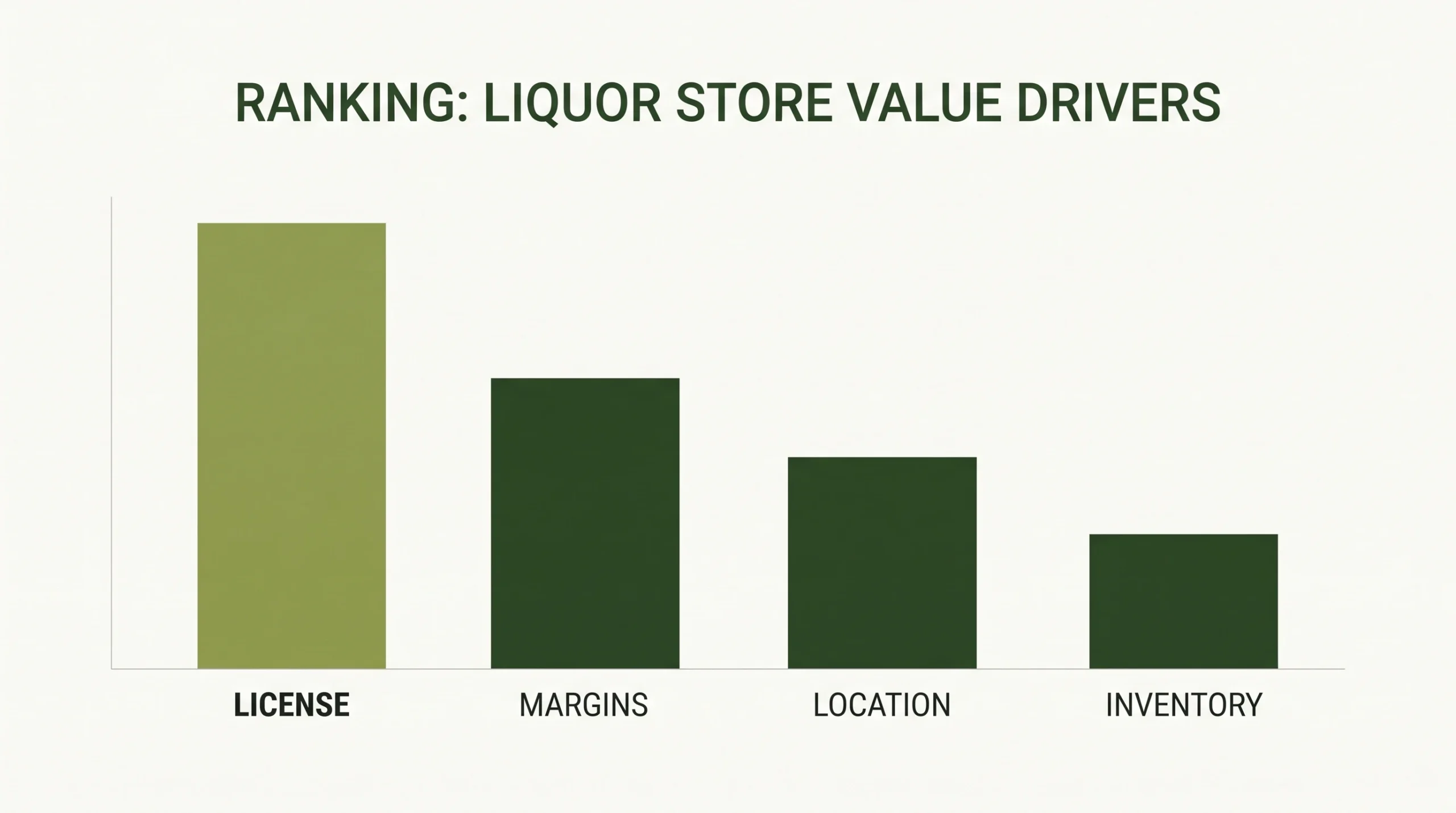
The value of a store is rarely just its shelves and coolers. The license can be the single largest asset, and location can make or break foot traffic. Margins shift by category, and lease terms shape long-term risk. Owners need this analysis for a sale, a partner buyout, estate planning, or a bank loan. Each purpose sets a different standard of value.
Key Takeaways
- Earnings drive the price: Most liquor stores sell for a multiple of Seller’s Discretionary Earnings, often near 2.5x to 3.5x.
- The license can be an asset: In quota states, a transferable license may be worth more than the fixtures.
- Inventory is priced apart: Stock is counted and added at cost at closing, outside the earnings multiple.
- Location and lease set risk: Foot traffic, competition, and renewal terms move the final multiple up or down.
- Method must fit the purpose: The market and income approaches carry the most weight for a going store.
These points connect earnings, assets, and risk into one number. The sections below break down each driver. They also show how a defensible figure is tested against IRS and market standards.
What Drives a Liquor Store Valuation?
A liquor store valuation rests on three drivers: earnings, the license, and the real estate setup. Appraisers study Seller’s Discretionary Earnings, or SDE, to gauge true owner cash flow. They weigh the license as a separate asset when the state limits supply. Then they factor the lease, the location, and local rivalry. The income and market approaches carry most of the weight, while the asset approach sets a floor. Each driver shifts the final multiple.
SDE starts with reported profit. An analyst then adds back owner pay, one-time costs, and personal items. This recast shows the cash a new owner could earn. The market approach compares the store with recent sales of similar shops. The income approach converts future cash flow into present value using a discount rate. A store with steady sales and a long lease earns a higher multiple. For more, see our guide on how to value a business based on cash flow.
How Much Is the Liquor License Worth?
A liquor license can be the most valuable single asset in the sale. Its worth depends on state law. Quota states cap the number of licenses by population. Pennsylvania, for example, allows roughly one retail license per 3,000 residents. When supply is fixed, the license trades like property and can command large sums. Open license states treat the permit as a routine cost to operate. There, the license adds little separate value.
In a quota market, buyers may pay tens of thousands of dollars, or far more, for the right to sell alcohol at a site. The Pennsylvania Liquor Control Board explains how over-quota counties block new permits. That scarcity lifts resale prices. Sofer Advisors verifies each license against recent local transfers and state records. We confirm whether the permit can move to a new owner. We also test whether its value sits inside the business or stands apart from it.
Which Margins Set a Store’s Earnings?
Gross margin in a liquor store shifts sharply by category. Spirits usually carry the highest markup. Wine sits in the middle. Beer often runs the thinnest, since shoppers know its price. Cigarettes, lottery, and mixers add volume but little margin. A store heavy in spirits and wine tends to post stronger earnings. That product mix feeds straight into SDE and the final value.
An appraiser studies the sales mix, not just total revenue. Two stores can post equal sales yet earn very different profits. The one selling more spirits and craft wine keeps more of each dollar. Slow beer volume and heavy tobacco sales pull margins down. Analysts also check inventory turnover, since fast-moving stock frees up cash. A clear, well-run mix supports a higher multiple. Our guide on adjusted EBITDA vs EBITDA shows how these add-backs work.
Why Do Location, Lease, and Zoning Matter?
Location decides how many customers walk through the door. A store near an anchor tenant or busy road sees steady traffic. Heavy nearby competition caps sales and lowers the multiple. The lease matters just as much. A long term with renewal options protects future cash flow. Zoning rules can block a new rival or limit store hours. Each factor shapes risk, and risk shapes value.
Buyers study foot traffic, parking, and the trade area around the store. A prime corner with few rivals supports premium pricing. A short lease creates real risk, since a rent spike can erase profit. Appraisers read the lease for term, renewal, and transfer rights. Zoning and local licensing can also protect a store by making new permits hard to get. That barrier can raise value. Sofer Advisors weighs these local facts against the numbers on the page.
How Is Inventory Handled in a Sale?
Inventory in a liquor store is priced apart from the business. The earnings multiple covers goodwill and cash flow. Stock is counted and added at cost at closing. Buyer and seller run a physical count on the transfer date. This way, the buyer pays only for the sellable product on hand. Damaged or dead stock stays with the seller. The split keeps the earnings figure clean.
A liquor store often holds a large amount of stock for its size. Counting it as a separate line prevents double counting inside earnings. The asset purchase agreement sets the date and method for the count. It also defines which items count as sellable. A careful count makes sure the inventory value does not inflate recurring earnings. That keeps the SDE multiple honest and the price fair to both sides.
What Multiples Apply to a Liquor Store?
Most liquor stores sell for a multiple of SDE. Recent market data points to a range near 2.5x to 3.5x, with a premium for scarce licenses and prime sites. Larger stores may be priced on EBITDA instead. BizBuySell reports a median sale price close to $425,000 on median revenue near $1,047,000. Multiples are a starting point, not a final answer. A formal valuation adjusts them for the specific store.
| Metric | Typical range | What it reflects | Best used for |
|---|---|---|---|
| SDE multiple | About 2.5x to 3.5x | Owner cash flow after add-backs | Owner-run single stores |
| EBITDA multiple | About 3.5x to 4.5x | Earnings before interest, tax, depreciation | Larger or multi-site operators |
| Revenue multiple | About 0.35x to 0.45x | Sales volume, a rough screen | Quick early estimates |
| License value | Set by state market | Scarcity in quota states | Added on top in quota markets |
These ranges give a quick screen, not a defensible number. A store with a scarce license, a strong lease, and steady spirits sales earns the top of the range. A store facing new competition or a short lease falls lower. IRS Revenue Ruling 59-60 warns against relying on any single rule of thumb. It asks appraisers to weigh many facts together. Sofer Advisors follows that guidance and the AICPA SSVS standard, so the figure holds up under review. Compare more sectors in our EBITDA multiple by industry guide.
Frequently Asked Questions
How do you value a liquor store?
You value a liquor store by recasting its earnings, then testing them against real sales. First an analyst adjusts profit to find true owner cash flow. Then the market and income approaches set a range. David Hern CPA ABV ASA and the Sofer Advisors team follow The Sofer Difference, a four-phase process of Discovery, Diligence, Analysis, and Delivery. The result is a figure you can defend to a lender or a court.
What is a liquor store worth $1 million in sales?
Sales alone do not set the price. Value rests on profit, not revenue. A store with $1 million in sales and a 12 percent margin earns far less than one with a 20 percent margin. Appraisers convert those earnings into SDE, then apply a market multiple. Two stores with equal sales can carry very different values once product mix, rent, and the license are counted.
How profitable is a liquor store?
Profit depends on product mix, rent, and inventory turnover. Spirits and wine carry stronger margins, while beer and tobacco run thin. A well-run store keeps costs low and stock moving. Successful shops still face local competition and steady overhead. We recast financial statements to show the true cash flow a new owner could earn, rather than the profit shown on a tax return.
Does the liquor license add to the value?
Often, yes, and sometimes a great deal. In quota states, the number of licenses is capped by population, so a transferable permit trades like property. There, the license can be worth more than the fixtures and stock combined. In open license states, the permit is a routine cost and adds little separate value. We confirm the transfer rules and the market value for your state and county.
What multiple do liquor stores sell for?
Most liquor stores sell near 2.5x to 3.5x Seller’s Discretionary Earnings, before inventory. Larger stores may be priced on an EBITDA multiple instead. The exact figure moves with location, lease terms, competition, and license value. A scarce license and a prime corner push the multiple up. New rivals or a short lease pull it down. A formal valuation adjusts the range for your store.
How much does a business valuation from Sofer Advisors cost?
A business valuation from Sofer Advisors usually runs $7,500 to $25,000. The price depends on how complex your financials are and the purpose of the report. A single-store review for planning falls near the lower end. A multi-site deal or a court dispute needs deeper work and costs more. We do not quote a flat fee sight unseen. Contact us for a scope matched to your store.
Do I need a large valuation firm?
You need the right fit, not the biggest name. Large firms such as Alvarez and Marsal or Kroll focus on enterprise deals and price to match. A solo appraiser may cost less but lacks database access and a review team. Sofer Advisors brings senior-level rigor to middle-market stores, backed by a full W2 team of 14 and subscriptions to major valuation databases. You get depth without enterprise overhead.
What documents do you need to value a liquor store?
We ask for three years of tax returns, profit and loss statements, and current balance sheets. We also need the lease, the license details, and a recent inventory breakdown. These records let us recast earnings and confirm the license value. This reflects our Heart of a Teacher approach: we show owners the math, not just the answer. The clearer your records, the tighter and more defensible the final figure.
Can competition lower a liquor store’s value?
Yes. Heavy nearby competition caps sales and pressures margins. A store must spend more on price and marketing to hold its share. That risk often lowers the valuation multiple. A location with few rivals captures more regional demand and supports premium pricing. Appraisers study competitor density, the trade area, and any zoning limits that make new permits hard to obtain before they set the final number.
Related Case Studies
- Car Wash Valuation: How to Value Express, Tunnel, and Subscription Models
- Multi-Unit Franchisee Valuation: Multiples vs Single Units
- When the Cost Approach Wins: Valuing Asset-Heavy Businesses
Executive Summary
A liquor store valuation blends earnings, the license, inventory, and location into one defensible figure. Most stores sell near 2.5x to 3.5x Seller’s Discretionary Earnings, with a premium for scarce licenses. BizBuySell reports a median sale price close to $425,000 on median revenue near $1,047,000. In quota states such as Pennsylvania, the license alone can be the largest asset. Inventory is counted and added at cost at closing. Gross margin shifts by category, so product mix matters. IRS Revenue Ruling 59-60 and the AICPA SSVS standard guide the work, so the number holds up for a sale, a loan, a dispute, or estate planning.
What Should You Do Next?
Start by gathering three years of tax returns, profit and loss statements, and your current lease and license. Confirm the purpose of the valuation, since a sale, a loan, and a court case use different standards. Then match your earnings to real market evidence, not a generic rule of thumb.
For a figure you can defend, work with David Hern CPA ABV ASA, whose team has testified in 11+ expert witness cases across Georgia, Florida, California, and New Mexico. Schedule a consultation to value your liquor store.
People Also Read
- Customer Concentration: Why It Cuts Sale Price 10 to 30 Percent
- EBITDA Add-Backs: What Buyers Accept and What They Reject
About the Author
This guide was prepared by David Hern CPA ABV ASA, founder of Sofer Advisors, a business valuation firm headquartered in Atlanta, GA serving clients across the United States. David holds dual accreditations as an Accredited Senior Appraiser (ASA) and is Accredited in Business Valuation (ABV), credentials recognized by the IRS, SEC, and FINRA. He also holds the Certified Exit Planning Advisor (CEPA) designation. With 15+ years of valuation experience, David has served as an expert witness in 11+ cases across multiple jurisdictions and built Sofer Advisors into an Inc. 5000-recognized firm with 180+ five-star Google reviews. Its full W2 employee team maintains subscriptions to all major valuation databases and operates under a next business day response policy. For professional business valuation services, visit soferadvisors.com/about-us/ or contact Sofer Advisors at soferadvisors.com/contact-us/.
Disclaimer: This content is for informational purposes only and does not constitute professional valuation advice. Business valuation conclusions depend on specific facts and circumstances. Contact Sofer Advisors for guidance regarding your specific situation.