

Last Updated: July 2026
A car wash valuation sets the economic worth of a car wash business, its assets, and its future earnings for a sale, financing, or tax. It weighs operational metrics like wash volume, tunnel throughput, and local competition. Analysts pair historical revenue with equipment condition to set value under the USPAP standards. The recurring revenue from memberships often drives the number more than any single asset.
Sofer Advisors provides valuations for tunnel, self-service, and in-bay automatic car wash owners. Its analysts hold CPA, ABV, and ASA credentials and have provided testimony in 11+ expert-witness cases across Georgia, Florida, California, and New Mexico. That work is backed by 180+ five-star Google reviews and grounded in verified site data, not industry averages alone.
Owners usually order a valuation before a sale, a buy-sell agreement, or bank financing for expansion. High capital intensity and swinging utility costs make precise income modeling essential. Because each site carries its own fixed and variable cost structure, the analysis has to verify the real economics of that location.
Key Takeaways
- Multiple range: car washes trade near 4x EBITDA for older full-service sites and 8x to 12x for modern express tunnels.
- Subscriptions drive value: recurring membership revenue is the single biggest value driver today.
- Three approaches: the income, market, and asset approaches together set a defensible value.
- KPIs matter: car count, revenue per car, subscription capture, and churn support the projection.
- Split the real estate: the property is appraised separately, with a fair market rent charged against operations.
Each element feeds the final number in a different way. The sections below break down the methods, the models, the KPIs, and the real estate split that shape a defensible car wash valuation.
What are the primary car wash valuation methods?
The primary methods are the income approach, the market approach, and the asset approach. The income approach values expected future cash flow, usually by capitalizing seller’s discretionary earnings (SDE) or an EBITDA multiple. Our guide to discounted cash flow techniques covers that math.
The market approach uses recent sales of similar car washes to set a price. The asset approach totals the current value of equipment and property. Because a car wash is capital-heavy, the choice between the cost and income approaches matters, and most reports blend the three for balance. Sofer Advisors weights them based on the deal type and the quality of the data.
How do business models affect car wash value?
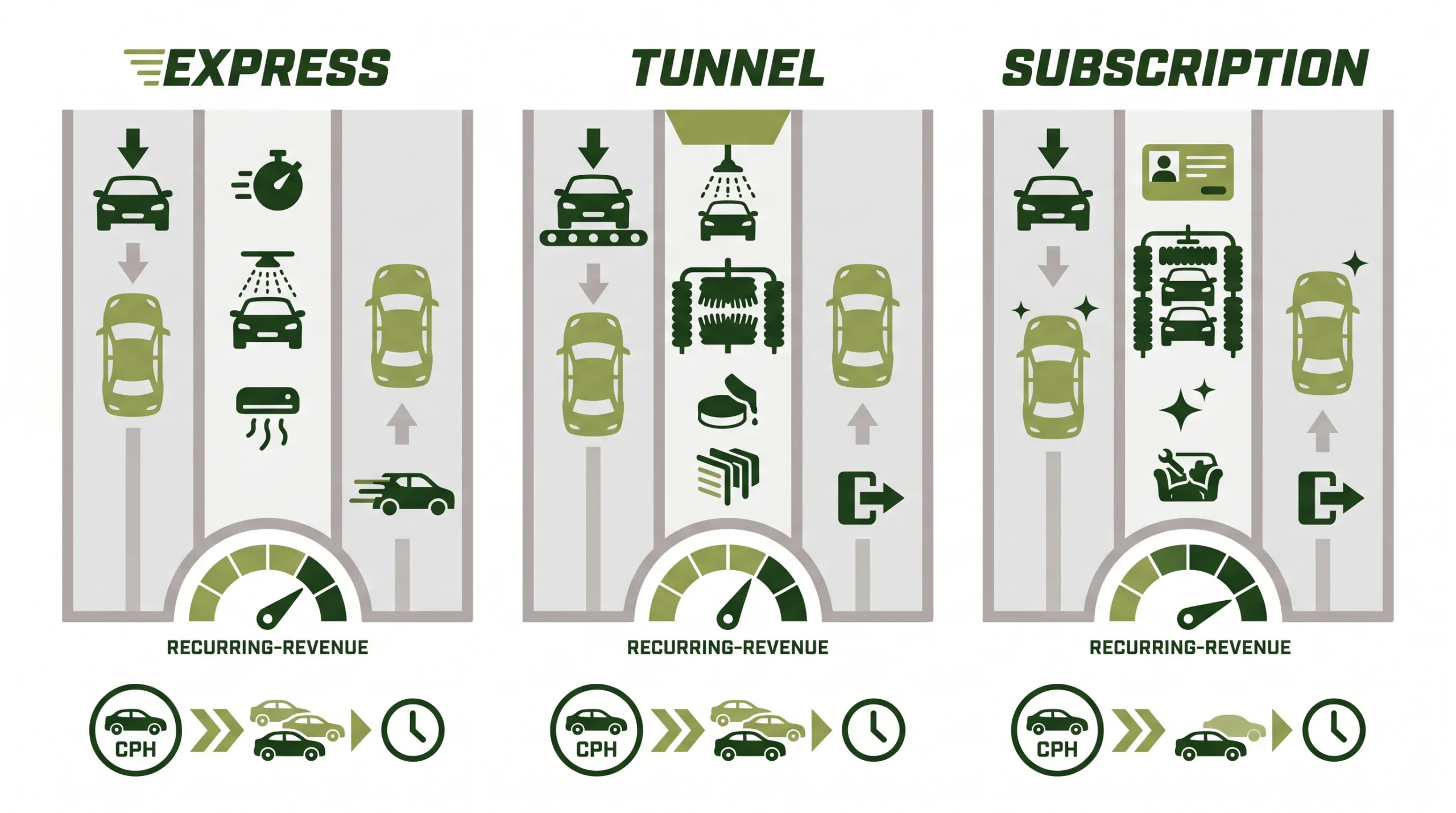
Express tunnel sites with subscription plans command the highest multiples because their revenue is predictable and their labor is low. These sites shift the profile from a volume business to a stable cash flow business. Full-service and in-bay automatic sites usually carry lower value, since they need more staff and produce less predictable cash flow.
The share of revenue from monthly memberships is a primary metric for buyers. High-volume express sites lean into subscriptions to build a loyal base. Businesses with more stable, long-term recurring revenue receive premium pricing, per Business Valuation Resources (BVR / DealStats) data. Sofer Advisors helps owners see how each revenue stream moves marketability.
Talk to a Sofer Advisors valuation specialist about which approach fits your car wash and its intended use.
Which KPIs matter most for a car wash?
A handful of operating metrics carry most of the weight in a car wash valuation:
- Wash volume, the number of cars per day or month
- Average revenue per car
- Subscription capture rate
- Membership churn rate
Wash volume sets the top of the funnel, and revenue per car sets the value of each visit. A high subscription capture rate signals durable, annuity-like income, while a low churn rate shows members stay active. Owners read these alongside chemical and labor costs as a percentage of revenue. Sofer Advisors studies these trends to build a realistic picture of long-term viability rather than a single-year snapshot.
How does real estate ownership affect value?
Real estate ownership forces a split between the business enterprise value and the property value. Each gets an independent appraisal under the Appraisal Foundation standards. Even when the owner holds title, the business value must isolate operations from the land and improvements.
When the business owns the land, it needs a commercial real estate appraisal for the site itself. The business valuation then charges a fair market rent as a hypothetical expense, even if no rent is actually paid, to show the true cost of occupying the space. If the site is leased, the lease rate, term, and renewal options become a primary factor in the value.
What is a typical EBITDA multiple for a car wash?
A typical multiple runs 4x to 6x EBITDA for older full-service sites and 8x to 12x or higher for modern express tunnels with strong subscription revenue. The figure moves with equipment age, operational efficiency, and the stability of recurring income. Lenders and buyers watch these ranges closely on any acquisition or loan.
Modern equipment, a high subscription share, and a prime location push a site toward the top of the range. Deferred maintenance or heavy local competition pulls it down. National firms like Alvarez & Marsal, Stout, and Kroll value large chains and portfolios; Sofer Advisors brings the same standards to independent operators and small groups, with senior involvement on every file through The Sofer Difference.
What documents are required for a formal valuation?
A formal valuation needs three to five years of financial statements and business tax returns, plus detailed car-count and revenue reports to reconcile performance. These files set the baseline and verify the income streams. The appraiser also needs an itemized list of furniture, fixtures, and equipment with acquisition dates and costs for the tunnel, vacuums, and terminals, along with the lease or deed and current membership counts. Sofer Advisors uses this record set during diligence so the value rests on verified site data.
How do valuation providers compare for a car wash?
The table below shows how the common options differ for a car wash owner.
| Provider | Approach | Best for | Timeline |
| Sofer Advisors | Income, market, and asset approaches in a full report | Transactions, financing, disputes, tax | 4-6 weeks |
| Business broker | Market-focused opinion of value to list a sale | Owners preparing to sell through that broker | 2-4 weeks |
| Automated tool | Rough SDE multiple estimate | Quick, informal self-assessment | Instant |
The right path depends on whether the situation needs a defensible, independent report or a rough estimate for planning. A formal valuation follows standards from the American Society of Appraisers and Revenue Ruling 59-60, so it holds up for an IRS filing, a bank, or a court. Automated tools and broker opinions serve narrower purposes and do not meet those standards. For any high-stakes use, the formal report is what protects the decision.
Car wash valuation blends operating analysis with standard valuation discipline. The questions below cover what owners ask most.
Frequently Asked Questions
How do you determine the value of a car wash?
You value a car wash by applying the income, market, and asset approaches to reach a defensible number. Appraisers project future cash flow, adjust for risk, and cross-check the result against recent sales of comparable sites. Sofer Advisors follows these standard methods so every report reflects the operational reality and equipment condition of the specific business, not a national average.
How much is a car wash business worth?
A car wash’s worth depends on its EBITDA, equipment quality, and the stability of its subscription revenue. Smaller or manual sites trade at lower multiples, while high-volume express tunnels with strong memberships command premiums. Sofer Advisors analyzes your site’s location demographics and performance metrics to estimate its worth within the current competitive market.
How profitable is owning a car wash?
Profitability turns on controlling fixed costs like utilities and labor while holding a high volume of recurring revenue. Operators lift margins by leaning on subscription plans, which smooth seasonal dips in traffic. Sofer Advisors reviews your expense ratios and revenue-per-car metrics to show how your profit compares to the benchmarks lenders and investors use.
How does real estate ownership impact a car wash valuation?
Real estate ownership splits the enterprise value from the property value. If the owner holds the land, the valuation charges a fair market rent to reveal true operating profit. Sofer Advisors appraises the property independently so the business interest reflects actual performance rather than real estate appreciation alone.
What is a typical EBITDA multiple for a car wash?
Multiples generally run from 4x for older mechanical sites to over 12x for modern express tunnels with large subscription bases. These figures rest on historical data from sources like Business Valuation Resources (BVR / DealStats). Sofer Advisors reviews your site performance and equipment age to place your business within the industry-standard range.
Does a franchise car wash have a higher value?
A franchise car wash can command a higher value through brand recognition, tested operating systems, and proven conversion models that lower buyer risk. Buyers pay for an established playbook and marketing presence. Sofer Advisors adjusts the risk profile of the valuation to reflect the specific benefits and obligations of the franchise agreement.
How do you value a car wash with a subscription model?
You value a subscription model by analyzing churn, average member lifetime, and total recurring monthly revenue. Because that revenue behaves like an annuity, it stabilizes value and raises buyer and lender confidence. Sofer Advisors evaluates these membership KPIs to show the strength of the recurring cash flow in the final report.
What is the difference between SDE and EBITDA for a car wash?
SDE, or seller’s discretionary earnings, adds back the owner’s salary and benefits plus non-cash items, so it suits smaller owner-operated sites. EBITDA separates operating performance from debt and ownership structure, so it fits larger businesses. Sofer Advisors determines which metric gives the most accurate view for your specific transaction.
How much does a car wash valuation from Sofer Advisors cost?
A car wash valuation from Sofer Advisors runs $5,000 to $20,000, based on its published engagement data, depending on site complexity, the report’s purpose, and the depth of diligence. The fee covers the analysis of historical financials, equipment condition, and market comparables. For a quote tied to your site, request a valuation estimate with your financials and car-count reports.
What risks can lower a car wash’s value?
The main risks are high membership churn, aging equipment that needs heavy reinvestment, and changes in local zoning or traffic patterns. Weak operations or rising utility costs that shrink margins also dampen value. Sofer Advisors identifies these operational and external risks during diligence to give a balanced, defensible view of the business.
Related Case Studies
- How to Value a Pizza Business: Expert Guide
- How to Value a Subway Franchise: Complete Guide
- How to Calculate the Value of a Restaurant
Executive Summary
A car wash is valued mainly with the income approach, capitalizing SDE or EBITDA at a market multiple that runs about 4x for older full-service sites to 8x-12x for modern express tunnels. Recurring membership revenue is the biggest driver, so car count, revenue per car, subscription capture, and churn all feed the projection. The property is appraised separately, with a fair market rent charged against operations to show true profit. To begin, gather three to five years of financials, car-count reports, an equipment list, and your lease or deed so a credentialed analyst can build a defensible value.
What Should You Do Next?
Pull together three to five years of financial statements, car-count and revenue reports, an itemized equipment list, and your lease or deed. Clean records let an analyst separate the business from the real estate and model the subscription base accurately. A defensible number turns a sale, a loan, or a partner buyout from a guess into a plan.
David Hern CPA ABV ASA, founder of Sofer Advisors, brings CPA, ABV, and ASA credentials and 11+ expert-witness cases to operational and real estate valuations. Schedule a free consultation to discuss your car wash.
People Also Read
- How to Value a Business Based on Cash Flow: Expert Guide
- Franchise Valuation Considerations for Business Owners
About the Author
This guide was prepared by David Hern CPA ABV ASA, founder of Sofer Advisors, a business valuation firm headquartered in Atlanta, GA serving clients across the United States. David holds dual accreditations as an Accredited Senior Appraiser (ASA) and is Accredited in Business Valuation (ABV), credentials recognized by the IRS, SEC, and FINRA. He also holds the Certified Exit Planning Advisor (CEPA) designation. With 15+ years of valuation experience, David has served as an expert witness in 11+ cases across multiple jurisdictions and built Sofer Advisors into an Inc. 5000-recognized firm with 180+ five-star Google reviews. Its full W2 employee team maintains subscriptions to all major valuation databases and operates under a next business day response policy.
For professional business valuation services, visit soferadvisors.com/about-us/ or contact Sofer Advisors at soferadvisors.com/contact-us/.
Disclaimer: This content is for informational purposes only and does not constitute professional valuation advice. Business valuation conclusions depend on specific facts and circumstances. Contact Sofer Advisors for guidance regarding your specific situation.