


Last Updated: June 2026
EBITDA add-backs are adjustments that remove non-recurring, owner-specific, or non-cash expenses from reported earnings. The result is a normalized measure of business cash flow. It is the number a buyer is purchasing a multiple of. Getting add-backs right is one of the most consequential financial decisions a seller makes. Every dollar of accepted add-back translates directly to a multiple of purchase price.
At a 6x EBITDA multiple, a $100,000 add-back is worth $600,000 in enterprise value. A $100,000 add-back that a buyer rejects costs the seller $600,000 at the closing table. The stakes are not abstract. Sofer Advisors helps owners and their advisors work through exactly these questions and turn the analysis into a defensible business valuation they can act on.
The following takeaways summarize the key valuation and transaction factors covered in this guide.
Key Takeaways
- Adjusted EBITDA Universal Deal – Adjusted EBITDA is the universal deal currency in M&A; every legitimate, documented add-back increases purchase price by the applicable multiple.
- Abovemarket Owner Pay Common – Above-market owner pay is the most common add-back and is well-accepted when benchmarked properly against market data.
- Onetime Nonrecurring Expenses Valid – One-time, non-recurring expenses are valid add-backs – but buyers will scrutinize repetition; an expense that recurs every year is not one-time.
- Relatedparty Rent Belowmarket Abovemarket – Related-party rent, below-market or above-market, requires independent market evidence and is frequently contested.
- Bad Debt Addbacks Contextspecific – Bad debt add-backs are context-specific – a genuine one-time collection failure is defensible; a pattern of bad debt is a business quality issue.
- Quality Earnings QofE Process – The quality of earnings (QofE) process is where add-backs are tested; unsupported add-backs found in QofE reduce the purchase price or kill deals.
Each of these factors is examined in depth in the sections that follow.
What Is the Difference Between EBITDA and Adjusted EBITDA?
EBITDA, earnings before interest, taxes, depreciation, and amortization, starts from net income and adds back four specific items: interest expense, income tax expense, depreciation, and amortization. This is a relatively standardized calculation. Two analysts looking at the same financials should produce the same EBITDA.
Adjusted EBITDA goes further. It adds back expenses that are specific to the current owner, non-recurring in nature, or non-cash items not already captured in D&A. The result is a representation of what the business would generate under arm’s-length operation. This is what buyers are paying a multiple for.
The key distinction: EBITDA is historical accounting math. Adjusted EBITDA is a representation about the business’s economic earning power. It reflects judgment calls about what is “non-recurring.” It also reflects what counts as “above-market pay.” This makes it more subjective, and more contested.
A well-constructed adjusted EBITDA schedule will show each adjustment line by line. It will include the dollar amount, the nature and rationale, and supporting records. It will also show whether the adjustment is one-time or structural. Sellers who present a clean, documented add-back schedule before QofE begins reduce friction and maintain negotiating position.
| Add-Back Category | Typical Acceptance | Documentation Required |
|---|---|---|
| Above-market owner pay | High – well-accepted | Salary benchmarks (BLS, industry surveys), replacement cost analysis |
| One-time legal fees (non-recurring litigation) | High | Engagement letters, invoices, explanation of non-recurrence |
| Non-recurring PPE repair (insurance event) | High | Insurance claim records, one-time nature confirmed |
| Excess owner perks (car, personal travel) | Moderate | Tax return breakdown, separation from legitimate business expense |
| Related-party rent (above or below market) | Moderate – frequently contested | Independent lease comp analysis, market rate appraisal |
| Management fees to related entities | Moderate | Records of services rendered; arms-length test |
| Revenue from discontinued operations | Moderate to Low | Explanation of why it won’t recur; confirmation in reps/warranties |
| Bad debt expense (isolated event) | Context-dependent | Customer payment history, aging report, reason for failure |
| Repeated “one-time” expenses | Low – high scrutiny | Will be treated as recurring unless clearly explained |
| Personal expenses buried in COGS | Low | Aggressive buyers will not accept without clean records |
Analysis at this level is the work of a credentialed valuation professional operating under the AICPA Statement on Standards for Valuation Services, which governs how a defensible conclusion of value is developed and documented.
Which Add-Backs Do Buyers Readily Accept?
The cleanest add-backs are also the most common. They are well-accepted because they reflect structural economics, not accounting creativity.
- Above-market owner pay. If the owner pays themselves $400,000 annually but a replacement CEO would cost $175,000, the $225,000 difference is a legitimate add-back. This is the single largest add-back in most small and mid-market deals. The key is having solid benchmarking data. Use BLS Occupational Employment Statistics, industry salary surveys, or pay databases to support the replacement cost figure.
- One-time legal or professional fees. A company that spent $120,000 defending a slip-and-fall lawsuit can add that back. It must be documented and the underlying issue must be resolved. What makes this add-back strong: a specific invoice or engagement letter. The seller must also provide a clear explanation of why it won’t recur. Confirmation in representations and warranties that the litigation is fully resolved completes the support.
- Non-recurring equipment repair or replacement. A $60,000 emergency compressor replacement after a one-time equipment failure is a legitimate add-back if supported by maintenance records. Buyers distinguish between deferred maintenance (recurring risk) and a genuine one-time event.
- COVID-related expenses and revenue impacts. Government grants received during 2020–2021 were treated as non-operating income and are typically backed out. Extraordinary COVID-related costs (PPE, facility modifications, one-time staffing) remain defensible add-backs in historical periods.
Which Add-Backs Trigger Buyer Pushback?
These add-backs are legitimate in principle but routinely contested in practice. They require stronger records and may survive QofE at a reduced amount.
Excess owner perks. Owners commonly run personal expenses through the business, personal vehicle costs, home internet, country club dues, personal travel with thin business rationale. A $50,000 “auto expense” for the owner’s personal vehicle is an add-back. But the buyer’s QofE analyst will ask for tax return footnotes and vehicle registration. They also want the documented business purpose. If 40% of the mileage was personal, expect 40% of the expense to be rejected.
Related-party rent above or below market. If you own the building through a separate LLC and lease it to the operating company at $8,000/month when market rent is $6,000/month, the $2,000 excess is an add-back. But market rent requires independent support. You need a broker opinion of value, a recent comp lease, or an appraisal. Sellers who claim a rent adjustment without market support invite disputes that delay or crater deals.
The inverse is equally contested. If your building is leased at $4,000/month but market is $6,000/month, a buyer will add $2,000/month to expenses (a negative add-back), reducing adjusted EBITDA. Both directions require honest market analysis.
Management fees to affiliated entities. If the operating company pays a holding company or family entity for “management services,” buyers will scrutinize whether any real services were rendered. Fees with no documented deliverables are rejected outright. Fees with supporting service agreements may survive QofE. Evidence of work performed is required.
Revenue from non-continuing operations. If a division is being wound down, adding back its losses is legitimate, but only if you can credibly show the operation is actually discontinued and wind-down costs won’t appear in future periods.
Which Add-Backs Kill Deals?
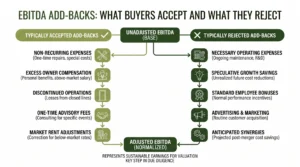
These are the categories that erode credibility, cause renegotiations, or result in a buyer walking.
- Repeated “one-time” items. If your tax returns show a different “one-time” legal expense every year for three years, no buyer will accept any of them as non-recurring. A pattern of “unusual” expenses is the business’s normal operating reality. QofE analysts are specifically trained to look for this pattern. They run the income statement line by line across multiple years. Any item that appears more than once gets flagged.
- Unsupported or undocumented items. An add-back with no supporting records is worthless in QofE. If you claim $80,000 in “miscellaneous non-recurring expenses” with no backup, expect it to be zeroed out. Every add-back needs a paper trail, invoice, bank statement, explanation letter, or accounting workpaper.
- Owner pay below market. Some sellers add back their full salary as if no replacement cost exists. But if the owner is the primary salesperson, the lead technician, and the accountant, replacing all those functions costs more than the salary being added back. Over-adding owner pay is a credibility issue. It colors the entire add-back schedule.
- Revenue recognition acceleration. If the seller pulled forward revenue into the measurement period (accelerated billing, early recognition of deferred revenue), the buyer’s QofE will identify it. The “add-back” will not just be rejected, it will become a downward adjustment.
David Hern CPA ABV ASA, founder of Sofer Advisors, brings a Heart of a Teacher to every engagement – translating complex valuation methodology into clear, actionable guidance that clients can act on before and after the report is delivered. With 15+ years of valuation experience, 11+ expert witness cases across multiple jurisdictions, and 180+ five-star Google reviews, David built Sofer Advisors into an Inc. 5000-recognized firm. The Sofer Difference is a four-phase process of Discovery, Diligence, Analysis, and Delivery that ensures every conclusion is defensible, documented, and tied to the specific facts of the business.
While national firms like Stout and Kroll serve large enterprise clients, Sofer Advisors specializes in middle-market businesses that require personalized attention, direct access to credentialed professionals, and a next business day response policy.
How Do QofE Analysts Scrutinize Add-Backs?
Quality of earnings analysis is the structured process through which a buyer verifies that the seller’s adjusted EBITDA represents economic reality. It is conducted by a CPA firm engaged by the buyer, or seller, in a sell-side QofE, and typically costs $20,000–$60,000 depending on company size and complexity.
The QofE process for add-backs follows a systematic method. Analysts obtain three years of tax returns and three years of financial statements. They also get the seller’s add-back schedule. They then:
- Reconcile tax returns to financial statements line by line to identify unexplained variances.
- Run a year-over-year income statement comparison to identify expense categories that spike unusually in the measurement year.
- Request general ledger detail for every add-back item, transaction-level support, not just totals.
- Apply a “recurring or not?” test: did this expense appear in prior years in any form?
- Benchmark owner pay against independent data.
- Verify one-time items against external records (court records for litigation, insurance documents for casualty events).
A QofE report that reduces the seller’s adjusted EBITDA by 10%–15% is common when the seller has been aggressive. At a 6x multiple on a $1M adjusted EBITDA claim, a $150,000 QofE reduction costs the seller $900,000 in purchase price. Sellers who conduct their own sell-side QofE before going to market are in a better negotiating position. They typically achieve higher final prices.
How Are Owner Pay Benchmarks Applied?
The benchmark question: what would an arm’s-length, professional manager charge to perform the owner’s functions? The answer depends on the specific roles, the market, and company revenue size.
General benchmarks for replacement CEO or general manager pay by company revenue:
- $1M–$3M revenue: $120,000–$160,000 total pay
- $3M–$10M revenue: $150,000–$200,000 total pay
- $10M–$25M revenue: $200,000–$275,000 total pay
- $25M–$50M revenue: $250,000–$350,000 total pay
These are starting points, not definitive answers. Industry sector, geography, and specific roles drive significant variation. An owner who is also the lead salesperson may require a separate add-back for sales commission savings. An owner who provides specialized technical expertise may have a higher replacement cost.
Use multiple data sources. BLS OES data is publicly available and credible. Industry-specific surveys from trade associations provide sector context. Pay consultants such as Pearl Meyer, Radford, and Equilar cover larger businesses. Arriving at a defensible midpoint from multiple sources is stronger than citing a single source.
The questions below address the most common issues business owners raise before engaging a qualified appraiser for a ebitda add backs due engagement.
Frequently Asked Questions
Does EBITDA include add-backs?
Standard EBITDA does not include add-backs, it is simply net income plus interest, taxes, depreciation, and amortization. Adjusted EBITDA adds the add-backs on top. Buyers often use both terms loosely.
Should bad debt be added back to EBITDA?
It depends on context. A genuine one-time bad debt event, a single customer insolvency that is documented and not representative of credit quality, can be added back. A pattern of bad debt in the accounts receivable aging is a business quality issue and will not be treated as an add-back.
How much does an unsupported add-back cost a seller?
At a 5x EBITDA multiple, every $100,000 of rejected add-back costs $500,000 in purchase price. The leverage is asymmetric: the cost of preparing proper records is minimal compared to the value at risk.
What is a sell-side quality of earnings and should sellers get one?
A sell-side QofE is a quality of earnings analysis conducted by a seller-engaged CPA firm before going to market. It identifies problems before buyers find them and allows the seller to prepare explanations and records. It signals to buyers that the financials have been vetted.
Can I add back personal health insurance premiums?
Owner health insurance premiums that run through the business are a standard add-back to the extent they exceed what the company would pay for a market-rate employee’s benefit plan. The marginal excess, typically the premium for owner family coverage above employee-level coverage, is a defensible add-back.
What is the typical range for owner pay add-backs?
Owner pay add-backs range from $50,000 to $300,000+ depending on how much the owner is overpaying themselves relative to market rate. For a $5M revenue business, an owner drawing $350,000 against a $175,000 market replacement cost produces a $175,000 add-back.
How does the treatment of add-backs differ between PE buyers and strategic buyers?
PE buyers tend to be more rigorous in QofE, they have dedicated deal teams and a financial model that must support a leveraged acquisition. Strategic buyers may be less formal but are equally interested in avoiding overpayment. In both cases, the underlying standard is the same: is this expense genuinely non-recurring and non-operational?
Are depreciation and amortization always added back in EBITDA?
Yes, depreciation and amortization are definitionally added back in EBITDA. But buyers then evaluate capital spending requirements independently. A business with high D&A and corresponding high replacement capex has lower free cash flow than EBITDA suggests. Buyers will calculate EBITDA minus capex for capital-intensive businesses.
What happens if add-backs are challenged after the LOI is signed?
QofE occurs after a letter of intent is signed. If the buyer’s QofE reduces adjusted EBITDA, the buyer typically retrades on price. They request a reduction corresponding to the multiple applied to the rejected add-back amount.
Can non-cash stock pay be added back to EBITDA?
Non-cash stock-based pay is frequently added back to EBITDA in private company valuations, as it is a non-cash charge. But buyers who intend to continue equity pay programs will model the ongoing cost in their forward projections. The add-back is clean in the historical period; the economic cost reappears in the buyer’s pro forma.
Related Case Studies
- Business Valuation For Mergers Buy Side Vs Sell Side
- How Do You Determine What A Business Is Worth Complete Guide
- Business Valuation Mistakes To Avoid What Can Go Wrong
Executive Summary
- Adjusted EBITDA is the primary deal currency in M&A; each accepted dollar of add-back increases enterprise value by the deal multiple.
- Well-accepted add-backs include above-market owner pay, documented one-time legal and casualty expenses, and owner personal expenses with clear separation from business operations.
- Contested add-backs include related-party rent, management fees to affiliated entities, and excess perks – all require independent market evidence.
What Should You Do Next?
If you are preparing for a business sale or need a defensible adjusted EBITDA analysis before entering a deal process, start with a certified valuation from a credentialed firm. David Hern CPA ABV ASA, founder of Sofer Advisors, holds dual ASA and ABV credentials recognized by the IRS, SEC, and FINRA, with 15+ years of valuation experience and 180+ five-star Google reviews. Schedule a consultation to discuss your business valuation needs.
People Also Read
- Why You Must Start Planning Your Business Exit Now With The Right Valuation Expert
- When To Start Succession Planning Your Strategic Timeline Guide
About the Author
This guide was prepared by David Hern CPA ABV ASA, founder of Sofer Advisors – a business valuation firm headquartered in Atlanta, GA serving clients across the United States. David holds dual accreditations as an Accredited Senior Appraiser (ASA) and is Accredited in Business Valuation (ABV), credentials recognized by the IRS, SEC, and FINRA. He also holds the Certified Exit Planning Advisor (CEPA) designation. With 15+ years of valuation experience, David has served as an expert witness in 11+ cases across multiple jurisdictions and built Sofer Advisors into an Inc. 5000-recognized firm with 180+ five-star Google reviews. The firm’s full W2 employee team maintains subscriptions to all major valuation databases and operates under a next business day response policy.
For professional business valuation services, visit soferadvisors.com/about-us/ or schedule a consultation at soferadvisors.com/contact-us/.
This content is for informational purposes only and does not constitute professional valuation advice. Business valuation conclusions depend on specific facts and circumstances. Contact Sofer Advisors for guidance regarding your specific situation.









