


Last Updated: July 2026
An asset-heavy business valuation finds the worth of a company whose value comes mostly from tangible assets like property, plant, and equipment. It applies to manufacturing, distribution, and heavy construction firms, where physical infrastructure outweighs intangibles like brand or customer lists. Analysts focus on the book value and the current market feasibility of those assets.
Sofer Advisors provides valuation services for owners, CPAs, and legal counsel facing these calculations. Operating since 2019, it has built a name for technical precision, backed by 180+ five-star Google reviews. Its experts bring deep experience to each engagement, having given expert-witness testimony in 11+ court cases across Georgia, Florida, California, and New Mexico.
A valuation professional must gauge the remaining useful life and replacement cost of physical assets to reach fair market value. Owners rely on these reports for tax filings, partner buyouts, or lending. The first step is knowing whether your company fits the asset-heavy profile.
Key Takeaways
- Asset-heavy baseline: manufacturing and logistics firms draw most of their value from physical equipment.
- Cost approach as a floor: it sets a starting point by measuring replacement or reproduction cost.
- Going-concern value: the income and market approaches capture earning power beyond fixed assets.
- Reporting rules: a deal requires value split between tangible and intangible assets under ASC 805.
- Tax stakes: an asset sale can trigger depreciation recapture, so a defensible valuation matters.
The sections below apply these principles to the technical steps. Each method ties to specific tax and reporting rules.
What defines an asset-heavy business?
An asset-heavy business is defined by large holdings of tangible items, such as property, plant, and equipment (PP&E). These form a primary part of its financial position and much of its operating capacity. Because these firms rely on physical capital, their balance sheet carries a high share of non-current assets compared to other sectors.
Industries like manufacturing and transportation need these large capital outlays to run. That stands in contrast to asset-light models, such as software or service firms, which lean on intangibles or human capital. Valuing a company with extensive physical holdings takes careful analysis of depreciation, maintenance, and market worth. Sofer Advisors applies specific methods so these physical records get accurate treatment during a sale or tax filing.
Why is the cost approach often used first?
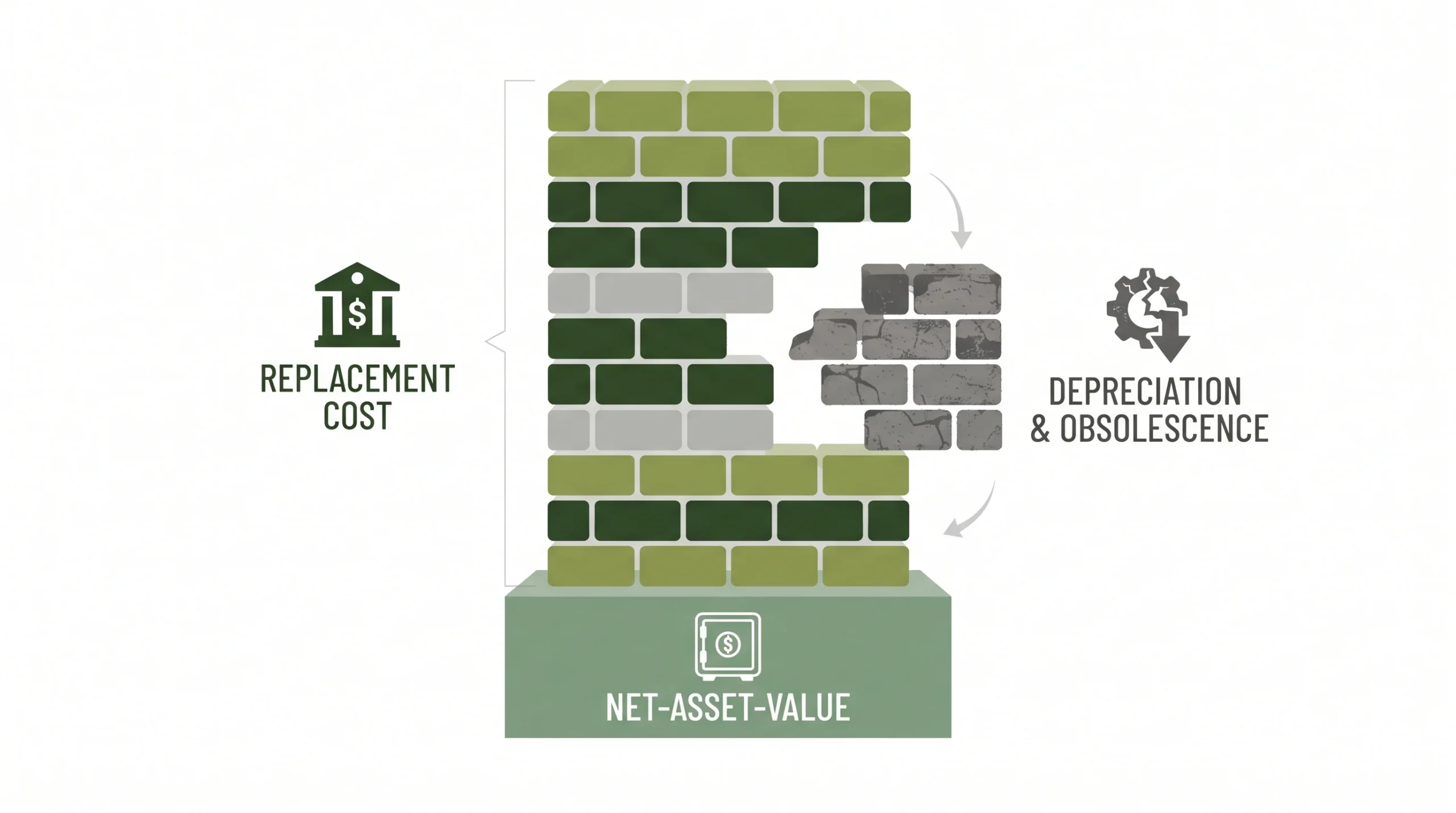
The cost approach is often used first for asset-heavy businesses because it values the tangible assets directly, in line with the principle of substitution. That principle says a prudent buyer will not pay more for an asset than the cost of a similar substitute. By focusing on physical components, the method gives a clear baseline where tangible property defines the operation. Our guide to the cost approach versus the income approach compares the two in depth.
The process calculates either replacement cost or reproduction cost. Replacement cost is the current price to build an asset with equal utility. Reproduction cost is the price to recreate an exact replica. Once that base cost is set, analysts subtract depreciation. That includes physical wear plus functional and economic obsolescence. Functional obsolescence covers flaws in design or utility. Economic obsolescence reflects outside market changes that cut value. This adjustment produces a fair value that matches the current condition of the property.
When do the income and market approaches apply?
The income and market approaches apply when a business is valued on its ongoing ability to earn, not on the liquidation of its assets. These methods find going-concern value, the worth of a business as an active enterprise. A balance sheet reflects historical cost, but these approaches capture the real profitability and market sentiment that physical assets alone miss.
A discounted cash flow analysis is a primary tool when earnings are strong and predictable. It projects future cash flows and discounts them to present value at a risk-adjusted rate, consistent with AICPA guidance. Market multiples from comparable transactions offer a reality check. Those multiples, from databases like Business Valuation Resources (BVR / DealStats), show how similar businesses trade. Using these viewpoints together builds a balanced, defensible value.
How does goodwill factor into the valuation?
Goodwill arises when the purchase price exceeds the fair market value of the net identifiable assets, as defined by ASC 805. In an asset-heavy deal, this is the final step to balance the books after every tangible and intangible item gets its own value. It ensures the buyer records all acquired components and separates them from the premium paid for future earning power.
A detailed purchase price allocation (PPA) isolates and reports these values. It reviews the target to assign value to every asset, from machinery to intellectual property. Separating those from residual goodwill satisfies the accounting rules for the deal. Because goodwill is not amortized, these figures stay on the balance sheet and face annual impairment testing under ASC 350. Sofer Advisors helps teams make sure these reports meet the standards.
Talk to a Sofer Advisors specialist about valuing your equipment and real estate for a deal or tax filing.
What tax implications should owners consider?
The sale structure, an asset sale versus a stock sale, creates very different tax outcomes for both sides. In an asset sale, the buyer acquires individual items and can step up the cost basis to fair market value. That allows larger depreciation deductions over time. The seller often faces a higher immediate tax bill, because the gain on specific assets can trigger depreciation recapture. Per the IRS, that recapture is taxed at ordinary income rates, not the lower capital gains rates. Our asset sale versus stock sale guide walks through the trade-offs.
A detailed valuation is vital to set the cost basis for each asset, which drives the purchase price allocation. Proper allocation manages the tax for both parties under federal rules. Owners must weigh these trade-offs to protect the net proceeds of the deal.
Which valuation provider is best for an asset-heavy firm?
The right provider depends on how you will use the report. An educational article is a starting point, and a broker’s listing shows current market sentiment, but neither is a certified opinion. Large advisory practices like Alvarez & Marsal, Stout, and Kroll serve big industrial deals. For tax or litigation, owners need a certified report with independent verification. The table below compares the options.
| Provider type | Valuation type | Asset appraisal detail |
| Sofer Advisors | Certified valuation (CPA/ABV, ASA) | Integrates machinery, equipment, and real estate |
| Educational resource | General articles and definitions | Does not perform asset-specific appraisals |
| Business broker | Sales listing estimate | Uses value for a market listing price only |
Choosing well means matching technical rigor to the report’s use. Educational resources give a starting point, and broker listings show market sentiment for specific items. For legal matters, filings under IRC Section 409A, or complex transfers under ASC 805, owners need a certified report. These include independent verification that holds up before the IRS or in court, consistent with USPAP standards. A firm that appraises machinery and equipment keeps the value consistent across the balance sheet and the physical site. That detail avoids the gaps that appear with simplified or non-certified estimates.
Asset-heavy valuation rewards detailed records and the right method mix. The questions below cover what owners ask most.
Frequently Asked Questions
How do you value an asset-heavy business?
You focus on both the value of the tangible items and the earning power of the whole entity. Analysts use the cost approach to find the replacement value of machinery and equipment, and the income approach to quantify long-term cash flow. Sofer Advisors weighs how these methods interact to see whether the business reaches its full potential as a going concern.
How much is a business worth with $500,000 in sales?
Revenue alone rarely proxies for value, because profit margins and the asset base drive the result. A business with $500,000 in sales might be worth a fraction of revenue if it carries high debt or little physical value, while a high-margin firm could earn a higher multiple. Sofer Advisors provides a custom estimate that weighs your earnings, industry risk, and balance sheet.
What is the difference between book value and fair market value for tangible assets?
Book value is the historical cost of an asset minus accumulated depreciation on the balance sheet. Fair market value is what a buyer would pay for that asset today in an open market. Sofer Advisors runs independent appraisals to find where physical assets differ from their accounting records, which is critical for accurate reporting during a sale or expansion.
Why can I not just use my tax assessment value for real estate in a valuation?
Tax assessments use mass appraisal built for municipal revenue, not the specific economic utility of a property. They often exclude leasehold improvements or specialized site infrastructure a buyer would weigh. Sofer Advisors uses independent, location-specific data so the property value reflects its real contribution to enterprise value.
How does ASC 820 affect an asset-heavy business valuation?
ASC 820 requires assets to be valued at an exit price in the most advantageous market for a market participant. That pushes the valuation away from historical cost and toward market-based inputs that reflect current demand for the equipment. Sofer Advisors uses these frameworks so your fair value reporting meets SEC and other regulatory requirements.
What documents are needed for an asset-heavy business valuation?
You need three years of financial statements, detailed fixed asset ledgers, and current lease agreements. The team also requests recent equipment maintenance files and property assessments to verify the condition of tangible holdings. Sofer Advisors works with your controller during the discovery phase to gather these records for a complete analysis.
What is the purpose of goodwill impairment testing under ASC 350?
Impairment testing under ASC 350 confirms that the carrying value of goodwill does not exceed its recoverable amount after the deal accounting. If key tangible assets face functional or economic obsolescence, business value can drop and trigger an impairment charge. Sofer Advisors runs these annual tests with quantitative analysis to help companies defend their reported figures under audit.
How much does an asset-heavy business valuation from Sofer Advisors cost?
An asset-heavy business valuation from Sofer Advisors runs $7,500 to $25,000, based on its published engagement data, with heavy equipment and multi-site work reaching the higher end. Cost depends on the number of asset classes, the condition records available, and the report’s purpose. For a quote tied to your firm, request a valuation estimate with your fixed asset ledger and financials.
Related Case Studies
- How to Value a Manufacturing Company: A Complete Guide
- How to Value a Logistics or 3PL Company
- Construction Company Valuation: A Complete Industry Guide
Executive Summary
For an asset-heavy business, the cost approach sets the floor by starting from replacement or reproduction cost and subtracting physical wear plus functional and economic obsolescence. But it is only a starting point: the income and market approaches capture the going-concern value that fixed assets alone miss, so a defensible number blends all three. Deal structure matters as much as method, since an asset sale can trigger depreciation recapture taxed at ordinary rates. To prepare, gather three years of financials, fixed asset ledgers, lease agreements, and equipment maintenance records so the analysis reconciles your physical base with your earnings under IRS and ASC standards.
What Should You Do Next?
Gather three years of tax filings, depreciation schedules for heavy equipment, and current balance sheets, then add fixed asset ledgers and lease agreements. These let the analysis reconcile your physical base with net income and pick the right method mix. Preparing early shortens the timeline and keeps the report aligned with IRS and ASC standards.
David Hern CPA ABV ASA, founder of Sofer Advisors, delivers neutral third-party valuations for tax, complex transactions, and disputes. Schedule a free consultation to discuss your situation.
People Also Read
- The Difference Between Book Value and Fair Value, Explained
- What Is Impairment Testing? An Asset Value Assessment Guide
About the Author
This guide was prepared by David Hern CPA ABV ASA, founder of Sofer Advisors, a business valuation firm headquartered in Atlanta, GA serving clients across the United States. David holds dual accreditations as an Accredited Senior Appraiser (ASA) and is Accredited in Business Valuation (ABV), credentials recognized by the IRS, SEC, and FINRA. He also holds the Certified Exit Planning Advisor (CEPA) designation. With 15+ years of valuation experience, David has served as an expert witness in 11+ cases across multiple jurisdictions and built Sofer Advisors into an Inc. 5000-recognized firm with 180+ five-star Google reviews. Its full W2 employee team maintains subscriptions to all major valuation databases and operates under a next business day response policy.
For professional business valuation services, visit soferadvisors.com/about-us/ or contact Sofer Advisors at soferadvisors.com/contact-us/.
Disclaimer: This content is for informational purposes only and does not constitute professional valuation advice. Business valuation conclusions depend on specific facts and circumstances. Contact Sofer Advisors for guidance regarding your specific situation.









