


Last Updated: July 2026
A multi-unit franchisee valuation finds the fair market value of a business that runs several locations under one or more franchise agreements. It captures the benefits of a group of units, not just one store on its own. Analysts weigh the agreement terms, location demographics, and total scale to reach a value under the standards in Revenue Ruling 59-60.
Serving clients since February 2019, Sofer Advisors provides neutral, third-party assessments for owners and their advisors. It holds 180+ five-star Google reviews and offers deep technical experience, including 11+ expert-witness cases with court testimony across multiple states. Its approach centers on clear, evidence-based reporting that meets the scrutiny of the IRS and other regulators.
Owners need these valuations for tax reporting, estate planning, or a sale. Because franchise agreements often carry unique transfer restrictions, a valuation takes a precise look at the legal and financial structure of the holdings. By applying professional standards such as those of the American Society of Appraisers, Sofer Advisors helps owners understand the true worth of their multi-unit operations.
Key Takeaways
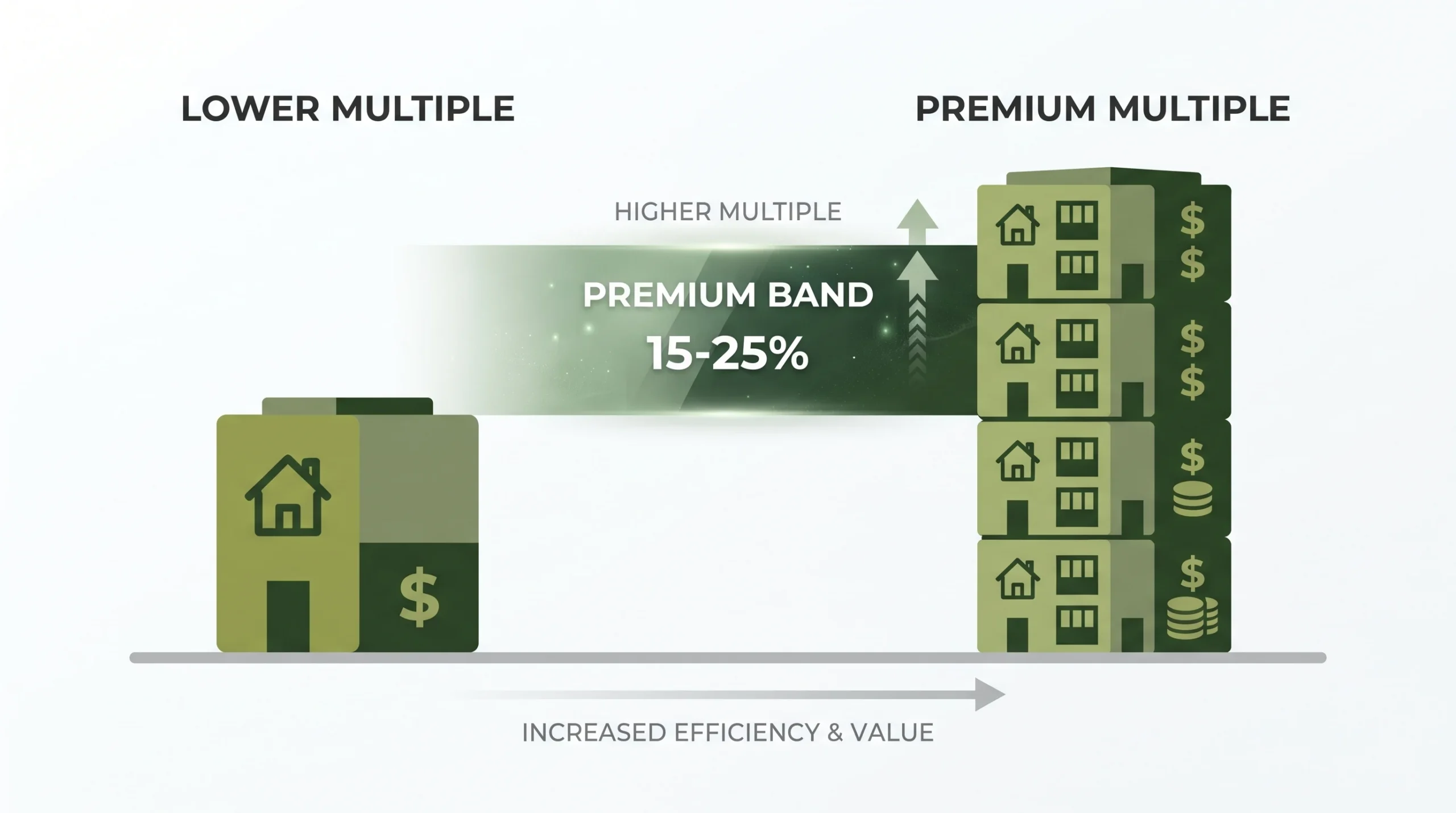
- Multi-unit premium: franchise groups often earn a 15 to 25% premium over single units, reflecting scale and diversified risk.
- Metric by size: larger groups use EBITDA multiples, while single owner-operated units rely on Seller’s Discretionary Earnings (SDE).
- Consolidated value: each unit is analyzed on its own, then summed, sometimes with a portfolio premium rather than an average.
- Agreement terms matter: remaining term length and renewal costs must be assessed to gauge future cash flow.
- Purpose drives method: M&A seeks strategic value, while tax valuations must follow IRS fair market value standards.
Each element interacts with the broader context of a franchise appraisal. The sections below cover each in detail.
How does multi-unit scale affect valuation?
Multi-unit scale creates a premium that reflects steadier cash flow and lower risk. A business across several sites often earns higher EBITDA multiples, because mixed revenue anchors overall performance. According to Business Valuation Resources (BVR / DealStats), scale and geographic reach often tie to lower swings in enterprise value.
Central operations apply the same controls across all sites. Shared back-office functions cut overhead, and buying power lowers the cost of goods sold. This lifts margins that single-unit peers struggle to match. When one location hits local headwinds, the wider group absorbs the hit without threat to the whole entity. That buffer against concentration risk makes the business more attractive to buyers. Sofer Advisors examines these strengths so each valuation captures the real benefit of a multi-unit footprint.
What valuation multiples are used for franchises?
Franchise valuations rely on a multiple of SDE for smaller, owner-operated units, or a multiple of EBITDA for larger, multi-unit enterprises. When an owner runs a single unit, SDE is primary, since it captures the total economic benefit to the owner after necessary expenses. For larger operations with professional management, EBITDA is the standard, because it reflects cash flow before interest, taxes, depreciation, and amortization. Our guide to SDE versus EBITDA shows how to pick the right one.
Smaller franchise valuations often normalize earnings through add-backs. These might include owner compensation, personal vehicle expenses, or one-time costs that do not reflect unit-level economics. Stripping these away gives a clearer picture of earning power. Larger organizations usually avoid these adjustments in favor of standard EBITDA, which better shows their scale under professional leadership. Our EBITDA multiples by industry guide shows how these compare across systems.
Are all franchise units valued the same?
Franchise units are not valued as one uniform block. A qualified valuator assesses each location on its performance, location quality, and local market before setting a combined enterprise value. Each unit has its own earnings profile that needs careful review. Analysts read unit-level P&L statements to separate local results from system-wide averages, checking traffic, labor costs, and lease terms to set fair expectations for future cash flow.
Evaluators look closely at four-wall EBITDA to isolate the direct profit of each site. By stripping away corporate overhead and shared regional expenses, they identify underperforming locations that may need a lower multiple or a distinct risk adjustment. A portfolio premium may apply to the total enterprise value, but only if the combined operations provide verifiable synergies that exceed the sum of the parts.
How are franchise agreements factored into value?
Franchise agreements shape value by setting the rights, duties, and costs tied to each location. They act as key intangible assets that set how long a franchisee can earn cash flow and what it costs to keep that right. Analysts read the Franchise Disclosure Document (FDD) to see how the remaining term, renewal options, and required fees affect a buyer’s return. The main agreement factors are:
- Remaining term length, which sets how long cash flow is secure
- Renewal and transfer fees, which are direct cash outflows
- A franchisor right of first refusal, which limits the buyer pool
- Mandatory re-imaging or upgrade requirements, which act as deferred liabilities
A short remaining term creates cash flow uncertainty if it cannot support a return on the purchase price. A unit with only two years left may need significant capital to extend, which lowers present value. Transfer and renewal fees reduce net earnings, and a strict right of first refusal can push down the market price. By reading the FDD alongside historical results, Sofer Advisors helps owners see how these terms shape the final value.
What risks can lower a multi-unit valuation?
Multi-unit value often drops when key-person dependency, geographic concentration, deferred capital spending, or heavy franchisor mandates exist. These create uncertainty about future cash flow, signaling to buyers that the business may need more investment to hold performance.
Key-person dependency occurs when success rests on one owner’s skills or presence. If that person leaves, operations often falter. Geographic concentration poses a similar risk, since all units in one city leave the company exposed to a local downturn. Franchisor mandates for remodels act as a required capital outflow that buyers deduct from the price. When a brand signals that units need major upgrades, it lowers the cash available to a new owner. Data from Business Valuation Resources notes these capital-intensity factors stay central to modern appraisal.
How does valuation differ for M&A versus tax purposes?
Valuation for M&A differs from tax reporting, because M&A seeks strategic value while tax requires fair market value under IRS rules. A buyer weighing an acquisition often pays a premium for synergy, reflecting the savings they expect once they combine the firm with their own operations. These buyer-specific motives allow higher values based on the unique fit.
Tax or estate valuations follow strict rules like IRS Revenue Ruling 59-60. These assume a hypothetical willing buyer and seller, neither under compulsion and both with reasonable knowledge of the facts. That excludes buyer-specific synergies and relies on quantitative benchmarks and observable market data to set a price any qualified buyer would accept.
Request a valuation estimate to confirm which standard applies to your situation.
Which valuation provider is best for a multi-unit franchisee?
The right provider matches the reason for the engagement, the available data, and the required standard. National firms like Alvarez & Marsal, Stout, and Kroll serve the largest portfolios, while a broker sets a listing price and a listing site gives a rough estimate. A specialist firm blends the income, market, and asset approaches for a defensible conclusion. The table below compares the options.
| Provider type | Typical approach | Primary use case |
| Sofer Advisors | Income, market, and asset; unit-level and FDD review | M&A, financing, tax and estate planning, litigation |
| Business broker | Broker opinion of value from market comps | Setting a listing price for a sale |
| Online listing site | General industry multiples | An informal, preliminary estimate for sellers |
These distinctions help owners see whether they need an indicative price or a defensible report built on formal standards. An informal estimate from a listing site or a broker opinion is a starting point, but it rarely satisfies the IRS or a commercial lender. A professional engagement addresses the specific risk profile of the business, giving a credible number for high-stakes decisions. Sofer Advisors uses a structured process aligned with USPAP and AICPA standards, which matters when the valuation must withstand review by tax authorities, auditors, or lenders.
Multi-unit valuation rewards four-wall analysis and a close read of the FDD. The questions below cover what owners ask most.
Frequently Asked Questions
How much do multi-unit franchise owners make?
Earnings vary widely with industry, brand, and operational efficiency, so a single figure is unreliable for planning. Owner earnings, often measured by SDE, fluctuate with the strength of the franchisor system and regional conditions. Sofer Advisors examines the unit-level profit and loss statements of every location to give a realistic read on true owner earnings for your situation.
Is a business worth three times profit?
Many small businesses trade near three times earnings, but that is a rough rule of thumb, not a professional standard. Multiples depend on risk, growth prospects, and the specific industry, as reported in Business Valuation Resources data. Sofer Advisors uses income and market approaches to see whether that benchmark fits or a different multiple is justified for your company.
What is the difference between SDE and EBITDA in a franchise valuation?
SDE includes the owner’s total compensation and benefits, which makes it the standard for single-unit owner-operated businesses. EBITDA is earnings before interest, taxes, depreciation, and amortization, the preferred metric for larger, multi-unit groups with professional management. Sofer Advisors selects the metric by the size and management structure so the valuation reflects the real business model.
How does the quality of the franchisor impact business value?
A franchisor with a strong national brand, high demand, and predictable support increases the perceived stability and future cash flow of the business. A franchisor facing litigation or weakening demand adds risk that depresses the multiple. Sofer Advisors reviews the Franchise Disclosure Document and market-wide performance to account for these external influences on your enterprise value.
What is a four-wall EBITDA in a franchise valuation?
Four-wall EBITDA isolates the direct profit of a single location by stripping away corporate overhead and shared regional expenses. It shows how each site performs on its own, which helps identify underperformers that need a lower multiple or a risk adjustment. Sofer Advisors uses four-wall analysis so the consolidated value reflects the real contribution of each unit.
How does a remaining franchise term affect value?
A short remaining term creates cash flow uncertainty if it cannot support a return on the purchase price. A unit with only two years left may need significant capital to secure an extension, which lowers present value. Sofer Advisors reviews the FDD and renewal terms to quantify how the remaining term and any renewal fees affect the final opinion of value.
How long does a multi-unit franchise valuation take?
A multi-unit franchise valuation typically takes three to six weeks from final document receipt. That window allows a detailed review of financial records, franchise agreements, and market benchmarks. Sofer Advisors stays diligent through the analysis phase so the final report gives a clear, defensible position that meets current AICPA and USPAP standards.
Does the franchise industry impact the valuation multiple?
Yes. The industry heavily influences the multiple, since a quick-service restaurant, a fitness brand, and a service franchise carry different margins, capital needs, and growth. Sofer Advisors benchmarks your system against comparable industry transactions so the multiple reflects the real risk and return of your specific brand.
How much does a multi-unit franchise valuation from Sofer Advisors cost?
A multi-unit franchise valuation from Sofer Advisors runs $5,000 to $20,000, based on its published engagement data, with larger portfolios and complex FDD reviews reaching the higher end. Cost depends on the portfolio’s complexity, the number of units, and the report’s purpose. For a quote tied to your group, request a valuation estimate with your unit financials and franchise agreements.
Related Case Studies
- How to Value a Construction Company: An Expert Guide
- How to Value Intellectual Property: Patents and Trademarks
- How to Value a Cybersecurity Company: ARR, NRR, and Comps
Executive Summary
A multi-unit franchisee typically earns a 15 to 25% premium over single units, because scale brings steadier cash flow, lower overhead, and diversified risk. Larger groups are valued on EBITDA and single owner-operated units on SDE, with add-backs normalizing the smaller ones. Each location is analyzed on four-wall EBITDA, then combined into a consolidated value, with a portfolio premium only where real synergies exist. Franchise agreement terms, the remaining length, renewal and transfer fees, a right of first refusal, and re-imaging mandates, all move the number. M&A valuations may pay for synergy, while tax valuations must hold to fair market value under Revenue Ruling 59-60. To prepare, gather unit-level financials, your FDD, and lease and renewal terms.
What Should You Do Next?
Gather unit-level profit and loss statements, your Franchise Disclosure Document, and all lease and renewal terms, then confirm whether your valuation is for M&A, tax, or estate purposes, since the standard differs. Flag any pending re-imaging mandates or short remaining terms that will affect value. An independent valuation can then combine four-wall results into a defensible portfolio number.
David Hern CPA ABV ASA, founder of Sofer Advisors, provides rigorous, independent valuations for multi-unit franchisees. Schedule a free consultation to discuss your situation.
People Also Read
About the Author
This guide was prepared by David Hern CPA ABV ASA, founder of Sofer Advisors, a business valuation firm headquartered in Atlanta, GA serving clients across the United States. David holds dual accreditations as an Accredited Senior Appraiser (ASA) and is Accredited in Business Valuation (ABV), credentials recognized by the IRS, SEC, and FINRA. He also holds the Certified Exit Planning Advisor (CEPA) designation. With 15+ years of valuation experience, David has served as an expert witness in 11+ cases across multiple jurisdictions and built Sofer Advisors into an Inc. 5000-recognized firm with 180+ five-star Google reviews. Its full W2 employee team maintains subscriptions to all major valuation databases and operates under a next business day response policy.
For professional business valuation services, visit soferadvisors.com/about-us/ or contact Sofer Advisors at soferadvisors.com/contact-us/.
Disclaimer: This content is for informational purposes only and does not constitute professional valuation advice. Business valuation conclusions depend on specific facts and circumstances. Contact Sofer Advisors for guidance regarding your specific situation.









