


Last Updated: August 2026
A control premium is the extra amount a buyer pays above a company’s per-share market value to gain a controlling interest. That control carries real power. The new owner can set strategy, replace managers, and steer how cash is spent. Deal data from the FactSet/BVR Control Premium Study puts these premiums at 20 to 30 percent above the pre-deal price. Sofer Advisors measures the premium when a value turns on the level of ownership.
Why does it matter? The value of a business is not one fixed number. It shifts with the size and the rights of the interest. A majority stake and a small minority share in the same firm can carry very different values. A control premium bridges that gap. It shows what buyers pay to hold the reins.
Key Takeaways
- Definition: A control premium is the added amount paid above market value to gain control of a company.
- Prerogatives of control: Control lets an owner set strategy, replace management, and direct the timing of cash flow.
- Measured from market data: Analysts pull premiums from completed deals and control premium studies, not one rigid formula.
- Inverse of a DLOC: A control premium and a discount for lack of control are two sides of the same coin.
- Not always paid: Some deals, such as a merger of equals or a distressed sale, carry no premium.
These points connect ownership rights to value. The sections below show why buyers pay, how the premium is measured, and when it applies to your interest.
Why do buyers pay a control premium?
Buyers pay a control premium to gain the power that comes with a majority stake. A controlling owner can change strategy, replace leaders, and sell off assets. That owner also sets the timing of payouts. Minority holders cannot do any of this. These rights are known as the prerogatives of control. They let a new owner run the business in a way that can lift its future earnings. That added earning power is what a buyer pays for.
The prerogatives of control usually include the ability to:
- Set company strategy and appoint or replace senior management.
- Direct how capital is spent and when profits are paid out.
- Sell, buy, or restructure assets to raise the firm’s earning power.
A buyer who can act on these rights often expects a higher return. One company may fold a target into its own shop and cut shared costs. Those gains lift the value of the bought firm above its standalone worth. A minority owner cannot force such changes. So a minority share is worth less per unit. Control is why the same company can carry two prices.
What is control versus a minority interest?
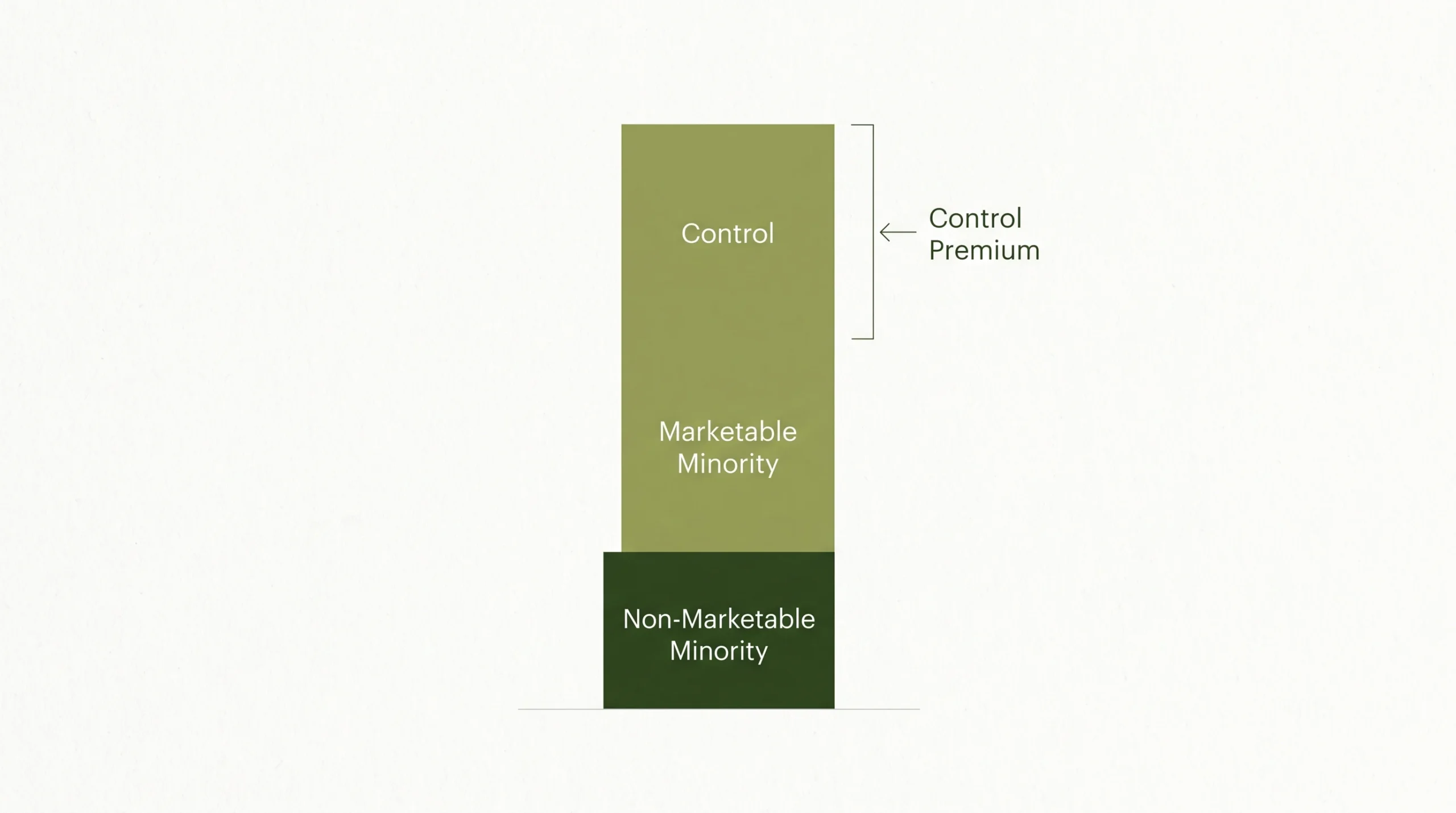
A controlling interest holds enough voting power to direct the company. A minority interest does not. This split creates what appraisers call the level of value. Fair market value is never one figure for a whole business. It depends on which level you are valuing. A control level sits at the top. A minority level sits lower, once you take out control and ease of resale.
The rights on a share drive where it lands. A 60 percent block can force a sale or set the budget. So it holds control. A 5 percent stake in a private firm holds almost none of that power. Its owner cannot change management or demand a payout. So a careful analyst first asks one plain question: what is being valued? The answer sets the base value and the premium or discount that follows.
How is a control premium measured?
A control premium is measured from real deal prices, not a set rule. The basic formula divides the buyout price per share by the pre-deal market price, then subtracts one. The result is the premium as a percent. Analysts confirm the figure against similar deals in the same sector. Control premium studies collect these prices across thousands of public buyouts. That evidence keeps the number tied to the market, not a guess.
Take a simple case. A public firm trades at a market value of 10 million dollars. A buyer pays 12.5 million dollars for full voting control. The extra 2.5 million dollars, or 25 percent, is the control premium. The FactSet/BVR Control Premium Study reports how these premiums group by industry and deal type. Sofer Advisors reviews recent deals so a result reflects real prices, not a stale benchmark. The market approach anchors the number in facts a reviewer can check.
How does it relate to a DLOC?
A control premium and a discount for lack of control (DLOC) are inverse ideas. A control premium is added to reach a controlling value. A DLOC is subtracted to reach a minority value. They describe the same gap from opposite ends. If the market pays a premium for control, then a minority share must sell for less. The two adjustments simply move value up or down the level-of-value ladder.
The math links them directly. A DLOC equals one minus one divided by one plus the premium. So a 25 percent control premium implies a DLOC of about 20 percent. The table below sets the two adjustments side by side, along with a related marketability discount.
| Adjustment | What it does | Direction | Applies to |
|---|---|---|---|
| Control premium | Adds value for the power to direct the firm | Increases value | A controlling interest |
| Discount for lack of control (DLOC) | Removes value a minority owner cannot access | Decreases value | A minority interest |
| Discount for lack of marketability (DLOM) | Removes value for shares that are hard to sell | Decreases value | Private, illiquid interests |
Getting these adjustments right protects a valuation under review. A minority stake in a private company often faces both a DLOC and a DLOM. Stacking them in the wrong order, or skipping one, can swing the answer by a wide margin. Sofer Advisors applies each adjustment to match the exact rights of the interest. That discipline keeps the result defensible for a tax filing, a deal, or a dispute.
When does a control premium apply?
A control premium applies only when the interest being valued actually carries control. It fits a purchase of a majority stake, or any share block that can direct the firm. It does not fit every deal. A merger of equals usually carries no premium, since neither side gains control. A distressed sale often closes below fair market value, so no premium exists to add. Forcing a premium into every valuation ignores what the market really shows.
Standards guide when and how the premium is used. IRS Revenue Ruling 59-60 frames fair market value and the weight given to control in tax matters. The AICPA Statement on Standards for Valuation Services sets how a credentialed analyst supports and reports each adjustment. David Hern CPA ABV ASA and the Sofer Advisors team read the governing documents first. If a share block cannot change management or force a sale, a premium rarely belongs in the number.
Where do valuators find control premium data?
Valuators pull control premium data from studies of completed public takeovers. The FactSet/BVR Control Premium Study is a leading source. It records the price a buyer paid over the pre-deal market price across thousands of deals. Analysts sort that data by industry, size, and year to find fitting comparables. This evidence turns a subjective call into a supported one. Cost of capital and deal databases round out the picture for a full valuation.
There is a real gap between a general figure and a defensible one. A quick average from a public article cannot support a tax filing or a court case. That is where The Sofer Difference matters. It is a four-phase process of Discovery, Diligence, Analysis, and Delivery that yields an audit-ready report. Large firms such as Alvarez and Marsal or Kroll focus on the biggest clients. Sofer Advisors brings that same senior-level rigor to middle-market owners. Unlike a solo practitioner, its full W2 team of 14 backs every conclusion with current data and a next business day response policy. Its Heart of a Teacher approach means owners see the math, not just the answer.
Frequently Asked Questions
What is an example of a control premium?
Say a public company has a market value of 10 million dollars. A buyer pays 12.5 million dollars to secure all of the voting shares. The extra 2.5 million dollars is the control premium, or 25 percent over the market price. That payment buys the power to set strategy, replace managers, and direct cash. Sofer Advisors isolates this premium so a client sees the price paid purely for control.
What is the difference between a control premium and a DLOC?
A control premium and a discount for lack of control describe the same value gap from opposite ends. A control premium is added to reach a controlling value. A DLOC is subtracted to reach a minority value. If a controlling interest earns a 25 percent premium, the matching minority share faces a DLOC near 20 percent. The team applies the one that fits the rights of the interest being valued.
How much is a typical control premium?
Public deal data from the FactSet/BVR Control Premium Study shows premiums often run from 20 to 30 percent over the pre-deal market price. That range is only a starting point. The real figure shifts with the industry, the number of bidders, and the gains a buyer expects. Sofer Advisors checks current precedent deals to confirm whether a specific case sits within, below, or above that common range.
Does a DCF include a control premium?
A standard discounted cash flow model values a company as a standalone entity. It does not add a control premium on its own. When the goal is a controlling value, an analyst may adjust the projected cash flows or the discount rate to reflect the powers of full ownership. Sofer Advisors sets the model to match the exact control profile of the interest, so the result fits the assignment.
Can a control premium be negative?
A control premium is rarely negative, but it can happen. This occurs when a controlling block is worth less per share than a smaller stake. Heavy legal limits on voting rights, or rules that block a majority owner from acting, can cause it. The premium then disappears because control brings no real power. The firm reviews the governance documents to explain why a premium may be absent in an unusual structure.
Is a control premium relevant for private companies?
A control premium stays relevant for private companies whenever the interest can direct firm policy or force a sale. Private shares often carry premiums or discounts based on the exact rights attached to each class. Because private stock has no public price, an analyst leans on deal studies and the governing documents. Sofer Advisors applies IRS Revenue Ruling 59-60 to weigh how control affects the value of a private business interest.
Is a control premium the same as goodwill?
A control premium is not a separate asset, and it is not the same as goodwill. In a purchase price allocation under ASC 805, the amount a buyer pays above the fair value of net assets is recorded as goodwill. A control premium can be part of that excess, since a buyer pays it for future gains. Our team keeps the two ideas distinct so financial reporting stays compliant and clear.
How much does a business valuation from Sofer Advisors cost?
Business valuations from Sofer Advisors typically run from 7,500 to 25,000 dollars. The fee depends on the complexity of your financial statements and the scope of the work. Simpler jobs for planning or tax reporting fall toward the lower end. A deal, a dispute, or a purchase price allocation needs deeper analysis and falls higher. Contact Sofer Advisors for a fee quote matched to your situation.
Related Case Studies
- Holding Company Discounts: How DLOC and DLOM Apply to Holdcos
- Statutory Fair Value vs Fair Market Value in Shareholder Disputes
- Blockage Discounts: Valuing Large Stock Positions
Executive Summary
A control premium is the added amount a buyer pays above market value to gain a controlling interest. It reflects the prerogatives of control: setting strategy, replacing management, and directing cash. Deal data puts premiums at 20 to 30 percent over the pre-deal price, though the real figure varies by industry and deal. Analysts measure the premium from completed deals. It moves inversely to a discount for lack of control. It applies only when the interest carries real power. Sofer Advisors builds each premium on current market evidence under IRS Revenue Ruling 59-60 and AICPA standards.
What Should You Do Next?
Start by confirming exactly which interest you are valuing and what rights it holds. Then decide whether the assignment sits at a control or a minority level, since that choice drives the premium or discount. Finally, tie any premium to current deal evidence rather than a generic benchmark.
For a valuation you can stand behind, work with David Hern CPA ABV ASA. His team has given expert witness testimony in 11+ cases across Georgia, Florida, California, and New Mexico. Schedule a consultation to discuss the control premium that fits your business.
People Also Read
- Revenue Ruling 93-12: Why Family Attribution Doesn’t Apply
- The Size Premium: Why Small Firms Carry Higher Rates
About the Author
This guide was prepared by David Hern CPA ABV ASA, founder of Sofer Advisors, a business valuation firm headquartered in Atlanta, GA serving clients across the United States. David holds dual accreditations as an Accredited Senior Appraiser (ASA) and is Accredited in Business Valuation (ABV), credentials recognized by the IRS, SEC, and FINRA. He also holds the Certified Exit Planning Advisor (CEPA) designation. With 15+ years of valuation experience, David has served as an expert witness in 11+ cases across multiple jurisdictions and built Sofer Advisors into an Inc. 5000-recognized firm with 180+ five-star Google reviews. Its full W2 employee team maintains subscriptions to all major valuation databases and operates under a next business day response policy. For professional business valuation services, visit soferadvisors.com/about-us/ or contact Sofer Advisors at soferadvisors.com/contact-us/.
Disclaimer: This content is for informational purposes only and does not constitute professional valuation advice. Business valuation conclusions depend on specific facts and circumstances. Contact Sofer Advisors for guidance regarding your specific situation.









