


Last Updated: July 2026
Statutory fair value is a legal standard set by state law to determine the price paid to shareholders in a dispute. It often omits the discounts that usually apply to private equity interests. Fair market value is a separate standard used in tax and deal contexts, and it allows marketability and minority discounts. The choice between the two can shift a minority shareholder’s value by more than 30%, which often becomes a primary source of conflict in litigation.
Picking the right standard takes an objective look at the legal or contractual framework that governs the entity. Sofer Advisors provides neutral, defensible valuations to help shareholders and counsel define the correct standard. With 180+ five-star Google reviews and 11+ expert-witness cases across multiple states, it makes sure reports align with the exact definitions judicial or statutory authorities require.
Owners and advisors must see that these definitions decide how an analyst treats non-controlling interests and lack of marketability. The wrong standard can produce very different outcomes for dissenting shareholders or buying entities. Defining the standard early is a critical step for everyone involved.
Key Takeaways
- Legal versus tax: statutory fair value is a legal standard set by state law; fair market value is a tax standard from the IRS.
- Discounts move the number: excluding control and marketability discounts can raise a minority value by 20 to 40% or more.
- Litigation use: statutory fair value applies in oppression lawsuits and dissenting shareholder cases.
- Expert analysis: a qualified expert is needed for a defensible opinion on the correct standard under state law.
- Approach differs: the standard drives whether discounts apply, which often changes the final result sharply.
Each of these ties to state statutes and tax rules. The sections below show how specific precedents and frameworks apply to different disputes.
What is fair market value (FMV)?
Fair market value is the price at which property would change hands between a hypothetical willing buyer and willing seller, with neither under compulsion. This standard, set by IRS Revenue Ruling 59-60, is the objective baseline for business appraisals. It assumes both parties have reasonable knowledge of the facts and act at arm’s length in their own interest.
FMV centers on a hypothetical transaction, not an actual sale. Because private companies often lack public trading, appraisers must account for reduced liquidity and control. That usually means applying a discount for lack of control (DLOC) and a discount for lack of marketability (DLOM). These reflect that a minority interest in a private entity holds less appeal than a controlling, liquid stake. Sofer Advisors follows these principles so every analysis stays defensible for tax and estate planning.
What is statutory fair value?
Statutory fair value is a standard governed by state-specific statutes and case law, which often differs from the fair market value used in federal tax reporting. Where federal standards rely on a hypothetical willing buyer and seller, statutory fair value is an equitable remedy to protect minority interests or provide an exit for investors. Jurisdictions develop it through local code and case-law precedent to resolve disputes.
These cases often arise in shareholder oppression lawsuits or when shareholders exercise dissenter’s rights. Because what is fair rests on the governing jurisdiction, the valuation must reflect local legal outcomes rather than general market trends. Sofer Advisors brings clarity to these standards through its litigation and dispute valuation work. Courts may require specific adjustments for the nature of these conflicts, regardless of what a standard market transaction would imply under USPAP.
How do valuation discounts differ between standards?
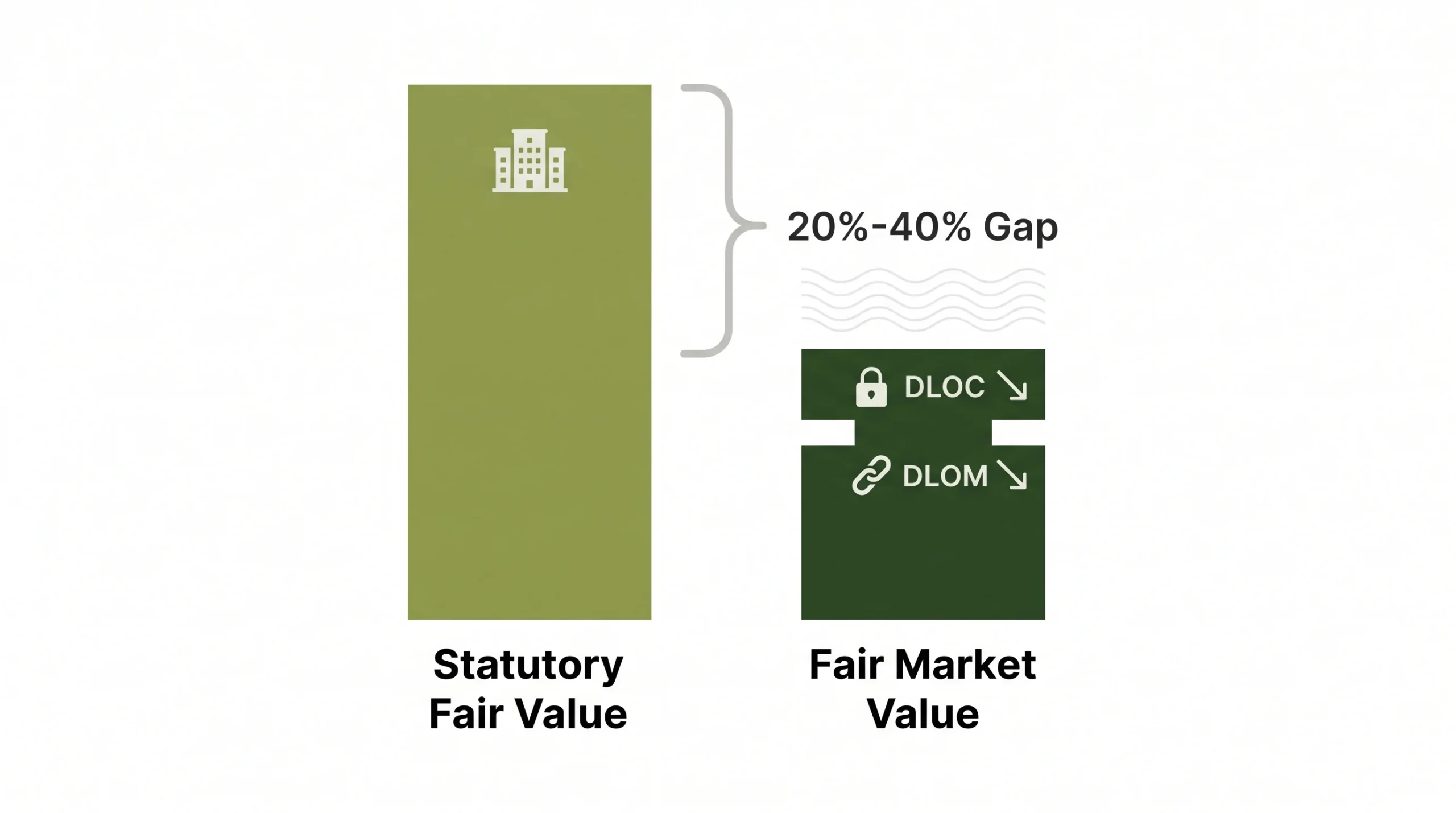
Discounts differ because the legal purpose of the proceeding decides whether an interest is adjusted for its constraints. Statutory fair value proceedings often disallow the DLOM and DLOC that are standard in FMV engagements. Courts usually exclude these to stop a controlling shareholder from using oppressive acts to lower the value of minority shares.
This approach seeks an equitable outcome by giving the minority holder their pro-rata share of the company’s full value. FMV standards, by contrast, allow the discounts to reflect that a hypothetical buyer would pay less for a stake with no voting power or liquidity. Without them, the value would not represent what a typical investor would pay in an open market.
When is each valuation standard applied?
The two standards apply in distinct settings, based on the legal and economic context. Fair market value is used for tax reporting, including gift and estate tax, and for most voluntary M&A deals. It assumes a hypothetical exchange between a willing buyer and seller, neither under compulsion, as defined in Revenue Ruling 59-60.
Statutory fair value is typically invoked in non-consensual court proceedings. It applies to forced buyouts or squeeze-outs where minority owners exercise dissenting shareholder appraisal rights. Courts set this value on state statutes rather than a hypothetical market transaction. For example, an ESOP transaction uses fair market value for compliance, while a court-ordered appraisal in a minority buyout relies on statutory fair value to set the payout. A business divorce often turns on this same distinction.
What is the financial impact of this difference?
The impact is significant, often a 20 to 40% gap between statutory fair value and fair market value appraisals. It happens because statutory fair value proceedings usually omit the control and marketability discounts central to FMV reporting, according to Business Valuation Resources (BVR / DealStats). When a valuation drops these downward adjustments, the result is a pro-rata share of enterprise value, not a discounted price for a minority interest.
For example, a 30% minority stake with a $300,000 pro-rata value might appraise at only $210,000 under fair market value after typical discounts. In court, demanding the full $300,000 under statutory fair value creates a major point of contention. The pro-rata portion reflects the share’s underlying worth, but actual market demand for that interest is often far lower. Misalignment on this threshold often decides the outcome of a dispute.
How does an expert witness navigate these standards?
An expert witness gives a defensible opinion by grounding the analysis in the relevant standard of value and the jurisdiction’s case law. This neutral role requires methods that hold up under cross-examination. Every decision, from choosing an income or market approach to setting discounts, must align with professional standards from the Appraisal Foundation.
Expert testimony means justifying not only the final number but the logic behind it. Reports must explain the inclusion or exclusion of specific discounts so judges and opposing counsel can follow the reasoning. Sofer Advisors uses the Heart of a Teacher approach to keep this complexity transparent for all parties. That reduces confusion and clarifies the economic basis of the final appraisal. Our guide to a buy-sell versus shareholder agreement shows how contracts can shape the standard.
Which provider is best for a dispute valuation?
The right provider depends on your goal: a broad financial view or a niche read of judge-made law in one jurisdiction. Large advisory practices like Alvarez & Marsal, Stout, and Kroll bring deep resources to big matters, while a specialist firm focuses on statutory-versus-FMV standards and state case law. The table below compares the options.
| Provider type | Expertise focus | Primary service |
| Sofer Advisors | Statutory vs FMV and deep jurisdictional case law | Litigation, tax, and financial advisory |
| National valuation firm | Broad business valuation and investment banking | Valuation and capital markets advisory |
| Legal directory or blog | State law and case commentary | Case summaries and attorney referrals |
Choosing the right partner takes a clear view of the goal. An advisor who supports transactional work may use different methods than a firm focused on court testimony. Advisors must understand how IRC Section 409A reporting interacts with state statutory demands to give an opinion that holds up. The choice comes down to whether counsel needs a broad financial perspective or a niche read of judge-made law in a single state. A neutral, fact-based approach keeps the valuation defensible for a tax filing or a court proceeding.
Dispute valuations reward the right standard and clear reasoning. The questions below cover what owners and counsel ask most.
Frequently Asked Questions
Is there a difference between fair value and fair market value?
Yes. Fair value is a legal term found in shareholder statutes or accounting standards, while fair market value is the price between a willing buyer and seller in an open market. Fair market value weighs the liquidity and control of the interest, while fair value follows the definitions in state law or accounting rules. Sofer Advisors differentiates these standards to keep your case compliant with the specific rules that govern it.
What is statutory value?
Statutory value is the price or method set by state law to resolve disputes between shareholders. Unlike market-based standards, it is dictated by legislative definitions and case-law precedent that often prioritize protecting minority investors. Courts use it to prevent unfair treatment during forced buyouts or dissenter actions. Sofer Advisors aligns its models with the state codes that define value for your proceeding.
Is real market value the same as fair market value?
Real market value is not a formal standard; laypeople often use it interchangeably with fair market value. Fair market value is the formal standard the IRS uses for tax reporting under Treasury Regulations. Informal terms can create confusion in legal or tax documents where precise definitions matter. Sofer Advisors uses standard terminology to prevent ambiguity in every report.
What are dissenter’s rights in a shareholder dispute?
Dissenter’s rights let shareholders demand a fair purchase of their shares after a major company action they oppose, such as a merger or a major asset sale. The shareholder essentially force-sells the interest to the company at a price set by a formal valuation. Sofer Advisors provides neutral, defensible valuations to establish an objective price in these mandatory purchase scenarios.
Why is a discount for lack of marketability often excluded in oppression cases?
Courts often exclude the DLOM in oppression cases so minority shareholders receive their pro-rata share of value. Applying it would penalize the oppressed shareholder for the controlling party’s actions, which courts view as inequitable. Omitting the discount produces a more just outcome. Sofer Advisors follows prevailing judicial standards so every conclusion holds up under legal scrutiny.
Can a buy-sell agreement override state law on fair value?
A well-drafted buy-sell agreement often acts as the primary governing document, letting parties define the method for calculating value and potentially override certain default state provisions. If the agreement explicitly specifies the calculation, courts generally respect the parties’ intent. It is essential to have an advisor review these agreements for clarity. Sofer Advisors identifies these contract-specific definitions during discovery to keep the analysis true to your agreement.
Does fair value under ASC 820 mean the same as statutory fair value?
No. ASC 820 fair value focuses on an exit price for financial reporting, while statutory fair value is a legal construct specific to state shareholder disputes. ASC 820 requires market-based inputs from a market participant’s view at a point in time. Statutory fair value is more fluid and depends on how a judge reads state statutes and case law. Sofer Advisors applies the correct framework for SEC reporting or litigation.
What qualifications should a valuation expert witness have?
A qualified expert witness should hold credentials like the Accredited in Business Valuation (ABV) or Accredited Senior Appraiser (ASA) designation. They also need deep experience applying valuation standards in court, with consistent reliance on IRS and AICPA guidance. A track record of neutral, expert analysis is critical before a judge or jury. Sofer Advisors offers this through founding partners with 11+ expert-witness cases.
How much does a litigation support valuation from Sofer Advisors cost?
A litigation support valuation from Sofer Advisors runs $7,500 to $25,000, based on its published engagement data, with heavy testimony and document review reaching the higher end. Cost tracks the hours for document review, expert research, and court preparation. For a quote tied to your matter, request an engagement estimate with your governing documents and the case details.
Related Case Studies
- Partnership Dissociation: How a Departing Partner’s Stake Is Valued
- How to Calculate Damages from a Breached Business Contract
- Earn-Out Valuation in M&A: Structuring and Fair Value
Executive Summary
Statutory fair value and fair market value are two different standards, and the one that governs a shareholder dispute decides whether discounts apply. Statutory fair value, set by state law for oppression and dissenter cases, usually strips the control and marketability discounts to give the minority a pro-rata share. Fair market value, used for tax and most deals, applies those discounts to reflect what a real buyer would pay. The gap can reach 20 to 40%, so the choice often decides the case. To prepare, review your bylaws and any buy-sell agreement, confirm the governing state statute, and engage a credentialed expert to fix the standard before the numbers are argued.
What Should You Do Next?
Review your corporate bylaws and any shareholder or buy-sell agreement, then confirm the governing state statute, since these decide which standard applies. Engage a credentialed valuation expert early to fix the standard before the numbers are argued. Settling this threshold up front prevents a costly misunderstanding later.
David Hern CPA ABV ASA, founder of Sofer Advisors, provides neutral, defensible valuations for shareholder disputes and appraisal-rights cases. Schedule a free consultation to discuss your situation.
People Also Read
- ASC 820 Fair Value Measurement: Hierarchy Levels Explained
- Personal Goodwill vs Enterprise Goodwill: A Tax and Divorce Guide
About the Author
This guide was prepared by David Hern CPA ABV ASA, founder of Sofer Advisors, a business valuation firm headquartered in Atlanta, GA serving clients across the United States. David holds dual accreditations as an Accredited Senior Appraiser (ASA) and is Accredited in Business Valuation (ABV), credentials recognized by the IRS, SEC, and FINRA. He also holds the Certified Exit Planning Advisor (CEPA) designation. With 15+ years of valuation experience, David has served as an expert witness in 11+ cases across multiple jurisdictions and built Sofer Advisors into an Inc. 5000-recognized firm with 180+ five-star Google reviews. Its full W2 employee team maintains subscriptions to all major valuation databases and operates under a next business day response policy.
For professional business valuation services, visit soferadvisors.com/about-us/ or contact Sofer Advisors at soferadvisors.com/contact-us/.
Disclaimer: This content is for informational purposes only and does not constitute professional valuation advice. Business valuation conclusions depend on specific facts and circumstances. Contact Sofer Advisors for guidance regarding your specific situation.









