


Last Updated: July 2026
Revenue Ruling 93-12 is an official IRS rule. For gift tax, it confirms one thing: the value of a minority stock interest given between family members is set on its own. You do not add up the family’s total ownership to build a fictional controlling interest. The rule remains a pillar of tax planning, because it treats each minority holding as its own asset. The IRS issued it to give clear guidance to taxpayers who transfer shares to relatives.
Owners often need guidance through the valuation process for tax reporting or gift transfers. Sofer Advisors has seven years in business and brings deep experience to every engagement. It works with the Heart of a Teacher approach, giving a clear explanation of complex concepts. Its analysts have handled 11+ expert-witness cases across Georgia, Florida, New Mexico, and California.
Understanding these distinctions helps owners prepare for tax compliance and transfer events. A qualified specialist provides the analysis to defend these positions before tax authorities. With 180+ five-star Google reviews, Sofer Advisors helps clients interpret how specific IRS findings affect their ownership structure. These insights form the basis for sound decisions on family business transitions or equity gifts.
Key Takeaways
- End of family attribution: Rev. Rul. 93-12 ended the IRS practice of aggregating family shares, so a gifted block is valued as a standalone minority interest.
- Discounts apply: gifted shares now qualify for lack-of-control and lack-of-marketability discounts on intra-family transfers.
- Real tax savings: these legitimate discounts cut the taxable value of transferred stock, managing gift and estate exposure.
- Willing-buyer standard: value follows the rights of the specific block, not the family ties between the parties.
- Formal appraisal required: IRS rules require a qualified appraisal to prove and document every discount.
Applying these concepts in a tax plan takes a sound grasp of how ownership rights and market discounts shape the final taxable value. The sections below cover each in detail.
What did Rev. Rul. 93-12 actually change?
Revenue Ruling 93-12 overturned the old IRS practice of adding up family shares to deny minority discounts. Before 1993, regulators used the now-obsolete Revenue Ruling 81-253 to ignore the status of a minority interest when a family held a majority together. The new rule set out that each gift of stock must be valued on its own, by the specific interest given.
By requiring each block to be valued independently, the ruling let taxpayers apply a discount for lack of control (DLOC) and lack of marketability to intra-family transfers. Legal and tax professionals now argue that even if a family owns a majority, an individual minority shareholder does not inherently hold operational control, as our guide to the control premium explains. Quantifying these discounts takes technical expertise in line with IRS and professional standards.
Why is family attribution a valuation issue?
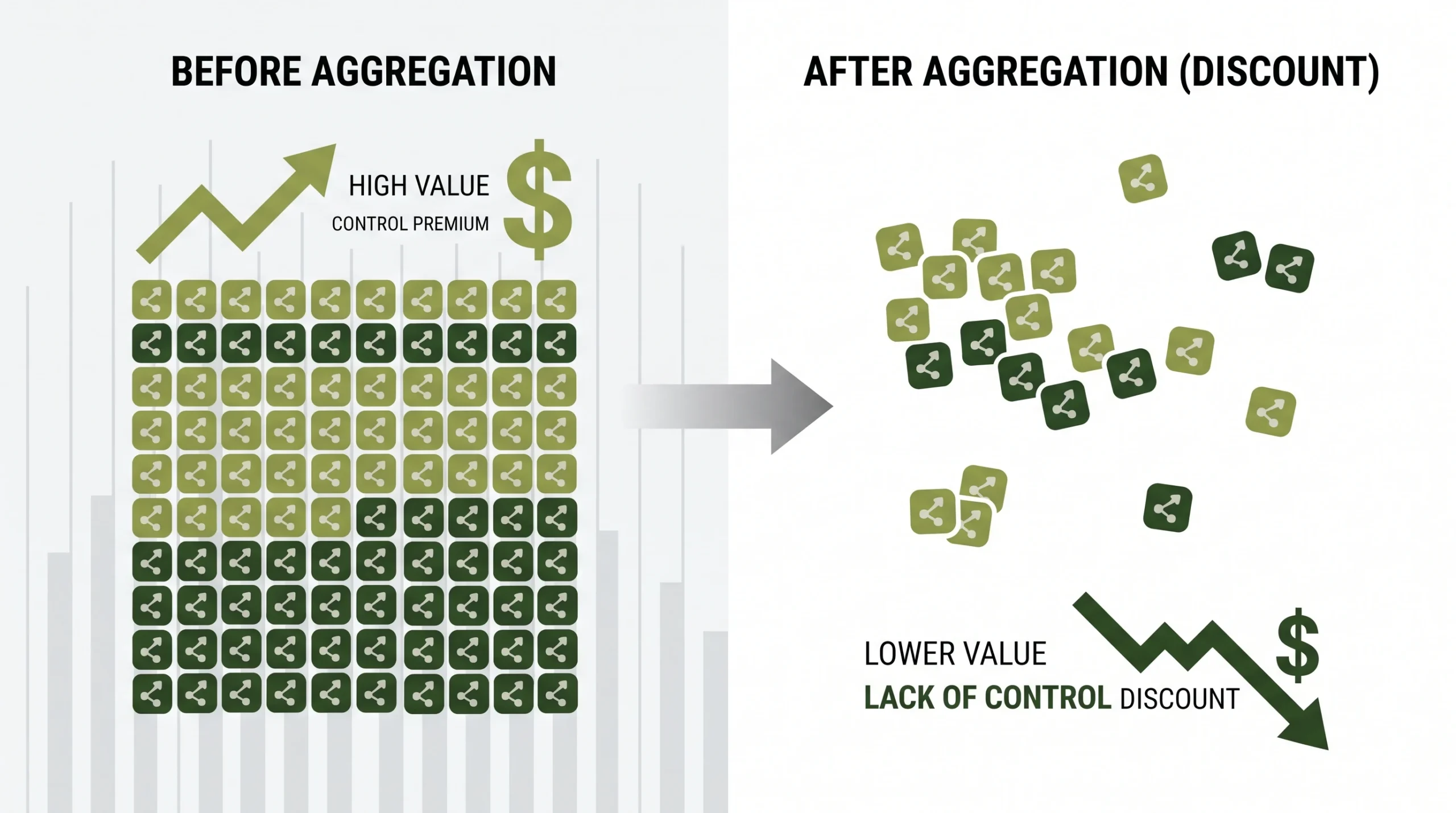
Family attribution is a valuation issue because it treats shares held by different family members as one controlling block. That ignores the control and marketability discounts that usually apply to smaller stakes. By grouping the shares, the valuation can inflate the value beyond what a market buyer would pay for that specific piece.
This practice conflicts with the willing-buyer, willing-seller standard of fair market value. Under standard guidance such as IRS Revenue Ruling 59-60, a price must reflect what a hypothetical third-party buyer would pay for that specific interest. A market buyer does not gain control or special rights just because the other owners are related, a point that matters in a minority oppression context. Ignoring these market realities can produce a value that does not match true economic worth.
How do discounts apply after Rev. Rul. 93-12?
After Revenue Ruling 93-12, discounts for intra-family minority transfers apply separately to reflect the real economics of the interest. The two are the discount for lack of control (DLOC) and the discount for lack of marketability (DLOM). A DLOC applies because a minority shareholder cannot direct policy, such as setting compensation or declaring dividends. A DLOM applies because there is no ready public market for the shares, which limits the owner’s ability to turn the investment into cash.
According to Business Valuation Resources (BVR / DealStats), these combined discounts are often the most significant adjustment in a private company appraisal. Analysts must justify the figures through empirical studies and case-specific financial data, not a rule of thumb.
Discuss your gift tax strategy with a Sofer Advisors specialist to see how these discounts apply to your situation.
What was the IRS’s argument before 1993?
Before 1993, the IRS argued that minority discounts were off the table in family-controlled companies. It cited a presumed unity of economic interest among family members. Under Revenue Ruling 81-253, the government said family members would always act together to keep control. That view assumed a minority shareholder in a family firm did not suffer the same lack of control as an unrelated one. By treating family blocks as one unit, the IRS tried to remove control discounts in nearly all intra-family transfers.
Federal courts challenged this family attribution theory for years, most notably in Estate of Bright v. United States. The courts ruled the hypothetical willing buyer must be an independent party, not an existing family member. These outcomes confirmed that a minority interest should be valued on its own characteristics. Facing consistent rejection, the IRS changed its position and issued Revenue Ruling 93-12 to align with the courts.
Does this ruling affect estate tax valuations?
The ruling strictly addresses gift tax, but its principle is a foundation for estate tax valuations too. When an owner dies, the estate includes only the interest owned at the moment of death, which appraisers value as a standalone block. Consistent with the logic of Rev. Rul. 93-12, that value does not include shares held by other surviving family members. The IRS does not require appraisers to aggregate the decedent’s interest with the holdings of surviving relatives to build a fictional controlling interest.
For estate tax, focusing on the decedent’s interest keeps the value tied to the real rights of the minority block. Since the estate gains no control through family ties, control and marketability discounts apply. This matters for compliance under the IRS tax code. Because the decedent owned only a minority portion, the tax is set on that limited ownership. Sofer Advisors uses this rule to bring clarity to complex estates where a business interest passes through inheritance.
How do you defend these discounts to the IRS?
You defend discounts to the IRS with a qualified appraisal from a credentialed expert. The report must clearly show the logic and data for each discount claimed. Examiners require proof of why a control or marketability discount applies to the specific entity. Sofer Advisors builds these reports by combining verified market data with company-specific risk factors, which creates a position that holds up under intense review.
Every report follows the Uniform Standards of Professional Appraisal Practice (USPAP), consistent with guidance from The Appraisal Foundation. The analysis uses empirical studies and public market data from sources such as DealStats to justify specific percentage ranges. By linking the discount to historical transaction evidence and the unique nature of the business, the work answers the questions most auditors raise. This methodical process provides the factual basis tax compliance requires.
Which provider is best for a minority discount valuation?
The right provider offers credentialed depth, review, and audit support that a solo analyst or a software tool cannot match. Large advisory practices like Alvarez & Marsal, Stout, and Kroll serve big estates, while a specialist firm brings the same rigor to family businesses. The table below compares the options.
| Provider type | Scope and credentials | IRS audit support |
| Sofer Advisors | Full W2 team with CPA, ABV, ASA, and CEPA credentials and court experience | Audit and inquiry support is standard in the engagement |
| Solo credentialed analyst | Often one analyst with one or two credentials | Usually at an added hourly rate, limited in scope |
| Generic online platform | Databases and automated models; no professional oversight | None; the user defends the valuation alone |
A firm with a full W2 team offers accountability a solo practitioner or a software tool cannot. Multiple reviewers check each report for accuracy and consistency with standards. When an auditor challenges a specific minority discount, a team with documented court experience has a clear edge over an automated output. Access to proprietary databases for market multiples is standard among experienced groups, while generic platforms often use outdated or limited data. Choosing the right partner means weighing the tax savings and risk reduction against the cost of a comprehensive report.
Minority discounts reward credentialed, well-documented analysis. The questions below cover what owners ask most.
Frequently Asked Questions
What is Revenue Ruling 93-12?
Revenue Ruling 93-12 is an official IRS pronouncement that a minority stock interest transferred between family members is valued as an independent block. It means the IRS must not aggregate the family’s total ownership to create a fictional controlling interest for tax purposes. Sofer Advisors follows this guidance by valuing each gifted interest on its individual characteristics, not the aggregate family holdings.
What is a revenue ruling from the IRS?
A revenue ruling is an official IRS interpretation of how the federal tax law applies to a specific set of facts. These rulings serve as authoritative guidance for taxpayers, accountants, and appraisers on complex code provisions. Because they act as binding interpretations, Sofer Advisors monitors them so every engagement stays current with the latest standards.
What is the difference between a minority and a controlling interest?
A controlling interest is ownership of 50 percent or more of the voting stock, which lets the owner dictate policy and management. A minority interest lacks these powers, which makes it less attractive to a hypothetical willing buyer. Sofer Advisors analyzes these specific rights to justify appropriate discounts for minority stakes that cannot control the company.
Can family attribution rules still apply in other tax areas?
Yes. Although Rev. Rul. 93-12 removed family attribution for gift tax valuation, specific attribution rules remain active elsewhere in the code. For example, the IRS applies attribution when deciding whether a transaction is a redemption or in certain corporate reorganizations. Sofer Advisors evaluates these implications to see whether attribution affects a client’s broader financial and succession planning.
Why is a qualified appraisal necessary for gift tax filings?
Without a professional report, a taxpayer may lack the evidence to defend claimed control or marketability discounts during an audit. The IRS requires a qualified appraisal to prove and document the value of a transferred interest. Sofer Advisors produces this documentation to give owners a defensible position that meets current standards.
How does Rev. Rul. 93-12 impact buy-sell agreement values?
Rev. Rul. 93-12 keeps the valuation of a minority interest independent of other family holdings when a buy-sell agreement dictates a transfer. If the agreement uses a formula, the underlying data must still reflect that the interest lacks control. Sofer Advisors reviews these agreements to see how they interact with federal tax standards and confirm the defined value holds up.
What discounts can be applied to a minority interest gift after Rev. Rul. 93-12?
Minority owners routinely apply a discount for lack of control and a discount for lack of marketability to gifted shares. These account for a minority shareholder’s inability to influence management and the difficulty of selling private stock. Sofer Advisors uses market-based data to calculate the specific percentages, so each discount rests on empirical evidence and fits the individual transfer.
Does the principle also apply to estate tax valuations?
Yes. The core logic that bars mandated family aggregation applies to estate tax valuations too. On an owner’s death, the estate includes only the interest the decedent held, which grants no control from the surviving family’s holdings. Sofer Advisors treats estate valuations with the same objective lens, valuing the interest strictly as a minority block to help manage the estate’s tax exposure.
How much does a gift tax valuation from Sofer Advisors cost?
A gift tax valuation from Sofer Advisors runs $7,500 to $25,000, based on its published engagement data, with complex entities and multiple entities reaching the higher end. Cost depends on data availability, ownership structure, and the number of entities involved. For a quote tied to your transfer, request a valuation estimate with your governing documents and financials.
Related Case Studies
- Owner Dependency vs Key Person Discount: Which Applies to You?
- How to Transfer Business Ownership: Options and Tax Impact
- Business Succession Planning: Tips for Smooth Transfers
Executive Summary
Revenue Ruling 93-12 ended the IRS practice of adding up a family’s shares to deny minority discounts, so each gifted block is now valued on its own. That lets intra-family minority interests earn a discount for lack of control and a discount for lack of marketability, which sharply cuts taxable value. The willing-buyer standard governs: family ties do not give a minority owner control, a principle federal courts confirmed in Estate of Bright before the IRS aligned its position. The same logic carries into estate tax, where only the decedent’s interest is valued. A qualified appraisal is required to document each discount. To prepare, compile your operating agreements, buy-sell provisions, and recent financial statements.
What Should You Do Next?
Compile your governing documents, including operating agreements, buy-sell provisions, and recent financial statements, since these are the foundation for identifying applicable discounts. Engage a credentialed appraiser to document each discount with market evidence before a transfer. Acting before an audit notice arrives keeps your position proactive and well-supported.
David Hern CPA ABV ASA, founder of Sofer Advisors, prepares defensible minority interest valuations for gift and estate tax. Schedule a free consultation to discuss your situation.
People Also Read
- How S Corp Owner Basis Is Tracked and Why It Matters at Sale
- Is Goodwill Tax Deductible? A Section 197 Guide
About the Author
This guide was prepared by David Hern CPA ABV ASA, founder of Sofer Advisors, a business valuation firm headquartered in Atlanta, GA serving clients across the United States. David holds dual accreditations as an Accredited Senior Appraiser (ASA) and is Accredited in Business Valuation (ABV), credentials recognized by the IRS, SEC, and FINRA. He also holds the Certified Exit Planning Advisor (CEPA) designation. With 15+ years of valuation experience, David has served as an expert witness in 11+ cases across multiple jurisdictions and built Sofer Advisors into an Inc. 5000-recognized firm with 180+ five-star Google reviews. Its full W2 employee team maintains subscriptions to all major valuation databases and operates under a next business day response policy.
For professional business valuation services, visit soferadvisors.com/about-us/ or contact Sofer Advisors at soferadvisors.com/contact-us/.
Disclaimer: This content is for informational purposes only and does not constitute professional valuation advice. Business valuation conclusions depend on specific facts and circumstances. Contact Sofer Advisors for guidance regarding your specific situation.









