


Last Updated: July 2026
A holding company discount lowers the net asset value of a holdco to reflect a non-controlling, non-marketable interest. Investors pay less for shares they cannot easily sell or use to direct the business. Appraisers size these discounts by comparing the entity against empirical study data. The result is a fair market value below a simple pro-rata share of the assets.
Sofer Advisors provides clear, data-heavy reports that help owners, attorneys, and CPAs see how these discounts move total equity value. Its analysts hold CPA, ABV, and ASA credentials and have supported 11+ expert-witness cases across Georgia, Florida, California, and New Mexico. That work follows the Heart of a Teacher approach, which favors honest explanation over sales pressure.
Setting the right discount takes a close read of structure, assets, and tax exposure. Owners need a report that maps their specific holdco to accepted standards to survive review. This guide shows how to calculate these values while staying compliant with the standards set by the IRS and the AICPA.
Key Takeaways
- Two separate adjustments: a holdco discount combines a discount for lack of control and a discount for lack of marketability.
- Applied to NAV: both adjustments reduce net asset value to reflect limited control and limited liquidity.
- What drives size: asset liquidity, shareholder-agreement terms, and dividend policy set the final discount.
- Study-backed: analysts support the numbers with closed-end fund, restricted stock, and pre-IPO data.
- Fact-specific for the IRS: generic percentage discounts are often rejected, so each figure needs a documented rationale.
These points set the mechanics for holdco discounts and their effect on the final value. The sections below show how the factors interact with tax rules and entity structure.
What is a holding company discount?
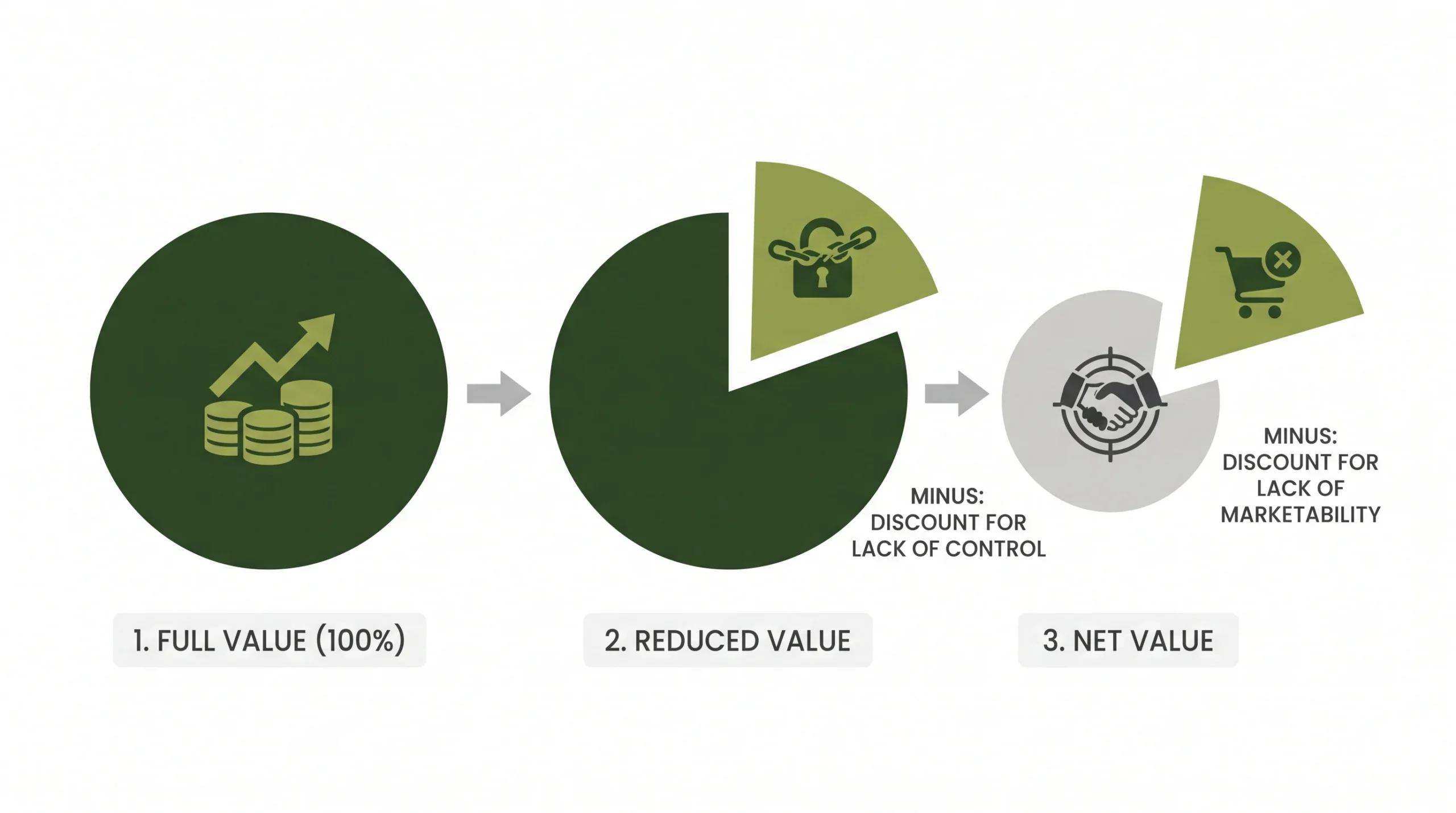
A holding company discount is the combined reduction applied to a firm that holds assets rather than running an operating business. You start from net asset value (NAV), then apply two adjustments in sequence. First comes the discount for lack of control (DLOC), for a minority owner who cannot direct decisions. Then comes the discount for lack of marketability (DLOM), for the limited ability to sell the interest quickly, following the USPAP standards from the Appraisal Foundation.
The sequence produces a value that reflects owning an interest in an entity that cannot be liquidated at will. Revenue Ruling 59-60 supports these adjustments when the interest cannot force a sale or a distribution; our guide to minority and marketability discounts works through both. Applying the steps in order keeps the total from being overstated and gives a defensible number for tax or a transaction.
Why are discounts applied to holdcos?
Discounts apply because minority owners cannot influence key decisions. They cannot control the assets, time a sale, or force a dividend. That lack of control, plus a private interest that is hard to sell, lowers what a buyer will pay.
There is a second layer. Holding companies often lack operating cash flow, so carrying costs can erode value over time. Many also carry a built-in capital gains tax on the assets. If those assets were sold today, the entity would owe tax, which reduces the net equity a shareholder can reach. That embedded liability supports a sizable discount from net asset value.
How is the DLOC calculated for a holdco?
The discount for lack of control compares the price of controlling interests to minority interests, using control-premium or closed-end fund data. The spread between a controlling block and a pro-rata minority share stands in for the lost control.
Closed-end fund analysis is a common route. An analyst compares a fund’s traded price per share to its net asset value per share. The gap reflects what investors expect for liquidity and control. Data from sources like Business Valuation Resources (BVR / DealStats) informs the range, but the final figure still needs professional judgment. Sofer Advisors builds defensible conclusions for tax and reporting from that evidence.
How is the DLOM determined for a holdco?
The discount for lack of marketability measures the penalty for not being able to convert an interest to cash quickly. Appraisers quantify it from restricted stock studies and pre-IPO studies, which compare public prices to shares carrying transfer restrictions.
Restricted stock studies show the price gap between freely traded stock and identical shares sold privately. Pre-IPO studies show the gap between private shares and their value once a company goes public. The quantitative marketability discount model (QMDM) adds another view: it treats the discount as a function of the expected holding period and growth. Because a holdco rarely has a clear exit, that waiting period becomes a core input. Sofer Advisors refines the discount from data in the BVR / DealStats database so it matches documented private-market behavior.
Which factors influence the discount size?
The size of the discount turns on a few entity-specific factors:
- The liquidity of the underlying assets
- The company’s dividend-paying capacity
- Restrictions in the shareholder agreement
- The expected holding period before a liquidity event
A portfolio of liquid, marketable securities usually carries a narrower discount than one holding private stock or real estate. A record of steady dividends signals that cash reaches shareholders, which can shrink the discount, while assets that produce no income or face an uncertain exit widen it because capital stays locked up. Each factor has to be documented against the specific entity, since the IRS rejects a discount that rests on a general rule.
What is the IRS view on these discounts?
The IRS accepts holdco discounts only when a clear, fact-specific analysis supports them. Agents want a report that explains why an interest lacks influence over the assets. Generic or unsupported discounts face a high risk of challenge and disallowance.
Revenue Ruling 59-60 says the value must weigh all relevant factors, including the specific rights of the shareholder. In Estate of Jones v. Commissioner, the court required distinct evidence for every reduction taken. Judges expect a technical breakdown tied to the company’s facts. A report that addresses both the math and the legal reality is far more credible, which is the standard Sofer Advisors works to in every file.
How do valuation firms approach holdco discounts?
The table below shows how the depth of analysis differs by firm type.
| Firm | Approach to discounts | Typical use | Differentiator |
| Sofer Advisors | Both DLOC and DLOM with multiple empirical studies and the QMDM, in a full report | Gift and estate tax, shareholder disputes, divorce | Heart of a Teacher, transparent, audit-ready |
| Kroll | Large-portfolio and financial-reporting models at national scale | Corporate reporting, large estates | Scale and reporting breadth |
| Stout | Transaction and dispute focus with deal data | M&A and litigation | Deal and testimony depth |
Depth of analysis is what matters most for tax or litigation. A transaction-focused firm may prioritize speed, while a valuation-heavy firm produces the documentation that withstands IRS review. Owners should weigh tax reporting against deal timelines when choosing an advisor. A number that holds up under audit usually rests on rigorous empirical evidence, not a general benchmark. Sofer Advisors follows The Sofer Difference, a Discovery, Diligence, Analysis, and Delivery process that supports a defensible final figure.
Holdco discounts sit at the intersection of valuation study data and tax law. The questions below cover what owners and advisors ask most.
Frequently Asked Questions
What is a holding company discount in valuation?
A holding company discount is the difference between a company’s net asset value and its fair market value for a minority shareholder. It combines the discount for lack of control and the discount for lack of marketability to reflect the inability to liquidate assets or influence management. Sofer Advisors applies these adjustments to reach the realistic economic interest an owner holds in an asset-based entity.
How do you calculate a holding company discount?
You calculate it in two steps: set the DLOC by comparing the interest to controlling blocks, then set the DLOM with models like the quantitative marketability discount model. These tools weigh asset liquidity and the likely holding period to reach a percentage reduction for a private interest. Sofer Advisors integrates both into its analysis so every discount rests on verifiable market data.
What is a reasonable discount for lack of marketability?
A reasonable DLOM often ranges from 10 to 30 percent, depending on the asset type and the transfer restrictions in the shareholder agreement. Liquid assets with short exit horizons draw lower discounts, while restricted private interests justify wider ones. Sofer Advisors reviews each entity’s specific facts to keep the chosen DLOM range defensible under IRS standards.
What is the difference between DLOC and DLOM?
The DLOC measures a shareholder’s lack of control over decisions and distributions, while the DLOM measures the difficulty of selling a private interest for cash. A holdco may carry a DLOC because a minority owner cannot force a liquidation, and a DLOM because the shares have no public market. Sofer Advisors applies them in sequence to avoid overstating the total reduction.
How does a holding company’s tax liability affect the discount?
An unrealized capital gains liability acts as an encumbrance on the assets, so appraisers reduce net asset value for that future tax. The adjusted figure better reflects what a buyer would pay for the interest. Sofer Advisors incorporates these tax-effective adjustments so the final report shows the entity’s true economic burden rather than a gross asset total.
Can a discount apply if the holdco only holds marketable securities?
Yes. A discount can apply even when every asset is publicly traded, because a minority holder still cannot control or liquidate the portfolio. The assets are liquid, but the interest itself is not and carries no controlling vote on strategy. Sofer Advisors weighs the distinction between the assets held and the specific ownership interest being appraised.
What court cases matter for holding company discounts?
Cases such as Estate of Jones v. Commissioner established that minority discounts need clear evidentiary support to survive audit and court review. They confirm that authorities reject arbitrary percentages and expect a technical analysis tied to the specific rights and restrictions of the interest. Sofer Advisors designs its methodology around these judicial requirements and documents each step for a defensible position.
How much does a holding company valuation from Sofer Advisors cost?
A standard business valuation from Sofer Advisors runs $7,500 to $25,000, based on its published engagement data. Final pricing depends on the asset structure, the number of holdings, and the timeline. The range covers the full control and marketability analysis for tax or a transaction. For a quote tied to your structure, request a valuation estimate with your holdings schedule and agreements.
What documents are needed for a defensible holdco valuation?
A defensible valuation needs full financial statements, tax returns, shareholder agreements, board minutes, and detailed schedules of the underlying property or securities. These records let an analyst study the entity’s history, dividend policy, and any legal limits on liquidity. Sofer Advisors gathers them during diligence to build a report that withstands close IRS review.
Related Case Studies
- Valuation of a Closely Held Business for Estate Tax Purposes
- Estate Planning Business Valuation: Gift and Tax Compliance
- The Difference Between Book Value and Fair Value
Executive Summary
A holding company discount adjusts net asset value for a minority, non-marketable interest. Start from NAV, apply the discount for lack of control, then the discount for lack of marketability, in that order. Asset liquidity, dividend policy, shareholder agreements, and any built-in capital gains tax set the size. Support each figure with closed-end funds, restricted stock, and pre-IPO data, because the IRS rejects generic percentages and courts demand fact-specific evidence. To begin, assemble your financial statements, holdings schedule, and shareholder agreements so a credentialed analyst can build a defensible, audit-ready report.
What Should You Do Next?
Gather your financial statements, a detailed schedule of holdings, shareholder agreements, and recent board minutes. These records let an analyst tie each discount to your entity’s specific rights and restrictions. A well-supported report turns a contested discount into a defensible position for tax or a dispute.
David Hern CPA ABV ASA, founder of Sofer Advisors, brings CPA, ABV, and ASA credentials and 11+ expert-witness cases to holding company and minority-interest valuations. Schedule a free consultation to discuss your structure.
People Also Read
- Cost Approach vs Income Approach: Complete Guide
- How to Value a Business Based on Cash Flow: Expert Guide
About the Author
This guide was prepared by David Hern CPA ABV ASA, founder of Sofer Advisors, a business valuation firm headquartered in Atlanta, GA serving clients across the United States. David holds dual accreditations as an Accredited Senior Appraiser (ASA) and is Accredited in Business Valuation (ABV), credentials recognized by the IRS, SEC, and FINRA. He also holds the Certified Exit Planning Advisor (CEPA) designation. With 15+ years of valuation experience, David has served as an expert witness in 11+ cases across multiple jurisdictions and built Sofer Advisors into an Inc. 5000-recognized firm with 180+ five-star Google reviews. Its full W2 employee team maintains subscriptions to all major valuation databases and operates under a next business day response policy.
For professional business valuation services, visit soferadvisors.com/about-us/ or contact Sofer Advisors at soferadvisors.com/contact-us/.
Disclaimer: This content is for informational purposes only and does not constitute professional valuation advice. Business valuation conclusions depend on specific facts and circumstances. Contact Sofer Advisors for guidance regarding your specific situation.









