


Last Updated: July 2026
A blockage discount is a reduction to a stock’s quoted per-share price that applies when a holding is so large the market cannot absorb it at that price without the price falling if the block is sold too fast. Sofer Advisors provides independent valuation analysis for the situations covered here. The quoted price is your starting point, but it may not be the price you get for the whole block.
Sofer Advisors weighs several things: the size of the holding and how easily it trades, the expected sale period, the cost to sell, and market conditions. The analysis should say why normal quotes do or do not show fair value on the valuation date. Fair value here means the price a willing buyer and seller would accept.
Key Takeaways
- Blockage is about market capacity. It is not an automatic cut for every big holding.
- You must compare the holding with real trading volume and market depth.
- A sale model should reflect a calm sale, not a rushed one.
- Control value, restricted stock, and blockage are separate ideas.
- Private foundation math may cap blockage and similar cuts.
What is a blockage discount?
A blockage discount lowers the quoted per-share price. It applies when the market could not take the whole block at that price. When daily volume is small and the holder owns many days or months of trading, a fast sale may move the price against the seller.
The key question is simple: what would a willing buyer and seller agree to when both have fair knowledge and neither feels forced to act? The analyst weighs the real ways to turn the block into cash, keeping the value tied to what the market can actually do. It mirrors the fair-value discipline used in the FMV of Closely Held Business Stock: IRS Methods analysis for private shares.
When might blockage apply?
Blockage may exist in a few settings. The holding may be large next to average daily volume, the bid-ask spread may be wide, or market depth may be thin, and the stock may trade in fits and starts. Tight ownership, high price swings, lockups, and a small pool of buyers can affect a sale too.
Size by itself is not enough. A large dollar holding in a stock that trades often may sell with little price impact, while a smaller holding in a rarely traded stock may need a long time to sell.
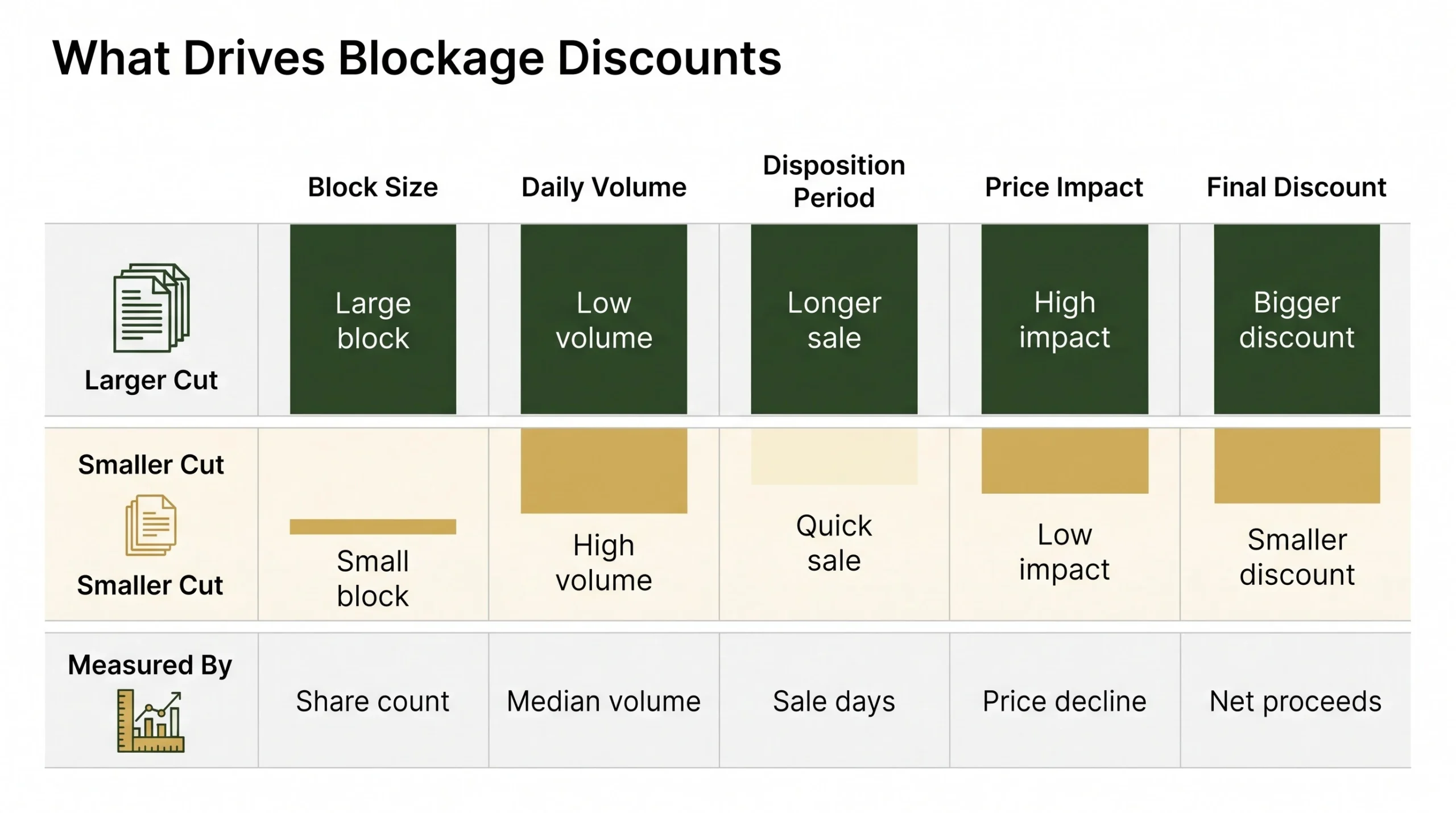
How is the discount measured?
One common method starts with time. The analyst estimates how long a calm sale would take, to stay within a fair share of normal volume. Then the analyst models the money you would collect over that span, including price impact, sale fees, risk during the wait, and the time value of money.
Other methods look at different sale paths, including a secondary offering, a private placement, a fast bookbuild, a hedge, or a sale to a strategic buyer. The chosen method should fit the rights on the shares and the market open on the valuation date.
What evidence supports a blockage conclusion?
Good evidence comes from many sources: past daily volume and quoted spreads, order-book depth, price swings, and free float. Free float is the share count open for public trading. Other data helps too, such as recent block trades and analyst coverage. The report should name its measurement period and explain any odd trading days.
The analysis should test how firm the result is, because small input shifts can change the answer a lot. These inputs include the sale pace, the sale period, price swings, and the discount rate.
How does volatility affect a blockage analysis?
Volatility means the size of price swings. It adds doubt during the sale period, because a longer span leaves more shares exposed to news, market moves, and demand shifts. The analysis should use a volatility measure that fits the stock and the period, then split ordinary market risk from the pressure the seller creates.
High volatility does not always mean a larger discount, since it may come with deep volume and strong buyer demand. The reverse can mislead too: a calm price history can hide thin market depth. The analyst should weigh volatility with other inputs, including spreads, volume, float, and ownership concentration.
How is blockage different from lack of marketability?
Blockage is about the market’s power to take a big block. A discount for lack of marketability is different, since it covers legal or real limits on turning an interest into cash. Restricted shares may face both problems, but you should not stack the two without checking for overlap, which can push the value too low.
A minority-interest discount is also its own thing, because it reflects the lack of control rights. A controlling block may instead earn a control premium, even when its size raises sale costs. The analyst must weigh every economic feature but must not count the same factor twice.
What are the tax and private-foundation considerations?
Different jobs follow different rules, including estate, gift, and charity gift work, and private foundation work has its own rules too. IRS Publication 561 notes that large blocks may need expert help, since supply and demand can push prices lower or higher.
Private foundations must figure a minimum investment return. For that math, IRS guidance allows an option to normal quotes when block size or a forced-sale worry makes quotes less accurate. The guidance also caps the combined cut for blockage and like factors at 10%, but that cap is only for this calculation. Do not apply it to estate, gift, reporting, or deal work.
How is a disposition period estimated?
The sale period starts with two facts: the share count in the block and the stock’s normal trading activity. The analyst reviews average and median daily volume, then checks the share of volume a seller could fairly take. Free float and swings around earnings news matter too. Using one busy day can hide the true time needed, so the measurement window should show typical conditions.
Selling is not steady, since a fixed share of each day’s volume may not work when volume falls, spreads widen, and swings rise. A sound analysis tests more than one sale pace and explains how the chosen case balances speed against price impact. The result is an estimate, not a promise.
What sale alternatives should an appraiser evaluate?
Open-market sales are just one path. Other choices depend on registration rights and buyer demand, including a marketed secondary offering or private placement, a fast bookbuild, or a structured deal. Each path has its own fees, discounts, disclosure needs, timing, and risk. A buyer may even value voting rights a volume model cannot see.
The analyst should compare real choices open on the valuation date and not model deals the holder could not legally or truly use. Governing documents, securities rules, board approvals, and market conditions shape the real choices. If one path yields stronger net proceeds than slow trading, the report should explain why it was picked or passed over.
How should price impact and holding risk be modeled?
Price impact reflects one risk: extra supply may push sale prices below the quoted price. Holding risk reflects another, because the price can move while unsold shares stay exposed. These two costs are linked but not the same. Mixing them without a clear model can count the same doubt twice and inflate the discount.
A clear model shows expected sales by period, estimated prices or impact costs, direct sale fees, and a discount rate applied to later cash. Sensitivity cases should vary the trading pace, swings, and sale horizon, so reviewers see whether the result rests on one input or holds across many market states.
What should the final blockage report document?
The report should name key facts: the security and share class, the ownership rights and block size, and the valuation date, standard of value, and use. It must keep the trading data, explain fixes for odd days, and show the math for sale time and net proceeds. Any use of later data should be limited to facts known or knowable on the valuation date, a discipline reinforced by The Appraisal Foundation through USPAP.
The conclusion should tie blockage to other factors, including control, marketability, and legal limits. It should also explain why a premium does not fit better, which matters when the block carries influence or strategic value. Professional standards such as the AICPA valuation guidance stress clear records, because a bare percentage without a trail is hard to defend when a tax office, auditor, board, or rival expert tests it.
Common mistakes
- Using a flat percentage with no trading-volume study.
- Treating a forced, fast sale as the fair value premise.
- Ignoring a real registered or private placement.
- Mixing blockage with control or marketability cuts.
- Using later trading data without saying if it was knowable.
- Applying a private foundation cap to a different purpose.
What should the valuation review compare?
A sound analysis ties each major judgment to the record and to market evidence on the valuation date. The points below sum up the core choices.
| Decision area | Evidence and review focus |
|---|---|
| What is a blockage discount | A blockage discount is an adjustment to the quoted per-share price when the market could not absorb the subject block at that price. |
| When might blockage apply | Potential blockage exists when the position is large compared with average daily trading volume, the bid-ask spread is wide, market depth is thin, or the security trades irregularly. |
| How is the discount measured | A common analysis estimates how long an orderly sale would take without exceeding a reasonable share of normal volume. |
The final report should reconcile these areas, not any method or input alone.
Frequently Asked Questions
Is a blockage discount automatic for a large stock position?
No. The holder must prove the point, showing that normal quotes do not reflect the value of the whole block. Market evidence must support the cut.
Can a large block be worth more per share?
Yes. Voting power, control, or strategic value can help, and a negotiated deal can also outweigh sale pressure. Weigh blockage with all ownership rights.
Does the discount equal the expected price decline?
Not always. A sound model may add several parts, including price impact, sale timing, risk, and fees. Support each part and check for overlap.
Why does an independent valuation matter?
An independent valuation records the assumptions, evidence, and methods used to address blockage discounts: valuing large stock positions. That record helps boards, owners, advisers, and reviewers understand how the conclusion was reached.
When should the valuation be updated?
Update it when the valuation date changes. Also update it when new financial, ownership, market, or deal facts could change the result.
Does the private foundation 10% cap apply to estate or gift work?
No. IRS guidance caps the combined cut for blockage and similar factors at 10%, but only for a private foundation’s minimum investment return math. Do not apply that cap to estate, gift, reporting, or deal work. Each of those purposes follows its own rules, so the 10% limit does not carry over to them.
What sets how long it takes to sell a large block?
Two facts start the estimate: the share count in the block and the stock’s normal trading activity. The analyst reviews average and median daily volume, then checks the share of volume a seller could fairly take. Free float and swings around earnings news matter too. Using one busy day can hide the true time a calm sale needs.
What evidence supports a blockage conclusion?
Good evidence comes from many sources, including past daily volume, quoted spreads, order-book depth, price swings, and free float. Recent block trades and analyst coverage help too. The report should name its measurement period and explain any odd trading days. Sofer Advisors also tests how firm the result is, since small input shifts can change the answer a lot.
Can blockage and marketability discounts be stacked together?
Restricted shares may face both problems, but you should not stack the two without first checking for overlap, since that can push the value too low. Blockage covers the market’s power to take a big block, while a marketability discount covers legal or real limits on turning an interest into cash. Weigh each feature, but never count the same factor twice.
Related Case Studies
- Minority Interest and Marketability Discounts Guide
- Valuation Discounts (DLOC and DLOM) on Estate and Gift Tax Returns
- What is Discount for Lack of Marketability in business valuation?
Executive Summary
A blockage discount lowers a stock’s quoted per-share price when a position is too large for the market to absorb at that price without pushing it down. It is never automatic; the holder must prove, with volume, spread, depth, and float evidence, that normal quotes overstate the whole block’s value in an orderly sale. Analysts estimate a disposition period from the block size and normal trading activity, then model price impact, sale fees, holding risk, and the time value of money, testing several sale paces.
Blockage must stay separate from control, minority-interest, and lack-of-marketability discounts so no factor is counted twice. For a private foundation’s minimum investment return, IRS guidance caps blockage and similar reductions at 10%, but that cap does not carry over to estate, gift, reporting, or deal work. A defensible report documents the security, rights, valuation date, standard of value, trading data, and full math behind the conclusion.
What Should You Do Next?
Gather the position size, share class, and any transfer restrictions. Pull the stock’s daily trading volume, spreads, and float over a period that reflects normal conditions. Record the purpose and valuation date, then have a specialist test whether the market can absorb the block and document a defensible conclusion.
David Hern CPA ABV ASA, founder of Sofer Advisors provides neutral, defensible valuations for large concentrated stock positions. Schedule a free consultation to discuss your situation.
People Also Read
- FMV of Closely Held Business Stock: IRS Methods
- Restricted Stock Units vs Stock Options: Key Differences
About the Author
This guide was prepared by David Hern CPA ABV ASAc, founder of Sofer Advisors, a business valuation firm headquartered in Atlanta, GA serving clients across the United States. David holds dual accreditations as an Accredited Senior Appraiser (ASA) and is Accredited in Business Valuation (ABV), credentials recognized by the IRS, SEC, and FINRA. He also holds the Certified Exit Planning Advisor (CEPA) designation. With 15+ years of valuation experience, David has served as an expert witness in 11+ cases across multiple jurisdictions and built Sofer Advisors into an Inc. 5000-recognized firm with 180+ five-star Google reviews. Its full W2 employee team maintains subscriptions to all major valuation databases and operates under a next business day response policy.
For professional business valuation services, visit soferadvisors.com/about-us/ or contact Sofer Advisors at soferadvisors.com/contact-us/.
Disclaimer: This content is for informational purposes only and does not constitute professional valuation advice. Business valuation conclusions depend on specific facts and circumstances. Contact Sofer Advisors for guidance regarding your specific situation.









