


Last Updated: July 2026
A size premium is the extra rate of return investors require when they back smaller, riskier firms instead of large, stable public ones. It reflects a simple truth, since smaller firms often see wider swings in results while facing less access to money and harder-to-sell shares. Finance professionals use this measure to adjust their cost of capital so the numbers match the real risks of private small and mid-size firms. Sofer Advisors gives independent valuation analysis for the choices in this article.
Sofer Advisors, founded in February 2019, has handled 11+ expert witness cases with court testimony across four states. Its data-driven, standards-based work has earned 180+ five-star Google reviews.
Owners and advisors must blend market data with firm-specific facts to pick the right size premium. The guide below shows how size risk shapes both value and financial reports.
Key Takeaways
- Size Premium Purpose: The size premium is the extra return investors want for the risks of holding smaller firms.
- Valuation Impact: It is a key input in the income approach, raising the total discount rate, which lowers the estimated value.
- Empirical Guidance: Valuators use data from sources like Kroll Cost of Capital, sorting firms into deciles to pick the right premium.
- Risk Interpretation: Some experts see this premium as a stand-in, since it may cover other issues like hard-to-sell shares or uneven data.
- Value Preservation: Owners can lower their risk profile by boosting report quality, widening their customer base, and steadying their teams.
Finding and using size premiums takes technical care, since these adjustments shift based on each firm’s own risks. The sections below show how specific facts drive these choices.
What is the theoretical basis for the size premium?
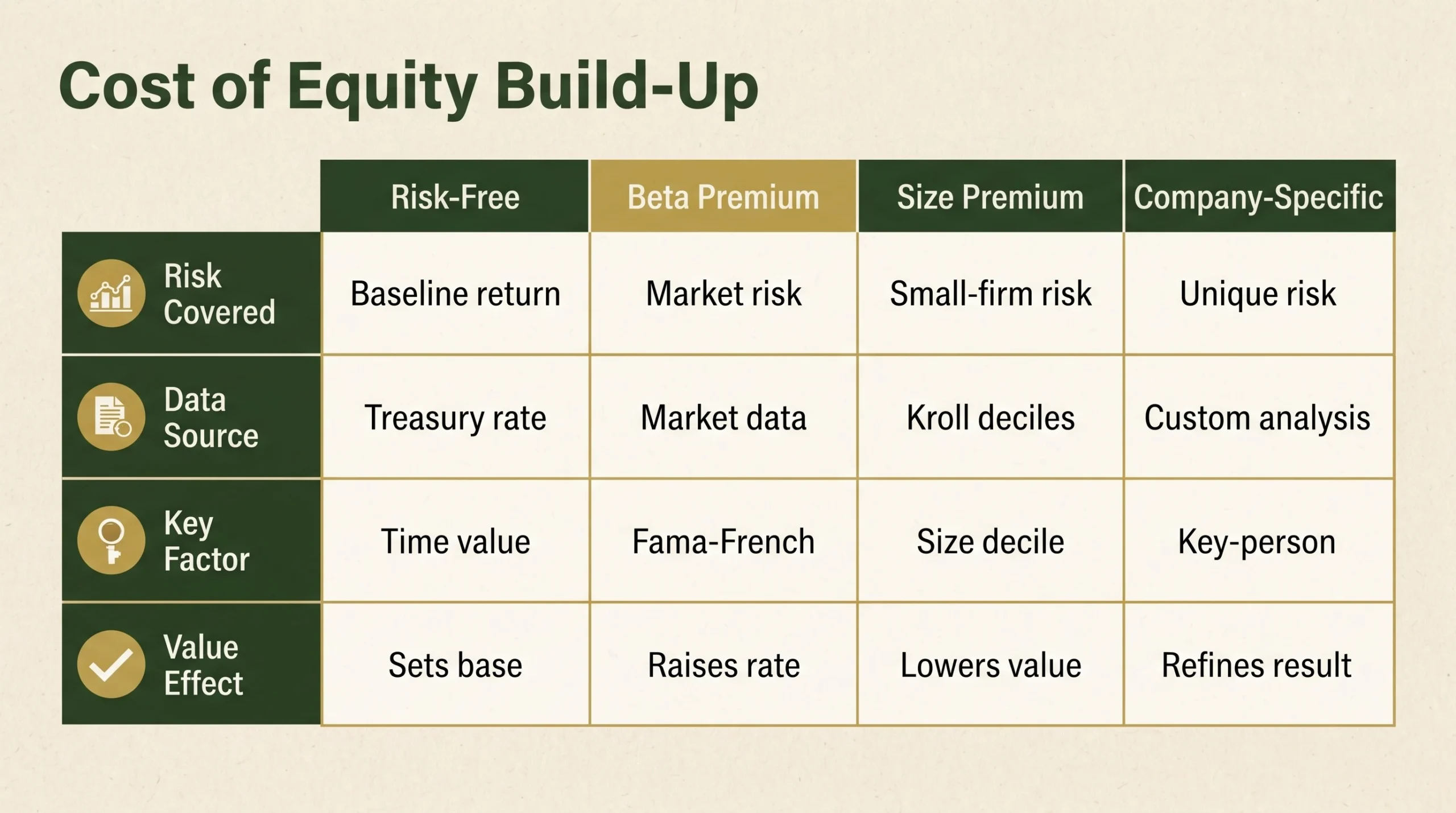
The size premium grows out of real financial research. The best-known example is the Fama-French three-factor model, which found that small-firm stocks have long earned higher returns than large-firm stocks. Finance models treat these returns as pay for the risk inside smaller firms, since the added yield offsets the greater chance of weak results or failure.
Smaller firms often struggle to raise money, which limits new projects and hurts them in slow times, and they also face bigger swings in daily operations. Because this world lacks the wide analyst coverage of public markets, it is harder for people to track how a firm is doing. According to Business Valuation Resources (BVR / DealStats), these facts add to the risk profile that appraisers weigh when they set firm value. The size premium is one layer in the wider weighted average cost of capital, stacked on the risk-free rate and equity risk premium to price a named risk. The right method depends on your deal type, industry, and standard of value, so a Sofer Advisors specialist can confirm the best fit.
How do appraisers calculate the size premium?
Appraisers set the size premium with real data. The main source is the Kroll Cost of Capital Navigator, which sorts market data into deciles based on firm size. A decile is one of ten equal groups, so the process places public firms into these size bands to show how returns shift as total equity value changes.
Next, the appraiser picks the right premium and adds this percent to the base discount rate, which feeds an income approach valuation such as the Discounted Cash Flow method. Smaller firms fall into lower deciles where the premium runs higher, so adjusting the cost of equity for size keeps the work tied to real market proof. The Appraisal Foundation publishes the uniform rules that guide how appraisers document such judgments in a defensible file.
Why is the size premium controversial?
The size premium sparks debate. Many experts see it as a stand-in for other risks rather than a risk on its own. Critics say the extra returns in small firms come from other things, including weak data quality, a higher chance of trouble, and hard-to-sell shares that are tough to split out from firm size. In fact, part of what the premium may capture overlaps with a discount for lack of marketability, since thin trading and slow exits punish small holdings in ways that look a lot like size risk.
Because of this, many pros build a company-specific risk premium (CSRP) that measures the unique risks of one firm. The approach lets an analyst face real issues head-on, such as reliance on one key person or customer, so a custom CSRP gives a clearer view than a broad, size-based tweak. Some analysts use both, applying a trimmed size premium alongside a CSRP so no single risk gets double-counted.
How does the size premium affect a valuation?
The size premium has a direct, inverse tie to the final value. When the premium goes up, so does the total discount rate, and because that rate sits in the denominator of the math, a higher rate leads to a lower value.
This drop happens by design, because the income approach treats risk as a penalty to value today. A firm valued at a 15 percent discount rate is worth far more than the same firm at 18 percent, so even a 1 to 2 percent rise in the premium can cut appraised worth by a large amount. Picking the right premium is therefore a key step; Sofer Advisors weighs these inputs with care so the result reflects real risk.
What metrics determine a company’s size?
Several measures set a firm’s size for valuation, including market cap, yearly revenue, EBITDA, and total assets. Market cap is the total value of a firm’s shares, so public firms use it to find their size band. Private firms lack a public price, so they lean on stand-ins like revenue, EBITDA, or total assets, and valuators often check Kroll data to pick the measure that best fits the firm’s size and risk.
EBITDA gives a steady view of how a firm runs across many industries, while total assets tell a clearer story of scale for equipment-heavy firms. A careful analyst tests more than one measure, since a single metric can distort an asset-light but revenue-rich firm.
How can a business owner reduce size-related risk?
An owner cuts size-related risk by facing the weak spots that push investors to add a size premium. Widening the customer base fixes the danger of leaning on too few clients, a problem so common that heavy customer concentration can cut a sale price on its own. Building a strong team cuts key-person risk and keeps work going without one single person. Audited financial statements boost data quality and trust for outsiders, and a clear record of steady cash flow proves earnings hold firm over time.
These moves shape a firm investors see as safer. An owner cannot change market value overnight, but higher quality earns a higher multiple, since the chance of shaky future earnings drops.
| Valuation Element | Sofer Advisors | Solo Practitioner / General CPA | mboventures.com (Blog) |
|---|---|---|---|
| Primary Risk Data Source | Kroll Cost of Capital Navigator | May rely on outdated books or simple heuristics | Discusses concepts but does not perform valuations |
| Application of Size Premium | Applied within a multi-step build-up method, adjusted for specific facts | Often applied as a standard, non-adjusted figure | Explains the theory of the size premium |
| Consideration of Alternatives | Evaluates CSRP vs. Size Premium based on specific company risks | Typically relies on size premium exclusively | N/A |
The gaps often come from time and tools: a generalist may use a set formula to move fast, while a focused analyst studies the nuance of your work to yield a stronger result. Firms like Stout or Alvarez & Marsal offer pro-grade work, and each provider meets AICPA rules in its own way. Pick a path that fits your reporting needs so the final estimate holds up under review.
What should the valuation review compare?
A strong analysis ties each big judgment to the records and to market proof on the valuation date. The points below sum up the article’s core choices.
| Decision area | Evidence and review focus |
|---|---|
| What is the theoretical basis for the size premium | Rooted in empirical research, notably the Fama-French three-factor model, which found small-company stocks historically outperformed large-company stocks over time. |
| How do appraisers calculate the size premium | Appraisers use empirical data, mainly the Kroll Cost of Capital Navigator, which sorts market data into deciles by company size. |
| Why is the size premium controversial | Controversial because many experts view it as a proxy for other risks rather than a standalone factor. |
The final report should tie these areas together rather than treat any method or input alone.
Frequently Asked Questions
What is the size premium in business valuation?
The size premium is the extra return investors want for backing smaller firms. They ask for it over what they want from large public ones. And this adjustment covers the risks smaller firms face, such as tight access to money or fewer product lines. Analysts add this premium to the discount rate to reflect the higher exposure of smaller shops. Sofer Advisors uses this measure for private firms so their discount rates show true market risk.
How much is a business worth with $500,000 in sales?
Revenue alone does not set value. Profit margins and capital structure drive the final result. A firm with $500,000 in sales can hold a wide range of values, depending on its EBITDA, owner earnings, and asset base. High-margin service firms may fetch higher multiples, while asset-heavy firms with thin margins often fetch less.
How much is a business worth that makes $300,000 a year?
A firm that earns $300,000 in yearly profit needs a full study. That study covers risk, growth potential, and the quality of earnings. The work often uses an income approach, where the yearly profit is the base for future cash flow math. And market trends, industry shifts, and physical assets matter too. Sofer Advisors finds these variables through close study to give owners a clear, defensible view of value.
How much is a business worth with $100,000 in sales?
At this level, the focus shifts. The work centers on seller earnings and the cost to replace key gear or stock. Firms with $100,000 in revenue often run as niche services or small practices, where owner effort is a big value driver. The appraisal must split two things: business value that can transfer and income that is really the owner’s pay. Sofer Advisors sorts these parts during discovery to keep the valuation accurate.
What is the difference between a size premium and a company-specific risk premium?
The size premium targets risk from a firm’s small scale in the wider market. The company-specific risk premium targets unique risk in one firm. And some factors fall under it, including key-person reliance, few large customers, or uneven results. The size premium comes from broad data sets like Kroll Cost of Capital. Meanwhile, the company-specific premium needs a custom look at the firm. Sofer Advisors sets both premiums to yield a precise discount rate.
How does the size premium affect a company’s valuation?
The size premium has an inverse tie to value. When the premium rises, the total discount rate rises too. Because that rate sits in the denominator of the math, a higher rate lowers the present value of future cash flows. Even a 1 to 2 percent rise in the premium can cut a firm’s appraised worth by a large amount.
What data source do appraisers use to find the size premium?
Appraisers rely on the Kroll Cost of Capital Navigator. It sorts market data into deciles, or ten equal groups, based on firm size. The appraiser picks the right premium from these bands and adds the percent to the base discount rate for an income approach, which keeps the work tied to real market proof.
What metrics determine a company’s size for valuation?
Several measures set a firm’s size, including market cap, yearly revenue, EBITDA, and total assets. Public firms use market cap, but private firms lack a public price, so they lean on stand-ins like revenue, EBITDA, or total assets. EBITDA gives a steady view across many industries, while total assets tell a clearer story for equipment-heavy firms.
How can a business owner reduce size-related risk?
An owner cuts size-related risk by facing weak spots. Widening the customer base fixes the danger of leaning on too few clients, while a strong team cuts key-person risk. Audited financial statements boost data quality and trust for outsiders, and a clear record of steady cash flow proves earnings hold firm over time.
Related Case Studies
- WACC for Business Valuation: Calculation and Application
- What is Discount for Lack of Marketability in business valuation?
- Key Person Discount: What Is It and When Does It Apply?
Executive Summary
The size premium is the extra return investors demand for holding smaller, riskier companies, and it traces to empirical research such as the Fama-French three-factor model. Appraisers quantify it with the Kroll Cost of Capital Navigator, which sorts public firms into deciles by size so the right premium can be added to the base discount rate. Because that rate sits in the denominator of the income approach, a higher premium lowers present value, and even a 1 to 2 percent shift can move the conclusion sharply. The measure stays controversial, since critics view it as a proxy for marketability, data quality, and distress risks, which leads many analysts to add a company-specific risk premium. Owners can reduce the penalty by widening their customer base, strengthening their team, and producing audited, steady records.
What Should You Do Next?
Get ready for your valuation now. Gather your last three years of income statements and balance sheets, and include your key performance measures too. Pick a clear, verifiable stand-in for your firm’s size, since this keeps your risk adjustment defensible if a tax or deal review tests it later.
David Hern CPA ABV ASA, founder of Sofer Advisors provides neutral, defensible valuations for small and mid-size companies. Schedule a free consultation to discuss your situation.
People Also Read
- Small Business Valuation Georgia What Every Owner Should Know
- Control Premium in Business Valuation: When It Applies
About the Author
This guide was prepared by David Hern CPA ABV ASAc, founder of Sofer Advisors, a business valuation firm headquartered in Atlanta, GA serving clients across the United States. David holds dual accreditations as an Accredited Senior Appraiser (ASA) and is Accredited in Business Valuation (ABV), credentials recognized by the IRS, SEC, and FINRA. He also holds the Certified Exit Planning Advisor (CEPA) designation. With 15+ years of valuation experience, David has served as an expert witness in 11+ cases across multiple jurisdictions and built Sofer Advisors into an Inc. 5000-recognized firm with 180+ five-star Google reviews. Its full W2 employee team maintains subscriptions to all major valuation databases and operates under a next business day response policy.
For professional business valuation services, visit soferadvisors.com/about-us/ or contact Sofer Advisors at soferadvisors.com/contact-us/.
Disclaimer: This content is for informational purposes only and does not constitute professional valuation advice. Business valuation conclusions depend on specific facts and circumstances. Contact Sofer Advisors for guidance regarding your specific situation.









