


Last Updated: July 2026
A veterinary group practice valuation finds the worth of several animal clinics. It usually happens during a sale to a private equity firm or a large buyer. The work reviews patient volume, recurring revenue, and specialized equipment. Appraisers must decide whether the practice runs as one portfolio or as a set of separate regional clinics to reach an accurate value.
Sofer Advisors provides neutral, third-party assessments for multi-site medical organizations. With seven years in business and 180+ five-star Google reviews, it applies established accounting standards to complex deal structures. Its senior staff brings significant experience in high-stakes settings, including court testimony as expert witness in 11+ cases across Georgia, Florida, California, and New Mexico.
Owners and their advisors start these projects when weighing a liquidity event or preparing for institutional investment. Knowing the difference between clinical metrics and financial reporting accuracy helps avoid common pitfalls. The sections below cover how professional standards, such as those from the American Society of Appraisers, apply to the operating models in this industry.
Key Takeaways
- Normalized EBITDA drives value: adjust for owner perks and non-market salaries to show true practice earnings.
- PE uses arbitrage: buy smaller practices at low multiples, roll them into a platform that commands a higher one.
- Value differs from real estate: the practice is valued separately from the facility, with a market-rate lease if the property is not sold.
- Multiples run 8x to 12x: attractive veterinary groups often see this range, based on growth and efficiency.
- Third-party neutrality: an independent report gives a baseline free of a broker’s incentive to close.
These factors define the financial health, transferability, and market position of a veterinary group. The sections below show how owners use this to stay in control during a sale.
What drives veterinary group practice value?
Value is driven mainly by normalized EBITDA, the standard for measuring steady cash flow. Beyond base earnings, value turns on metrics like revenue per veterinarian, client retention, and the mix of specialty versus general care. Higher multiples are common when a practice shows strong margins and a clear path to grow. Our veterinary practice valuation guide covers the methods.
Multi-location synergies often raise terminal value by pooling resources across sites. These efficiencies cut overhead for supply purchasing and insurance processing. Centralized scheduling and billing let owners apply uniform standards across sites, shifting the focus from daily clinical tasks to scaling group operations.
Long-term associate veterinarian contracts secure the human capital base, which protects patient continuity and steady income. Diversified revenue, including pharmacy, boarding, or grooming, reduces reliance on a single service line. According to IBBA Market Pulse data, groups with diversified models often see better valuation outcomes than single facilities. Sofer Advisors helps owners assess how these components shape their valuation range.
How do PE buyers calculate roll-up valuation multiples?
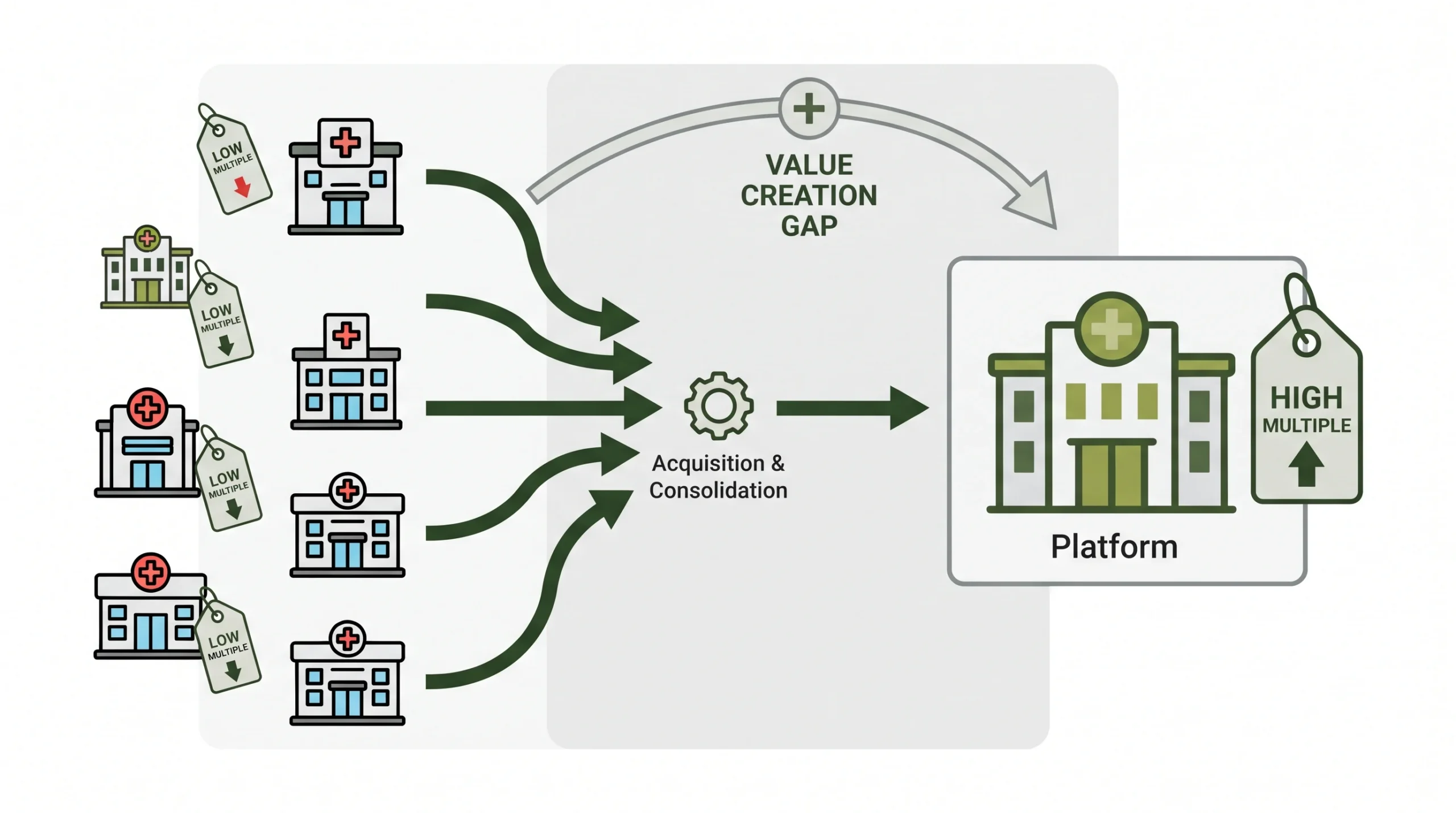
Private equity buyers set roll-up multiples by applying a target EBITDA multiple that fits the deal’s intent. They split a large platform deal from a smaller tuck-in to manage their cost of capital. A platform is the base entity in a sector, and it often earns a premium multiple for its systems and market share. Buyers add smaller practices as tuck-ins at lower multiples, because these lack the scale of a platform.
This gap drives multiple arbitrage: a larger group with a high multiple buys smaller practices at lower ones. It folds those earnings into a vehicle that trades at a higher rate, so total value rises at once with no change in operations. A Quality of Earnings (QoE) report checks the target’s past financials before closing. Per AICPA standards, this work confirms the reported EBITDA is steady cash flow, not a one-time gain. Our look at behavioral health roll-ups shows the same platform-and-add-on math.
What adjustments are made to vet practice financials?
Analysts normalize earnings to reflect a practice’s true, recurring cash flow. This corrects for non-operating items that distort historical performance. Normalizing means adjusting for owner-specific expenses, one-time charges, and non-market-rate items, which gives a clearer view of future returns for buyers or tax authorities. The common adjustments are:
- Discretionary owner spending, such as personal vehicles, travel, or family insurance
- One-time events, such as major equipment repairs or legal settlements
- Below-market rent when the owner holds the real estate separately
- Owner salaries that sit above or below the market rate
Each add-back reveals more of the real economics. Discretionary items inflate expenses and understate profit, so removing them raises normalized earnings. Comparing paid rent to fair market rates keeps the operational burden accurate. Adjusting owner salaries to market clarifies true profitability.
How does real estate factor into the valuation?
Real estate factors in mainly by being left out of the core business value. The value of the operating business is almost always separate from the property. A buyer will either buy the property in a separate deal or, more often, sign a long-term lease. That split lets USPAP standards apply cleanly to both the business and the property.
When the owner keeps the property, the lease terms directly affect the business value. A lease at fair market rent avoids artificially inflating or reducing operating cash flow. Below-market rent makes expenses look lower, which inflates EBITDA and leads to an inaccurate value. Above-market rent suppresses cash flow and lowers the value. A long-term lease keeps the earnings stream stable for any successor. Holding these costs at market is essential to maximize value during the transaction advisory process.
What is the role of intangible assets?
Goodwill captures the intangibles that drive a premium price. This includes the value of a trained team of veterinarians and technicians, plus the cover of non-compete agreements. These reflect the practice’s stability and its ability to keep earning after a change in ownership. Deep client loyalty also sits within this intangible value.
A strong system for practice operations lowers key-person risk, so success ties to the entity, not one owner. Corporate buyers prioritize practices that run without the daily input of founders. When an entity proves its resilience through high retention and strong systems, it often supports a higher multiple. Sofer Advisors examines these factors in its transaction work to help owners see what buyers truly value.
Which valuation provider is best for a veterinary group?
Owners choose among independent valuation firms, industry brokers, and M&A advisory groups. All three estimate worth, but their incentives and standards create real gaps in the result. An independent firm focuses on standards like USPAP, while a broker often treats valuation as a means to a deal price. Large firms like Alvarez & Marsal, Stout, and Kroll serve the biggest deals. The table below compares the options.
| Provider type | Service focus | Conflict of interest |
| Sofer Advisors | Neutral, defensible opinion of value | None; fee is flat, not tied to a sale |
| Industry broker | Marketing and closing a listing | High; commission based on sale price |
| M&A advisory firm | Large-scale consolidation support | Moderate; success fees |
A conflict often arises when the party doing the valuation also represents the buyer or seller in an active deal. Because a broker earns a commission on the sale price, their number can lean optimistic rather than neutral. An independent firm gives a defensible assessment disconnected from deal success, which meets the standards required for American Society of Appraisers compliance. Owners often use a neutral report as a firmer base for negotiation than an estimate from an interested party. Sofer Advisors keeps the appraisal function distinct from any brokering so owners see the true economic reality of their practice.
Roll-up valuations reward normalized earnings and independent analysis. The questions below cover what owners ask most.
Frequently Asked Questions
How do you calculate the value of a veterinary practice?
Valuing a veterinary practice focuses primarily on the income approach, which turns historical and projected cash flow into a present-day value. It uses normalized EBITDA and a chosen multiple to reflect future earnings potential. Sofer Advisors uses the income approach alongside market-based methods so the conclusion reflects both internal performance and industry trends.
How much is a vet practice worth?
A practice’s worth is not fixed; it is a result of profitability, growth, and operational resilience. Many veterinary groups trade in an 8x to 12x EBITDA range, but the final figure depends on staff quality and client retention. Sofer Advisors evaluates these traits to provide a defensible estimate based on current market conditions.
How profitable is a veterinary practice?
Profitability is often measured by EBITDA margin, the cash flow left after operating expenses and staff costs. A well-managed practice may see margins of 15% to 25%, based on service mix and local efficiency. Sofer Advisors reviews these margins during discovery to see how a practice compares to national benchmarks.
What is a good EBITDA multiple for a veterinary practice?
A good multiple currently sits between 8x and 12x EBITDA for attractive, multi-clinic groups. Smaller or single-site practices may earn lower multiples due to reduced scale and higher relative overhead. To find the right multiple for a specific situation, Sofer Advisors runs an independent market analysis aligned with the current M&A environment.
How does a roll-up strategy affect my practice’s value?
A roll-up creates value arbitrage: a private equity group buys smaller practices at lower multiples and folds them into a platform that trades at a premium. This institutional buying power can push valuations above individual practice sales. Sofer Advisors clarifies how this consolidation trend shapes the offer prices owners receive from larger groups.
What is the difference between enterprise value and equity value in a sale?
Enterprise value is the total cost to acquire the business including debt and cash, while equity value is what remains for owners after all liabilities. Buyers usually negotiate on enterprise value, then adjust at closing for debt. Sofer Advisors helps owners understand the distinction so they can anticipate their actual proceeds after debts are paid.
How long does a veterinary practice valuation take?
A typical engagement runs four to eight weeks from start to finish. That window allows the discovery and diligence phases and the final analysis. Sofer Advisors holds these standards to deliver a thorough report that meets tax and transaction planning needs while staying sensitive to the owner’s timeline.
What documents are needed for a veterinary group valuation?
You need three years of financial statements and tax returns, plus fixed asset and equipment lists, lease agreements, and production reports by veterinarian. Payroll detail and any associate contracts help confirm the human capital base. Sofer Advisors requests these during discovery so the analysis captures the full financial and operational picture.
How much does a veterinary practice valuation from Sofer Advisors cost?
A veterinary practice valuation from Sofer Advisors runs $10,000 to $30,000, based on its published engagement data, with multi-clinic consolidations reaching the higher end. Cost depends on the number of locations and the depth of the audit work. For a quote tied to your group, request a valuation estimate with your financials and clinic list.
Related Case Studies
- How Multi-Location Dental Group Practices Are Valued
- How to Value a Healthcare Management Services Organization (MSO)
- How to Value an Ambulatory Surgery Center: Multiples and Methods
Executive Summary
Private equity buyers value veterinary groups on normalized EBITDA, with attractive multi-clinic platforms trading at 8x to 12x. Roll-ups create value through multiple arbitrage: buy small practices at a low multiple and fold them into a platform that trades higher, lifting total enterprise value with no change in core operations. The operating business is valued separately from the real estate, with a market-rate lease so cash flow is not distorted. Intangibles, a trained team, non-compete agreements, and deep client retention, support the premium. To prepare, gather three years of financials, associate contracts, lease terms, and production reports, and get an independent valuation before you negotiate.
What Should You Do Next?
Gather three years of financials and tax returns, associate contracts, your lease terms, and production reports by veterinarian, then normalize earnings for owner perks and non-market rent. Get an independent valuation before you enter talks with a consolidator, since it sets a neutral baseline. That preparation protects your position when a platform buyer makes an offer.
David Hern CPA ABV ASA, founder of Sofer Advisors, provides neutral, defensible valuations for multi-site medical groups. Schedule a free consultation to discuss your situation.
People Also Read
- Medical Practice Valuation Multiples: A Complete Guide
- Quality of Earnings Reports: What Buy-Side QofE Actually Tests
About the Author
This guide was prepared by David Hern CPA ABV ASA, founder of Sofer Advisors, a business valuation firm headquartered in Atlanta, GA serving clients across the United States. David holds dual accreditations as an Accredited Senior Appraiser (ASA) and is Accredited in Business Valuation (ABV), credentials recognized by the IRS, SEC, and FINRA. He also holds the Certified Exit Planning Advisor (CEPA) designation. With 15+ years of valuation experience, David has served as an expert witness in 11+ cases across multiple jurisdictions and built Sofer Advisors into an Inc. 5000-recognized firm with 180+ five-star Google reviews. Its full W2 employee team maintains subscriptions to all major valuation databases and operates under a next business day response policy.
For professional business valuation services, visit soferadvisors.com/about-us/ or contact Sofer Advisors at soferadvisors.com/contact-us/.
Disclaimer: This content is for informational purposes only and does not constitute professional valuation advice. Business valuation conclusions depend on specific facts and circumstances. Contact Sofer Advisors for guidance regarding your specific situation.









