


Last Updated: June 2026
A quality of earnings report is not an audit. Confusing the two is one of the most expensive mistakes buyers make in M&A. An audit opines on whether financial statements follow GAAP. A quality of earnings analysis, abbreviated QofE, examines whether the earnings number a seller markets is real, repeatable, and correctly calculated. Those are different questions. The QofE answers ones the audit does not. In most middle-market deals, the QofE is the single document that most often re-trades deal price or surfaces issues that kill a deal entirely.
Buy-side QofE means the analysis is commissioned by the buyer. It typically happens after a letter of intent is signed. The goal is to verify the financial representations made during the sale process. This verification happens before binding commitments are made. Sell-side QofE, by contrast, is commissioned by the seller before the process begins. It gets ahead of issues and presents clean financials to buyers. It also reduces buyer leverage in post-LOI negotiations. Both serve the same analytical function. The timing and who pays for it determines which type you have. Sofer Advisors helps owners and their advisors work through exactly these questions and turn the analysis into a defensible business valuation they can act on.
The following takeaways summarize the key valuation and transaction factors covered in this guide.
Key Takeaways
- QofE Tests EBITDA Quality – A QofE tests EBITDA quality, not GAAP compliance – it is an earnings verification, not an audit
- Buyside QofE Standard Middlemarket – Buy-side QofE is standard in middle-market M&A and is typically commissioned after LOI signing
- Four Components Due Diligence – The four components of due diligence are financial, operational, legal, and commercial – QofE is the financial component
- Common QofE Adjustments Include – Common QofE adjustments include revenue recognition timing, disputed add-backs, related-party transactions, and working capital normalization
- QofE Reduces EBITDA 15 – A QofE that reduces EBITDA by 15%–20% from the seller’s stated figure is common and will trigger a re-trade negotiation
- Sellers Commission Sellside QofE – Sellers who commission a sell-side QofE before process launch reclaim negotiating leverage
Each of these factors is examined in depth in the sections that follow.
What Is a Quality of Earnings Report and How Is It Different from an Audit?
An audit answers a narrow compliance question: are these financial statements free from material misstatement? Auditors test transactions, verify account balances, and confirm that accounting policies are reliably applied. They do not opine on whether the earnings number presented to a buyer is a useful proxy for future cash flows. They do not evaluate whether EBITDA add-backs are defensible. They do not evaluate whether revenue recognized in December should count for that year’s EBITDA.
A QofE answers the business question: is this EBITDA real, recurring, and correctly presented? QofE analysts, typically forensic accountants or M&A advisory CPAs, work through three to five years of financial data. They interview management and review underlying contracts. They reconstruct the income statement from scratch using their own assumptions. They are not bound by GAAP. They ask: what would a sophisticated buyer want to know about the reliability of these earnings before signing a binding purchase agreement?
The output is a report that presents adjusted EBITDA. It also includes a schedule of proposed adjustments with explanatory detail. It covers a working capital analysis and findings on revenue quality and one-time items. QofE reports are not standardized in format across firms. But the analytical content is largely consistent.
Having audited financials does not eliminate the need for a buy-side QofE. Most institutional buyers commission a QofE regardless of whether the seller has audited statements. The audit gives comfort on GAAP compliance. The QofE gives comfort on earnings quality. Both are needed.
Analysis at this level is the work of a credentialed valuation professional operating under the AICPA Statement on Standards for Valuation Services, which governs how a defensible conclusion of value is developed and documented.
What Are the Four Components of Due Diligence?
M&A due diligence for a middle-market deal is typically organized into four parallel workstreams. Each addresses a different dimension of risk.
Financial due diligence is the QofE and related financial analysis. It covers historical earnings quality, revenue recognition, working capital adjustment, debt and debt-like items, and off-balance-sheet liabilities. It directly determines what normalized EBITDA the buyer applies a multiple to.
Operational due diligence evaluates the business’s ability to perform post-close. It covers management depth, operational processes, technology infrastructure, and the overall operating model. For services businesses, this often includes interviews with key employees and customers.
Legal due diligence covers corporate structure, contracts, litigation history, intellectual property ownership, employment matters, and regulatory compliance. Legal counsel reviews every material contract for assignment provisions, change-of-control clauses, and potential liabilities.
Commercial due diligence assesses market position and competitive dynamics. It asks whether the growth assumptions in the investment thesis are supportable. Are the end markets growing? Are pricing trends favorable? Commercial due diligence is more common in larger deals and PE platform acquisitions.
QofE is the financial component of this framework. It is almost always commissioned first. Its findings often cascade into the other workstreams. If QofE identifies a revenue focus issue, that feeds operational and commercial due diligence. If it identifies a related-party deal, that feeds legal review.
What Specific Adjustments Do QofE Analysts Scrutinize?
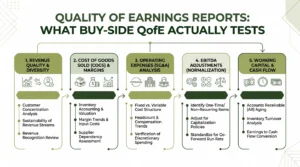
QofE analysts are looking for EBITDA inflation. They look for places where the seller’s stated earnings include items that will not recur, have been incorrectly classified, or show accounting choices that flatter earnings without corresponding cash flow.
Revenue recognition is typically the first area of scrutiny. The question is whether revenue is recognized when earned versus when cash is received. Analysts check whether the timing choices have been applied reliably across all periods. Businesses that front-load annual contract revenue instead of deferring it are overstating current-period earnings. Any deviation from consistent revenue recognition is flagged.
EBITDA add-backs, items the seller proposes to add back to EBITDA as one-time or non-recurring, are scrutinized individually. Common proposed add-backs include: legal fees for a one-time dispute, costs of a failed acquisition, above-market rent on an owner-occupied property, and personal expenses run through the business. QofE analysts will evaluate each add-back for records, non-recurrence, and business purpose. Add-backs without records or with questionable labels will be partially or fully disallowed.
Working capital adjustment is a separate but critical component. Working capital, current assets minus current liabilities, is the liquidity needed to run the business at a stable rate. If the seller has been managing working capital down before close to maximize cash at closing, the QofE will identify this. The working capital peg will be set at a normalized level. The difference between the managed-down working capital and the normalized peg comes out of the seller’s proceeds.
Related-party deals, sales to or purchases from entities owned by the seller, family members, or management, are reviewed for arm’s-length pricing. A business that sells services to a related party at above-market rates has EBITDA that is not reproducible by an arm’s-length buyer. Those economics must be adjusted.
Deferred revenue is a liability that represents cash received from customers for services not yet delivered. Sellers who include customer prepayments in EBITDA without properly reflecting the deferred revenue liability will see that overstated EBITDA corrected by the QofE analyst.
What Fails a QofE and How Does It Re-Trade a Deal?
A QofE rarely “fails” in the binary sense, it is not pass/fail. What happens instead is that the QofE analyst’s adjusted EBITDA diverges from the seller’s stated EBITDA. The size of that divergence determines what happens to the deal.
If adjusted EBITDA after QofE is within 5%–10% of the seller’s stated EBITDA, most deals proceed without a re-trade. The buyer has confidence in the earnings base. The small adjustments fall within the margin of uncertainty already priced in.
If adjusted EBITDA is 15%–25% below the seller’s stated figure, the buyer has a basis to renegotiate price. The LOI purchase price was based on a multiple of EBITDA. If the EBITDA was overstated by 20%, the price should decline in proportion. Whether the seller accepts a re-trade depends on how competitive the sale process was and whether there are other bidders. In a single-buyer process, the seller has little leverage.
If adjusted EBITDA is more than 30% below the seller’s stated figure, the deal typically terminates. Active fraud or hidden liabilities also typically end the deal. The buyer invokes their right to walk under the due diligence contingency in the LOI or purchase agreement.
The most common deal-killers in QofE are: systematic revenue overstatement through aggressive recognition, add-backs for expenses that are clearly recurring, and owner-operator related-party deals where the seller is both buyer and vendor on key expense categories.
David Hern CPA ABV ASA, founder of Sofer Advisors, brings a Heart of a Teacher to every engagement – translating complex valuation methodology into clear, actionable guidance that clients can act on before and after the report is delivered. With 15+ years of valuation experience, 11+ expert witness cases across multiple jurisdictions, and 180+ five-star Google reviews, David built Sofer Advisors into an Inc. 5000-recognized firm. The Sofer Difference is a four-phase process of Discovery, Diligence, Analysis, and Delivery that ensures every conclusion is defensible, documented, and tied to the specific facts of the business.
While national firms like Stout and Kroll serve large enterprise clients, Sofer Advisors specializes in middle-market businesses that require personalized attention, direct access to credentialed professionals, and a next business day response policy.
Is an FDD the Same as a QofE?
Financial due diligence (FDD) and quality of earnings are related but not identical. In common usage, they are often used interchangeably. Both refer to the financial analysis conducted by a buy-side advisor to evaluate earnings quality. But there is a meaningful distinction in scope.
QofE focuses on the income statement: is the EBITDA figure real, recurring, and correctly calculated? FDD is a broader term. It covers the QofE scope plus balance sheet analysis. It also covers debt and debt-like item identification, tax exposure review, and sometimes working capital analysis as a separate deliverable.
In practice, most buy-side financial advisory firms deliver an integrated report that covers both. They call it either QofE or FDD depending on their preferred terminology. When reviewing an engagement letter from a buy-side financial advisor, the deliverables list tells you what is actually included.
The distinction matters when buyers are trying to scope down the cost of diligence on a smaller deal. A focused QofE on just EBITDA quality costs less than a full FDD that includes balance sheet analysis, tax diligence, and working capital support. For deals under $5 million in enterprise value, a scoped QofE may be all that is warranted. For deals over $15 million, a full FDD is standard.
When Should Sellers Commission a Sell-Side QofE?
Sellers should commission a sell-side QofE when they are planning a process that will attract institutional buyers or PE-backed acquirers. It is also appropriate when their financials are complex, multiple entities, related-party deals, or non-standard revenue recognition.
The strategic rationale is clear. Buyers use the QofE as a price negotiation tool. If the QofE surfaces issues the seller was not aware of, the buyer has all the leverage. If the seller already knows what the QofE will say, because they ran their own before the process, they can fix the issues before going to market or disclose them clearly. Surprises cause re-trades and deal failures.
Sell-side QofE typically costs $20,000 to $75,000. That cost is almost always recovered through better pricing, fewer re-trade concessions, and faster closings.
The questions below address the most common issues business owners raise before engaging a qualified appraiser for a quality earnings reports buy engagement.
Frequently Asked Questions
What are the 4 components of due diligence?
The four components are financial, operational, legal, and commercial. Financial due diligence runs first and informs the others.
What is a sell-side quality of earnings?
A sell-side QofE is commissioned by the seller before entering a sale process. It performs the same analysis a buyer would commission. The goal is to let the seller present clean, verified financials and reduce post-LOI re-trade risk.
Is FDD just an audit?
No. An audit tests GAAP compliance and balance sheet accuracy. FDD and QofE test earnings quality, whether the EBITDA a seller presents is real, recurring, and correctly calculated.
How much does a quality of earnings report cost?
Typically $20,000 to $100,000 depending on business complexity, deal size, and scope. Smaller businesses with clean financials are at the lower end.
How long does a QofE take to complete?
A standard buy-side QofE on a lower-middle-market business takes four to eight weeks. The analyst must have full access to financial records to start.
What happens if the QofE finds problems?
The buyer will use QofE findings to re-trade the price, request more representations and warranties, or in serious cases, terminate the deal. Sellers are better served fixing known issues before process or disclosing them proactively.
Do small businesses need a QofE?
For deals under $2 million in enterprise value, a formal QofE is less common. Above $5 million, some form of QofE is standard. Above $10 million, institutional buyers will always commission one.
Can Sofer Advisors help with the valuation side of a QofE process?
Yes. Sofer Advisors provides certified business valuations used alongside QofE engagements. Our valuations establish a defensible EBITDA-based value that sellers can present with confidence.
What is a working capital peg and why does it matter?
The working capital peg is the target level of net working capital the seller must deliver at closing. If actual working capital at close is below the peg, the shortfall reduces the seller’s proceeds dollar-for-dollar.
What are the most common add-backs that buyers reject?
Add-backs that recur in multiple years but are labeled as one-time, above-market pay to family members for minimal services, legal fees that represent an ongoing cost, and personal expenses without clear records of business purpose.
Related Case Studies
- Business Valuation For Mergers Buy Side Vs Sell Side
- How Do You Determine What A Business Is Worth Complete Guide
- Business Valuation Mistakes To Avoid What Can Go Wrong
Executive Summary
- A QofE tests EBITDA reliability, not GAAP compliance – it is the buy-side’s primary tool for verifying that the earnings multiple they are paying is justified
- The four components of M&A due diligence are financial, operational, legal, and commercial
- Common adjustments that reduce stated EBITDA include revenue recognition timing, non-recurring add-back disputes, and related-party transactions
What Should You Do Next?
If you are preparing to sell a business or are considering an acquisition, understanding the quality of your own earnings, before a buyer does, is the most important step you can take. David Hern CPA ABV ASA, founder of Sofer Advisors, holds dual ASA and ABV credentials recognized by the IRS, SEC, and FINRA, with 15+ years of valuation experience and 180+ five-star Google reviews. Schedule a consultation to discuss your business valuation needs.
People Also Read
- Buy Sell Agreement Vs Shareholder Agreement Key Differences
- Buy Sell Agreement Vs Shareholder Agreement Atlanta Guide
About the Author
This guide was prepared by David Hern CPA ABV ASA, founder of Sofer Advisors – a business valuation firm headquartered in Atlanta, GA serving clients across the United States. David holds dual accreditations as an Accredited Senior Appraiser (ASA) and is Accredited in Business Valuation (ABV), credentials recognized by the IRS, SEC, and FINRA. He also holds the Certified Exit Planning Advisor (CEPA) designation. With 15+ years of valuation experience, David has served as an expert witness in 11+ cases across multiple jurisdictions and built Sofer Advisors into an Inc. 5000-recognized firm with 180+ five-star Google reviews. The firm’s full W2 employee team maintains subscriptions to all major valuation databases and operates under a next business day response policy.
For professional business valuation services, visit soferadvisors.com/about-us/ or schedule a consultation at soferadvisors.com/contact-us/.
Disclaimer
This content is for informational purposes only and does not constitute professional valuation advice. Business valuation conclusions depend on specific facts and circumstances. Contact Sofer Advisors for guidance regarding your specific situation.









