


Last Updated: June 2026
This article is for dental group owners and their advisors preparing for a sale, recapitalization, or partner buyout in 2026. You will learn the valuation methods buyers use, the key metrics that move your multiple, and the steps to take before engaging a buyer.
A dental support organization valuation is the formal process of finding the fair market value of a multi-location dental group. It accounts for centralized management structures and the recurring nature of dental revenue. Buyers, lenders, and equity sponsors rely on this figure to set acquisition prices and financing terms. A DSO valuation answers every group practice owner’s most pressing question: what is my platform worth?
When a dental group grows past three or four locations, its value no longer follows the same rules as a solo practice. Revenue concentration, management depth, and EBITDA margins shift the conversation from clinical multiples to private equity deal math. Sofer Advisors, headquartered in Atlanta, GA, works with dental group owners who need a credentialed, defensible number before any transaction. Getting that number wrong can cost owners hundreds of thousands of dollars at closing.
Key Takeaways
- EBITDA Multiple Range – Multi-location dental groups typically sell at 6x to 14x EBITDA in 2026. Platform deals exceeding 10 locations often clear the upper end.
- Income Approach Dominance – The income approach drives most DSO valuations because of the stable, recurring nature of dental revenue.
- Provider Dependency Risk – Groups where a single dentist controls more than 35% of collections receive a 1x to 2x EBITDA discount.
- Management Layer Value – A trained, non-owner management team can add 1x to 3x EBITDA by removing personal goodwill.
- Overhead Benchmark – Groups hitting 30% platform overhead sell at or above 10x EBITDA. Groups at 45% to 50% attract lower bids.
- Regulatory Compliance Costs – Open OSHA citations or unresolved payer audits can reduce a DSO valuation by 5% to 20%.
These factors interact to affect your concluded enterprise value. The sections below examine how appraisers weigh competing methods and where owners leave value on the table.
What Is a DSO Valuation and Who Needs One?
A DSO valuation is a formal appraisal that assigns a dollar value to a dental support organization. It accounts for multi-site revenue, centralized support costs, and the contractual relationships between the management company and affiliated clinical entities. Any dental group owner exploring a sale, recapitalization, or partner exit needs one before entering negotiations.
The need for credentialed valuations has grown as private equity activity in dentistry has increased. The North American DSO market is projected to surpass $200 billion in total industry revenue by the late 2020s, according to precedenceresearch.com. More buyers mean more pressure on sellers to arrive with a defensible number.
Dental group owners often confuse a broker opinion – which estimates what a deal might close at – with a certified appraisal. A certified appraisal prepared under USPAP standards is what lenders, courts, the IRS, and equity sponsors require. Dual ABV and ASA credentials – recognized by the IRS and SEC – provide the rigor that survives legal scrutiny.
How Do Appraisers Value a Multi-Site Group?
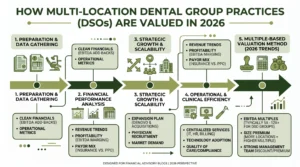
Appraisers use three main methods: the income approach, the market approach, and the asset approach. For most dental group platforms, the income approach carries the most weight. Dental revenue is recurring and driven by patient relationships. The income approach projects normalized EBITDA, applies a discount rate, and arrives at an enterprise value. The market approach uses comparable transaction data from mcguirewoods.com to cross-check that result. Here is how each method applies:
- Income Approach (Discounted Cash Flow or Capitalized Earnings): Primary method. Most weight is given when the group has three or more years of audited financials.
- Market Approach (Comparable Transactions): Secondary method. Cross-checks income approach results using EBITDA multiples from recent DSO sales tracked by firms including Kroll and Stout.
- Asset Approach (Net Asset Value): Minimal weight for going concerns. Used as a floor check for distressed groups only.
Each method produces a different indicated value. The appraiser reconciles them by weighting each based on data quality and the specific facts of your group. A model suited for a stable 5-location group may not fit a 20-location platform still opening de novos. Getting the method mix right is where a credentialed appraiser adds the most value.
Why Do EBITDA Multiples Vary So Much?
EBITDA multiples for dental groups range from 6x to 14x or more for large platforms. That wide band reflects real differences in risk, growth profile, and buyer competition. The table below shows how group size and management maturity typically influence the multiple range buyers will consider.
| Group Profile | Typical EBITDA Multiple |
|---|---|
| 2-4 locations, owner-dependent | 5x – 7x |
| 5-9 locations, partial management layer | 7x – 10x |
| 10+ locations, full management team | 9x – 14x |
Revenue diversification across payer types – commercial, Medicaid, Medicare Advantage – reduces concentration risk. A trained management team that operates without owner involvement removes personal goodwill from the equation. Consistent EBITDA margins above 20% signal a controlled cost structure. Buyers tracked by gadental.org pay premium multiples for groups they can absorb quickly.
Factors that compress multiples include single-site revenue concentration above 40%, high associate turnover, and aging equipment. Any unresolved issue under the Anti-Kickback Statute or Stark Law creates liability that buyers discount dollar-for-dollar. Understanding where your group sits before entering a sale process is critical.
How Does the 50-40-30 Rule Affect DSO Value?
The 50-40-30 rule is a benchmark used to assess dental practice profitability at different stages. Overhead costs should represent no more than 50% of collections for a solo practice, 40% for a small group, and 30% for a mature DSO platform. When overhead stays within these targets, EBITDA margins support strong acquisition multiples.
Buyers apply this rule as a quick screen. A 10-location group with 48% overhead – well above the 30% benchmark – signals that the management structure is not yet mature. It may also signal that location-level costs are not controlled. Both conditions compress the multiple offered. Hitting 30% usually requires centralized billing, group purchasing contracts, and a management fee structure. That structure must capture the true cost of DSO support services. A 5-point overhead reduction on a group generating $10 million in collections adds $500,000 to normalized EBITDA. That is worth $5 million at a 10x multiple. Reviewing your overhead ratio before a sale gives you time to capture that value.
What Challenges Reduce a DSO’s Appraised Value?
Several common issues reduce a dental group’s appraised value during a formal engagement. The most damaging ones develop gradually and catch sellers off guard. The four most common issues are:
- Provider Dependency: Buyers apply a 1x to 2x EBITDA discount when any single provider controls more than 35% of group revenue.
- Lease Structure Problems: Below-market leases expiring within two years, or above-market leases with no termination rights, create liability buyers price into their offers.
- Payer Mix Concentration: Medicaid collections above 60% of revenue draw reimbursement risk concerns from private equity buyers. This reduces modeled terminal value.
- Incomplete Financial Records: Unaudited financials, inconsistent inter-company charges, or missing cost allocation schedules slow diligence and reduce buyer confidence.
Addressing these issues requires time – often 12 to 24 months. Dental group owners planning to sell in the next three to five years should start the valuation process now. A pre-transaction appraisal from Sofer Advisors identifies these gaps while there is still time to close them. Open OSHA citations or unclear fee-splitting arrangements attract costly legal scrutiny.
When Should a Dental Group Get a Formal Appraisal?
Timing matters. The worst time to get your first valuation is after you have already received a letter of intent. At that point, you have no basis for comparison and no time to fix gaps.
The right time is at least 12 to 24 months before any planned transaction. Starting early gives you a baseline value and identifies drivers most likely to move your multiple. Other trigger events include partner buyouts and estate planning. These apply when the DSO is a large portion of the owner’s estate.
The Sofer Difference is a four-phase process – Discovery, Diligence, Analysis, and Delivery. It is designed to give dental group owners a clear picture of what their platform is worth and why. Each phase builds from an initial financial assessment to a final certified report that meets USPAP standards. Most valuations at Sofer Advisors complete within four to eight weeks.
DSO valuations involve fact-sensitive questions that every group practice owner should understand before entering a transaction.
Frequently Asked Questions
What does a dental support organization valuation from Sofer Advisors cost?
A healthcare practice valuation from Sofer Advisors typically ranges from $10,000 to $30,000 depending on the number of locations and ownership structure complexity. Most engagements complete within four to eight weeks. Rush timelines are available at a 25% to 50% premium. Schedule a free consultation to receive a scoped estimate for your specific situation.
Are DSOs taking over dentistry?
DSOs are capturing an increasing share of dental practice ownership, but independent practices still represent the majority of offices nationwide. Market data from precedenceresearch.com suggests DSO-affiliated locations now account for about 25% to 30% of all dental offices. That is up from under 10% two decades ago. The trend is real but not uniform. Rural areas still favor independent ownership, while urban specialty-heavy markets have seen the most consolidation.
How do DSOs make money?
DSOs generate revenue through management service agreements with affiliated clinical entities, typically charging 5% to 15% of a practice’s collections. The DSO also captures value through centralized purchasing and operational efficiencies that improve EBITDA margins at each location. Private equity-backed DSOs grow EBITDA through organic growth and add-on acquisitions. They then exit at a higher multiple than the average they paid to build the platform.
What is the 50-40-30 rule in dentistry?
The 50-40-30 rule is an overhead benchmark used to evaluate dental practice profitability at different scales. A solo practice targets overhead no higher than 50% of collections, a small group 40%, and a mature DSO platform 30%. When overhead stays within these targets, EBITDA margins support strong acquisition multiples. Buyers apply this rule as a quick screen before committing to full diligence.
What EBITDA multiple should a 10-location dental group expect in 2026?
A 10-location dental group with clean financials, a trained management team, and EBITDA above $2 million can realistically expect 9x to 12x EBITDA in 2026. Groups with strong payer diversification may attract the higher end. Groups with concentrated provider risk or heavy Medicaid exposure typically see 6x to 8x. A formal valuation establishes a realistic anchor before you engage any buyer.
How is personal goodwill treated in a DSO valuation?
Personal goodwill is the portion of a practice’s value tied to a specific provider’s skills, reputation, or patient relationships. It reduces enterprise value because it cannot be transferred to a buyer. Appraisers separate personal from enterprise goodwill using criteria including non-compete strength, associate coverage ratios, and how much production would survive the owner’s departure. Building a strong associate bench reduces this discount materially.
What credentials should a DSO appraiser hold?
A DSO appraiser should hold at minimum one of the following: ABV (Accredited in Business Valuation, issued by the AICPA), ASA (Accredited Senior Appraiser, issued by the American Society of Appraisers), or CVA (Certified Valuation Analyst). For engagements involving IRS, SEC, or litigation review, dual credentials provide the strongest foundation. Appraisers without these credentials produce reports that lenders and courts often will not accept as reliable evidence of value.
How does a recapitalization differ from a full DSO sale?
A recapitalization involves selling a majority stake to a private equity sponsor while retaining equity in the recapitalized entity. A full sale transfers 100% of ownership to the buyer. In a recap, the seller’s retained equity participates in a second liquidity event when the sponsor exits. Most owners pursuing a recap target a blended return from the initial proceeds plus the rollover equity value at exit.
Related Case Studies
- Medical Practice Valuation Atlanta: Healthcare Sale and Transition Guide
- Dental Practice Valuation Atlanta Owners Guide 2026
- Why You Must Start Planning Your Business Exit Now With The Right Valuation Expert
Executive Summary
Dental support organization valuation in 2026 is shaped by EBITDA multiples ranging from 6x to 14x, income approach methodology, and operational factors – provider dependency, overhead efficiency, and management depth – that buyers scrutinize closely. The 50-40-30 overhead benchmark, personal goodwill separation, and quality of earnings documentation directly affect enterprise value at closing. Dental group owners who start the valuation process 12 to 24 months before a planned transaction are best positioned to close at the top of the market range.
What Should You Do Next?
If you own a multi-location dental group and are thinking about a sale or recapitalization, the right first step is a formal, credentialed appraisal. It gives you a defensible baseline value. Review your EBITDA margin against the 50-40-30 benchmark and identify provider dependency or lease issues before a buyer finds them.
David Hern CPA ABV ASA, founder of Sofer Advisors brings a Heart of a Teacher to every DSO engagement, breaking down complex valuation methodology into clear, actionable terms that owners and advisors can use. With 15+ years of experience, dual credentials recognized by the IRS and SEC, and 180+ five-star Google reviews, Sofer Advisors delivers reports that stand up to scrutiny. Schedule a consultation to find out what your platform is worth.
People Also Read
- Dental Practice Valuation Atlanta Owners Guide 2026
- Why You Must Start Planning Your Business Exit Now With The Right Valuation Expert
About the Author
This guide was prepared by David Hern CPA ABV ASA, founder of Sofer Advisors – a business valuation firm headquartered in Atlanta, GA serving clients across the United States. David holds dual accreditations as an Accredited Senior Appraiser (ASA) and is Accredited in Business Valuation (ABV), credentials recognized by the IRS, SEC, and FINRA. He also holds the Certified Exit Planning Advisor (CEPA) designation. With 15+ years of valuation experience, David has served as an expert witness in 11+ cases across multiple jurisdictions and built Sofer Advisors into an Inc. 5000-recognized firm with 180+ five-star Google reviews. The firm’s full W2 employee team maintains subscriptions to all major valuation databases and operates under a next business day response policy.
For professional business valuation services, visit soferadvisors.com or schedule a consultation.
This content is for informational purposes only and does not constitute professional valuation advice. Business valuation conclusions depend on specific facts and circumstances. Contact Sofer Advisors for guidance regarding your specific situation.