


Last Updated: June 2026
A Management Services Organization (MSO) is valued using EBITDA multiples ranging from 6x to 12x. The range depends on specialty mix, contract quality, and growth trajectory. Unlike a physician practice, the MSO holds no clinical assets, it owns the management infrastructure. This makes it the preferred vehicle for private equity investment in healthcare. Getting that valuation right requires attention to fair market value (FMV) standards, federal healthcare regulations, and the specific mechanics of how the MSO generates revenue.
The separation between the MSO and the Professional Corporation (PC) or Professional Association (PA) is not optional, it is legally required. Attorneys and CPAs who advise on healthcare transactions often encounter valuations that blur this line. This creates exposure under the Stark Law and the Anti-Kickback Statute (AKS). A credentialed MSO valuation untangles that structure and quantifies each entity’s economic contribution independently. Sofer Advisors helps owners and their advisors work through exactly these questions and turn the analysis into a defensible business valuation they can act on.
The following takeaways summarize the key valuation and transaction factors covered in this guide.
Key Takeaways
- MSO EBITDA Multiples Range – MSO EBITDA multiples range from 6x to 12x, with specialty-backed and PE-affiliated MSOs at the higher end.
- Management Fees Must Set – Management fees must be set at fair market value – above-FMV fees create Stark Law and AKS liability.
- MSO Valuation Separate Affiliated – MSO valuation is separate from the affiliated PC/PA valuation; the two entities are valued independently.
- Contract Term Renewal Rights – Contract term and renewal rights are major value drivers – month-to-month management agreements compress multiples.
- PE Firms Use MSOs – PE firms use MSOs to own the non-clinical infrastructure without crossing corporate practice of medicine (CPOM) restrictions.
- Physician Buying Valuations MSO – Physician buy-in valuations for MSO equity require a defensible FMV opinion, not a ballpark estimate.
Each of these factors is examined in depth in the sections that follow.
What Is a Management Services Organization and How Does It Make Money?
A Management Services Organization is a business entity, typically a corporation or LLC, that provides administrative, operational, and management services to one or more healthcare providers. The MSO does not employ clinical staff or bill for clinical services. It bills the affiliated physician practice under a management services agreement (MSA) for a defined bundle of services.
Those services typically include billing and revenue cycle management, human resources, payroll, IT infrastructure, supply chain, marketing, credentialing, compliance, and facilities management. In return, the PC or PA pays the MSO a management fee. This fee is usually structured as a fixed monthly payment, a percentage of the practice’s net collections, or a hybrid.
The percentage-of-collections model is common in primary care and high-volume specialties. In that structure, the MSO receives 10% to 30% of net collections depending on the scope of services. In a flat-fee model, the fee is set based on a cost-plus margin analysis or a benchmark of comparable transactions. Both structures create recurring, contractual cash flow, which is precisely what makes MSOs attractive to investors.
Beyond the base management fee, MSOs often generate ancillary revenue through subleasing facilities to the PC, selling or leasing medical equipment, and providing staffing services. In some structures, the MSO also captures a share of ancillary revenue streams like lab, imaging, or pharmacy housed inside its non-clinical ownership footprint.
All of these fee arrangements must be set at fair market value. A management fee that exceeds the value of services rendered is a potential disguised distribution of clinical profits. This triggers Stark Law and AKS scrutiny. The FMV opinion is not a formality in healthcare MSO transactions, it is legal protection.
A market multiple is a starting point, not a conclusion of value. A defensible fair market value still rests on the factors the IRS sets out for valuing closely held businesses under Revenue Ruling 59-60.
Who Owns an MSO and Why Does the Ownership Structure Matter?
MSO ownership varies by context. In private equity-backed models, a PE firm or its affiliated management company owns the MSO outright. In de novo physician group models, the founding physicians own the MSO. In hospital or health system affiliations, the health system may own the MSO and offer management services to independent physicians.
The PE-backed model is the most acquisitive. PE firms target MSOs because the structure lets them own a scalable non-clinical business without running afoul of corporate practice of medicine (CPOM) laws. CPOM laws exist in most states and prohibit non-physician entities from directly employing physicians or controlling clinical decisions. The MSO owns everything that is not clinical. The PC, owned by licensed physicians, handles clinical practice. The PE firm owns the MSO. The physicians own the PC. The MSA connects the two.
From a valuation standpoint, ownership matters because it affects control premiums, governance rights, and the terms under which equity is transferred. When PE buys an MSO, they are acquiring the contractual right to collect management fees from affiliated practices. The value of that stream depends on contract duration, renewal terms, exclusivity provisions, and the embedded growth path.
Physician group ownership creates a different dynamic. When a physician group sells an MSO stake to a new PE sponsor, or when a new physician partner buys in, the valuation must be documented and defensible. The IRS, state regulators, and plaintiff’s counsel all look at these transactions.
How Are MSOs Valued? EBITDA Multiples and DCF Approaches
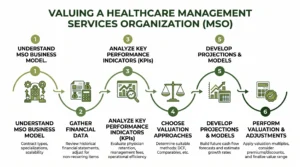
MSO valuation uses three primary approaches, consistent with IRS Revenue Ruling 59-60 and AICPA valuation standards: the income approach, the market approach, and the asset approach. In most MSO transactions, the income approach carries the most weight. This includes a discounted cash flow (DCF) or capitalization of earnings method.
The starting point is EBITDA. MSO EBITDA margins vary widely depending on how the MSO is structured. A lean management services platform with minimal overhead might carry EBITDA margins of 20% to 35%. A fully built-out MSO with internal billing, HR, and IT infrastructure might show margins of 12% to 22% after fully loaded cost allocations.
Once EBITDA is normalized, stripping out non-recurring items, owner pay adjustments, and related-party transactions, it is multiplied by a market-derived multiple. That multiple reflects both the transaction market for comparable MSO sales and the specific risk attributes of the subject company.
| MSO Type | Typical EBITDA Multiple Range |
|---|---|
| Single-specialty, 1–3 practices | 4x – 6x |
| Multi-specialty, regional platform | 6x – 9x |
| PE-backed, >10 affiliated practices | 8x – 12x |
| High-growth, tech-enabled MSO | 9x – 14x |
| Month-to-month MSA, high concentration | 3x – 5x |
The DCF approach is useful when the MSO is in growth mode, adding affiliated practices under a rollup strategy. The analyst projects management fee revenue over a 5–7 year period. A risk-adjusted discount rate of 15%–25% is applied, depending on stage and risk. Then the analyst calculates a present value. A terminal value is added to capture ongoing value beyond the projection period.
The asset approach is rarely the primary method for operating MSOs. It may be used as a floor or a sanity check in distressed situations.
What Is the Stark Law and AKS Relevance in MSO Valuation?
The Stark Law (42 U.S.C. § 1395nn) prohibits physician self-referral for designated health services billed to Medicare and Medicaid. Exceptions exist, and one commonly used exception requires that any pay to a physician, including indirect payments flowing through an MSO, be consistent with fair market value. It must not reflect the volume or value of referrals.
The Anti-Kickback Statute (AKS) is a criminal statute. It prohibits offering, paying, soliciting, or receiving remuneration to induce or reward referrals of items or services covered by federal healthcare programs. MSO fee arrangements can implicate AKS if fees are inflated, if the PC is receiving below-market rent or services, or if the structure is designed to disguise a referral payment.
This is the legal basis for FMV opinions in MSO transactions. When a PE firm acquires an MSO, when a new physician buys into the MSO, when a management fee is renegotiated, or when the MSA is extended, each event requires documented FMV support. At Sofer Advisors, we approach healthcare MSO FMV under AICPA-credentialed standards, with full documentation of the method, comparables used, and key assumptions.
David Hern CPA ABV ASA, founder of Sofer Advisors, brings a Heart of a Teacher to every engagement – translating complex valuation methodology into clear, actionable guidance that clients can act on before and after the report is delivered. The Sofer Difference is a four-phase process of Discovery, Diligence, Analysis, and Delivery that ensures every conclusion is defensible, documented, and tied to the specific facts of the business.
While national firms like Stout and Kroll serve large enterprise clients, Sofer Advisors specializes in middle-market businesses that require personalized attention, direct access to credentialed professionals, and a next business day response policy.
What Drives Value Up or Down in an MSO?
Management fee concentration is the single largest risk factor in most MSO valuations. If 80% of the MSO’s revenue comes from one affiliated practice and that practice leaves, the MSO collapses. Buyers apply concentration discounts similar to those used in customer concentration analysis. A 20%+ concentration with one practice warrants scrutiny. A 50%+ concentration requires structural mitigation or a significant price adjustment.
Contract quality is the second major driver. An MSA with a 5-year term, auto-renewal provisions, and a termination penalty is worth meaningfully more than a month-to-month agreement. Buyers model the risk of practice departure into their DCF, a short-notice termination right in the MSA is a ceiling on value. PE sponsors acquiring MSO platforms often renegotiate MSA terms before close to extend duration and lock in exclusivity.
Specialty mix matters because management fee rates and practice profitability vary dramatically by specialty. A GI, orthopedics, or dermatology MSO generates more EBITDA per affiliated physician than a primary care MSO. High-procedure specialties create higher net collections. This means higher absolute management fees even at the same fee percentage.
Geographic diversification, scalability, technology stack, and quality of the management team all affect where within the multiple range the MSO prices. An MSO with a proven playbook for onboarding new affiliated practices commands a platform premium.
How Is MSO Valuation Used in Physician Buy-Ins?
When a physician group sells a portion of its MSO to a new PE sponsor, or when a new physician partner purchases MSO equity as part of joining a practice, the transaction must be priced at FMV. This is not a suggestion, it is a regulatory requirement under Stark and AKS safe harbor provisions.
The physician buy-in context is sensitive because the physician is both a buyer of MSO equity and a referral source to the practices managed by that MSO. If the purchase price is below FMV, the discount could constitute remuneration for referrals. If the sale price is above FMV, it could similarly be characterized as a disguised payment for referrals.
Valuation professionals handling physician buy-ins must use a reproducible method and clearly document the FMV conclusion. They must produce a written report that can withstand scrutiny from the OIG, DOJ, or plaintiff’s counsel. The buy-in price must be supportable as the price a willing buyer would pay a willing seller in an arm’s length transaction, regardless of what the parties negotiated.
The questions below address the most common issues business owners raise before engaging a qualified appraiser for a mso management services organization engagement.
Frequently Asked Questions
What is a management services organization?
An MSO is a business entity that provides administrative, operational, and management services to healthcare providers under a contractual management services agreement. It does not employ physicians or bill for clinical care, it manages the non-clinical business of affiliated medical practices.
How does an MSO make money?
MSOs generate revenue through management fees paid by affiliated physician practices. Fees are typically a percentage of net collections (10%–30%) or a fixed monthly payment. More revenue may come from facility subleases, equipment leasing, and staffing services.
Who typically owns an MSO?
Ownership varies. Private equity firms own the MSO in PE-backed physician practice management models. Physician groups own MSOs in independent practice structures. Health systems own MSOs in alignment models. PE ownership is most common in high-growth specialty rollups.
What EBITDA multiples apply to MSO valuations?
Single-specialty, smaller MSOs typically trade at 4x–6x EBITDA. Regional platforms and PE-backed structures with multiple affiliated practices trade at 6x–12x. High-growth, tech-enabled MSOs have reached 12x–14x in competitive processes.
Why does Stark Law matter in MSO valuation?
The Stark Law requires that any pay arrangement between an MSO and affiliated physicians be at fair market value. It must not reflect the volume or value of referrals. Management fees that exceed FMV can constitute a Stark violation, exposing the parties to False Claims Act liability and repayment obligations.
What is an MSA and why does its structure affect MSO value?
A Management Services Agreement is the contract between the MSO and the affiliated PC or PA. Its term length, termination notice requirements, exclusivity provisions, and fee structure directly affect the MSO’s cash flow certainty and its value. Multi-year MSAs with renewal terms and termination penalties support higher multiples.
How is an MSO valued differently from the affiliated physician practice?
The MSO and the PC/PA are valued as separate legal entities. The MSO is valued on its management fee revenue stream and EBITDA. The physician practice is valued on its clinical revenue, adjusted for the management fee paid to the MSO. The two valuations must be internally consistent, the fee cannot create artificial value in one entity by depleting value in the other.
Do MSO valuations require a certified appraiser?
For transactions that implicate Stark Law, AKS safe harbors, or IRS gift/estate requirements, a written FMV opinion from a qualified appraiser is not just best practice, it is regulatory protection. CPA firms, healthcare consultancies, and credentialed valuation firms (CVA, ABV) provide these opinions. Not all of them carry equal weight in regulatory proceedings.
What is the difference between revenue-based and EBITDA-based MSO multiples?
Revenue multiples (typically 1x–3x revenue for MSOs) are used as a sanity check or in early-stage MSOs with limited profitability history. EBITDA multiples are the primary benchmark in mature MSO transactions because they reflect actual economic earnings. Revenue multiples obscure margin differences between well-run and poorly-run MSOs.
Can an MSO be valued using a DCF if it is still growing?
Yes. The DCF approach is preferred when the MSO is in active growth mode, adding affiliated practices under a rollup strategy. The analyst projects fee revenue by practice and applies a risk-adjusted discount rate. A terminal value reflects the stabilized platform value at the end of the projection period.
Related Case Studies
- Medical Practice Valuation Atlanta Healthcare Sale Transition Guide
- Healthcare Business Valuation Methods Guide Sofer Advisors
- Fairness Opinion In MA Atlanta What Georgia Business Owners And Boards Need To Know
Executive Summary
- MSOs are valued primarily on EBITDA using market multiples of 4x–12x, depending on size, specialty, contract quality, and growth profile.
- All management fee arrangements must be set at FMV to comply with the Stark Law and Anti-Kickback Statute – valuation is a compliance requirement, not just a negotiation tool.
- The MSO and the affiliated PC/PA are valued as separate entities; the management fee is an arm’s-length transaction between them.
- Contract duration and renewal terms are among the most important value drivers – month-to-month MSAs compress multiples significantly.
What Should You Do Next?
If you are involved in an MSO transaction, whether as a PE sponsor, a physician group, an attorney, or a CPA, a credentialed FMV opinion is not optional. David Hern CPA ABV ASA, founder of Sofer Advisors, holds dual ASA and ABV credentials recognized by the IRS, SEC, and FINRA, with 15+ years of valuation experience and 180+ five-star Google reviews. Schedule a consultation to discuss your business valuation needs.
People Also Read
- Business Valuation Services United States Expert Guide 2025
- Business Valuation Services Atlanta Expert Guide For Georgia Business Owners
About the Author
This guide was prepared by David Hern CPA ABV ASA, founder of Sofer Advisors – a business valuation firm headquartered in Atlanta, GA serving clients across the United States. David holds dual accreditations as an Accredited Senior Appraiser (ASA) and is Accredited in Business Valuation (ABV), credentials recognized by the IRS, SEC, and FINRA. He also holds the Certified Exit Planning Advisor (CEPA) designation. With 15+ years of valuation experience, David has served as an expert witness in 11+ cases across multiple jurisdictions and built Sofer Advisors into an Inc. 5000-recognized firm with 180+ five-star Google reviews. The firm’s full W2 employee team maintains subscriptions to all major valuation databases and operates under a next business day response policy.
For professional business valuation services, visit soferadvisors.com/about-us/ or schedule a consultation at soferadvisors.com/contact-us/.
This content is for informational purposes only and does not constitute professional valuation advice. Business valuation conclusions depend on specific facts and circumstances. Contact Sofer Advisors for guidance regarding your specific situation.