


Last Updated: June 2026
This article is for ASC owners, physician investors, healthcare attorneys, and M&A advisors who need to understand how ASC valuations work. By the end, you will know which methods apply and what EBITDA multiples buyers pay. You will also know which legal rules must be met and what to prepare before engaging a credentialed appraiser.
Ambulatory surgery center valuation is the formal process of finding the fair market value of an outpatient surgical facility as a going concern. ASC ownership changes hands through physician buy-ins, hospital joint ventures, and private equity buyouts. An accurate, credentialed valuation protects all parties and supports Stark Law and Anti-Kickback Statute compliance. It gives owners a clear picture of what their facility is worth before any deal closes.
When millions of dollars and complex ownership structures are involved, a rough estimate is not enough. Sofer Advisors, headquartered in Atlanta, GA, provides healthcare business valuations for physician groups, health systems, and private equity sponsors across the United States. The firm brings dual-credentialed expertise, 180+ five-star Google reviews, and a next business day response policy.
Key Takeaways
- EBITDA Multiples Drive Most Deals – ASC deals close at 7x to 12x adjusted EBITDA, with top single-specialty centers reaching 11x to 14x.
- Three Methods Apply – Appraisers use the income, market, and asset approaches, weighting income and market methods most heavily.
- Payer Mix Is the Biggest Driver – A center with 60%+ commercial insurance volume commands a large premium over Medicaid-heavy facilities.
- Stark Law Requires a Written Opinion – Any physician ownership deal must be supported by a credentialed, independent fair market value appraisal under USPAP.
- Credentials Matter Legally – An ASA or ABV designation from an IRS- and SEC-recognized body adds legal weight in disputes, audits, and court proceedings.
ASC valuations involve several interacting factors that affect method selection and the final number. The sections below examine each in detail.
What Is an Ambulatory Surgery Center?
An ambulatory surgery center is a licensed outpatient facility where physicians perform same-day surgical procedures. Common specialties include orthopedics, eye surgery, GI procedures, and spine. Patients arrive, receive care, and go home the same day. This makes ASCs more efficient and less costly than hospital outpatient departments.
From a valuation standpoint, an ASC is treated as a going concern. We value the full operating business, including contracts, equipment, staff, and physician relationships. We do not value just the building.
ASCs are often structured as joint ventures between physicians and a management company or health system. That creates a clear need for formal, independent valuation opinions. The Stark Law prohibits financial arrangements between referring physicians and healthcare entities not priced at fair market value. A credentialed independent appraiser must issue the written opinion that meets legal standards. Without that opinion, a well-intentioned deal can expose physicians and facilities to civil and criminal liability.
The structure of an ASC also shapes which methods apply. A multi-specialty center with many physician-owners has a different risk profile than a single-specialty facility. That difference affects how the appraiser weights goodwill, assesses transferability, and benchmarks against comparable deals.
Which Methods Do Appraisers Use?
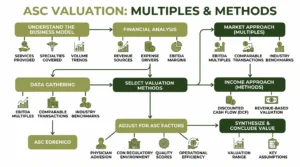
Three core approaches apply to ASC valuations: the income approach, the market approach, and the asset approach. We weight income and market methods most heavily because ASCs are operating businesses, not equipment collections.
The income approach calculates value from expected future cash flow. We project normalized EBITDA. Then we apply a discount rate or cap rate. The market approach anchors value to real deal data expressed as a multiple of EBITDA or revenue. The asset approach applies mainly when tangible assets dominate or the facility is winding down.
Here is how the three methods compare in typical ASC work:
| Approach | Primary Use Case | Key Input | Typical Weighting |
|---|---|---|---|
| Income (DCF / Capitalization) | Going concern, stable or growing revenue | Normalized EBITDA, discount rate | 40-60% |
| Market (Transaction Multiples) | Benchmarking against comparable sales | EBITDA or revenue multiples | 30-50% |
| Asset (Net Asset Value) | Wind-down or asset-heavy facilities | Fair market value of assets minus liabilities | 0-20% |
A credentialed appraiser applies all three methods, then does a final review to reach one defensible conclusion. This review ensures the final opinion holds up under scrutiny. It can withstand review from the IRS, health system legal teams, or a court. Appraisers credentialed by AICPA Forensic and Valuation Services follow this multi-method standard in every healthcare project.
What EBITDA Multiples Do Buyers Pay?
EBITDA multiples are the most common way buyers and sellers discuss ASC value. Most deals fall between 7x and 12x adjusted EBITDA. High-performing single-specialty centers can reach 11x to 14x. Multi-specialty centers with mixed payer volume typically close in the 6x to 9x range.
Several factors shift the multiple up or down:
- Payer mix: Centers with 60% or more commercial insurance attract higher multiples. Commercial insurers pay much more per procedure than Medicare or Medicaid.
- Case volume and growth: A center performing 4,000 or more cases per year with steady growth is more attractive than a stagnant facility.
- Specialty mix: High-acuity specialties like spine and orthopedics generate higher revenue per case, supporting a larger multiple.
- Physician tenure: Long-term commitment backed by multi-year agreements reduces buyer risk.
- Facility condition: A newer facility with updated equipment commands a premium over one needing major capital investment.
Payer mix has an outsized impact. A spine procedure reimbursed at $8,000 by a commercial payer might bring only $3,500 under Medicare. That gap flows directly into EBITDA, then gets multiplied at closing. Improving your payer mix two to three years before a sale compounds the value gain. Only a credentialed appraiser can issue the written opinion that ties the multiple to comparable deal data.
What Are the Biggest Valuation Pitfalls?
Many errors appear repeatedly in ASC valuations. Knowing them before you engage an appraiser helps avoid delays, disputes, and regulatory exposure. The most common pitfalls are:
- Using a stale appraisal: An opinion more than 12 months old may not reflect current multiples. Regulators expect a current opinion at the deal date.
- Failing to normalize EBITDA: One-time expenses, above-market owner pay, and related-party deals must be adjusted before applying any multiple.
- Misallocating goodwill: ASCs carry both enterprise goodwill and personal goodwill. Misallocating these components affects tax treatment and buy-in pricing.
- Selecting an unqualified appraiser: A CPA who occasionally values businesses is not the same as a credentialed ASA or ABV specialist with healthcare experience.
- Skipping the written report: Stark Law compliance requires a written valuation report as part of the deal compliance package.
David Hern CPA ABV ASA, founder of Sofer Advisors brings a Heart of a Teacher to every project, explaining legal rules in plain terms that physicians and legal counsel can act on. Each of these pitfalls is avoidable when you start early and work with a credentialed, healthcare-experienced appraiser.
How Do You Prepare for an ASC Valuation?
Preparation before the appraiser arrives saves time and improves the final report. The Sofer Difference is a four-phase process: Discovery, Diligence, Analysis, and Delivery. It gives owners a clear picture of what their company is worth and why. Clients who arrive organized move through Discovery faster and reach Delivery on time.
Here is a standard records checklist for an ASC valuation project:
- Three to five years of audited or reviewed financial statements
- Monthly case volume reports broken down by specialty and procedure
- Current payer contracts and reimbursement rate schedules
- Physician ownership agreements and any pending buy-in or buy-out terms
- Equipment inventory with purchase dates and current condition notes
- Facility lease terms and any planned renewal or relocation details
Having these records ready from day one lets the appraiser focus on analysis rather than chasing papers. Diligence normalizes financials and benchmarks the center against industry data. Analysis builds the income, market, and asset models. Delivery produces the final USPAP-compliant report. The timeline from signed engagement letter to final report is four to eight weeks. This assumes all records are available at the start.
Frequently Asked Questions
What is the typical EBITDA multiple for an ambulatory surgery center?
Most ASC deals close between 7x and 12x adjusted EBITDA. Single-specialty centers with strong commercial payer contracts often reach the higher end. Multi-specialty centers with mixed payer volume typically close in the 6x to 9x range. The actual multiple depends on payer mix, specialty concentration, physician tenure, and facility condition. An appraiser uses comparable deal data to justify the applied multiple in the final written opinion.
How much does an ASC valuation from Sofer Advisors cost?
A healthcare practice valuation typically ranges from $10,000 to $30,000 depending on the size of the center, complexity of the ownership structure, and purpose of the appraisal. Most standard ASC projects are done within four to eight weeks. Rush work is available at a 25 to 50 percent premium. Schedule a free consultation to receive a scoped estimate for your specific situation.
Why does an ASC valuation need to meet fair market value standards?
The Stark Law and Anti-Kickback Statute require any financial arrangement involving a referring physician, including ASC ownership interests, to be priced at fair market value. A credentialed written appraisal gives both the center and the physician records to defend the deal. Without that opinion, the arrangement may be treated as an improper inducement. That triggers civil and criminal penalties under federal law.
What is the difference between enterprise goodwill and personal goodwill in an ASC?
Enterprise goodwill is tied to the business itself, including location, contracts, brand, and operational systems. Personal goodwill belongs to a specific physician’s referral relationships and patient base. Enterprise goodwill is transferable and included in the purchase price. Personal goodwill is not transferable and directly affects buy-in pricing and tax treatment at closing. Separating the two requires review of physician agreements, tenure, and referral patterns.
How long does an ambulatory surgery center valuation take?
A standard ASC valuation takes four to eight weeks once the appraiser receives all needed records. Complex projects involving many ownership classes or regulatory disputes may take eight to twelve weeks. Rush work can be done in two to three weeks at a premium. The timeline depends heavily on the client. Prompt delivery of financial records, payer contracts, and operational data at the start keeps the project on schedule.
What credentials should an ASC appraiser hold?
An appraiser doing a healthcare valuation for Stark Law compliance should hold credentials recognized by the IRS and major regulatory bodies. The Accredited Senior Appraiser (ASA) designation and the Accredited in Business Valuation (ABV) credential from the American Society of Appraisers are the most widely accepted. A CPA license alone is not enough. The appraiser must also show specific healthcare experience and follow USPAP standards.
What triggers the need for a new ASC valuation?
Physician buy-ins and buy-outs always require a current opinion. Adding a hospital partner or private equity investor is another common trigger. Valuations more than 12 months old are generally not accepted for compliance. Litigation, divorce involving physician partners, estate planning, and refinancing can also require a new appraisal. Each triggering event has its own records requirements that must be met before the deal closes.
How is an ASC valued differently from a physician practice?
An ASC is valued as an operating business where facility costs, case volumes, and payer contracts drive the analysis. A physician practice valuation places more weight on physician-specific goodwill and individual provider output. ASCs have higher facility and equipment costs that affect the asset approach weighting. The comparable deal data set differs much. The Stark Law rules for ASC ownership also apply differently than for standard physician practice arrangements.
Related Case Studies
- Sofer Advisors Healthcare Practice Valuation Case Study
- Business Valuation For Mergers Buy Side Vs Sell Side
- Sofer Advisors Exit Planning Valuation Case Study
Executive Summary
Ambulatory surgery center valuation requires applying the income, market, and asset approaches to a highly regulated operating business. EBITDA multiples typically range from 7x to 12x, driven by payer mix, case volume, specialty mix, and physician tenure. Stark Law and Anti-Kickback Statute rules require every physician ownership deal to be supported by a credentialed, independent fair market value opinion under USPAP. We normalize EBITDA, benchmark against comparable deals, and review multiple methods to reach a defensible conclusion.
What Should You Do Next?
Gather your last three years of financial statements, payer contracts, and case volume reports before speaking with an appraiser. If your center has a physician buy-in or partnership change planned in the next 12 months, start now. Early engagement ensures you meet regulatory timelines. Confirm the appraiser you select holds ASA or ABV credentials and can show healthcare valuation experience.
David Hern CPA ABV ASA, founder of Sofer Advisors has completed healthcare valuations across the United States for physician groups, health systems, and private equity sponsors. His ASA and ABV credentials are recognized by the IRS, SEC, and FINRA. Schedule a consultation to discuss your ASC valuation needs.
People Also Read
- Why You Must Start Planning Your Business Exit Now With The Right Valuation Expert
- What To Expect During A Business Valuation Step By Step Process
About the Author
This guide was prepared by David Hern CPA ABV ASA, founder of Sofer Advisors – a business valuation firm headquartered in Atlanta, GA serving clients across the United States. David holds dual accreditations as an Accredited Senior Appraiser (ASA) and is Accredited in Business Valuation (ABV), credentials recognized by the IRS, SEC, and FINRA. He also holds the Certified Exit Planning Advisor (CEPA) designation. With 15+ years of valuation experience, David has served as an expert witness in 11+ cases across multiple jurisdictions and built Sofer Advisors into an Inc. 5000-recognized firm with 180+ five-star Google reviews. The firm’s full W2 employee team maintains subscriptions to all major valuation databases and operates under a next business day response policy.
For professional business valuation services, visit soferadvisors.com or schedule a consultation.
This content is for informational purposes only and does not constitute professional valuation advice. Business valuation conclusions depend on specific facts and circumstances. Contact Sofer Advisors for guidance regarding your specific situation.









