


Last Updated: August 2026
A trade name valuation is a way to measure what a brand name, trademark, or logo is worth on its own. It treats the name as a separate asset. The value is the income the name earns, apart from buildings, gear, or staff. Most experts use the relief-from-royalty method. It applies a royalty rate to branded sales. Market data shows these rates often run from under 1 percent to about 5 percent. Sofer Advisors builds each figure on real license deals, not a generic rule.
This work matters most during a deal. When one company buys another, the buyer must set a price for each asset. That includes the brand. Tax filings, estate transfers, and court cases also call for it. Value rises with brand strength, loyal customers, pricing power, and legal cover. A well-known mark that lets a firm charge more will carry a higher number.
Key Takeaways
- Definition: A trade name valuation prices a brand as a standalone intangible asset, separate from the rest of the business.
- Relief-from-royalty method: The common approach values the mark by the royalties an owner avoids by holding it.
- The royalty rate drives the result: The rate is the most judgment-heavy input. A small change moves the final value a lot.
- Useful life and taxes matter: Remaining useful life and the tax amortization benefit both shape the present value.
- ASC 805 and tax uses: Purchase price allocations, gift and estate filings, and disputes all require these reports.
These points connect the method to its real uses. The sections below break down each input, from the royalty rate to useful life. They also show when the income and cost approaches fit better.
What is the relief-from-royalty method?
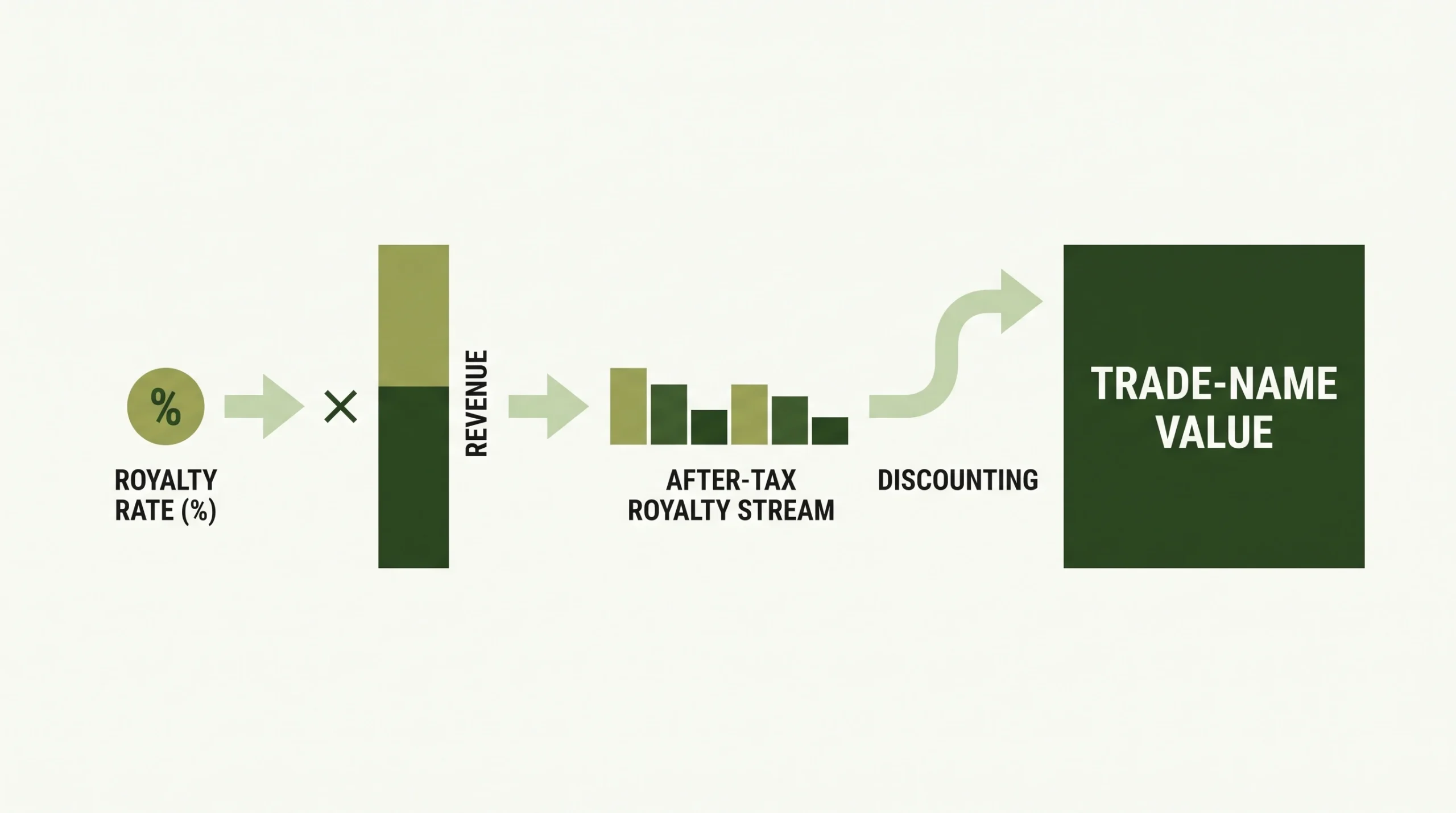
The relief-from-royalty method values a trade name by the royalties an owner skips by owning it. If the firm did not hold the mark, it would license the name from someone else and pay a fee. Owning it removes that cost. That saving is the benefit. An analyst then finds value in four steps. First, forecast the sales the brand supports. Next, apply a royalty rate. Then subtract tax. Last, discount the after-tax savings to today’s value. The method sits inside the income approach.
The inputs come from market data, not guesswork. An analyst first forecasts branded sales across the asset’s useful life. Next comes the royalty rate, drawn from real license deals. The savings are taxed, then brought to today’s dollars with a discount rate. The result shows how much the name adds to total value. Sofer Advisors follows the Heart of a Teacher approach here. It shows owners the math, not just the answer.
How do you choose a royalty rate?
You choose a royalty rate by studying license deals for similar brands. Analysts pull matching deals from market data, then weigh the brand’s strength and its industry margins. A strong, well-known name supports a higher rate. A weak or plain one supports less. Published market royalty rate data shows that rates vary widely within one sector. So the choice must fit the facts.
The rate is the most argued input. A shift of one point can change the value by six figures. So the pick must rest on proof, not a round number. Brand fame, legal cover, and profit margins all guide it. A mark that lets a firm charge more earns a higher rate. Each rate should trace back to real license deals and the practice in the AICPA Accounting and Valuation Guide for Business Combinations.
What is a trademark’s remaining useful life?
Remaining useful life is how long a trademark will keep earning money. Some marks carry a set life, tied to a product cycle or a renewal date. Others are treated as indefinite when the brand shows lasting strength and steady reinvestment. The choice matters because it sets how many years of royalty savings enter the model. A longer life means more years of benefit and a higher value.
Under ASC 805, an indefinite-lived trademark is not amortized. Instead, it is tested for impairment each year. A finite-lived mark is amortized over its useful life. Analysts weigh legal cover, renewal history, and the brand’s market spot to set the period. Too short a life understates value. Too long a life inflates it. Getting this right keeps the report solid for both tax and reporting.
How does the tax amortization benefit work?
The tax amortization benefit, or TAB, is the extra value a buyer gains from writing off an asset over time. When a brand is bought in a taxable deal, the buyer can deduct its cost. That lowers future taxes. Those savings have value today. So the asset is worth a bit more than its raw cash flows suggest. Analysts add the TAB to reach a full fair market value.
The benefit exists because tax rules let buyers write off bought intangibles, often across 15 years. Each year’s deduction trims the tax bill. Discounted to today, those savings raise the asset’s value by a set percentage. Skipping the TAB understates the number. Adding it lines the result up with how a real buyer would price the mark. This step is standard under the AICPA guide and in ASC 805 work.
What other methods value a trade name?
Two other methods can value a trade name. One is the income approach through excess earnings. The other is the cost approach. The multi-period excess earnings method finds the cash flow tied only to the brand. It first charges for the other assets that help produce it. The cost approach adds up what it would take to rebuild the name from scratch. Each one acts as a check on the relief-from-royalty result.
| Method | What it measures | Best suited to | Typical role |
|---|---|---|---|
| Relief-from-royalty | Royalties saved by owning the mark | Brands with a clear licensing market | Primary method |
| Excess earnings (MPEEM) | Cash flow left after other asset charges | Brands that drive most of the revenue | Cross-check or primary |
| Cost approach | Cost to rebuild the brand | New or minor marks | Floor value |
No single method fits every case. The relief-from-royalty method leads when license data exists, because it ties value to a real market. The excess earnings method works when the brand drives most of a firm’s income. It does need careful contributory asset charges. The cost approach sets a floor. A buyer would not pay more than the cost to rebuild the name. Sofer Advisors often runs more than one method, then blends them into a single, solid value.
When do you need a trade name valuation?
You need a trade name valuation when a brand’s worth must be proven for accounting, tax, or legal reasons. The most common trigger is a purchase price allocation under ASC 805. After a deal, the buyer must set fair value for each asset bought. That includes the trade name and goodwill. Gift and estate filings, license deals, and brand disputes also call for a formal report.
Each purpose sets its own standard of value. A purchase price allocation follows ASC 805 and the acquisition method in Deloitte’s ASC 805 accounting roadmap. Tax work follows IRS Revenue Ruling 59-60 and its eight factors. Court work follows the court’s rules and often USPAP. This is where The Sofer Difference matters. It is a four-phase process of Discovery, Diligence, Analysis, and Delivery. It yields an audit-ready report. Large firms such as Alvarez and Marsal, Kroll, and Stout serve mostly big clients. Sofer Advisors brings that same senior-level rigor to middle-market owners, backed by a full W2 team of 14 and 180+ five-star Google reviews.
Frequently Asked Questions
How do you value a trade name?
Most experts value a trade name with the relief-from-royalty method. An analyst forecasts the revenue the brand supports, applies a royalty rate from comparable license deals, subtracts tax, and discounts the after-tax savings to present value. The income and cost approaches can confirm the result. The final report ties each input to market evidence so it holds up for tax and financial reporting.
What royalty rate is used for a trade name?
There is no single fixed rate. Analysts study license agreements for similar brands, then match a rate to the subject brand’s strength and industry margins. Market data shows rates that range from under 1 percent to well above 5 percent of branded sales. A strong, protected mark supports a higher rate. A weak or generic one supports less, so the choice must fit the facts.
Is a trade name the same as goodwill?
No. A trade name is an identifiable, legally protected asset that carries the brand and the right to use the name. Goodwill is the leftover value that cannot be tied to any single asset, such as workforce or general reputation. During a purchase price allocation under ASC 805, an analyst separates the trade name from goodwill so each is reported on its own.
How is a trademark’s useful life decided?
An analyst weighs legal protection, renewal history, product cycles, and the brand’s market position. A mark tied to a fading product gets a finite life. A brand with lasting demand and steady reinvestment may be treated as indefinite. The chosen period sets how many years of royalty savings enter the model, so it directly shapes the value and the way the asset is later amortized or tested.
Can an unregistered trade name have value?
Yes. A trade name can hold real value even without formal registration if the market knows it and it drives sales. Registration adds legal strength and makes the asset easier to defend. The valuation still centers on the cash flow the name produces. A well-known unregistered mark can outweigh a registered one that few buyers recognize, though weaker legal protection may lower the rate applied.
What is a contributory asset charge?
A contributory asset charge is a rent-like deduction for the other assets that help a brand earn income. Working capital, equipment, and a trained workforce all support sales, so the excess earnings method subtracts a fair return on each. What remains is the cash flow the trade name alone produces. Without these charges, the brand would absorb value that truly belongs to other assets, and the result would be overstated.
Why does the royalty rate matter so much?
The royalty rate sets the whole model in motion, so a small change has a large effect. A shift of one point can move the final value by six figures. Because the rate rests on judgment, buyers, sellers, and tax authorities often contest it. An outside, evidence-based rate drawn from real license deals removes much of that friction and gives every party a credible reference point.
What standards govern a trade name valuation?
Several frameworks apply, depending on the purpose. Financial reporting follows ASC 805 and the AICPA valuation guide for business combinations. Tax and estate work follows IRS Revenue Ruling 59-60 and its eight factors. Many engagements also meet USPAP, set by The Appraisal Foundation. David Hern CPA ABV ASA leads each report against these rules so it survives review by auditors, the IRS, or a court.
How much does an ASC 805 valuation from Sofer Advisors cost?
Purchase price allocations and ASC 805 intangible valuations from Sofer Advisors typically run from $15,000 to $50,000. The range depends on the deal size and the number of intangible assets involved. A single trade name costs less than a deal with several marks, customer lists, and technology. The purpose and reporting scope also affect the fee. Contact the firm for a quote matched to your transaction.
Related Case Studies
- Valuing Contingent Consideration (Earnouts) under ASC 805
- When the Cost Approach Wins: Valuing Asset-Heavy Businesses
- Excess Earnings: Valuing Goodwill and Assets
Executive Summary
A trade name valuation prices a brand as a separate intangible asset. The relief-from-royalty method leads: it applies a royalty rate, often under 1 to 5 percent of branded revenue, then discounts the after-tax savings to present value. Remaining useful life sets the number of years, and the tax amortization benefit lifts the result. The excess earnings and cost approaches serve as checks. Most reports support a purchase price allocation under ASC 805 or a gift and estate filing under IRS Revenue Ruling 59-60. Sofer Advisors reconciles the methods into one defensible conclusion of value for owners, buyers, and attorneys.
What Should You Do Next?
Start by gathering branded revenue figures, marketing budgets, and trademark filings so an analyst can isolate the brand’s earnings. Next, confirm the purpose, since a purchase price allocation and a tax filing follow different rules. Then match the royalty rate to real license evidence rather than a round benchmark.
For a valuation you can defend, work with David Hern CPA ABV ASA. His team has given expert witness testimony in 11+ cases across Georgia, Florida, California, and New Mexico. Schedule a consultation to discuss your trade name or ASC 805 valuation.
People Also Read
- Reasonable Royalty: Valuing IP Infringement Damages
- The Net Asset Value Method: Balance Sheet Over Earnings
About the Author
This guide was prepared by David Hern CPA ABV ASA, founder of Sofer Advisors, a business valuation firm headquartered in Atlanta, GA serving clients across the United States. David holds dual accreditations as an Accredited Senior Appraiser (ASA) and is Accredited in Business Valuation (ABV), credentials recognized by the IRS, SEC, and FINRA. He also holds the Certified Exit Planning Advisor (CEPA) designation. With 15+ years of valuation experience, David has served as an expert witness in 11+ cases across multiple jurisdictions and built Sofer Advisors into an Inc. 5000-recognized firm with 180+ five-star Google reviews. Its full W2 employee team maintains subscriptions to all major valuation databases and operates under a next business day response policy. For professional business valuation services, visit soferadvisors.com/about-us/ or contact Sofer Advisors at soferadvisors.com/contact-us/.
Disclaimer: This content is for informational purposes only and does not constitute professional valuation advice. Business valuation conclusions depend on specific facts and circumstances. Contact Sofer Advisors for guidance regarding your specific situation.









