


Last Updated: September 2026
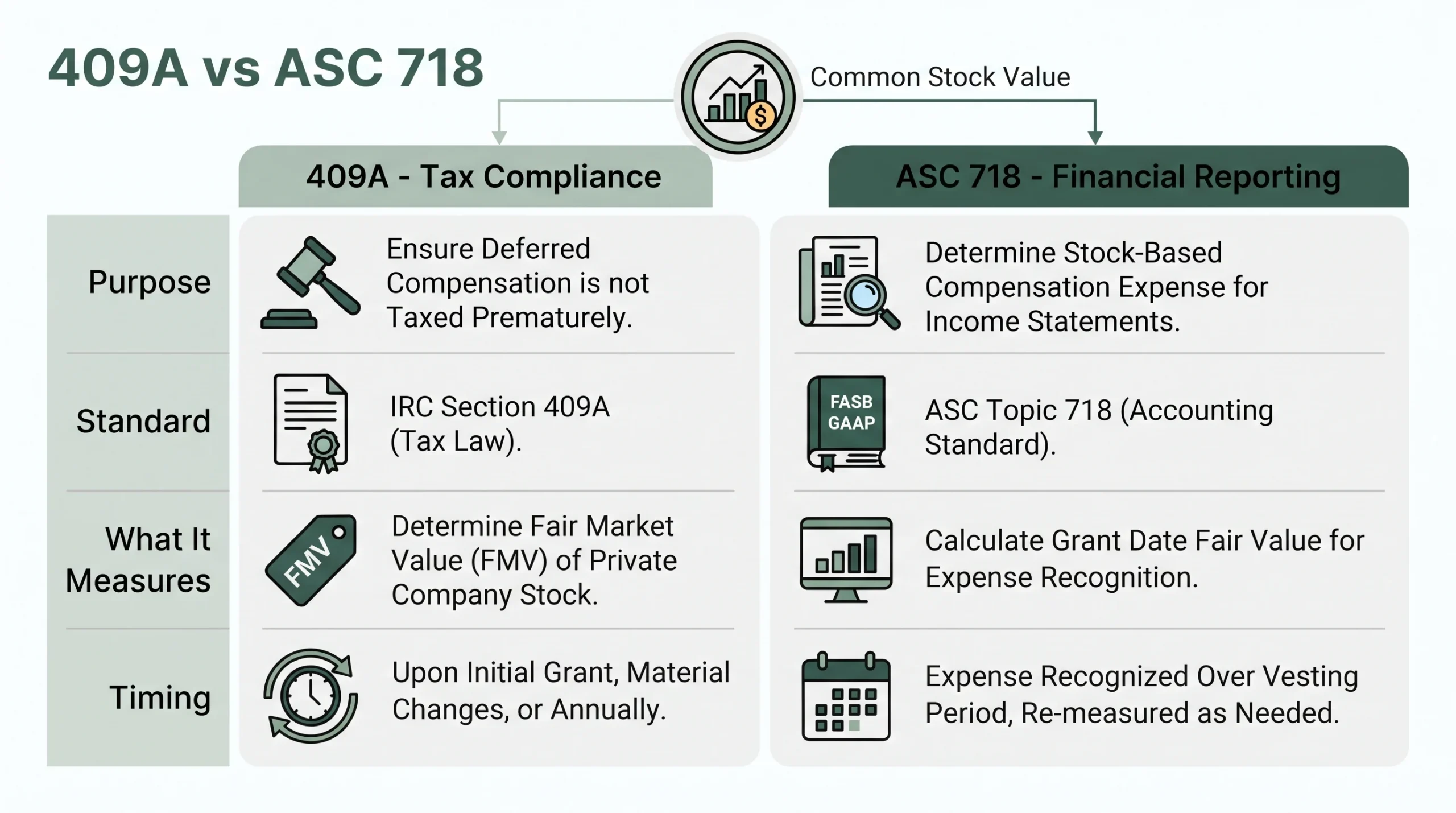
409A vs. ASC 718 comes down to purpose, not price. A 409A valuation sets the fair market value of a private company’s common stock so it can price stock options for a tax safe harbor under IRC Section 409A. ASC 718 measures the grant date fair value of that same award and records it as a compensation expense on the financial statements. One number often feeds both, and an independent appraisal generally supports the safe harbor for up to 12 months. Still, the two rules answer to different masters.
Founders and finance teams often assume one report covers everything. It does not. A 409A protects employees and the company from IRS penalties on deferred compensation. ASC 718 keeps the books compliant with US GAAP. Knowing where the two overlap and where they split prevents costly rework and audit questions later.
Sofer Advisors provides financial reporting and tax valuations for private companies across the United States. With 180+ five-star Google reviews and 11+ expert witness cases, the firm applies standards such as USPAP and the AICPA valuation standards to equity compensation work. Its senior staff helps founders and CFOs turn one defensible value into a clean result on both sides.
Key Takeaways
- Two purposes, one value: the same private company stock value can feed a 409A tax filing and an ASC 718 accounting entry.
- 409A is a tax rule: it sets fair market value so an option strike price is at least the common stock value on the grant date.
- ASC 718 is a GAAP rule: it measures grant date fair value with an option model and expenses it over the vesting period.
- Same input, different jobs: the tax safe harbor and the accounting expense use different measurement dates and inputs, so results can diverge.
- Independence matters: an outside appraisal gives a rebuttable presumption of reasonableness, valid up to 12 months or until a material event.
These points frame the rest of this guide. The sections below explain each standard, show how one value serves both, and map where the two split.
What is a 409A valuation?
A 409A valuation is an independent estimate of the fair market value of a private company’s common stock. It exists to price stock options and other deferred pay under IRC Section 409A, a tax rule. The core requirement is simple. An option strike price must be at least the fair market value of the common stock on the grant date. Set it too low and the IRS can treat the discount as taxable, with extra tax and interest for the employee.
The upside is the safe harbor. When a qualified independent party performs the appraisal, the value earns a rebuttable presumption of reasonableness. That shifts the burden to the IRS to prove the number wrong. The value generally holds for 12 months or until a material event, such as a new funding round or a major deal. Companies often refresh the report each year. Our guide on 409A valuation requirements covers the compliance steps in full.
What is ASC 718 and what does it cover?
ASC 718 is the US GAAP standard for share-based payment. It tells a company how to record the cost of stock options, restricted stock, and similar awards on its financial statements. The rule measures each award at its grant date fair value. That figure then becomes a compensation expense, spread across the vesting period. So a four-year option grant hits the income statement in pieces over four years, not all at once.
ASC 718 applies to public and private companies alike. It also reaches beyond plain options to units, appreciation rights, and employee purchase plans. Because the expense flows through earnings, auditors review the fair value and the model behind it. Our overview of what equity compensation is and how it is valued shows the award types that fall under this standard.
How can one valuation serve two purposes?
One valuation can serve both because both rules look at the same underlying thing: the value of the company’s common stock. A 409A study builds that value using accepted methods, such as the option pricing method that allocates value across preferred and common shares. ASC 718 then uses the same equity value as the starting point for the grant date fair value of an award. The tax filing and the accounting entry share one foundation.
This is where good sequencing pays off. When the 409A is current and well documented, the ASC 718 measurement can build on it with far less duplicate work. Sofer Advisors coordinates both so the common stock value, the cap table, and the assumptions line up across the tax and accounting records. Our look at 409A valuation methods explains the allocation models that both standards can draw on.
Where do 409A and ASC 718 diverge?
They diverge in purpose, timing, and what they measure. A 409A answers a tax question: is the strike price high enough to avoid a penalty? ASC 718 answers an accounting question: what is the fair value of the award, and how much expense does it create? Because the questions differ, the measurement date, the specific inputs, and even the model can differ. The table below sets them side by side.
| Factor | 409A valuation | ASC 718 measurement |
| Governing body | IRS, under IRC Section 409A | FASB, under US GAAP |
| Purpose | Tax safe harbor for option pricing | Financial reporting of pay expense |
| What it sets | Fair market value of common stock | Grant date fair value of the award |
| Key date | Grant date, valid up to 12 months | Grant date of each award |
| Main tool | Equity allocation and market data | Option model such as Black-Scholes |
| Where it lands | Strike price and tax records | Compensation expense on the books |
The split matters most when facts change mid year. A new funding round can reset the common stock value for the next grant, which changes both the 409A safe harbor and the ASC 718 inputs. Timing gaps between a grant date and a stale appraisal can also pull the two apart.
What inputs and models drive each measurement?
Both measurements rely on a common set of inputs, then apply them to different ends. The 409A leans on the total equity value, the rights of preferred shares, and market comparables to reach a common stock value. ASC 718 takes an award-level view. It runs an option pricing model, most often Black-Scholes or a lattice model, using the stock value plus assumptions for volatility, expected term, and the risk-free rate.
Small input changes move the result. A higher volatility assumption raises the option’s fair value and the resulting expense under ASC 718. A later grant date after a priced round can lift the common stock value that anchors the 409A. Sofer Advisors documents each assumption so the tax and accounting outputs trace back to one clear source. That discipline reflects the Heart of a Teacher approach the firm brings to complex work.
Which valuation firm should handle 409A and ASC 718 work?
Choose a firm that treats the 409A and the ASC 718 measurement as one coordinated project, not two invoices. Large national firms such as Alvarez & Marsal, Stout, and Kroll serve enterprise clients with deep benches and matching fees. Middle-market companies often want senior attention and faster turns instead. Unlike solo appraisers, a firm with a full W2 team of 14 and subscriptions to major valuation databases can defend both numbers if they are questioned.
The Sofer Difference is a four-phase process: Discovery, Diligence, Analysis, and Delivery. That structure keeps the common stock value, the option models, and the assumptions aligned from the first call to the final report. With 11+ expert witness cases across Georgia, Florida, California, and New Mexico and a next business day response policy, the firm pairs rigor with speed. Our comparison of a financial reporting valuation shows how the accounting side fits the wider engagement.
The questions below cover what founders and finance leaders ask most about these two standards.
Frequently Asked Questions
What is Section 409A in simple terms?
Section 409A is a tax rule for nonqualified deferred compensation, which includes most private company stock options. In plain terms, it says an option’s strike price cannot be below the fair market value of the common stock on the grant date. A company gets that value from an independent 409A appraisal. Doing so protects employees from surprise taxes and penalties on the discount the IRS would otherwise see.
What does ASC 718 apply to?
ASC 718 applies to share-based payment awards a company gives for services. That covers stock options, restricted stock, restricted stock units, stock appreciation rights, and employee stock purchase plans. It reaches both public and private companies. The standard requires each award to be measured at grant date fair value and recorded as a compensation expense over the vesting period, so it flows through reported earnings under US GAAP.
Is a 409A valuation legally required?
A 409A valuation is not filed with the IRS, so it is not required in the way a tax return is. It is, however, the practical way to earn the safe harbor. Without a qualified independent appraisal, the company must prove its stock value was reasonable if audited. That burden is hard to meet. Most venture-backed companies get a 409A before granting options to stay protected.
Can you give employee stock options without doing a 409A?
Yes, a company can technically grant options without a 409A, but it takes on real risk. The strike price still must meet fair market value under Section 409A. Without an independent appraisal, the company loses the safe harbor and must defend its own number. If the IRS disagrees, employees can face income tax, a 20% penalty, and interest on the discount. Most companies view the appraisal as cheap insurance.
Do 409A and ASC 718 use the same fair value?
They often start from the same common stock value, but they do not always land in the same place. The 409A sets the fair market value of common stock for tax purposes. ASC 718 uses that value as an input, then applies an option model to reach the award’s grant date fair value. So the base can match while the final figures differ, because each standard measures a different thing.
How does stock option expense flow from the 409A value?
The 409A gives the common stock value on the grant date. ASC 718 feeds that value into an option pricing model, along with volatility, expected term, and the risk-free rate, to compute the award’s fair value. That fair value becomes the total compensation expense. The company then spreads it across the vesting period, recording a slice each reporting period until the award fully vests.
When do 409A and ASC 718 values diverge?
They diverge when timing or inputs shift. A grant made months after the last 409A may sit on a stale value, while ASC 718 still measures at the true grant date. A new funding round can reset the common stock value between grants. Different volatility or term assumptions in the option model also push the accounting figure away from the raw 409A number. Careful dating keeps the gap small.
How often do you need a new 409A valuation?
A 409A generally stays valid for 12 months or until a material event, whichever comes first. A material event includes a priced funding round, a major acquisition offer, or a big change in the business. Most private companies refresh the report every year to keep the safe harbor alive. A fresh value also gives the ASC 718 measurement a current base for new grants.
How much does a 409A and ASC 718 valuation cost?
A 409A valuation from Sofer Advisors typically runs $2,500 to $9,000, with a timeline of two to four weeks. The range depends on the company’s stage, cap table, and the number of share classes. Coordinating the ASC 718 measurement alongside it often reduces duplicate work. For a quote tied to your grants and reporting needs, request a valuation estimate with your cap table and financials.
Related Case Studies
- Restricted Stock Units vs Stock Options: Key Differences
- Stock Appreciation Rights: How SARs Work and How They Are Valued
- Phantom Stock Plan: How It Works and When to Use One
Executive Summary
409A and ASC 718 often share one input, the value of a company’s common stock, yet they answer two different questions. A 409A valuation sets the fair market value so option strike prices meet the IRC Section 409A tax safe harbor, valid up to 12 months or until a material event. ASC 718 measures the grant date fair value of each award with an option model, then records it as a compensation expense over the vesting period under US GAAP. The two can diverge on timing, inputs, and models. A current, well-documented 409A gives the accounting side a clean base and keeps both records consistent.
What Should You Do Next?
Start by confirming your latest 409A is current, since a stale value weakens both the tax safe harbor and the ASC 718 base. Next, list every grant and its grant date, then match each to the right common stock value. Finally, align the option model assumptions, volatility, expected term, and the risk-free rate, so the tax and accounting records tell one story. That preparation avoids audit questions and rework.
David Hern CPA ABV ASA, founder of Sofer Advisors, delivers coordinated 409A and financial reporting valuations for private companies. Schedule a consultation to discuss your equity compensation needs.
People Also Read
- 409A Valuation for Startups: What Founders Must Know
- Purchase Price Allocation ASC 805 and IFRS 3: Complete Guide for Business Leaders
About the Author
This guide was prepared by David Hern CPA ABV ASA, founder of Sofer Advisors, a business valuation firm headquartered in Atlanta, GA serving clients across the United States. David holds dual accreditations as an Accredited Senior Appraiser (ASA) and is Accredited in Business Valuation (ABV), credentials recognized by the IRS, SEC, and FINRA. He also holds the Certified Exit Planning Advisor (CEPA) designation. With 15+ years of valuation experience, David has served as an expert witness in 11+ cases across multiple jurisdictions and built Sofer Advisors into an Inc. 5000-recognized firm with 180+ five-star Google reviews. Its full W2 employee team maintains subscriptions to all major valuation databases and operates under a next business day response policy.
For professional business valuation services, visit soferadvisors.com/about-us/ or contact Sofer Advisors at soferadvisors.com/contact-us/.
Disclaimer: This content is for informational purposes only and does not constitute professional valuation advice. Business valuation conclusions depend on specific facts and circumstances. Contact Sofer Advisors for guidance regarding your specific situation.









