


Last Updated: July 2026
The Excess Earnings Method is a hybrid business valuation approach that isolates the worth of assets you cannot touch, like goodwill-the extra value that comes from a firm’s name, clients, or skill. It blends the asset-based and income-based ways to reach a single figure, and it does so by finding the profit that beats a fair return on a firm’s physical assets. That leftover profit points straight to the value of hidden assets. Sofer Advisors gives independent valuation help for the choices in this guide.
The method works in a clear way. First, you find the fair return owed on the firm’s physical assets, and any profit left over counts as excess. You then turn that excess into a value for the hidden assets. Owners use this when goodwill drives much of the firm’s worth.
Sofer Advisors has worked for 7 years. And the team brings strong skill to each valuation task while holding a high bar for accuracy. That work has earned 180+ five-star Google reviews from owners, lawyers, and CPAs.
Owners and fiduciaries often weigh this method against other options during a sale or a tax event, since the right choice depends on how steady the firm’s returns are. A firm grasp of these numbers helps you get ready. And it also prepares you for IRS reviews or deal talks.
Key Takeaways
- Hybrid Valuation Nature: This method mixes the asset and income ways to value goodwill, pulling out profit that beats a fair return on physical assets.
- Historical Regulatory Foundation: The method goes back to IRS Revenue Ruling 68-609, which gives a frame for pricing hidden value through excess returns, though many experts now see it as a last resort.
- Subjectivity Risk Factors: The method leans hard on expert judgment, including the return on assets and the rate used to turn profit into value, so small changes can swing the final number by a lot.
- Limited Standard Compliance: Most modern fair value rules, like ASC 820, do not back this mixed method because it lacks the rigor that hard reports need.
- Specific Case Application: This method suits narrow, simple cases and shows up most in some legal fights, while experts rarely use it for broad appraisals or tax plans.
Each factor shapes how well this method fits your deal or report. The parts below show how these points apply to you, helping you pick the right valuation path.
What is the Excess Earnings Method?
The Excess Earnings Method is a mixed way to value a business. It joins asset-based and income-based tools to price the assets you cannot touch, finding the profit that beats a fair return on physical assets-leftover value that points to goodwill. Reviewing broader goodwill valuation methods shows where it fits among an analyst’s options.
Experts take total steady earnings, subtract a fair return on physical assets, and turn the leftover income from hidden assets into a value for goodwill.
How is excess earnings calculated?
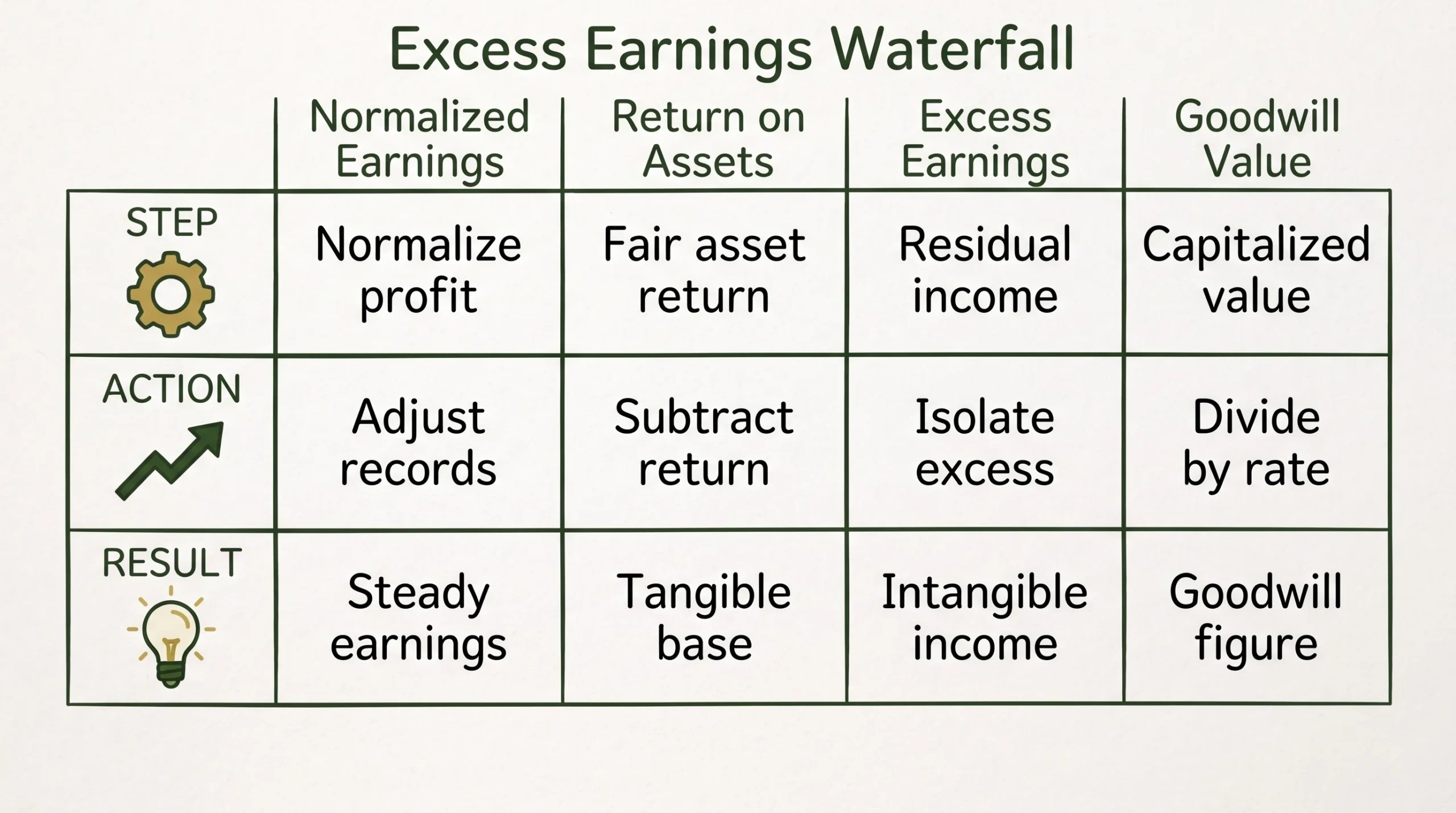
You find excess earnings by pulling out the return from hidden assets, after a fair return on all net physical assets. A five-step flow isolates goodwill.
First, the analyst finds normal earnings by fixing past records to show steady, lasting profit. Second, the expert values the net physical assets. Third, the expert sets a fair return on those assets using a market-drawn rate. Fourth, the owner subtracts that return from normal earnings, leaving the excess earnings. Fifth, the analyst divides that excess by a capitalization rate to turn the yearly figure into lasting goodwill value.
The chosen rates matter a lot: the return rate for physical assets and the rate that turns excess profit into value both rest on judgment, not hard facts. A return rate set too low overstates hidden value, and one that ignores the risk of the excess cash skews the result.
Picking the right rates takes skill and good data, drawn from sources like Business Valuation Resources alongside other market signs of economic health. Sofer Advisors has earned 180+ five-star Google reviews for clear, sound valuations. Request a valuation estimate to see how these inputs shape your number.
When is this method most appropriate?
This method fits small, simple firms best. Think of pro practices or sole owners, where personal goodwill drives much of the value and the owner is often the main source of revenue. Many medical or legal firms work this way, where standard models often miss the picture.
It does not fit every case, though: not reports under ASC 820, nor large, complex firms. Pro practices lean on it in some legal fights, such as divorce cases or owner disputes, which ask: how much value leaves if the owner walks away? Sorting that turns on the split between personal and enterprise goodwill, and the personal goodwill vs enterprise goodwill guide shows why that line matters so much in tax and divorce work.
What are its main advantages?
The top plus of this method is its focus on goodwill. It gives a clear number for that asset, while other methods hide goodwill inside larger sums, giving small firms a distinct view of hidden worth.
Most experts like the clear logic of this method, which follows step by step and shows the math behind the final number. Its long track record in courts also lends trust that newer models may lack. Per the Uniform Standards from The Appraisal Foundation, each choice needs clear reasoning to hold up in court.
What are its primary criticisms?
The main gripe is its soft inputs. Two figures rest on judgment alone: the return rate on physical assets and the rate that turns excess earnings into value. With no clear market marks for either, small shifts can move the final figure a lot, worrying people who need firm numbers.
Modern rules treat this method with care, and groups like the AICPA and USPAP see it as a last resort. It often fails strict fair value tests for one reason: it lumps all hidden assets into one pool instead of valuing each on its own, hiding what each adds. So most experts skip it when better tools exist. A cleaner path breaks the intangibles apart, and the guide to intangible asset valuation shows how analysts price patents, brands, and customer lists on their own terms.
How does it compare to other methods?
This method acts as a mixed tool, bridging income-based and asset-based ways. A pure income tool like a Discounted Cash Flow (DCF) projects future cash and brings it to today’s value; this method instead pulls out hidden value by subtracting a fair return on physical assets from total earnings.
Experts often use more than one method, which strengthens the result for tax and legal work: one model can add bias, while several cross-check the final number. Sofer Advisors uses many methods, keeping each estimate tied to real records and sound forecasts, holding the work to the bar set by the IRS and the American Society of Appraisers.
The next table compares how Sofer Advisors applies technical standards against common learning sites online, such as mjcpa.com and wallstreetmojo.com.
| Feature | Sofer Advisors | mjcpa.com (as an educational resource) | wallstreetmojo.com (as an educational resource) |
|---|---|---|---|
| Primary Use Case | Defensible valuations for M&A, tax, litigation, and financial reporting | Explaining accounting concepts and calculations | Providing formulas and templates for financial modeling |
| Compliance Standard | Follows USPAP & AICPA standards (ASC 820, 409A) | Describes general accounting principles | Focuses on theoretical financial formulas |
| Use of Excess Earnings Method | As a corroborating check or in specific litigation cases; rarely primary method | As a defined calculation to be learned for accounting | As a formulaic example of a valuation technique |
These gaps matter when you pick an advisor; your choice should match the job. Learning sites give great math and basic reference, but they are not neutral outside experts, so they cannot serve legal or money disputes. A report for the IRS or a buyer needs more, and static templates add real risk. Sofer Advisors fills this gap with strict USPAP work.
What should the valuation review compare?
A sound review ties each big call to real records and to market proof on the valuation date. The points below sum up the core choices from this guide.
| Decision area | Evidence and review focus |
|---|---|
| What is the Excess Earnings Method | The Excess Earnings Method is a hybrid valuation approach that estimates total business value by combining asset-based and income-based techniques to isolate the value of intangible assets. |
| How is excess earnings calculated | Excess earnings are calculated by isolating the return generated by intangible assets after accounting for a fair return on all net tangible assets. |
| When is this method most appropriate | This method is most appropriate for small, non-complex businesses such as professional practices or sole proprietorships where personal goodwill represents a major portion of value. |
The final report should tie these areas together rather than treat any method or input alone.
Frequently Asked Questions
How do you calculate excess earnings?
First, take the total earnings of the firm. Then subtract a fair return on the net physical assets. And the income that stays is the return from hidden assets. Next, divide that leftover income by a rate that turns income into value. And the result is an estimate for the hidden assets. Sofer Advisors sets each input with care, so every part of your value shows up clearly.
How much is a business worth with $500,000 in sales?
Sales alone rarely show a firm’s true value. Profit margins and assets shape the final number more. A firm with $500,000 in sales might be worth a small share of that if it holds high debt. Meanwhile, a high-margin firm could earn a higher multiple instead.
What are the top 3 valuation methods?
The three main methods are income, market, and asset. The income method values a firm on future cash flows, while the market method compares a firm to similar sales. The asset method finds the net value of balance sheet items.
What are excess earnings for social security?
For Social Security, excess earnings mean income above set yearly limits. That extra income may cut benefits for people below full retirement age. It differs from the business term with the same name, where excess earnings show returns from hidden assets. Owners often mix up these two terms when they plan an exit. So Sofer Advisors helps clear up how each one hits your tax plans.
Why is the Excess Earnings Method controversial in modern valuation?
The method draws fire for its soft inputs. Two of them rely on judgment: one is the rate that turns profit into value. And the other is the return on physical assets. Small errors here cause big swings in the result, which can lead to numbers with no market support. Modern rules prefer data you can check and trust.
What is Revenue Ruling 68-609?
Revenue Ruling 68-609 is the IRS rule that gave rise to the Excess Earnings Method. It sets a frame for pricing hidden value through excess returns, which is profit that beats a fair return on physical assets. The rule has a long history, but many experts now treat this method as a last resort rather than a first choice.
When is the Excess Earnings Method most appropriate?
This method fits small, simple firms best, such as professional practices or sole owners where personal goodwill drives much of the value. Many medical or legal firms work this way. It also shows up in some legal fights, like divorce cases or owner disputes. It does not fit large, complex firms or reports under ASC 820.
How does the Excess Earnings Method differ from a DCF?
A Discounted Cash Flow, or DCF, projects future cash and brings it to today’s value. The Excess Earnings Method works another way. It pulls out hidden value by subtracting a fair return on physical assets from total earnings. Experts often use more than one method, since leaning on a single model can add bias to the final number.
Does the Excess Earnings Method meet ASC 820 standards?
No. Most modern fair value rules, like ASC 820, do not back this mixed method because it lacks the rigor that hard reports need. It also lumps all hidden assets into one pool instead of valuing each one on its own. For a report under ASC 820, most experts turn to methods that meet these strict standards instead.
Related Case Studies
- Goodwill Valuation Methods: Which Approach Is Right?
- Goodwill vs Intangible Assets: Key Differences Explained
- Personal Goodwill vs Enterprise Goodwill: Tax & Divorce Guide
Executive Summary
The Excess Earnings Method prices goodwill by isolating the profit that exceeds a fair return on a firm’s tangible assets, then capitalizing that excess into a lasting value. It rests on a five-step flow: normalize earnings, value net tangible assets, set a fair return on them, subtract that return to find excess earnings, and capitalize the result.
Rooted in IRS Revenue Ruling 68-609, the method suits small professional practices and litigation matters like divorce and owner disputes, where personal goodwill drives much of the value. Its two judgment-based inputs-the asset return rate and the capitalization rate-make results easy to challenge, so standards from the AICPA, USPAP, and ASC 820 treat it as a last resort. For a defensible conclusion, analysts pair it with income and market approaches and tie every input to real records.
What Should You Do Next?
Start by naming the purpose of your valuation, since a divorce case, a gift filing, and an ASC 820 report each demand a different path. Next, gather clean financials so an analyst can normalize earnings and value your tangible assets on firm ground. Then engage a credentialed valuation expert who can select the right method and defend each input if a reviewer pushes back.
David Hern CPA ABV ASA, founder of Sofer Advisors provides neutral, defensible valuations for goodwill and intangible assets. Schedule a free consultation to discuss your situation.
People Also Read
- Goodwill Impairment Testing ASC 350: Complete Guide for 2025-2026
- How to Value Personal Goodwill: Complete Guide for Business
About the Author
This guide was prepared by David Hern CPA ABV ASAc, founder of Sofer Advisors, a business valuation firm headquartered in Atlanta, GA serving clients across the United States. David holds dual accreditations as an Accredited Senior Appraiser (ASA) and is Accredited in Business Valuation (ABV), credentials recognized by the IRS, SEC, and FINRA. He also holds the Certified Exit Planning Advisor (CEPA) designation. With 15+ years of valuation experience, David has served as an expert witness in 11+ cases across multiple jurisdictions and built Sofer Advisors into an Inc. 5000-recognized firm with 180+ five-star Google reviews. Its full W2 employee team maintains subscriptions to all major valuation databases and operates under a next business day response policy.
For professional business valuation services, visit soferadvisors.com/about-us/ or contact Sofer Advisors at soferadvisors.com/contact-us/.
Disclaimer: This content is for informational purposes only and does not constitute professional valuation advice. Business valuation conclusions depend on specific facts and circumstances. Contact Sofer Advisors for guidance regarding your specific situation.









