


Last Updated: July 2026
The net asset value method values a business by subtracting what it owes from the fair market value of what it owns, giving a fixed picture of a firm on a single date. Sofer Advisors gives independent valuation help for the choices we cover here. This method relies on the balance sheet rather than future profits, so it ties the value to real items you can inspect, appraise, and audit. Owners often pick this method for a holding company, and they also use it when a business plans to close or sell key assets.
Sofer Advisors offers valuation help for owners, CPAs, and lawyers, drawing on seven years of work with tricky tax, court, and deal reports. Its work rests on fair, fact-based reports that pass a hard review, and with 180+ five-star Google reviews, the firm has earned wide trust.
Owners and their advisors often ask experts to guide them because the rules for financial reports can get complex. Knowing how the net asset method works helps you choose well during mergers, tax planning, or court cases, since good data lets each party trust the final result.
Key Takeaways
- Valuation purpose dictates standards: Different goals need different rules, so tax work uses IRC Section 409A while financial reports use ASC 820. The wrong rule can cause audit problems or bad tax filings.
- Data sources drive defensibility: Sofer Advisors uses market data you can check, like records from Business Valuation Resources (BVR/DealStats), which builds a solid base for each number.
- Reporting requires specific methods: The income, market, and asset approaches each serve a role, and the right one depends on the IRS or SEC, per AICPA standards.
- Timing affects cost and accuracy: Most jobs take 2 to 12 weeks based on how complex they are, per Sofer Advisors data, so good prep helps you meet deadlines.
- Expertise shapes the final analysis: This work draws on 11+ expert witness cases, and that skill keeps the view fair and neutral.
Why use the net asset value method?
The net asset value method fits asset-heavy firms best because it looks at what tangible things are worth, not future cash. This suits manufacturers or real estate firms that own a lot of gear, land, or buildings. You add up each item and subtract debts, which sets a firm floor value that helps most when a firm may close or sells key assets. Income methods lean on shaky profit guesses, while this method stays steady when profits are low or hard to predict.
For firms with few intangible assets, this method gives a fair, clear number because its main gain is less guesswork, tying the value to real items you can check and audit. So it is a standard tool for firms in trouble, where closing value matters most to lenders. Other methods use market multiples, but those can miss the strength of a firm built on fixed assets. This method uses current appraisals, which gives a real exit number for holding firms. The right method depends on your deal, your field, and the value standard you need, so talk to a Sofer Advisors specialist about the best fit.
How is net asset value calculated?
To find net asset value, subtract Total Liabilities from the Fair Market Value (FMV) of Total Assets. FMV means the price a willing buyer would pay today, and owners use this number to see the true worth of their firm, going past what the books show. A book value drawn from historical cost rarely matches current market reality.
To close that gap, advisors build an adjusted balance sheet, a fresh list that shows current worth. The work starts with a full review of each asset and debt, and experts then update each item to its FMV. This gives a clear, current view of the firm, and each change ties back to an appraisal or a market comparison.
What assets require the most adjustment?
Real estate and machinery need the biggest changes because their market worth often differs a lot from the recorded cost. When a firm leans on heavy gear, these items fill the balance sheet, and old cost does not show today’s reality. This is true for items that shift in value fast or get heavy use.
A formal real estate appraisal is standard for firms with big land or buildings, and the Appraisal Foundation (USPAP) standards set the frame for this work to make sure the value shows the real market stake. Complex gear also often needs an expert view, since that expert judges the years of use left and the cost to replace it.
Firms must check each account to see if the full balance can be collected. When past data shows some money owed will never come in, that loss must show up in the numbers. Inventory needs the same check, since slow-moving stock rarely sells for its recorded cost. Skip these fixes, and the firm’s value looks too high, which hurts you in a deal or a tax event.
When is this method unreliable?
The net asset method does not fit service firms well because it misses the real worth of firms that own little gear or stock. For these firms, the balance sheet shows few tangible assets, often a small slice of the total worth. That is because their true value sits in earning power and non-physical assets.
Take SaaS firms as one case, since they run on the strength of their software and steady income. Their value lives in customer ties, ideas, and code, which accountants call goodwill or intangible assets. The net asset method skips these key parts because rules often keep them off a standard balance sheet. Service firms face the same trouble, as their people and skill drive profit, not fixed gear. For these firms an income or market approach gives a truer picture.
How does NAV compare to other methods?
The net asset method works as a break-up tool, so it differs from the Income and Market Approaches because it looks at what a firm gets if it closes, while the other two treat the firm as one that keeps running. The Income Approach measures the value of future profit, and the Market Approach ranks a firm against like firms. The Asset Approach finds the net cash left if a firm sold all assets and paid all debts today.
The Income Approach includes a Discounted Cash Flow analysis that looks ahead at the profit a firm makes as a going concern. The Market Approach uses EBITDA multiples, a common measure of a firm’s core earnings, drawn from the Business Valuation Resources (BVR / DealStats) database to compare a firm to its peers. A full report often blends all three views, per AICPA professional standards, which helps square what a firm owns with what it earns.
Can goodwill be included in NAV?
The pure Adjusted Net Asset Method leaves out goodwill, the extra worth from a firm’s name or clients. It looks at the FMV of tangible and identifiable intangible assets and finds total equity by subtracting debts, so it skips the premium a firm might earn from its good name.
Sometimes a valuation needs to count goodwill, so analysts use the Excess Earnings Method. This blended tool starts with net assets and adds a value for profit above a normal return on those assets. The method follows the frame set in Revenue Ruling 68-609, which the IRS uses to guide how to value intangibles when other methods fail. By measuring income above a basic return, experts give a solid value that plain asset models miss. See how intangible asset valuation isolates and prices contracts, brands, and customer lists.
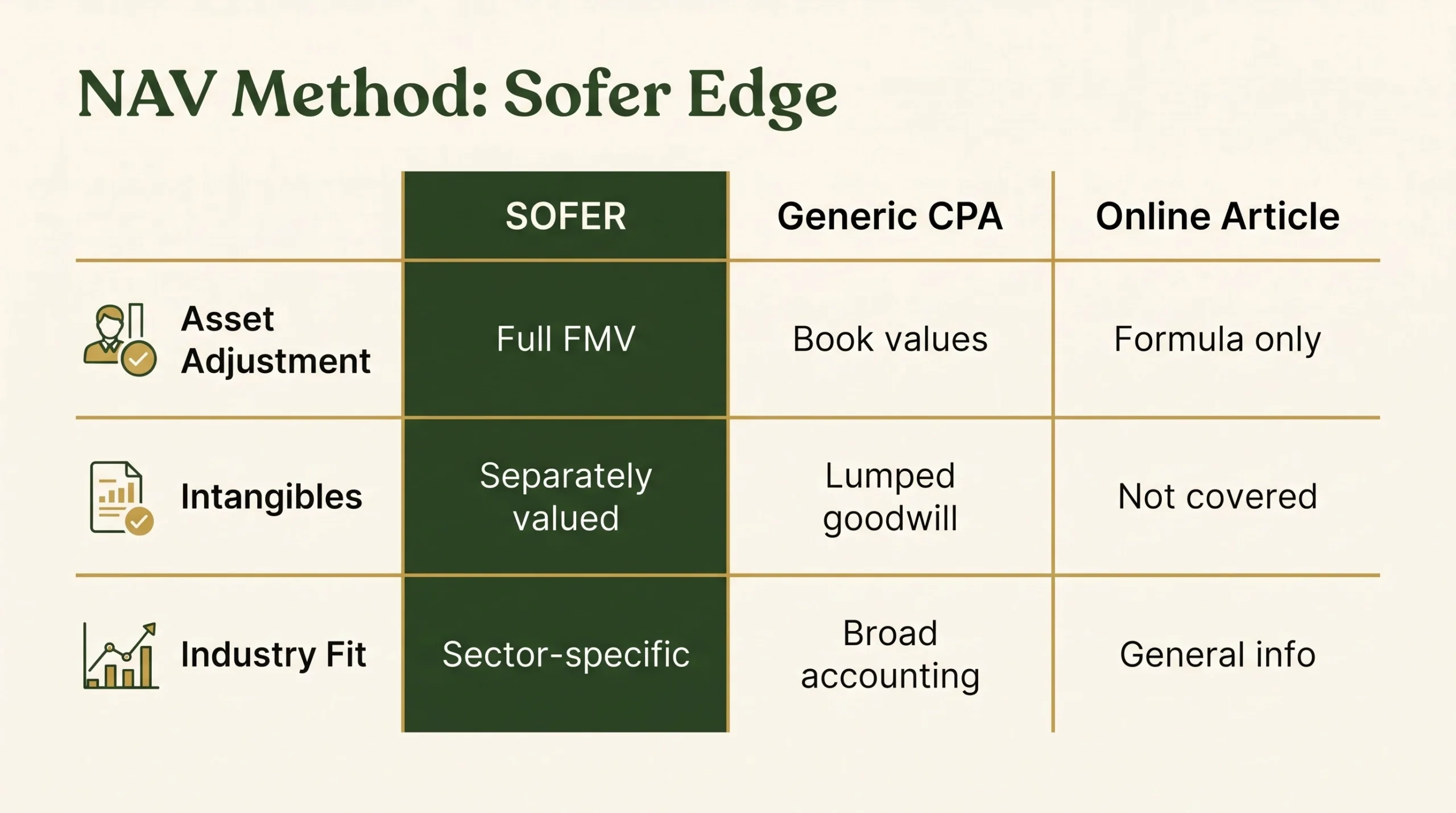
| Feature | Sofer Advisors | Generic CPA Firm (adamsbrowncpa.com) | Online Article (investopedia.com) |
|---|---|---|---|
| Asset Adjustment | Detailed FMV adjustments for all asset classes, supported by third-party data and expert reports | Typically relies on client-provided book values or depreciation schedules | Provides a general formula but no practical adjustment guidance |
| Intangible Assets | Separately identifies and values identifiable intangibles like contracts | Often combines all intangibles under one goodwill entry | Mentions intangibles as a limitation without a valuation method |
| Industry Expertise | Applies specific methodologies for asset-heavy sectors like manufacturing | General accounting applied broadly across industries | N/A – General information only |
The method you pick often turns on the quality of your records and how much expert review your assets get. Basic software tools or set formulas give a broad view, but they skip the fine fixes needed to pass a hard review or check a deal price. Pro work leans on special databases like Business Valuation Resources (BVR / DealStats) to confirm market-based asset multipliers, so each line shows its current worth and the advisor gives a firm base for tax reports, partner fights, or sales.
What should the valuation review compare?
A strong analysis ties each big call to the records and market proof on the valuation date.
| Decision area | Evidence and review focus |
|---|---|
| Why use the net asset value method | The net asset value method is most appropriate for asset-heavy businesses because it focuses on the total worth of tangible holdings rather than projected future cash flows. |
| How is net asset value calculated | Net asset value is calculated by subtracting Total Liabilities from the Fair Market Value (FMV) of Total Assets. |
| What assets require the most adjustment | Tangible assets, particularly real estate and machinery and equipment, require the most significant adjustments because their market values often diverge sharply from their recorded historical cost. |
The final report should square these areas, not treat any method or input on its own.
Frequently Asked Questions
What is the net asset method of business valuation?
The net asset method finds a firm’s value in a clear way. You take the FMV of all assets, then subtract the total debts. Sofer Advisors follows this path to find the true worth of tangible assets, which helps owners who face a deal or a tax filing.
How much is a business worth with $100,000 in sales?
Sales alone do not set a firm’s value. A firm with $100,000 in sales could be a strong service shop, or it could be deep in debt. Net asset value often serves as the best measure if physical assets drive the worth. Sofer Advisors checks if your setup gives a solid floor value, looking at gear, working cash, and debts you owe.
Is net asset value a valuation method?
Yes, the net asset method is a known way to value a firm. It forms the base of the asset-based approach. And it works well for firms that hold big fixed or liquid assets, such as real estate or machinery.
What is the formula for net asset value method?
The formula is simple. Take the Total FMV of Assets, then subtract Total Liabilities. This needs solid appraisals for each asset on the books, such as machinery, land, and stock. Net asset value shows the current worth of those assets, adjusting for inflation and market demand, so your final report shows what a buyer would pay today.
For which type of company is the net asset method most appropriate?
This method fits asset-heavy firms best. Think makers, real estate holding groups, or builders. It is also the top choice for firms in liquidation. And it suits firms that lack steady profit for income methods.
Which assets usually need the most adjustment?
Real estate and machinery need the biggest changes. Their market worth often differs a lot from the recorded cost. A formal real estate appraisal is standard for firms with big land or buildings, following Appraisal Foundation (USPAP) standards. Complex gear also needs an expert view to judge the years of use left and the cost to replace it.
Can goodwill be included in net asset value?
The pure Adjusted Net Asset Method leaves out goodwill, the extra worth from a firm’s name or clients. When a valuation needs to count it, analysts use the Excess Earnings Method, which starts with net assets and adds a value for profit above a normal return, following Revenue Ruling 68-609.
When is the net asset method unreliable?
The net asset method does not fit service firms well. It misses the real worth of firms that own little gear or stock, since their value sits in earning power and intangible assets. Take SaaS firms, whose value lives in customer ties, ideas, and code that rules keep off a standard balance sheet.
How does the net asset method compare to the income and market approaches?
The net asset method works as a break-up tool, showing what a firm gets if it closes. The Income Approach measures the value of future profit using a Discounted Cash Flow analysis, while the Market Approach ranks a firm against peers using EBITDA multiples. A full report often blends all three views.
Related Case Studies
- Cost Approach vs Income Approach: Complete Guide
- Going Concern Valuation: What It Means for Your Business
- Difference Between Book Value and Fair Value Explained
Executive Summary
The net asset value method sets a firm’s worth by subtracting total liabilities from the fair market value of its assets, giving a balance-sheet figure fixed to a single date. It fits asset-heavy firms such as manufacturers, real estate holders, and liquidating businesses, and it stays steady when profits are low or hard to predict. Because book values from historical cost rarely match today’s market, advisors build an adjusted balance sheet, restating real estate, machinery, receivables, and inventory to current FMV. The method understates service and software firms, whose value lives in goodwill and intangibles kept off the standard ledger. Where goodwill matters, the Excess Earnings Method adds value for profit above a normal return under Revenue Ruling 68-609.
What Should You Do Next?
First, name your valuation goal and the standard it must meet, since tax, financial reporting, and litigation each demand different rules. Next, gather a current balance sheet, recent tax filings, and specific asset appraisals for real estate and major equipment. Then review depreciation schedules and upkeep records so each tangible item can be restated to fair market value.
David Hern CPA ABV ASA, founder of Sofer Advisors provides neutral, defensible valuations for asset-heavy businesses valued under the net asset value method. Schedule a free consultation to discuss your situation.
People Also Read
- Intangible Asset Valuation: Methods for Measuring Hidden Value
- SaaS Valuation: Complete Guide to Software Company Value
About the Author
This guide was prepared by David Hern CPA ABV ASAc, founder of Sofer Advisors, a business valuation firm headquartered in Atlanta, GA serving clients across the United States. David holds dual accreditations as an Accredited Senior Appraiser (ASA) and is Accredited in Business Valuation (ABV), credentials recognized by the IRS, SEC, and FINRA. He also holds the Certified Exit Planning Advisor (CEPA) designation. With 15+ years of valuation experience, David has served as an expert witness in 11+ cases across multiple jurisdictions and built Sofer Advisors into an Inc. 5000-recognized firm with 180+ five-star Google reviews. Its full W2 employee team maintains subscriptions to all major valuation databases and operates under a next business day response policy.
For professional business valuation services, visit soferadvisors.com/about-us/ or contact Sofer Advisors at soferadvisors.com/contact-us/.
Disclaimer: This content is for informational purposes only and does not constitute professional valuation advice. Business valuation conclusions depend on specific facts and circumstances. Contact Sofer Advisors for guidance regarding your specific situation.









