


Last Updated: September 2026
A SLAT business interest valuation sets the fair market value of a private company stake before an owner moves it into a spousal lifetime access trust. The appraisal supports the gift the owner reports to the IRS. It also fixes how much lifetime exemption the gift uses. For 2026, the federal lifetime gift and estate tax exemption sits at $15 million per person under the 2025 tax law. A defensible number keeps that transfer on solid ground.
Sofer Advisors prepares these appraisals for owners and their estate attorneys. Its team takes a Heart of a Teacher approach, so each report explains the income, market, and asset methods in plain words. That work is backed by 180+ five-star Google reviews and testimony as an expert witness in 11+ cases across Georgia, Florida, California, and New Mexico.
Owners usually start this work with an estate planning attorney and a CPA. The goal is a signed appraisal that holds up if the IRS reviews the gift. The sections below explain how the value is set, which discounts apply, and how the gift reaches Form 709.
Key Takeaways
- Removes future growth: a SLAT moves a business interest and its future appreciation out of the taxable estate while a spouse keeps access.
- Qualified appraisal required: the IRS expects a qualified appraisal from a credentialed expert to support the gifted value.
- Discounts improve efficiency: lack of control and lack of marketability discounts can lower the reported gift and stretch the exemption.
- Fair market value governs: the value follows IRS Revenue Ruling 59-60 and Treasury rules, not a simple rule of thumb.
- No sunset to rush: the lifetime exemption is now permanent at $15 million per person, so a SLAT is a planning choice, not a deadline.
Each of these points shapes how much exemption the gift uses. The sections below examine each one in detail.
What is a spousal lifetime access trust (SLAT)?
A spousal lifetime access trust (SLAT) is an irrevocable trust one spouse creates for the other. The donor spouse moves assets into the trust as a completed gift. Those assets, plus their future growth, leave the couple’s taxable estate. The beneficiary spouse can still draw on the trust during life, which keeps money within reach of the family.
The structure gives high-net-worth families two clear benefits. First, it shifts value out of the estate before the business grows further. Second, it keeps a safety valve open through the beneficiary spouse. A business interest is a common funding asset because it often carries strong future growth. That growth is exactly what the owner wants to move out of the estate today.
Why must a SLAT business interest be appraised?
A SLAT business interest must be appraised because the IRS requires a qualified appraisal to support the gift’s fair market value. The appraisal backs the number reported on Form 709, the gift tax return. Without it, the owner risks penalties and a challenge to the transfer. A private company stake has no public price, so an expert must build the value from the ground up.
The risks of skipping this step are real. If the IRS finds the interest was undervalued, it can assess accuracy-related penalties. A weak report can also cost the owner part of the exemption the gift was meant to use. In some cases, the IRS may question the whole transfer. A credentialed appraisal, prepared before the gift, keeps the plan on firm footing.
How is fair market value set for a SLAT gift?
Fair market value is the price a willing buyer and a willing seller would agree on, with neither under pressure and both well informed. For a private business, appraisers follow IRS Revenue Ruling 59-60 as the main guide. They weigh the income, market, and asset approaches to reach a supported number. Sofer Advisors applies these methods to fit the size and risk of the interest being gifted.
Each approach views the business from a different angle. The income approach turns expected cash flow into present value. The market approach compares the company to similar sales and public peers. The asset approach measures the net value of what the company owns. A skilled appraiser weighs the three based on the facts. For deeper context, see our guide to Revenue Ruling 59-60.
What discounts apply to a SLAT business gift?
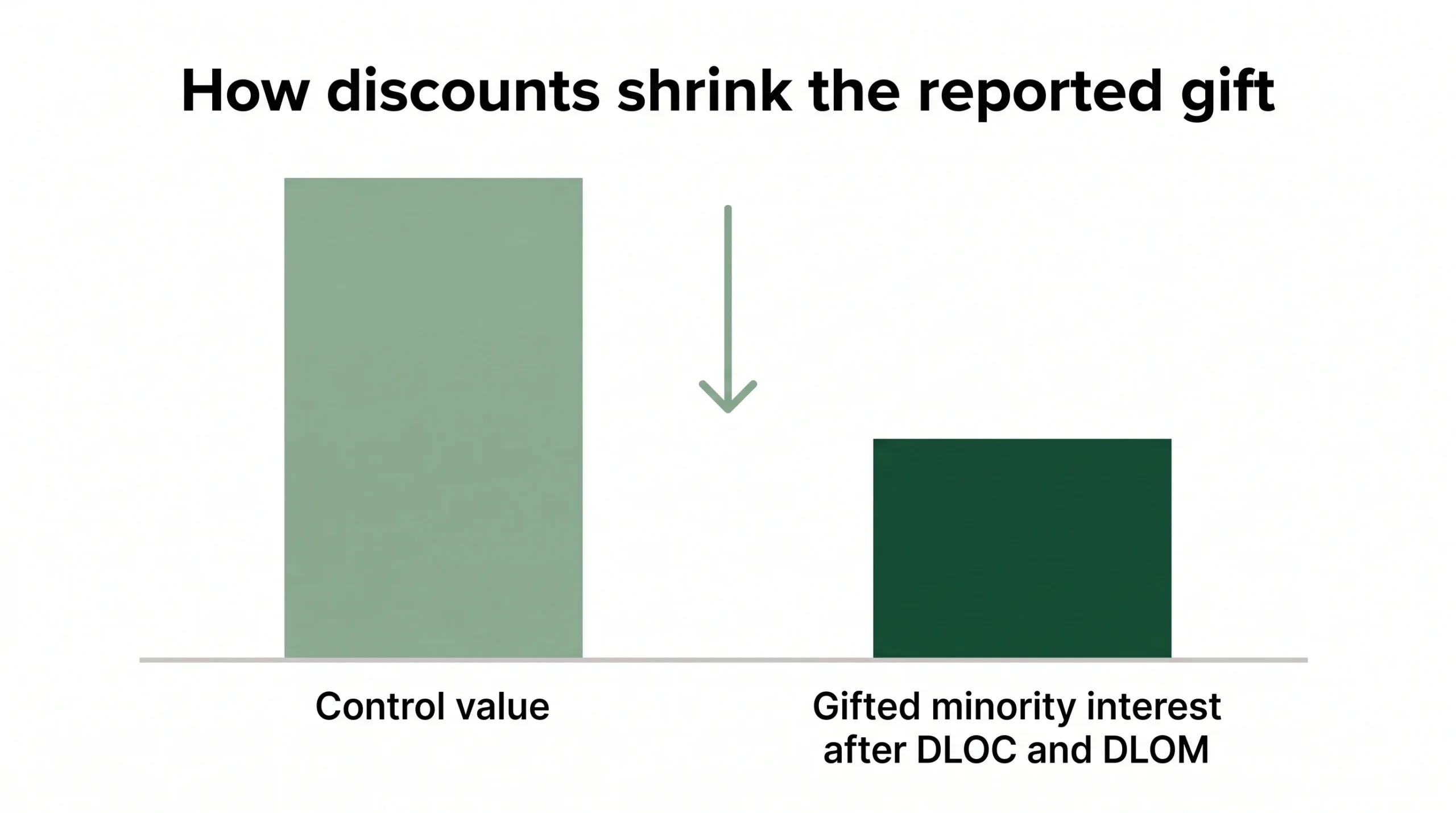
Two discounts usually apply to a SLAT business gift: a discount for lack of control and a discount for lack of marketability. A minority, non-voting stake cannot steer the company or sell quickly. Both traits lower what a buyer would pay. Applied with support, these discounts reduce the reported gift and help the owner stretch the exemption.
- Discount for lack of control (DLOC): reflects a minority owner’s limited say over policy, distributions, and company structure.
- Discount for lack of marketability (DLOM): reflects how hard it is to sell a private interest when no public market exists.
An appraiser does not pick these figures at random. The size of each discount comes from the operating agreement, the ownership rights, and market data on private transfers. Empirical studies show minority, non-marketable stakes trade well below control value. A clear, supported discount is easier to defend than a round number. For more, read our guide to minority interest and marketability discounts, which shows how the two adjustments work together.
How do you report a SLAT gift to the IRS?
A SLAT gift is reported on Form 709, the United States gift tax return, for the year of the transfer. The owner attaches the qualified appraisal and a full description of the interest and its discounts. Filing this way meets the adequate disclosure rules and starts the IRS review window. The IRS measures a gift of property at its fair market value on the date it changes hands.
Timing is about value, not a deadline. The 2025 tax law made the lifetime exemption permanent at $15 million per person, or $30 million for a married couple, indexed each year. There is no scheduled sunset. So a SLAT lets an owner use exemption and move future growth now, rather than race an expiring benefit. Locking in today’s value, with fair discounts, is what makes the transfer efficient.
Which valuation firm should value a SLAT gift?
The right firm for a SLAT gift is an independent, credentialed valuation specialist, not a broker or a general tax preparer. National firms like Alvarez & Marsal, Stout, and Kroll serve the largest corporate deals. Many middle-market owners instead need a specialist who works estate and gift matters directly and can defend the report. The table below compares three common options.
| Provider | Typical focus | Best for |
| Independent valuation specialist | Defensible estate and gift appraisals with supported discounts | SLATs, gifting, and IRS-facing reports |
| Local CPA or solo practitioner | Tax prep and general accounting | Routine returns and basic advice |
| National firm (Alvarez & Marsal, Stout, Kroll) | Large corporate transactions | Public companies and enterprise deals |
Each option fits a different need. A solo CPA may be right for routine filings, but a large estate gift calls for a report built to survive review. Sofer Advisors runs each engagement through The Sofer Difference, a four-phase process of Discovery, Diligence, Analysis, and Delivery. Its work follows the Uniform Standards of Professional Appraisal Practice (USPAP) and the business valuation standards of the American Society of Appraisers. Dual ABV and ASA credentials, a full W2 team, and a next-business-day response back that work.
A defensible SLAT appraisal rests on the fair market value standard, well-supported discounts, and clean disclosure on Form 709. The questions below cover what owners ask most before they fund a trust.
Frequently Asked Questions
How much is a business worth with $1,000,000 in sales?
A business with $1,000,000 in sales has no single fixed value, because worth tracks profit and risk, not revenue. A high-margin company with steady cash flow can be worth far more than a thin-margin one at the same sales. Most appraisers start with an income approach, then test it against comparable sales. The result depends on earnings quality, growth, and the specific facts of the company.
How much is a business worth that makes $300,000 a year?
A business earning $300,000 a year is valued by first defining that figure, since owner earnings and net profit are not the same. Appraisers apply a multiple that fits the industry, the asset base, and the growth outlook. Two firms with equal earnings can carry very different values based on risk. A close review of the financial statements and market benchmarks sets a supportable range.
What is the simplest method of valuing a business interest?
The market approach is often the simplest method, since it uses prices from similar sold businesses or public peers. It is easy to grasp, but it still needs care. The comparables must be adjusted for size, profit, and risk before they mean anything. For a gift into a trust, professional standards guide which method carries the most weight for the specific interest and its intended use.
How much is a business worth with $500,000 in sales?
A business with $500,000 in sales is worth what its earnings and risk profile support, not a flat share of revenue. Overhead, debt, and owner pay all shape the answer. A lean operation can be worth much more than a high-cost one at the same top line. An appraiser reviews historical results and current market conditions to reach an accurate, supportable value.
What is a qualified appraisal for IRS purposes?
A qualified appraisal is a written report prepared by a credentialed appraiser, such as one holding an ASA or ABV, under recognized standards like Revenue Ruling 59-60. It describes the interest, the methods used, and the reasoning behind any discounts. For a gift, it must be signed and dated in line with IRS timing rules. A report that meets these tests is far more likely to hold up on review.
Can I value my own business for a SLAT?
Self-valuation is not advised for a SLAT, because the IRS looks for an independent, qualified appraisal to support a gifted interest. An owner’s own estimate lacks the objectivity and technical support the rules expect. A weak or biased figure can trigger penalties or a challenge to the transfer. A credentialed, independent appraiser gives the gift the documentation it needs to stand up.
What discounts apply when gifting a business interest to a SLAT?
Gifts of a minority business interest usually carry a discount for lack of control and a discount for lack of marketability. The first reflects a minority owner’s limited power over the company. The second reflects how hard it is to sell a private stake with no public market. Each discount must rest on the ownership terms and market data. Well-supported discounts lower the reported gift and preserve exemption.
Does the estate tax exemption still expire at the end of 2026?
No, the earlier 2026 sunset no longer applies. The 2025 tax law set the lifetime gift and estate tax exemption at a permanent $15 million per person, or $30 million for a married couple, indexed each year. There is no scheduled expiration. A SLAT remains a sound way to use exemption and move future growth, but the choice rests on planning goals, not on a looming deadline.
How much does a business valuation cost?
A standard business valuation typically runs from $7,500 to $25,000. The price depends on the size and complexity of the company, the ownership structure, and the reporting timeline. A gift into a trust often needs added work on discounts and disclosure, which can affect the fee. Owners should ask for a written scope and a clear quote before an engagement begins so there are no surprises.
Related Case Studies
- How Family Limited Partnerships Are Valued for Gift and Estate Tax
- Selling a Business Interest to an IDGT: Mechanics and Valuation
- Estate Freeze Strategies: How Valuations Lock In Today’s Value
Executive Summary
Funding a SLAT with a business interest calls for a qualified appraisal before the gift is made. The value follows the fair market value standard and IRS Revenue Ruling 59-60, weighing the income, market, and asset approaches. Discounts for lack of control and lack of marketability can lower the reported gift and stretch the $15 million per person exemption, which is now permanent with no sunset. The gift is reported on Form 709 with the appraisal attached. Sofer Advisors prepares defensible reports for owners and their attorneys, with supported discounts and clean disclosure that hold up on review.
What Should You Do Next?
Gather three years of financial statements and tax returns, the operating or shareholder agreement, and a list of the interest being gifted. Coordinate the appraisal date with your estate attorney so the report is signed before the transfer. Then confirm how any control and marketability discounts will be supported and disclosed on Form 709.
David Hern CPA ABV ASA, founder of Sofer Advisors, prepares defensible valuations for estate and gift planning. Schedule a consultation to discuss your situation.
People Also Read
- Valuation Discounts (DLOC and DLOM) on Estate and Gift Tax Returns
- What Is a GRAT and How Does It Transfer Business Value to Heirs?
About the Author
This guide was prepared by David Hern CPA ABV ASA, founder of Sofer Advisors, a business valuation firm headquartered in Atlanta, GA serving clients across the United States. David holds dual accreditations as an Accredited Senior Appraiser (ASA) and is Accredited in Business Valuation (ABV), credentials recognized by the IRS, SEC, and FINRA. He also holds the Certified Exit Planning Advisor (CEPA) designation. With 15+ years of valuation experience, David has served as an expert witness in 11+ cases across multiple jurisdictions and built Sofer Advisors into an Inc. 5000-recognized firm with 180+ five-star Google reviews. Its full W2 employee team maintains subscriptions to all major valuation databases and operates under a next business day response policy.
For professional business valuation services, visit soferadvisors.com/about-us/ or contact Sofer Advisors at soferadvisors.com/contact-us/.
Disclaimer: This content is for informational purposes only and does not constitute professional valuation advice. Business valuation conclusions depend on specific facts and circumstances. Contact Sofer Advisors for guidance regarding your specific situation.









