Last Updated: October 2026
An assembled workforce is one of the few things a valuation measures and then hides. The appraiser prices it, writes down a real number, and then folds that number into goodwill. Nothing lands on its own line. That is why the item confuses almost everyone who reads the allocation schedule for the first time. The value is there, but the label is not.
The team at Sofer Advisors values assembled workforces for buyers, CPAs, and deal attorneys, backed by Inc. 5000 recognition in both 2024 and 2025. The question comes up in almost every business combination. What is this trained staff worth, and why can the owner not book it as an asset? The short answer is that it is valued as a cost, then absorbed into goodwill under ASC 805.
This guide defines an assembled workforce, explains why the accounting rules keep it out of the identifiable intangibles, and shows how it is still measured. It also covers the Section 197 tax contrast, the FASB authority behind the treatment, and how a workforce supports other intangibles in a valuation.
Key Takeaways
- What it is: the trained, in-place staff a buyer inherits, already hired, onboarded, and brought up to speed.
- Not a separate asset: it fails the ASC 805 separability test, so it gets no line of its own and its value folds into goodwill.
- Still valued: appraisers price it with the replacement cost method, also called cost-to-recreate, even though it never stands alone.
- A supporting role: the workforce acts as a contributory asset, carrying a charge when other intangibles are valued under MPEEM.
- Tax is different: for federal tax the same workforce is a Section 197 intangible, amortized over 15 years.
Each of these points ties back to one tension: book and tax treat the staff in opposite ways. The sections below take them one at a time.
Why Is Assembled Workforce Valuation Important to Understand?
An assembled workforce valuation decides how clean your allocation schedule looks. When a buyer closes a deal, ASC 805 asks it to split the price across every asset it acquired. That exercise is called a purchase price allocation. The appraiser values the identifiable intangibles first. Those are the items with a legal right or a market, such as customer relationships, trade names, patents, and developed technology. Each one is tested against three approaches: income, market, and cost. Whatever price is left over becomes goodwill. The assembled workforce never joins the identifiable list. Yet it still carries value, and that value needs support. If no one prices the staff, the goodwill number sits there as a plug with nothing behind it. An auditor will ask why. A tax team will ask the same thing from the other side, because tax lets the workforce be written off. Understanding where the staff fits keeps the book schedule defensible and the tax return correct.
What Is an Assembled Workforce?
An assembled workforce is the existing, trained staff that comes with a business when it changes hands. It is not any single person. It is the group, already hired, screened, and productive. A buyer who acquires that team skips the cost of building one. It does not have to post jobs, run interviews, or train new hires for months. That saved cost is the source of the value. The idea shows up most often in a deal, but the staff itself is ordinary: the people who already run the shop on day one. Think of a manufacturer with a floor crew that knows the machines, or a services firm with analysts who know the clients. The knowledge lives in the group. An appraiser measures that replacement burden and calls the result the value of the assembled workforce. It is real, it is quantifiable, and it still will not appear as its own asset.
Why Does ASC 805 Not Treat It as a Separate Intangible Asset?
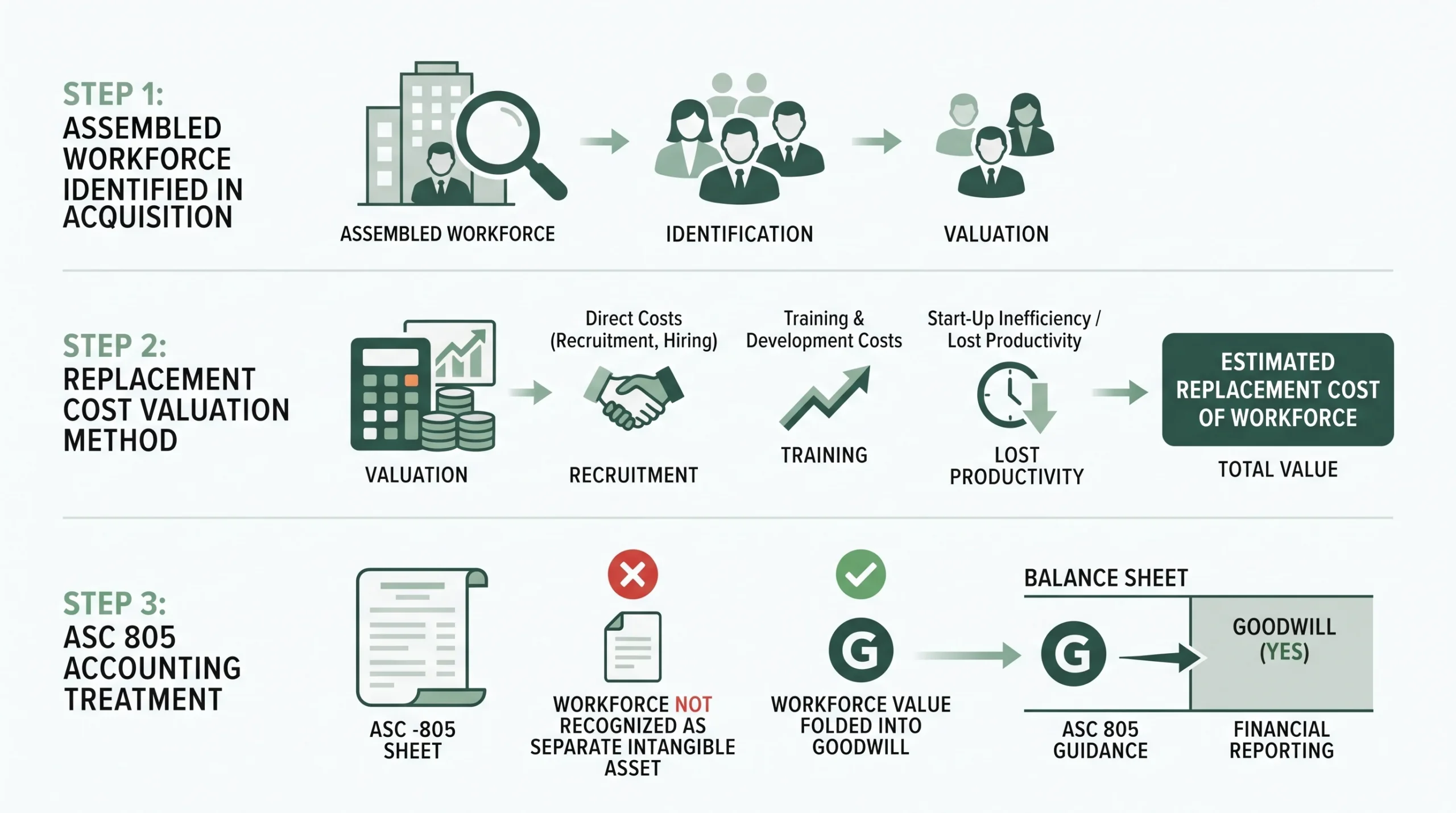
ASC 805 only recognizes an intangible asset apart from goodwill when it meets one of two tests. The first is the contractual-legal criterion. The asset comes from a contract or a legal right, like a patent or a lease. The second is the separability criterion. The asset can be sold, licensed, or transferred on its own, even if it is bundled with something else. An assembled workforce fails both. No contract gives a buyer ownership of the staff, because employees are not property and can leave at will. And the group cannot be sold apart from the business. You cannot carve out the team and hand it to another company. Because it meets neither test, FASB keeps it out of the identifiable intangibles and rolls its value into goodwill. The rule is set out in the Accounting Standards Codification, Topic 805, which FASB maintains as the authority for business combinations. The logic is plain. If you cannot move an item on its own, it is not separable, and it belongs with the going concern it supports.
How Is an Assembled Workforce Valued?
An assembled workforce is valued with the replacement cost method, also known as cost-to-recreate. The appraiser asks a simple question. What would it cost to build this same team from scratch today? The answer has several parts. There are recruiting costs, such as advertising and headhunter fees. There is the time managers spend interviewing and hiring. There is formal training to bring new people up to the current level. And there is lost productivity during the ramp-up, when a new hire is paid but not yet fully useful. Add those parts and you have the replacement cost of the staff. That total is the value of the assembled workforce. The number rarely stands by itself, though. More often it works as a contributory asset. When an appraiser values customer relationships with the multi-period excess earnings method, or MPEEM, the model has to pay a rent for every asset that helps produce those earnings. The workforce is one of those assets, so it carries a contributory asset charge. Sofer Advisors handles this work inside its financial reporting valuation practice, so the workforce figure and the goodwill it supports both hold up.
How Does Section 197 Treat It Differently for Tax?
Tax law flips the accounting answer on its head. For financial reporting, the workforce vanishes into goodwill. For federal income tax, it is a named, deductible item. The Internal Revenue Code lists an assembled workforce as a Section 197 intangible. When a buyer acquires a business in an applicable asset acquisition, it amortizes the cost of that workforce over 15 years, the same period that covers goodwill for tax. So the staff that gets no book line does get a tax deduction. The split surprises owners who expect one set of rules. The deal itself is reported on Form 8594, the asset acquisition statement both sides file. The price is spread across asset classes under Section 1060, which sets the method the IRS expects. The practical point is that one valuation feeds two schedules that look nothing alike. A good appraiser explains why, so the owner is not left thinking one of them is wrong.
Who Values an Assembled Workforce, and How Do the Options Compare?
Buyers pick a valuation partner based on deal size, audit exposure, and budget. Large national firms such as Alvarez & Marsal, Stout, and Kroll serve big public companies with broad advisory teams. Sofer Advisors focuses on defensible, partner-led valuations for closely held and middle-market businesses, with expert witness testimony in 11+ cases behind its reports and 180+ five-star Google reviews. The table below sets out the common options.
| Provider | Typical role | Best for |
|---|---|---|
| Specialized valuation firm (e.g. Sofer Advisors) | Prices the workforce and the other intangibles, then documents the goodwill they support | Closely held and middle-market deals needing audit-ready support |
| Large national firm | Broad advisory plus valuation at enterprise scale | Large public companies with complex, multi-entity deals |
| Deal attorney or CPA | Structures the transaction and files the returns; does not value | Buyers needing the legal and tax work built around the numbers |
Sofer Advisors runs each engagement through a four-phase process it calls The Sofer Difference, moving from Discovery to Diligence to Analysis to Delivery. That structure keeps every input tied to the records behind it. It reflects the Heart of a Teacher approach, which means explaining the reasoning behind a number rather than just handing over a figure. For an allocation that stands up to review, an independent valuation supplies both the workforce figure and the trail of evidence behind it.
Frequently Asked Questions
What is an assembled workforce in a valuation?
An assembled workforce is the trained, in-place staff a buyer gets when it acquires a business. It covers the hiring, onboarding, and training already paid for, so the new owner skips that cost. Under accounting rules the group has real economic value, yet it is not booked as its own asset. Sofer Advisors measures that value during a purchase price allocation so the goodwill figure is supported.
Why is an assembled workforce not a separate intangible asset?
An assembled workforce fails the separability test in ASC 805. A buyer cannot sell, license, or transfer the staff apart from the business, and no contract or legal right attaches to the group. Because it meets neither the contractual-legal nor the separability criterion, the value folds into goodwill instead of standing alone. Sofer Advisors documents that reasoning so the treatment holds up in an audit of the financial statements.
How is an assembled workforce valued?
An assembled workforce is valued with the replacement cost method, also called cost-to-recreate. The appraiser adds up what it would take to hire and train an equal team today. That includes recruiting fees, interview time, formal training, and lost productivity during ramp-up. The total is the value of the in-place staff. Sofer Advisors builds this model from payroll and hiring records so each input traces back to a real source.
Is an assembled workforce a Section 197 intangible for tax?
Yes. For federal tax, an assembled workforce is a Section 197 intangible, so its cost is amortized over 15 years once a business is bought in an applicable asset acquisition. This differs from financial reporting, where the same workforce disappears into goodwill. The two systems treat it in opposite ways. Sofer Advisors reconciles the book and tax views so owners understand why the schedules do not match.
What is the difference between an assembled workforce and goodwill?
Goodwill is the residual left after a buyer assigns value to every identifiable asset. An assembled workforce is one piece of that residual, not a separate line. The workforce captures the value of trained staff, while goodwill also holds expected growth and buyer-specific benefits. The workforce sits inside goodwill rather than beside it. Sofer Advisors quantifies the workforce so the goodwill number is explained rather than left as a plug.
Can the relief from royalty method value an assembled workforce?
No. The relief from royalty method values assets a company could license, such as a patent or a trade name. A business cannot license its own staff to itself, so there is no royalty to measure. The right tool is replacement cost. Sofer Advisors applies the correct approach to each intangible, using relief from royalty for brands and cost-to-recreate for the workforce, so the allocation reads clearly.
What is the difference between an assembled workforce and personal goodwill?
An assembled workforce is the collective value of a trained group of employees. Personal goodwill is tied to one owner or key person and their reputation, skills, and relationships. The workforce stays with the entity after a sale, while personal goodwill can walk out the door unless a non-compete locks it in. Sofer Advisors separates the two so the valuation assigns each dollar to the right place.
How much does an assembled workforce valuation cost?
Most assembled workforce valuations run from $7,500 to $25,000 and take about two to six weeks, depending on staff size and the scope of the deal. The fee covers the replacement cost model and the support an auditor expects. A flat price is quoted up front, so the cost is clear before work starts. Sofer Advisors scopes the engagement first, then quotes a fixed fee. Request a free estimate for your situation.
What data is needed for an assembled workforce valuation?
An assembled workforce valuation needs payroll records, recent recruiting and training costs, and a short description of each role. Those inputs drive the cost-to-recreate model, from advertising and headhunter fees to onboarding time and lost output. The better the records, the more defensible the result. Sofer Advisors gathers this during its discovery phase so the figure reflects the actual staff of the acquired business, not a generic estimate.
Related Case Studies
- Purchase Price Allocation ASC 805 and IFRS 3: Complete Guide for Business Leaders
- The Multi-Period Excess Earnings Method (MPEEM) Explained
- Goodwill vs Intangible Assets: Key Differences Explained
Executive Summary
An assembled workforce is the trained, in-place staff a buyer inherits in a deal. It has real value, because the buyer skips the cost of building a team. But ASC 805 does not list it as a separate intangible. The staff fails both the contractual-legal and the separability tests, so FASB folds its value into goodwill. Appraisers still price it with the replacement cost, or cost-to-recreate, method, and the figure often works as a contributory asset charge inside an MPEEM model. Tax law goes the other way. There the workforce is a Section 197 intangible, amortized over 15 years. One valuation feeds two schedules that look nothing alike, which is why a clear explanation matters as much as the number. The first step is a replacement cost model built from real payroll and hiring records.
What Should You Do Next?
Gather your payroll data, recent hiring and training costs, and a role list for the acquired staff, since a clean file supports a defensible figure. Confirm whether the deal is an asset acquisition, because that is what triggers the Section 197 treatment on the tax side. This guide was prepared by David Hern CPA ABV ASA, founder of Sofer Advisors, an Inc. 5000 firm specializing in neutral third-party valuations for financial reporting. Schedule a free consultation to discuss your specific situation.
People Also Read
- Intangible Asset Valuation: Methods for Measuring Hidden Value
- Is Goodwill Tax Deductible: Section 197 Guide
About the Author
This guide was prepared by David Hern CPA ABV ASA, founder of Sofer Advisors, a business valuation firm headquartered in Atlanta, GA serving clients across the United States. David holds dual accreditations as an Accredited Senior Appraiser (ASA) and is Accredited in Business Valuation (ABV), credentials recognized by the IRS, SEC, and FINRA. He also holds the Certified Exit Planning Advisor (CEPA) designation. With 15+ years of valuation experience, David has served as an expert witness in 11+ cases across multiple jurisdictions and built Sofer Advisors into an Inc. 5,000-recognized firm with 180+ five-star Google reviews. Its full W2 employee team maintains subscriptions to all major valuation databases and operates under a next business day response policy.
For professional business valuation services, visit soferadvisors.com/about-us/ or contact Sofer Advisors at soferadvisors.com/contact-us/.
This content is for informational purposes only and does not constitute professional valuation advice. Business valuation conclusions depend on specific facts and circumstances. Contact Sofer Advisors for guidance regarding your specific situation.