Last Updated: October 2026
Goodwill impairment disclosure is the set of facts a company must report in its financial statement notes after it records a goodwill impairment loss. The rules sit in ASC 350-20-50. They cover the amount of the loss, why it happened, the reporting unit affected, and how the fair value was measured. The disclosure explains the write-down. It does not perform the test behind it.
The team at Sofer Advisors prepares the fair value work that these disclosures rest on, backed by Inc. 5000 recognition in both 2024 and 2025. A write-down lowers reported earnings. Without a clear note, a reader sees the smaller number but not the reason for it.
This guide walks through what must be disclosed in the period of a loss, the Level 3 fair value disclosures, the goodwill rollforward, and the lighter path for private companies. It keeps the disclosure separate from the impairment test itself.
Key Takeaways
- Disclosure is not the test: ASC 350-20-50 governs what you report after a loss, while the impairment test measures whether a loss exists and how large it is.
- Four core items: in the period of the loss you disclose the amount, the facts and circumstances, the method and significant assumptions, and the income statement caption.
- Fair value is Level 3: a reporting unit’s fair value rests on internal forecasts and a company-specific discount rate, so ASC 820 adds disclosures for the technique and the key inputs.
- Rollforward by segment: ASC 350-20-50-1 asks for a goodwill rollforward in total and for each reportable segment, with gross goodwill and accumulated impairment shown apart.
- Private companies disclose less: entities on the Private Company Council alternative amortize goodwill and report a shorter set of items under ASC 350-20-50-6.
Each item answers a different question for a reader. The sections below take them one at a time.
Why Do Goodwill Impairment Disclosures Matter?
Goodwill impairment disclosures matter because they tell investors why an asset lost value and how large the loss was. A write-down signals that an acquired business is worth less than its carrying amount. Without the note, a reader sees a lower net income but not the cause. The disclosures under ASC 350-20-50 fill that gap, so the market can judge earnings quality and forecast future cash flow with more confidence.
The disclosure is separate from the accounting entry. The entry reduces goodwill on the balance sheet and books a loss on the income statement. The notes explain the facts behind that number. They name the reporting unit, the trigger, and the method used to measure fair value. Public companies carry the heaviest load. Auditors read these notes closely, and the Securities and Exchange Commission has pressed filers to expand thin disclosures. A clear note answers the examiner before the question is asked.
What Must You Disclose When Goodwill Is Impaired?
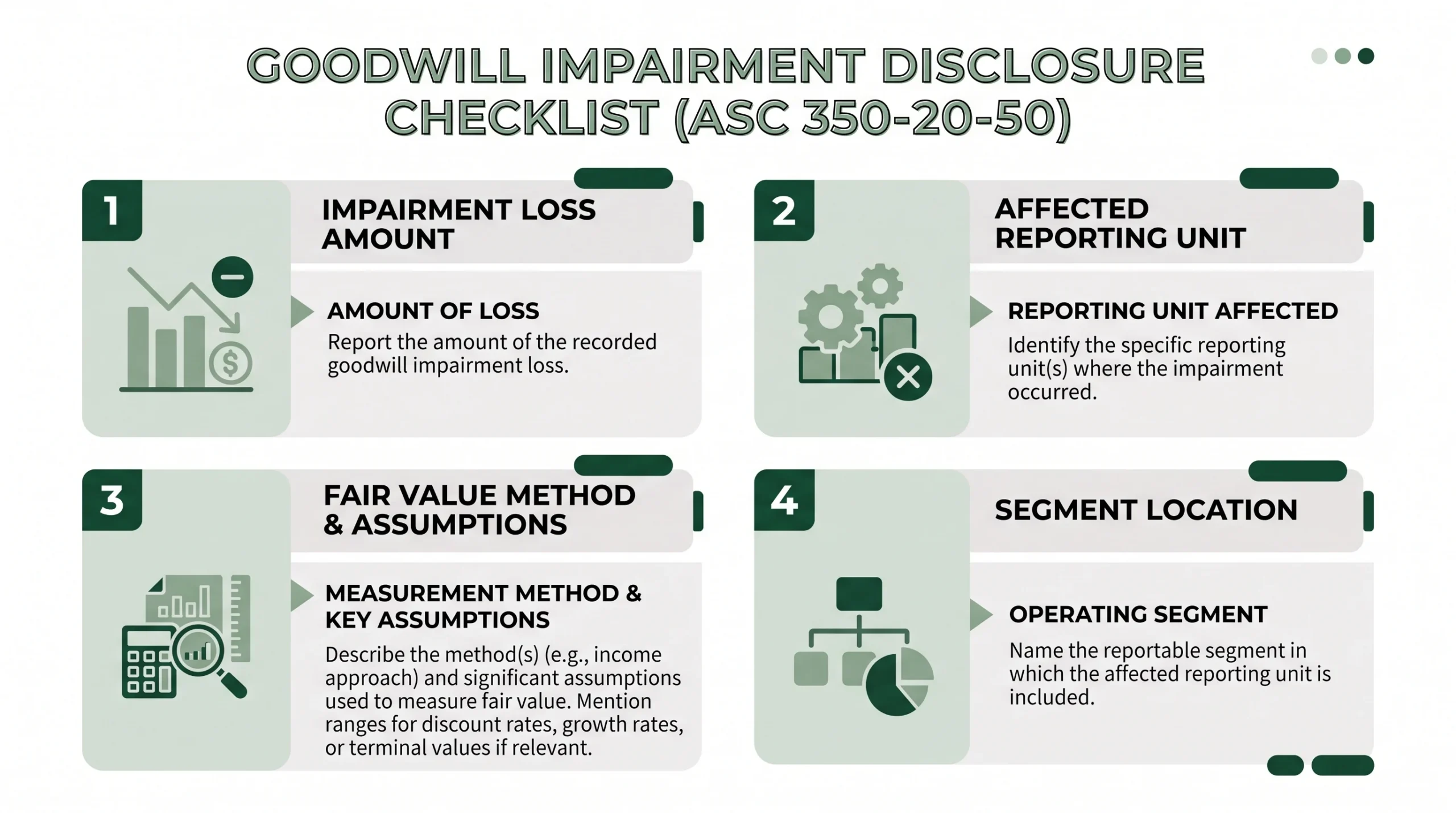
In the period a goodwill impairment loss is recognized, ASC 350-20-50-2 requires four things in the notes. Disclose the amount of the loss. Describe the facts and circumstances that led to it, meaning the triggering event. Explain the method and the significant assumptions used to measure the reporting unit’s fair value. State the income statement caption where the loss sits. The affected reporting unit and its reportable segment are named as well.
Each element answers a different question. The amount sizes the hit. The facts and circumstances give the cause, such as a lost customer or a sustained drop in share price. The method tells the reader whether the fair value came from an income approach, a market approach, or both. The assumptions, like the discount rate and the growth rate, show how sensitive the number is. ASC 350-20-50-1 then ties the goodwill back to each reportable segment, so users can see which part of the business took the charge.
What Level 3 Fair Value Disclosures Apply?
When a reporting unit’s fair value is measured for an impairment, that measurement is a nonrecurring fair value under ASC 820. Because the inputs are internal forecasts and a company-specific discount rate, the measurement sits in Level 3 of the fair value hierarchy. ASC 820 then asks for its own disclosures. Report the fair value recorded, the valuation technique used, and the significant unobservable inputs behind it.
Level 3 means the inputs are not observable in an active market. For a reporting unit, that usually describes projected cash flows, the long-term growth rate, and the weighted average cost of capital. The note should name the technique, often a discounted cash flow model, and disclose the key inputs. Some entities add a range or a weighted average for each input. You can read how the ASC 820 fair value hierarchy sorts these inputs. This is where a documented valuation earns its keep.
How Does the Goodwill Rollforward Work?
ASC 350-20-50-1 requires a rollforward of the goodwill carrying amount for each period a balance sheet is presented. The rollforward starts with gross goodwill and accumulated impairment at the beginning of the period. It then adds goodwill from new acquisitions, subtracts impairment losses and disposals, and ends with the closing balance. Companies that report segments show this in total and for each reportable segment.
The rollforward gives a reader the full movement in one table, not just the ending number. Gross goodwill and accumulated impairment are shown apart, so a large past write-down stays visible. The segment detail matters most. It links each dollar of goodwill to the part of the business that carries it, which is also the level where impairment is tested. Setting those units correctly is its own task, covered in reporting unit determination under ASC 350. A unit with a zero or negative carrying amount gets its own note.
How Do Disclosure and the Test Differ for Private Companies?
The test and the disclosure are two different jobs. The test measures whether goodwill is impaired and by how much, comparing a reporting unit’s carrying amount to its fair value. The disclosure reports that result and the reasoning in the notes. A company can run the test and record no loss, yet still track the factors it reviewed. Private companies get a lighter path on both the test and the disclosure.
Since ASU 2017-04, the test is one step. The loss equals the carrying amount over fair value, capped at the goodwill balance, as the step-by-step ASC 350 test lays out. Private companies that elect the Private Company Council alternative amortize goodwill over ten years or less and test only when a triggering event occurs. Their disclosures under ASC 350-20-50-6 are shorter. They describe the facts and circumstances, the loss amount, and the method used to measure fair value, but skip the segment rollforward.
Who Values a Reporting Unit, and How Do the Options Compare?
Most companies hire an outside specialist to measure a reporting unit’s fair value for an impairment. The choice turns on the size of the business, the audit exposure, and the budget. A specialized valuation firm prices the reporting unit and documents every assumption for the auditor. Large national firms handle enterprise-scale engagements. A company’s own audit firm cannot value the same figure it audits, because independence rules block that overlap.
Large national firms such as Alvarez & Marsal, Stout, and Kroll serve big public companies with broad advisory teams. Sofer Advisors focuses on defensible, partner-led valuations for closely held and middle-market businesses, backed by expert witness testimony in 11+ cases and 180+ five-star Google reviews. The table below sets out the common options.
| Provider | Typical role | Best for |
|---|---|---|
| Specialized valuation firm (e.g. Sofer Advisors) | Measures the reporting unit’s fair value and documents the assumptions for the disclosure | Closely held and middle-market firms needing audit-ready support |
| Large national firm | Broad advisory plus valuation at enterprise scale | Large public companies with many reporting units |
| Internal finance team | Prepares forecasts and the draft rollforward | Early review, later checked by an independent specialist |
Sofer Advisors runs each engagement through a four-phase process it calls The Sofer Difference, moving from Discovery to Diligence to Analysis to Delivery. That structure keeps every fair value conclusion tied to the forecast and the inputs behind it. It reflects the Heart of a Teacher approach, which means explaining the reasoning behind a number rather than handing over a figure. You can review the full scope of Sofer Advisors business valuation services for financial reporting.
Frequently Asked Questions
What must be disclosed when goodwill is impaired?
In the period of the loss, ASC 350-20-50-2 requires the amount of the impairment, a description of the facts and circumstances that triggered it, the method and significant assumptions used to measure fair value, and the income statement caption where the loss appears. The affected reporting unit and its segment are identified as well. Sofer Advisors prepares the fair value analysis and the documentation that each of these disclosures relies on.
Where in the financial statements do these disclosures appear?
The impairment loss appears on its own line within continuing operations on the income statement, under ASC 350-20-45-2. The narrative disclosures, the method, the assumptions, and the goodwill rollforward live in the notes to the financial statements. They stay in the notes until the loss is no longer presented. Sofer Advisors supplies the valuation report that supports both the income statement figure and the note disclosures that auditors review.
What assumptions must be disclosed for the fair value measurement?
The notes must describe the method used, such as a discounted cash flow model, and the significant inputs behind it. For a reporting unit, those inputs usually include projected cash flows, the long-term growth rate, and the discount rate, or weighted average cost of capital. These are Level 3 inputs under ASC 820. Sofer Advisors documents each assumption and its source, so the disclosure survives the auditor’s first round of questions.
At what level are goodwill impairment disclosures made?
Goodwill is tested and disclosed at the reporting unit level, which is an operating segment or one level below it. ASC 350-20-50-1 also requires the goodwill rollforward in total and for each reportable segment. So a reader can trace a charge from the whole company down to the segment that carried the goodwill. Sofer Advisors reviews your segment structure to confirm the reporting units before any fair value work begins.
Can you show a goodwill impairment disclosure example?
Suppose a company buys a software unit and later loses a major client. Its carrying amount is 10 million dollars and its fair value falls to 7 million. The note would state the 3 million dollar loss, name the unit and its segment, explain the lost client as the trigger, and describe the discounted cash flow method used. Sofer Advisors builds that supporting analysis so the figures in the note tie to the valuation file.
How is disclosure different from the impairment test?
The test is the measurement. It compares a reporting unit’s carrying amount to its fair value and sets the loss, which since ASU 2017-04 is a single step. The disclosure is the reporting of that result and its reasoning in the notes. A company can test and find no impairment, so it records no loss and makes no impairment disclosure. Sofer Advisors handles the measurement and the documentation that the disclosure then draws from.
What lighter disclosures apply to private companies?
A private company that elects the Private Company Council alternative amortizes goodwill over ten years or less and tests only when a triggering event occurs. When a loss is recognized, ASC 350-20-50-6 still asks for the facts and circumstances, the loss amount, and the method of measuring fair value. It drops the segment-level rollforward. Sofer Advisors advises private companies on which disclosures the alternative requires and prepares the valuation behind them.
Do Level 3 fair value disclosures apply to a goodwill impairment?
Yes. The fair value of a reporting unit is a nonrecurring measurement built on internal forecasts and a company-specific discount rate, so it falls in Level 3 of the ASC 820 hierarchy. The notes should describe the valuation technique and the significant unobservable inputs. Those inputs carry the most audit risk. Sofer Advisors prepares the Level 3 analysis and lays out each input, so the disclosure reads as supported rather than asserted.
How much does a valuation to support goodwill impairment disclosure cost?
A valuation that supports goodwill impairment disclosure usually runs from $7,500 to $25,000 and takes about two to six weeks, depending on the number of reporting units and the deadline. The fee covers the fair value measurement, the assumptions, and the documentation your auditor needs. A fixed price is quoted up front. Sofer Advisors scopes the work first, then sets the fee. Request a free estimate for your reporting units.
Related Case Studies
- Goodwill Impairment Testing ASC 350: Complete Guide for 2025-2026
- ASC 350 Goodwill: Identifying a Triggering Event
- Qualitative Step 0 Goodwill Impairment Assessment
Executive Summary
Goodwill impairment disclosure is how a company explains a write-down, not how it calculates one. In the period of the loss, ASC 350-20-50-2 calls for the amount, the facts and circumstances behind it, the method and significant assumptions used to measure fair value, and the income statement caption. Because a reporting unit’s fair value is a Level 3 measurement, ASC 820 adds disclosures for the technique and the key inputs. ASC 350-20-50-1 requires a goodwill rollforward by segment. Private companies on the Private Company Council alternative disclose less under ASC 350-20-50-6. A documented fair value is what holds each disclosure together.
What Should You Do Next?
Start by confirming your reporting units and pulling the current carrying amount of goodwill for each one. Check for triggering events, such as a lost contract or a sustained decline in your market, that would force a test and its disclosures. Then gather the forecasts and the discount rate a fair value measurement will need. This guide was prepared by David Hern CPA ABV ASA, founder of Sofer Advisors, an Inc. 5000 firm focused on neutral third-party valuations for financial reporting. Request a business valuation and schedule a free consultation to review your reporting units.
People Also Read
- Impairment Testing: Sofer Advisors Complete Guide
- Goodwill Impairment Journal Entry: Debit and Credit
About the Author
This guide was prepared by David Hern CPA ABV ASA, founder of Sofer Advisors, a business valuation firm headquartered in Atlanta, GA serving clients across the United States. David holds dual accreditations as an Accredited Senior Appraiser (ASA) and is Accredited in Business Valuation (ABV), credentials recognized by the IRS, SEC, and FINRA. He also holds the Certified Exit Planning Advisor (CEPA) designation. With 15+ years of valuation experience, David has served as an expert witness in 11+ cases across multiple jurisdictions and built Sofer Advisors into an Inc. 5,000-recognized firm with 180+ five-star Google reviews. Its full W2 employee team maintains subscriptions to all major valuation databases and operates under a next business day response policy.
For professional business valuation services, visit soferadvisors.com/about-us/ or contact Sofer Advisors at soferadvisors.com/contact-us/.
This content is for informational purposes only and does not constitute professional valuation advice. Business valuation conclusions depend on specific facts and circumstances. Contact Sofer Advisors for guidance regarding your specific situation.