Last Updated: October 2026
A Charitable Remainder Unitrust pays its income beneficiary a set percentage of the trust’s assets, and those assets are revalued every year. That single fact shapes the whole engagement. A CRUT valuation is not a one-off number you set at funding and then forget. The appraisal at contribution fixes the starting value and the charitable deduction. The annual revaluation then resets the payout for the life of the trust.
Sofer Advisors values closely held business interests contributed to these trusts for owners, CPAs, and estate attorneys, backed by expert witness testimony in 11+ cases and 180+ five-star Google reviews. When a private company interest funds a CRUT, its value is not obvious. The IRS expects a qualified appraisal to prove it, and the first Sofer Advisors report has to hold up for years.
This guide explains what a CRUT does, how a contributed business interest is appraised, and why the trust is revalued each year. It also covers the IRS rules, the required forms, and the tax traps that decide whether the deduction survives a review.
Key Takeaways
- Two valuations, not one: a contribution appraisal sets the deduction, and an annual revaluation resets the unitrust payout every year.
- The 10% remainder rule: the present value of the charity’s remainder must be at least 10% of the funding fair market value, or the trust fails.
- Discounts apply: a closely held interest is valued with a discount for lack of control and a discount for lack of marketability.
- Forms follow the gift: the contribution appraisal supports Form 8283, and the trust reports each year on Form 5227.
- A thin appraisal is risky: a value the IRS rejects can cost the full deduction and trigger misstatement penalties.
Each piece ties back to one appraised number. The sections below take them one at a time.
Why Is a CRUT Valuation Important to Understand?
A CRUT valuation decides whether the charitable deduction stands and whether the trust itself qualifies. The owner contributes an appreciated business interest, skips the capital gains hit on a direct sale, and keeps an income stream for life or a term of years. All of that rests on the appraised fair market value at funding. Price it well and the deduction holds. Price it short or high and the IRS can deny the deduction, add penalties, and question the trust. Because the payout is recalculated yearly, the valuation keeps mattering long after the gift is made.
What Does a CRUT Do for a Business Owner?
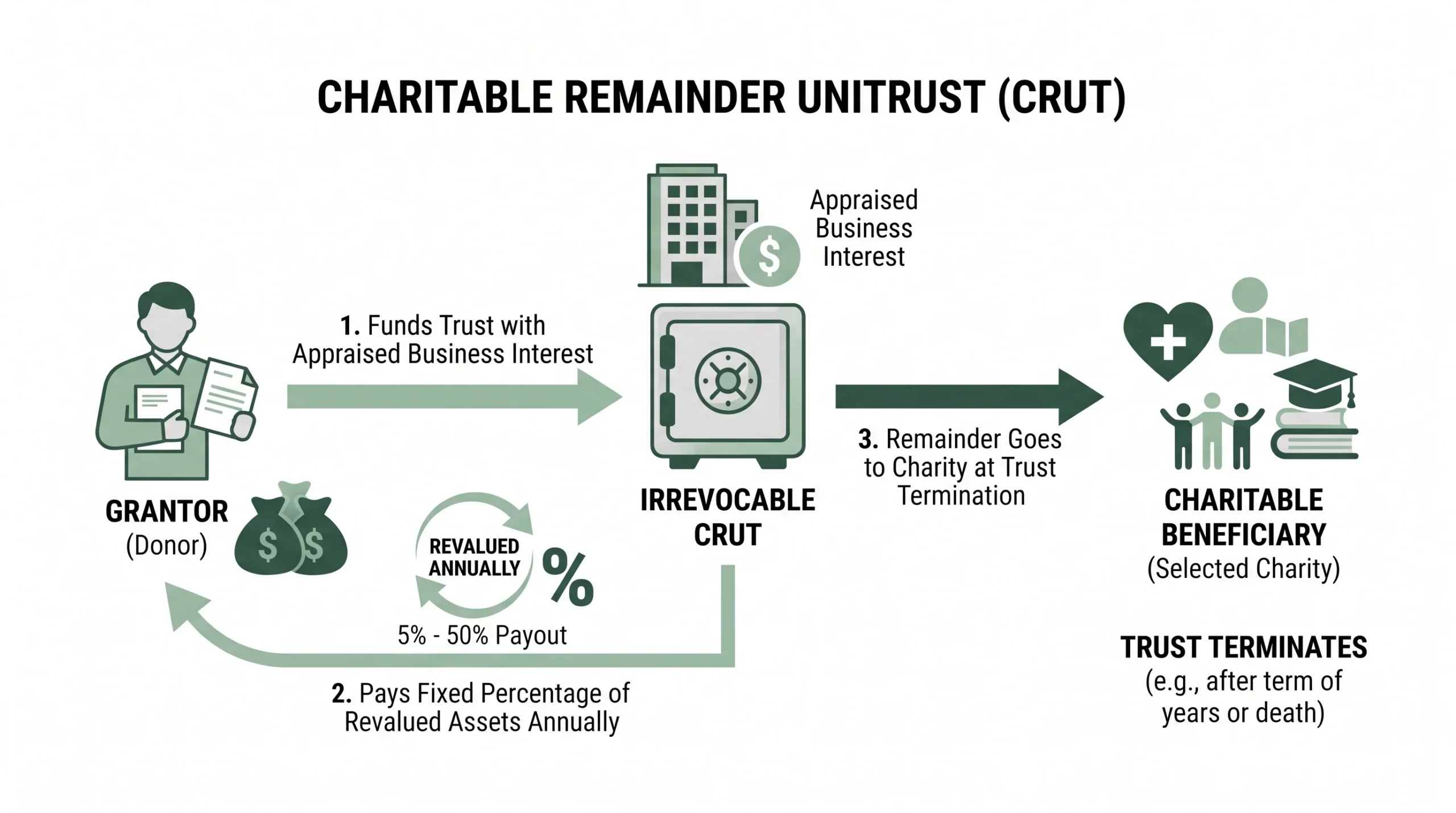
A CRUT is an irrevocable trust that turns one appreciated asset into lifetime income and a future charitable gift. The owner moves private company stock into the trust. The trust sells it, pays no capital gains tax on the sale, and reinvests the full proceeds. The owner then receives a yearly payout set as a fixed percentage of the trust’s value.
The gift is split in two. The income beneficiary keeps the payout stream. The charity receives whatever is left at the end of the term. The donor claims a deduction today for the present value of that remainder. Owners most often use this structure during a liquidity event, such as a company sale or a stock redemption, when a large gain would otherwise be taxed all at once.
How Is a Contributed Business Interest Valued?
An appraiser values the interest using the income approach, the market approach, and the asset approach, then weighs them based on the facts of the business. The goal is fair market value: the price a willing buyer and a willing seller would agree on, with neither forced to act. This is the same standard set out in IRC Section 170 for charitable contributions.
A closely held interest is harder to value than public stock. The appraiser applies a discount for lack of control when the stake is a minority position. A discount for lack of marketability follows, because a private interest cannot be sold quickly. These discounts lower the value, and the IRS checks them closely. For any noncash gift over $5,000, the donor needs a qualified appraisal to support Form 8283. A weak appraisal is the first thing an examiner attacks.
What Are the IRS Rules for a CRUT?
A CRUT lives under IRC Section 664, which sets the tests the trust must pass to stay tax exempt. The first is the 10% rule. The present value of the charity’s remainder must be at least 10% of the funding fair market value. If the math falls short, the trust does not qualify at all.
The payout rules come next. The yearly distribution must be at least 5% and no more than 50% of the trust’s value. The 5% floor gives the income beneficiary a real stream. The 50% cap stops the trust from being drained before the charity sees anything. Because each percentage runs off the asset value, a sound appraisal at funding and a sound revaluation each year are both required. The trust reports its income, payouts, and assets every year on Form 5227.
Why Are CRUT Assets Revalued Every Year?
A unitrust pays a fixed percentage of a changing value, so the value has to be measured again each year. If the trust holds publicly traded stock, the revaluation is simple. If it still holds a closely held business interest, it is not. A private interest has no daily price, so the trustee needs a fresh appraisal to set the payout.
This is where many plans stumble. The contribution appraisal is only the start. Every year the interest stays in the trust, its value can move with earnings, the market, and the size of the remaining stake. A payout built on a stale or guessed number invites an IRS challenge and can shortchange either the beneficiary or the charity. A yearly appraisal keeps the distribution correct and the trust defensible.
How Does a CRUT Compare to Other Giving Options?
A CRUT is not the only way to give an appreciated interest, but it is the one that pays the donor back. A donor-advised fund gives a clean, immediate deduction, yet it returns no income and the donor only recommends grants. A private foundation offers the most control over giving, but it carries heavy filings, excise tax, and yearly payout rules. A CRAT is the CRUT’s cousin: it pays a fixed dollar amount instead of a percentage, so its assets are not revalued each year.
The table below sets out the common choices.
| Vehicle | Income to donor | Best for |
|---|---|---|
| Charitable Remainder Unitrust | Yes, a percentage revalued yearly | Owners wanting income plus a future gift |
| Donor-advised fund | No | Simple, low-cost giving with a current deduction |
| Private foundation | No | Families wanting lasting control over grants |
Who Values a CRUT Interest, and How Do the Options Compare?
Owners pick a valuation partner based on the size of the interest, the audit exposure, and the budget. Large national firms such as Alvarez & Marsal, Stout, and Kroll serve big public companies with broad advisory teams. Sofer Advisors focuses on defensible, partner-led appraisals for closely held and middle-market businesses, with expert witness testimony in 11+ cases and recognition as an Inc. 5000 firm behind its reports. You can see how Sofer Advisors approaches tax and estate reporting valuations for these contributions.
Sofer Advisors runs each engagement through a four-phase process it calls The Sofer Difference, moving from Discovery to Diligence to Analysis to Delivery. That structure ties the contribution value, and each yearly revaluation, back to the facts behind it. It reflects the Heart of a Teacher approach, which means explaining the reasoning behind a number rather than just handing over a figure. For a trust that stands up to review, an independent valuation supplies both the value and the record behind it.
Frequently Asked Questions
What is the 10% rule for charitable remainder trusts?
The 10% rule says the present value of the charitable remainder must be at least 10% of the asset’s fair market value at funding. It proves the trust is a real charitable gift and not a disguised investment account. The figure is calculated under IRS actuarial rules and the Section 7520 rate. Sofer Advisors tests this threshold before a contribution is finalized, so the appraised value supports a trust that actually qualifies with the IRS.
What is the fair market value for charitable donations?
Fair market value is the price at which property would change hands between a willing buyer and a willing seller, with neither forced to act and both reasonably informed. For a business interest, that calls for an objective study of earnings, assets, and comparable sales. Sofer Advisors prepares independent, defensible valuations that meet this standard, so the deduction a donor reports on a federal tax return rests on a documented number rather than a guess.
Is a CRUT a good idea?
A CRUT fits an owner who holds a highly appreciated asset, wants to defer the capital gains tax a direct sale would trigger, and plans to support a charity. It also returns a lifetime or term income stream, which a simple donation does not. It is less useful for small gifts or owners who need full control. Sofer Advisors helps owners weigh it by showing how different asset values change both the payout and the deduction.
How are CRUT distributions calculated?
A CRUT distribution is a fixed percentage of the net fair market value of the trust’s assets, measured again at the start of each year. That percentage must fall between 5% and 50%, so the payout rises and falls with the trust’s value. A closely held interest needs a fresh appraisal to set the figure. Sofer Advisors supplies accurate yearly valuations so each distribution stays inside the payout bounds the tax code requires.
Why are CRUT assets revalued every year?
Because a unitrust pays a percentage of a moving value, the trustee must remeasure the assets at the start of each year to set that year’s payout. Public stock is easy to price, but a private business interest has no market quote, so it needs a new appraisal. Sofer Advisors prepares these yearly valuations so the distribution tracks the real value and the trust stays defensible if the IRS ever looks at it.
What is the difference between a CRUT and a CRAT?
A CRUT pays a percentage of the trust’s value, recalculated every year, so the income rises and falls with the assets. A CRAT pays a fixed dollar amount set at funding, regardless of how the investments perform, so its assets are not revalued each year. One shares market risk and reward; the other locks the number. Sofer Advisors helps clients see how the volatility of a business interest affects which of these two structures fits.
Which IRS forms report a CRUT contribution?
The donor reports a noncash gift over $5,000 on Form 8283, with the qualified appraisal attached to support the claimed value. The trust itself files Form 5227 each year to report its income, distributions, and asset values. Both filings have to agree with the valuation behind the gift. Sofer Advisors prepares appraisal reports that support the figures these forms carry, so the paperwork and the valuation tell one consistent story.
Who needs a qualified appraisal for a CRUT?
Any donor who contributes a noncash asset worth more than $5,000, such as a closely held business interest, must obtain a qualified appraisal to claim the deduction. The report has to meet IRS standards and be prepared by a qualified appraiser at the time of the transfer. Sofer Advisors performs these qualified appraisals under recognized valuation standards, giving donors the independent support the IRS requires to back a charitable deduction.
How much does a CRUT valuation cost?
Most CRUT business valuations run from $7,500 to $25,000 and take about two to six weeks, depending on the interest and the deadline. The range covers the work needed to document fair market value, discounts, and the qualified appraisal. A flat fee is quoted up front, so the cost is clear before the work starts. Request a free estimate from Sofer Advisors for your situation.
Related Case Studies
- Valuing a Business Interest Donated to a CRT
- Valuation Discounts (DLOC and DLOM) on Estate and Gift Tax Returns
- Donating Private Company Stock to a Donor-Advised Fund
Executive Summary
A CRUT lets an owner move an appreciated business interest into a trust, skip the capital gains tax on a direct sale, and keep a yearly income stream, with the remainder going to charity. The deduction and the payout both rest on an appraised fair market value. At funding, a qualified appraisal sets the deduction and must pass the 10% remainder rule under Section 664. Because a unitrust pays a percentage of a changing value, the assets are revalued every year, which means a closely held interest needs a fresh appraisal annually. Expect discounts for lack of control and marketability, a Form 8283 at contribution, and a Form 5227 each year. The first step is a defensible value, and the last step is keeping it current.
What Should You Do Next?
Gather the company’s financial statements, the entity documents, and the trust terms, since a clean file supports a defensible value. Confirm whether the interest will stay in the trust, because that decides if you need yearly appraisals as well as the contribution appraisal. This guide was prepared by David Hern CPA ABV ASA, founder of Sofer Advisors, an Inc. 5000 firm specializing in neutral third-party valuations for tax and estate reporting. Schedule a free consultation to discuss your specific situation.
People Also Read
- What Is a GRAT and How Does It Transfer Business Value to Heirs?
- Valuing a Business Interest to Fund a SLAT
About the Author
This guide was prepared by David Hern CPA ABV ASA, founder of Sofer Advisors, a business valuation firm headquartered in Atlanta, GA serving clients across the United States. David holds dual accreditations as an Accredited Senior Appraiser (ASA) and is Accredited in Business Valuation (ABV), credentials recognized by the IRS, SEC, and FINRA. He also holds the Certified Exit Planning Advisor (CEPA) designation. With 15+ years of valuation experience, David has served as an expert witness in 11+ cases across multiple jurisdictions and built Sofer Advisors into an Inc. 5,000-recognized firm with 180+ five-star Google reviews. Its full W2 employee team maintains subscriptions to all major valuation databases and operates under a next business day response policy.
For professional business valuation services, visit soferadvisors.com/about-us/ or contact Sofer Advisors at soferadvisors.com/contact-us/.
This content is for informational purposes only and does not constitute professional valuation advice. Business valuation conclusions depend on specific facts and circumstances. Contact Sofer Advisors for guidance regarding your specific situation.