Last Updated: October 2026
Consumer brand valuation is the work of pricing a consumer or direct-to-consumer business and the brand behind it. The choice between an EBITDA multiple and a revenue multiple usually decides the number. Profitable, established brands are priced on earnings. High-growth brands that still lose money are priced on sales. Pick the wrong one and the value can be off by half.
The analysts at Sofer Advisors value consumer brands for owners, buyers, and their advisors, an approach recognized by Inc. 5000 honors in both 2024 and 2025. A multiple is only shorthand. Behind it sit margins, growth, and how loyal the customers really are.
This guide explains when each multiple applies, what drives a consumer brand’s value, and how the brand name itself is valued as a separate asset. It also shows why a single rule-of-thumb figure is a starting point, not an answer.
Key Takeaways
- Match the multiple to the stage: use an EBITDA multiple for profitable, established brands and a revenue multiple for high-growth brands that are not yet profitable.
- Value drivers set the number: growth rate, gross margin, repeat purchase, customer acquisition cost, and channel mix move the multiple up or down.
- Retention beats raw reach: a brand with high repeat orders and a low acquisition cost earns a higher multiple than one that buys every sale with ads.
- The brand is its own asset: the name and trademarks are intangible assets, often valued on their own with the relief-from-royalty method.
- One multiple is a starting point: a rule-of-thumb figure gives a rough range, not a defensible value for a deal, a tax filing, or a dispute.
Each of these points feeds the final number. The sections below take them one at a time.
Why Does Consumer Brand Valuation Matter?
Consumer brand valuation matters because the brand is often the most valuable thing the company owns. In a sale, a tax filing, or a financing, the price turns on how that value is measured. A clear, documented figure lets a buyer and a seller negotiate from the same facts. A vague one invites a fight, a repricing, or an audit.
For a consumer packaged goods or DTC business, physical assets are usually small. The inventory and the warehouse racks are worth little next to the customer base and the name on the box. That is why the method you choose carries so much weight. A credible valuation also supports a loan request, a buy-sell agreement, or an estate plan. Sofer Advisors has priced these intangibles in work backed by expert witness testimony in 11+ cases.
When Do You Use EBITDA vs Revenue Multiples?
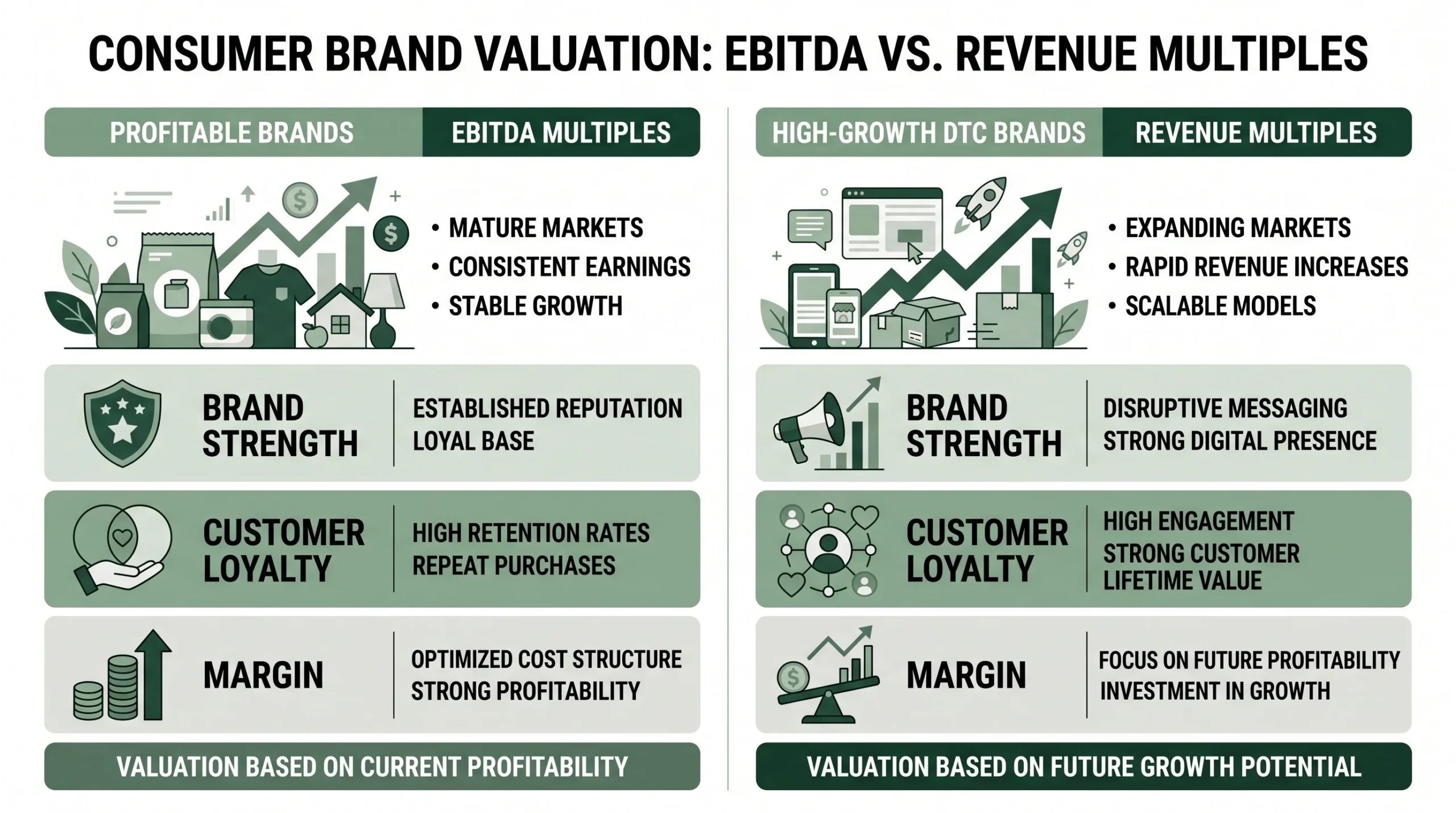
Use an EBITDA multiple when the brand is profitable and its earnings are steady. Use a revenue multiple when the brand is growing fast but still spends more than it earns. EBITDA multiples reward proven cash flow. Revenue multiples reward scale and future potential. The split tracks the brand’s stage, not a preference for one method over the other.
A mature consumer brand with years of stable margins fits the earnings approach. You normalize EBITDA, then apply a market multiple drawn from comparable deals. A young DTC brand doubling its sales each year rarely shows real profit, because it reinvests every dollar into acquiring customers. For that brand, a revenue multiple captures the trajectory the earnings do not yet show. As a very general guide, mainstream DTC brands have recently traded near 3x to 6x EBITDA, with premium or fast-growing brands higher. These are directional figures, not a quote for any one business.
What Drives a Consumer Brand’s Value?
The main value drivers are growth rate, gross margin, repeat purchase, customer acquisition cost, channel mix, and brand strength. Together they tell a buyer how durable the cash flow is. A brand that keeps customers cheaply and sells at a healthy margin earns a higher multiple. One that depends on constant ad spend to replace lost customers earns less, even at the same revenue.
Two numbers do a lot of the work. Customer lifetime value measures the total profit from one customer over time. Customer acquisition cost measures what it takes to win that customer. A wide gap between them signals a strong, defensible brand. Channel mix matters too. A direct-to-consumer site gives higher margins and first-party data, while heavy reliance on one retailer or marketplace adds risk. Customer and channel concentration can cut the price a buyer will pay.
How Is the Brand Itself Valued as an Intangible?
The brand name and its trademarks are intangible assets, separate from the business that uses them. A common way to value them is the relief-from-royalty method. The idea is simple. If the company did not own the name, it would have to license it and pay a royalty. The value of the brand is the royalty it is spared, projected over time and discounted to today.
The analyst starts with a market royalty rate for similar brands, applies it to the revenue the name supports, and discounts the saved payments to a present value. This separate figure matters for purchase price allocation, for licensing, and for tax. Under IRC Section 197, an acquired trademark is amortized over 15 years, so the number assigned to the brand has a real tax effect. You can read more on the relief-from-royalty method for trademarks.
How Reliable Is a Rule-of-Thumb Multiple?
A rule-of-thumb multiple is a rough starting point, not a reliable answer. Industry averages describe a crowd of businesses, not yours. Two brands with the same revenue can be worth very different amounts once you look at margin, retention, and risk. The average hides exactly the differences that set the price. It can start a conversation, but it should never end one.
Multiples also move with the market. In the 2021 boom, some DTC brands drew revenue multiples of 8x to 12x. By 2026 that range had compressed to roughly 3x to 6x for most brands, as buyers shifted their focus from growth to profit. A figure that was fair two years ago can be far off today. For tax work, the standard is fair market value under IRS Revenue Ruling 59-60, which calls for a full look at the facts, not a single ratio.
Who Values Consumer Brands, and How Do the Options Compare?
Owners choose a valuation partner based on the purpose of the report, the stakes, and the budget. Large national firms such as Alvarez & Marsal, Stout, and Kroll serve big public companies with broad advisory teams. Sofer Advisors focuses on defensible, partner-led valuations for closely held and middle-market consumer brands, with 180+ five-star Google reviews behind its reports. The table below sets out the common options.
| Provider | Typical role | Best for |
|---|---|---|
| Specialized valuation firm (e.g. Sofer Advisors) | Builds a defensible value using earnings, revenue, and brand-specific methods | Owners needing tax, estate, M&A, or litigation support that holds up to review |
| Large national firm | Broad advisory plus valuation at enterprise scale | Large public companies with complex, multi-brand portfolios |
| Online business broker | Lists and markets the brand for sale; gives a market-based price indication | Owners ready to sell who want a buyer, not a certified report |
Sofer Advisors runs each engagement through a four-phase process it calls The Sofer Difference, moving from Discovery to Diligence to Analysis to Delivery. That structure keeps every multiple tied to the brand’s own numbers. It reflects the Heart of a Teacher approach, which means explaining the reasoning behind a value rather than just handing over a figure. See how Sofer Advisors structures its business valuation services for consumer and DTC brands.
Frequently Asked Questions
What are the best multiples for valuing a consumer brand?
The best multiple depends on the brand’s stage and profitability. A profitable, established brand is usually priced on an EBITDA multiple, which ties value to proven earnings. A high-growth brand that reinvests its cash is often priced on a revenue multiple, which captures scale instead of current profit. Sofer Advisors reviews your margins, growth, and risk before choosing the multiple that fits your brand rather than a generic average.
When should you use EBITDA multiples instead of revenue multiples?
Use an EBITDA multiple when earnings are steady and the brand turns a real profit, since the number then rests on cash flow a buyer can rely on. Switch to a revenue multiple when the brand grows fast but shows little or no profit because it spends heavily to win customers. Sofer Advisors matches the method to the brand’s stage so the value reflects how the business actually earns.
How are high-growth DTC brands valued when they are not profitable?
High-growth direct-to-consumer brands are often valued on a revenue multiple, because their earnings are held down by heavy spending on customer acquisition. The multiple reflects growth rate, gross margin, and how well the brand keeps customers over time. A brand that retains buyers cheaply earns a higher figure. Sofer Advisors tests whether that growth is durable before applying any revenue multiple, so the value is not built on spending alone.
What EBITDA multiple do consumer brands sell for?
As a general guide, mainstream DTC brands have recently traded near 3x to 6x EBITDA, with premium or fast-growing brands and larger consumer packaged goods companies often higher. These ranges are directional and move with the market, so they are a starting point, not a price. Sofer Advisors builds a multiple from comparable deals and your brand’s own margins and risk, rather than applying a single industry figure to every business.
How does a direct-to-consumer channel affect brand value?
A strong direct-to-consumer channel usually raises value. Selling straight to the customer means higher margins, direct first-party data, and more control over the brand experience. That data makes future sales easier to forecast, which lowers risk for a buyer. Heavy reliance on a single retailer or marketplace does the opposite. Sofer Advisors weighs your channel mix carefully, since the quality of the sales channel can move the multiple as much as the revenue itself.
What is the relief-from-royalty method for a brand?
The relief-from-royalty method values a brand by the license fee the company avoids by owning its name. The analyst sets a market royalty rate, applies it to the revenue the brand supports, and discounts those saved payments to a present value. It isolates the worth of the name from the rest of the business. Sofer Advisors uses this method for purchase price allocation, licensing questions, and tax filings where the brand must be valued on its own.
What is the difference between brand value and brand equity?
Brand value is a dollar figure, the financial worth of the brand as an asset you could sell or license. Brand equity is the qualitative strength behind it, the awareness, trust, and loyalty that let a brand charge more or sell more easily. Equity drives value, but they are not the same number. Sofer Advisors measures brand value by isolating the cash flows tied to the name and the loyalty that protects them.
Why is a single rule-of-thumb multiple not enough?
A single multiple describes an average business, not yours. Two consumer brands with equal revenue can be worth very different amounts once margin, retention, and customer concentration are weighed. Rules of thumb also lag the market, so a figure that fit the 2021 boom can mislead today. Sofer Advisors treats a rule of thumb as a sanity check, then builds a defensible value from your real numbers and the purpose of the report.
How much does a consumer brand valuation cost?
A consumer brand valuation generally runs from $7,500 to $25,000 and takes about four to eight weeks, depending on the brand’s size, the data available, and the purpose of the report. The fee covers the earnings, revenue, and brand-specific work needed for a defensible number. Sofer Advisors scopes each engagement first, then quotes a fixed price. Request a free estimate for your brand to confirm the range.
Related Case Studies
- DTC Ecommerce Valuation: Why Multiples Compressed in 2026
- Revenue Multiple Valuation: When to Use It Instead of EBITDA
- How to Value an Amazon FBA Business: Multiples and Risks
Executive Summary
A consumer brand is priced on an EBITDA multiple when it is profitable and steady, and on a revenue multiple when it is growing fast but not yet profitable. The number moves with growth, gross margin, repeat purchase, customer acquisition cost, and channel mix. The brand name itself is a separate intangible, often valued by the relief-from-royalty method and amortized over 15 years once acquired. A single rule-of-thumb multiple only sets a rough range. Recent DTC multiples compressed from the 2021 boom to roughly 3x to 6x EBITDA, which shows how fast averages age. The first step is a clear read of the brand’s margins, retention, and purpose for the report.
What Should You Do Next?
Pull together your financial statements, your customer retention and acquisition data, and any trademark or licensing records, since clean numbers support a defensible multiple. Decide the purpose first, whether a sale, a tax filing, or a dispute, because it shapes the standard of value. This guide was prepared with David Hern CPA ABV ASA, founder of Sofer Advisors, an Inc. 5000 firm specializing in neutral third-party valuations. Schedule a free consultation through the Sofer Advisors contact page to discuss your brand.
People Also Read
- The Relief-from-Royalty Method for Valuing Trademarks
- EBITDA Multiple for Business Valuation by Industry
About the Author
This guide was prepared by David Hern CPA ABV ASA, founder of Sofer Advisors, a business valuation firm headquartered in Atlanta, GA serving clients across the United States. David holds dual accreditations as an Accredited Senior Appraiser (ASA) and is Accredited in Business Valuation (ABV), credentials recognized by the IRS, SEC, and FINRA. He also holds the Certified Exit Planning Advisor (CEPA) designation. With 15+ years of valuation experience, David has served as an expert witness in 11+ cases across multiple jurisdictions and built Sofer Advisors into an Inc. 5,000-recognized firm with 180+ five-star Google reviews. Its full W2 employee team maintains subscriptions to all major valuation databases and operates under a next business day response policy.
For professional business valuation services, visit soferadvisors.com/about-us/ or contact Sofer Advisors at soferadvisors.com/contact-us/.
This content is for informational purposes only and does not constitute professional valuation advice. Business valuation conclusions depend on specific facts and circumstances. Contact Sofer Advisors for guidance regarding your specific situation.