


Last Updated: August 2026
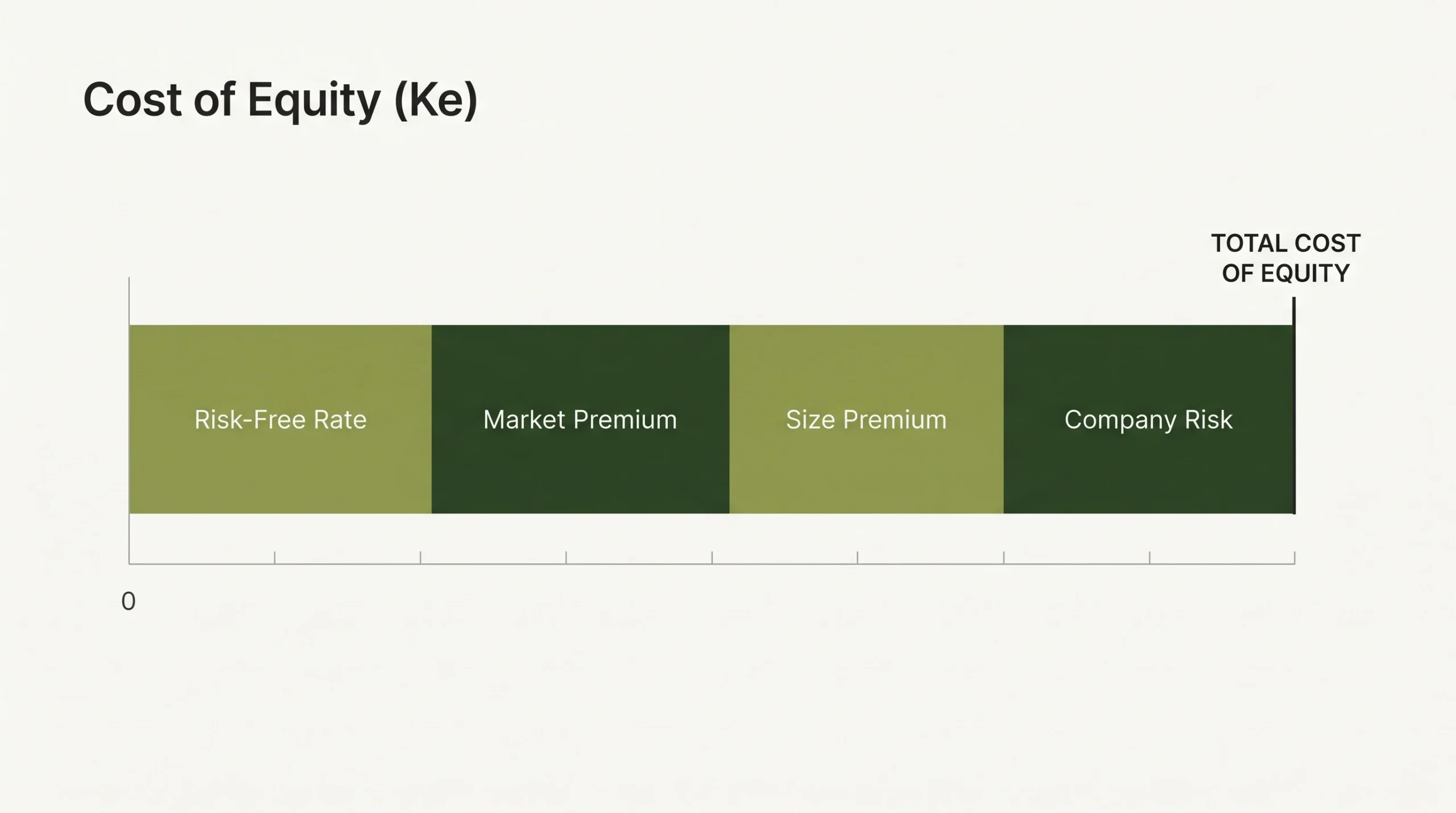
The capital asset pricing model (CAPM) is a formula for a company’s cost of equity. It adds a risk premium to a safe base rate. For a private company, the standard version falls short, because the model was built on public stock data. So evaluators adjust it. Sofer Advisors rebuilds each input from market evidence, then adds premiums for size and firm-specific risk. A small change in the rate can move the final value by six figures.
The adjustments matter because the plain model assumes a diversified investor and a liquid market, neither of which fits a closely held firm. A single owner carries all of one company’s risk and cannot sell in a day. So the rate has to account for size, firm-specific risk, and a hard exit, or it will understate risk and overstate value. Getting each input right is what keeps the result defensible.
Key Takeaways
- What CAPM does: It sets the cost of equity by adding a risk premium to a safe base rate.
- Why private firms differ: A private company has no traded stock, so its beta is not directly observable.
- Borrowed beta: Analysts take beta from public peers, then unlever and relever it to fit the subject firm.
- Extra premiums: A size premium and a company-specific risk premium raise the rate for smaller firms.
- Illiquidity counts: A private owner cannot sell fast, so the value often carries a discount for lack of marketability.
Each change ties the rate to the real business, not a public benchmark. The sections below show how to build beta, size the premiums, and defend the result.
What is the capital asset pricing model?
The capital asset pricing model is a formula for the cost of equity. It starts with a risk-free rate. Then it adds the equity risk premium times beta. The risk-free rate comes from long-term government bonds. Beta measures how much a stock moves with the market. The equity risk premium is the extra return investors want for holding stocks over bonds.
The result feeds larger models too. The cost of equity is one input in the weighted average cost of capital, or WACC. That rate then discounts future cash flow in an income approach. A clean cost of equity keeps the whole model honest.
Why is standard CAPM hard for a private company?
Standard CAPM leans on data that only public stocks produce. The formula needs a beta you can observe. Beta comes from daily price moves against the market. A private company has no traded shares, so there is no price to track. Without that stream, you cannot measure the link between the firm and the broader economy.
There is a second gap. Public shares can be sold in a day, while a private stake stays locked for years. Standard CAPM ignores that limit. It also skips risks tied to a single business, such as one big customer or one key owner. These holes are why the classic model, used alone, gives an incomplete answer. Valuators reach for other data to close them.
How do you find beta from public comparables?
You build a private company’s beta from public peers. First, pick a group of traded firms in the same line of work. Their betas reflect both business risk and debt. Debt levels differ from firm to firm, so you strip that effect out. This gives an unlevered, or asset, beta for each peer. You take the median of the group, then add the subject firm’s own debt back in. The final relevered beta fits the private firm’s capital structure.
The steps below show the flow:
- Select peers: Choose public firms with similar work and size.
- Unlever each beta: Remove the effect of each peer’s debt.
- Relever the median: Apply the subject firm’s own debt mix.
Peer choice drives the whole result. A loose match imports the wrong risk, and the rate drifts off. Sofer Advisors screens comparables by industry, size, and margin, then documents each pick. That record is what lets the beta hold up under IRS or audit review.
What is a size premium, and why add it?
A size premium is extra return investors want for backing a smaller firm. Small firms tend to carry more risk than large ones. They have thinner cash reserves, fewer customers, and less room to absorb a bad year. So the market prices their equity to yield more. Skip this premium and you understate the risk, which overstates the value.
The Kroll Cost of Capital Navigator tracks how returns rise as company size falls. Valuators pull the right band for the subject firm and add it to the rate. Sofer Advisors uses current Kroll data on every engagement, not a stale figure from an old report. This reflects the Heart of a Teacher approach the firm brings to each job: show the owner where the number came from, not just the number.
What is a company-specific risk premium?
A company-specific risk premium, or CSRP, covers risks that beta and size miss. Beta captures market-wide risk. Size captures the small-firm effect. Neither one sees the danger inside a single business. The CSRP fills that gap. It is the most judgment-based input in the model, so an evaluator must show the reasoning behind it. Under AICPA SSVS, that support has to sit in the file.
Common drivers push the premium up. One owner who holds every client tie creates key-person risk. One customer who brings half the revenue creates concentration risk. A single region, a thin product line, or weak records add more. David Hern CPA ABV ASA weighs each factor against market evidence, then sets a premium the firm can defend. The aim is a rate that mirrors the real business.
How do total beta and illiquidity change the rate?
Total beta answers a specific problem: the owner of a private firm is rarely diversified. Standard beta assumes an investor holds many stocks, so only market risk matters. A single owner holds one asset and feels all of its risk. Total beta divides ordinary beta by its correlation with the market. The result is higher, which raises the cost of equity.
Illiquidity works on the value from the other side. A public share sells in seconds, but a private stake can take months or years to move. Buyers pay less for that delay, so appraisers apply a discount for lack of marketability, or DLOM. The size of the DLOM depends on the facts, and it must be backed by data. Both total beta and the discount push toward the same idea: a private interest is harder to own and harder to exit, and the rate should say so.
How does CAPM compare with the build-up method?
CAPM and the build-up method both land on a cost of equity, but they start from different places. CAPM uses beta to scale market risk. The build-up method skips beta and stacks premiums on the risk-free rate instead. For a firm with few clean public comparables, the build-up method is often the steadier choice.
| Method | How it builds the rate | Need a public beta? | Best suited to |
|---|---|---|---|
| Modified CAPM | Risk-free rate plus beta times the equity risk premium, plus size and firm-specific premiums | Yes, borrowed from peers | Firms with clear public comparables |
| Build-up method | Risk-free rate plus a stack of premiums, with no beta term | No | Small firms with few good comparables |
Running both methods guards against a single bad input. If the two rates line up, confidence rises. If they split, that gap points to a peer set or a premium worth a second look. This cross-check is part of The Sofer Difference, a four-phase process of Discovery, Diligence, Analysis, and Delivery. Large shops such as Alvarez and Marsal or Big 4 valuation practices aim this rigor at enterprise clients. Sofer Advisors brings the same standard to middle-market owners, and unlike a solo practitioner, backs each conclusion with a full W2 team of 14 and every major valuation database.
Frequently Asked Questions
Can you use CAPM for a private company?
You can, but only after you adjust it. A private company has no traded stock, so you cannot read its beta from the market. You borrow beta from public peers, then add a size premium and a company-specific risk premium. Sofer Advisors uses this modified model to meet the standards required for tax, financial reporting, and litigation work.
How do you find a proxy beta for a private company?
Start with a group of public firms in the same industry and find their equity betas. Each beta blends business risk with the effect of that firm’s debt. You strip the debt effect out to reach an asset beta, take the median, then add back the subject firm’s own debt mix. Sofer Advisors runs this unlever and relever process and records every peer choice, so the final beta reflects the private firm, not the peer group.
What is a good size premium for a small business?
A size premium often runs from about 3 to 7 percent, and sometimes higher for very small firms. The exact figure depends on the company’s size band and industry. Kroll Cost of Capital data shows that returns rise as company size falls. Sofer Advisors pulls the current band for your firm rather than a rounded rule of thumb, so the premium fits your actual scale and risk.
What is total beta?
Total beta measures risk for an owner who holds one business instead of a wide portfolio. Standard beta counts only market risk, since it assumes the investor is diversified. A single owner is not, so total beta divides ordinary beta by its correlation with the market. The result is larger, which lifts the cost of equity. It fits a valuation built for one concentrated owner.
How does illiquidity affect the value?
Illiquidity lowers value through a discount for lack of marketability, or DLOM. A public share sells in seconds, but a private stake can take months or years to sell. Buyers pay less for that wait, so appraisers reduce the value to match. The size of the discount rests on the facts and on market studies. Sofer Advisors supports each DLOM with data, so the final number can survive review.
What is the build-up method?
The build-up method sets a cost of equity without beta. It starts with a risk-free rate, then adds premiums one at a time: an equity risk premium, a size premium, an industry premium, and a company-specific premium. Because it needs no public comparables, it fits small firms well. Sofer Advisors often runs it beside modified CAPM and compares the two rates for a more defensible result.
Why does the risk-free rate matter?
The risk-free rate is the floor of the whole model. It stands for the return an investor earns with no market risk, and it usually comes from long-term government bonds. Every premium in CAPM sits on top of it, so a wrong base skews the final rate. Sofer Advisors uses current, sourced bond yields on each engagement, which keeps the base of your cost of equity accurate.
What does a beta of 1.2 mean?
A beta of 1.2 means a stock tends to move about 20 percent more than the market. When the market rises or falls, this asset swings a bit harder. That points to higher market risk, which raises the return investors want. A private firm has no beta of its own, so Sofer Advisors builds a proxy from public peers to reflect the same idea for your company.
How much does a business valuation from Sofer Advisors cost?
Business valuations from Sofer Advisors typically run from 7,500 to 25,000 dollars, depending on complexity and scope. Simpler engagements for planning or a single tax filing fall toward the lower end. Deals, disputes, and multi-entity work call for deeper analysis, so they sit higher. Contact Sofer Advisors for a fee quote matched to your situation.
Related Case Studies
- Levered vs Unlevered Beta in Private Valuation
- Company-Specific Risk Premium: How It’s Sized
- The Size Premium: Why Small Firms Carry Higher Rates
Executive Summary
CAPM sets a cost of equity, but its plain form needs public stock data a private company cannot supply. To adapt it, valuators borrow beta from public peers, unlever and relever it, then add a size premium from the Kroll Cost of Capital Navigator and a company-specific risk premium. Total beta fits a single, undiversified owner, and a discount for lack of marketability reflects the hard exit. Size premiums often run 3 to 7 percent. Sofer Advisors cross-checks CAPM against the build-up method and documents each input to meet IRS Revenue Ruling 59-60 and AICPA SSVS.
What Should You Do Next?
Review your capital structure and confirm your discount rate carries the size and firm-specific premiums a private firm needs. Check that the beta traces to real public peers, not a broad guess. Then match every input to market evidence that can stand up in an audit or a dispute.
For a cost of equity you can defend, work with David Hern CPA ABV ASA. His team has given expert witness testimony in 11+ cases across Georgia, Florida, California, and New Mexico, and earned 180+ five-star Google reviews. Schedule a consultation to discuss the model that fits your business.
People Also Read
About the Author
This guide was prepared by David Hern CPA ABV ASA, founder of Sofer Advisors, a business valuation firm headquartered in Atlanta, GA serving clients across the United States. David holds dual accreditations as an Accredited Senior Appraiser (ASA) and is Accredited in Business Valuation (ABV), credentials recognized by the IRS, SEC, and FINRA. He also holds the Certified Exit Planning Advisor (CEPA) designation. With 15+ years of valuation experience, David has served as an expert witness in 11+ cases across multiple jurisdictions and built Sofer Advisors into an Inc. 5000-recognized firm with 180+ five-star Google reviews. Its full W2 employee team maintains subscriptions to all major valuation databases and operates under a next business day response policy. For professional business valuation services, visit soferadvisors.com/about-us/ or contact Sofer Advisors at soferadvisors.com/contact-us/.
Disclaimer: This content is for informational purposes only and does not constitute professional valuation advice. Business valuation conclusions depend on specific facts and circumstances. Contact Sofer Advisors for guidance regarding your specific situation.









