


Last Updated: July 2026
Beta measures how much a company’s stock moves against the whole market. Unlevered beta takes that measure one step further. It strips out the effect of a company’s debt.
This gives us a clean view of the risk in the business itself. Because debt magnifies how much a stock price swings, removing it lets us see the risk of the assets alone, so analysts can compare firms that carry very different debt loads.
Sofer Advisors offers focused valuation work for owners, lawyers, and CPAs who face complex reports or tax planning. The firm started in 2019 and has handled 11 or more expert witness cases across several states.
Good valuation work needs more than big formulas; it needs a clear grasp of the data behind them, and we build every engagement around explaining how each number shapes the final value.
Key Takeaways
- Unlevered Beta Measurement: This number shows business risk alone. It removes the effect of a company’s debt.
- Comparing Risk Profiles: Analysts use it to line up public firms with private targets that hold different debt.
- The Re-levering Process: We find unlevered beta from public peers. Then we re-lever it to match the target firm’s debt.
- Cost of Equity Impact: Beta feeds the Capital Asset Pricing Model. That model sets the cost of equity and the discount rate.
- Data Reliability Standards: Strong reports need quality beta inputs. Trusted sources like Kroll Cost of Capital or BVR help meet USPAP and AICPA rules.
These ideas show how debt shapes risk and sit at the heart of most income-based business valuation methods. The sections below walk through the math and how to apply these numbers to private firms.
Why is unlevering beta necessary for valuation?
Unlevering beta lets us isolate a firm’s pure business risk. This clean figure, called the asset beta, removes the effect of debt so we can compare firms that hold different debt loads on a fair, level footing.
Say a public peer carries heavy debt; its stock may swing hard for that reason alone, and that swing might not reflect the core business at all.
A raw beta pulled straight from a public peer can throw off a private value when the debt loads do not match. An unadjusted beta gives a wrong cost of equity, and that error then flows into the Weighted Average Cost of Capital, or WACC.
WACC blends the cost of debt and equity into one rate, so care here keeps the discount rate true to the real business risk. We follow standard AICPA valuation practice, which keeps results steady for tax or deal work.
How do you calculate unlevered beta?
To find unlevered beta, we use a set formula: divide levered beta by one plus the product of two parts. The first part is one minus the marginal tax rate, and the second is the debt-to-equity ratio. This removes the effect of debt, leaving the core business risk.
We start by pulling the levered beta of public peers from a resource such as Kroll.
Next, we find each peer’s debt-to-equity ratio using the market value of equity and debt, since market value shows what these items are worth today. The right marginal tax rate then ties the result to the target industry.
Sofer Advisors uses these exact inputs to keep models in step with current markets. Picking the right peer group stays a key step, because a poor peer set can skew the whole result.
What is the process for re-levering beta?
Re-levering beta adjusts a peer beta to fit the target firm. We first find an industry-average unlevered beta, then re-lever it using the target’s own debt and tax rate, giving a cost of equity built for that one firm.
The formula reads: Levered Beta = Unlevered Beta [1 + (1 – Tax Rate) (Target Debt/Equity)]. This step sits inside the Capital Asset Pricing Model (CAPM), a common way to set the cost of equity, and the math shows how debt shifts risk for equity holders.
This fix sharpens the cost of equity, which then helps us discount future cash flows to what those dollars are worth today, a core step in any discounted cash flow analysis. A clean input keeps the whole model honest.
Where do you find reliable beta data sources?
Valuation professionals use paid subscription services for beta data, such as Kroll Cost of Capital, Bloomberg, and Business Valuation Resources (BVR). These platforms set the industry standard and give clean, normalized data that holds up under review.
Unverified data puts a valuation at risk, so strong reports need sources the field trusts. Both AICPA and USPAP standards apply here, and USPAP is the core rule set for appraisal work.
Under these rules, appraisers must back up each assumption and support every data input. Citing trusted, paid sources helps a report survive review and hold up in tax or court matters.
How does beta impact the cost of equity?
CAPM uses beta as a key multiplier that scales the Equity Risk Premium, or ERP, which is the extra return investors want for owning stocks. Together, these set the cost of equity for a firm.
A beta above 1.0 lifts the cost of equity above the market average, while a beta below 1.0 pulls it down. The math ties together three inputs: the risk-free rate, beta, and the ERP.
The result is a sound discount rate. Analysts use this link to gauge the premium investors want, which reflects the risk of holding a private firm’s shares and shapes both its enterprise value and equity value.
Skip this step and an owner may misread their cost of capital. With sound inputs, Sofer Advisors builds a value that fits your true risk.
What are common mistakes when using beta?
A few errors show up often with beta: using the wrong tax rate in the formula, ignoring the gap in debt between firms, and picking a look-back period that does not fit.
These slips happen when the data does not match the firm’s real risk, so practitioners must line up each input with care. Market value also gives a truer view of financing risk than old balance-sheet figures, and analysts should avoid a negative beta without a clear reason, since such figures are rare and usually mean a stock moves against the market.
Timeframes matter too: the beta period should match the ERP period, a point Kroll Cost of Capital studies have noted. When the periods clash, the discount rate drifts off and loses its link to the real economy.
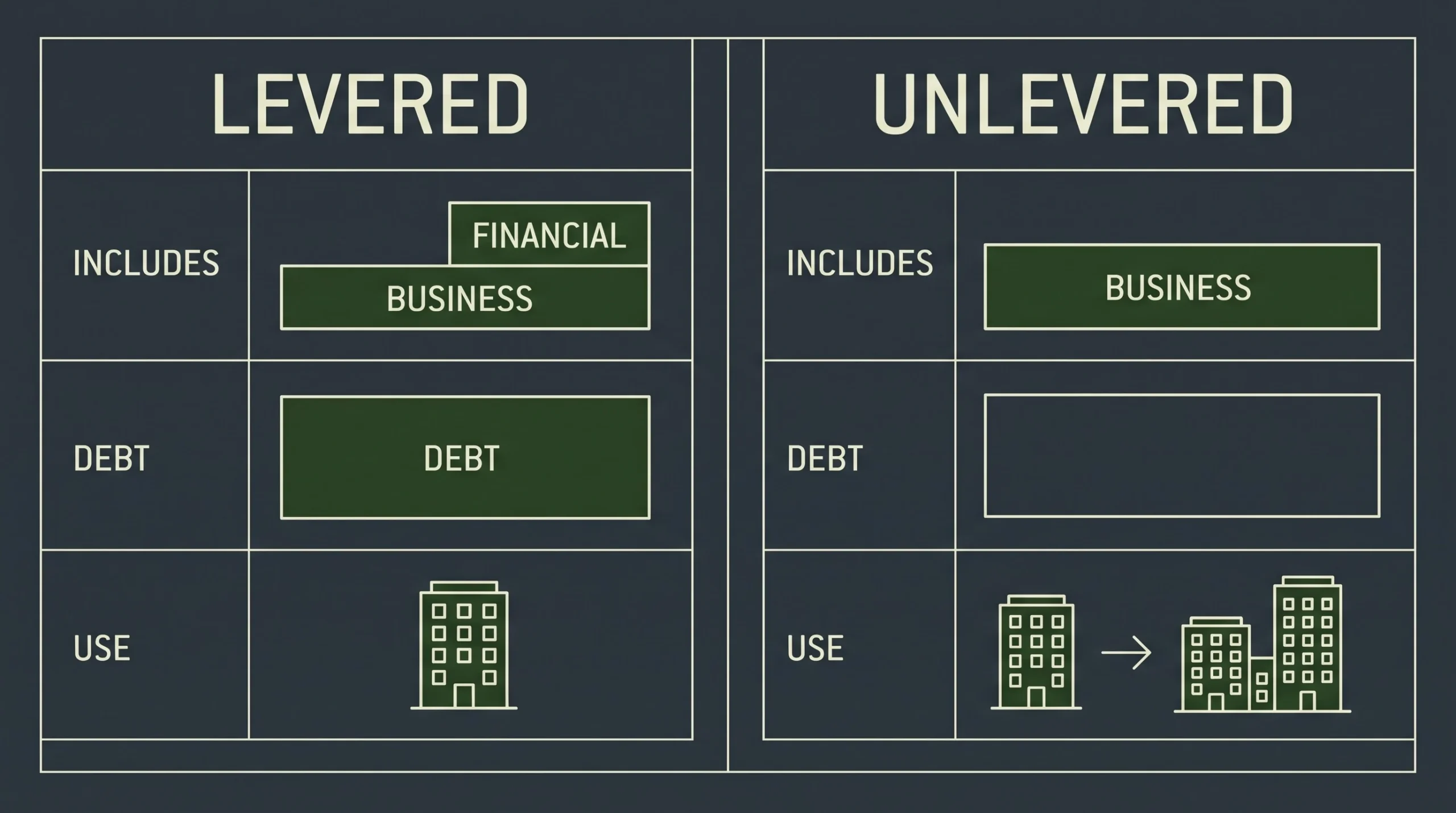
The choice between levered and unlevered beta rests on your goal and the firm under review. Both numbers start from market swings, but they play different roles when we weigh the risk premium.
| Attribute | Levered Beta (βL) | Unlevered Beta (βU) |
|---|---|---|
| Definition | Measures a company’s stock volatility relative to the market, including its debt. | Measures a company’s pure business volatility relative to the market, excluding debt. |
| Reflects | Business Risk + Financial Risk | Business Risk Only |
| Primary Use Case | Assessing the current risk of a publicly traded company as-is. | Comparing companies with different debt levels and calculating WACC for private companies. |
Analysts often turn to firms like Stout, Kroll, and Alvarez & Marsal for beta data, since these national firms offer broad, benchmarked data sets. To fit a private firm, an analyst finds a peer-group average and strips out the debt effect, leaving a clean number that reflects core risk without each peer’s own financing choices.
We then shape that figure to the private target’s own balance sheet, capturing the risk of core operations while honoring the target’s debt. This method follows the rules from The Appraisal Foundation, which sets USPAP and keeps each step open and fair, so equity risk is neither over- nor understated.
What should the valuation review compare?
A sound analysis ties each judgment to real records and market evidence on the valuation date. The points below sum up this article’s core choices.
| Decision area | Evidence and review focus |
|---|---|
| Why is unlevering beta necessary for valuation | Unlevering beta is necessary for valuation because it allows for the isolation of a company’s pure business risk, known as the asset beta. |
| How do you calculate unlevered beta | To calculate unlevered beta, you use the formula that divides levered beta by the sum of one plus the product of one minus the marginal tax rate and the debt/equity ratio. |
| What is the process for re-levering beta | The process for re-levering beta focuses on adjusting a guideline company beta to reflect the specific financial risk of a target entity. |
The final report should tie these areas together. It should not treat any method or input alone.
Frequently Asked Questions
What is levered vs unlevered beta?
Is beta in CAPM levered or unlevered? Do you use levered or unlevered beta for WACC?
Levered beta includes the effect of a company’s debt, while unlevered beta removes that effect to show pure operating risk. The Capital Asset Pricing Model (CAPM) needs the levered beta to set the cost of equity. For WACC, we start with the unlevered beta from peers and re-lever it based on the subject firm’s debt, and Sofer Advisors uses these exact steps for sound results.
Why is unlevered beta sometimes called asset beta?
Unlevered beta is called asset beta because it reflects the risk of the firm’s assets and core work alone, stripping away the risk that debt adds. What remains is the risk in the firm’s core activities, a fair baseline for comparing firms, and Sofer Advisors normalizes this metric so every value rests on pure operating risk.
Do private companies have a beta?
Private firms have no traded stock price, so they lack a direct, visible stock beta. Instead, we estimate a proxy beta by looking at similar public firms and adjusting for industry and size, which builds a sound risk number for the private firm. Sofer Advisors blends these peer comparisons to set a defensible beta for private firms of any size.
What are the limitations of using beta in valuation?
Beta rests on past price swings, which may not predict future ones in a changing industry. It also assumes a strong tie between the firm and the broad market, and that tie often fails for small, private, or niche firms, where thin trading can distort the number. Sofer Advisors handles these gaps by adding size premiums and firm-specific risk adjustments to support the core beta.
What is a good unlevered beta?
There is no single “good” number, because unlevered beta shifts a lot by industry, depending on how a sector reacts to economic cycles and its own operations. High-growth sectors like tech often show higher betas, while stable utilities tend to show lower ones, and Sofer Advisors weighs your firm against these sector benchmarks to set a fair risk profile.
What is the formula to unlever beta?
To unlever beta, divide the levered beta by one plus a product. That product is one minus the marginal tax rate, times the debt-to-equity ratio. This removes debt’s effect and leaves the core business risk. Sofer Advisors pulls the levered beta of public peers from a source like Kroll, then applies this exact formula to keep models current.
How does a beta above or below 1.0 change the cost of equity?
Beta scales the cost of equity around the market average. A beta above 1.0 lifts the cost of equity above that average, while a beta below 1.0 pulls it down. The math ties three inputs together: the risk-free rate, beta, and the Equity Risk Premium. Sofer Advisors uses sound inputs so this rate reflects your firm’s true market risk.
Which sources give reliable beta data?
Valuation professionals rely on paid subscription services such as Kroll Cost of Capital, Bloomberg, and Business Valuation Resources (BVR). These platforms set the industry standard and give clean, normalized data that survives review. Both AICPA and USPAP standards apply, and appraisers must support every data input, so Sofer Advisors stresses these trusted sourcing habits in each engagement.
What are the most common mistakes when using beta?
Common errors include using the wrong tax rate, ignoring the debt gap between firms, and picking a look-back period that does not fit. Analysts should also match the beta period to the ERP period and avoid a negative beta without a clear reason. Sofer Advisors lines up each input with care, so a rushed figure does not skew the whole result.
Related Case Studies
- WACC for Business Valuation: Calculation and Application
- What is a DCF Valuation? Complete Guide to DCF Method
- Terminal Value Formula: How to Calculate It in a DCF
Executive Summary
Unlevered beta, or asset beta, isolates a firm’s business risk by removing debt, so analysts can compare public peers and private targets on a level footing. The workflow pulls levered peer betas from a trusted source like Kroll, unlevers each using its marginal tax rate and market-based debt-to-equity ratio, then averages the group and re-levers that figure to the target’s own capital structure. That re-levered beta drives CAPM, which sets the cost of equity from the risk-free rate, beta, and the Equity Risk Premium, and in turn feeds WACC and the discount rate. A beta above 1.0 raises the cost of equity while one below 1.0 lowers it, so errors in the tax rate, debt gap, or look-back period ripple through the model. Because unverified inputs put a valuation at risk, AICPA and USPAP standards require appraisers to support every assumption with defensible data.
What Should You Do Next?
Review your firm’s capital structure first, since the debt-to-equity mix drives how a peer beta must be re-levered to fit your risk. If you are preparing for a deal or tax event, request a review of your beta inputs and confirm they match the ERP period and the right marginal tax rate. Finally, check any past valuation reports to confirm they unlevered peer betas correctly, the step that isolates core business risk from financing choices.
David Hern CPA ABV ASA, founder of Sofer Advisors provides neutral, defensible valuations for private company valuations. Schedule a free consultation to discuss your situation.
People Also Read
- Business Valuation Services United States: Expert Guide 2025
- Purchase Price Allocation ASC 805 and IFRS 3: Complete Guide for Business Leaders
About the Author
This guide was prepared by David Hern CPA ABV ASAc, founder of Sofer Advisors, a business valuation firm headquartered in Atlanta, GA serving clients across the United States. David holds dual accreditations as an Accredited Senior Appraiser (ASA) and is Accredited in Business Valuation (ABV), credentials recognized by the IRS, SEC, and FINRA. He also holds the Certified Exit Planning Advisor (CEPA) designation. With 15+ years of valuation experience, David has served as an expert witness in 11+ cases across multiple jurisdictions and built Sofer Advisors into an Inc. 5000-recognized firm with 180+ five-star Google reviews. Its full W2 employee team maintains subscriptions to all major valuation databases and operates under a next business day response policy.
For professional business valuation services, visit soferadvisors.com/about-us/ or contact Sofer Advisors at soferadvisors.com/contact-us/.
Disclaimer: This content is for informational purposes only and does not constitute professional valuation advice. Business valuation conclusions depend on specific facts and circumstances. Contact Sofer Advisors for guidance regarding your specific situation.









